The 400-Meter Secret of Drag Racing
Share This Page
Drag racing, where two vehicles accelerate down a straight line, usually over a quarter mile (402 meters) and a winner is determined, is one of the purest motorsports. But it is not just about power: reaction time, starting technique, and the engineering that keeps 11,000-horsepower engines running are also integral parts of the race. In this guide, we break down the NHRA classes, the secrets of nitromethane engines, and the 'art' of the Christmas tree system one by one.
Highlights
- Top Fuel dragsters can exceed 11,000 horsepower and, in under 3.7 seconds, reach speeds of over 330 mph
- A Top Fuel vehicle can burn up to 15 gallons of nitromethane in a single run
- According to NHRA rules, for speeds over 200 mph, dual parachutes are mandatory
- Brittany Force set the fastest pass in NHRA history in 2025 at 343.16 mph and made the fastest pass in NHRA history
- The 2026 drag season in Türkiye continues with a three-round championship at the Antalya Kepez Drag Strip
NHRA Classes: Which Vehicle Runs in Which Lane?
The NHRA, the heart of American drag racing, has more than 200 vehicle classes competing under 15 categories. Do not be confused: the four professional categories are Top Fuel, Funny Car, Pro Stock and Pro Stock Motorcycle. The rest is a vast spectrum ranging from hobby classes to serious amateur leagues.
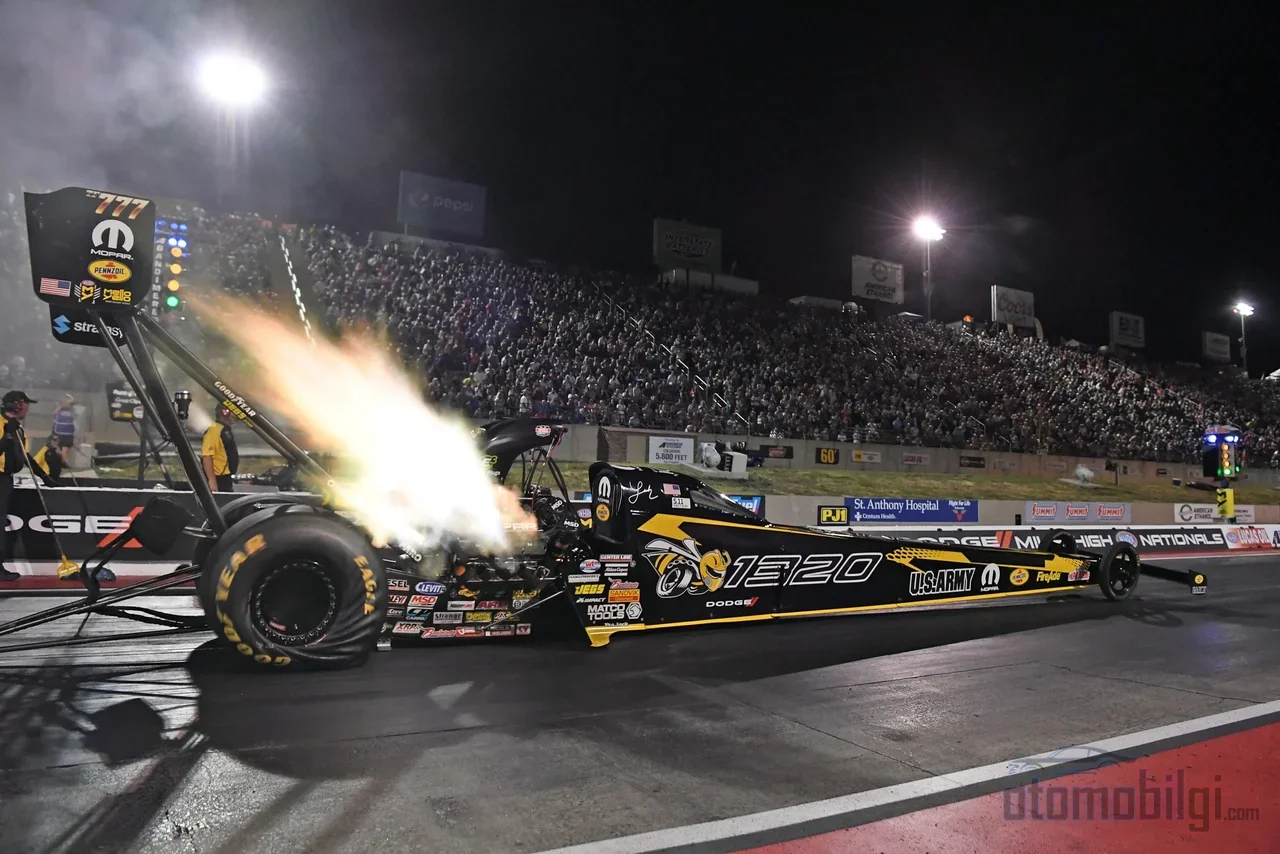
Top Fuel dragsters are considered the kings of the sport - and they deserve it. A supercharged, fuel-injected 500-cubic-inch Chrysler Hemi adaptation engine finishes the quarter mile in under 3.7 seconds, with trap speeds exceeding 330 mph. The vehicle is a full 25 feet long, with carbon fiber laid over a chromoly tube chassis, and a race weight of 2,330 pounds. This long, slender thing is actually like a rocket.
Funny Car uses the same 500-cubic-inch engine, but the vehicle is different: a shorter wheelbase and a carbon fiber body resembling a remotely mass-produced automobile. Here is the interesting part: there is no transmission in a Funny Car! Power is transferred to the rear tires through a multi-stage clutch controlled by timers. Times are in the 3.8-second range, with speeds again over 330 mph. So why are there separate classes if both have the same engine? The answer is simple: one is an open-wheeled missile, the other is a closed-bodied monster resembling a 'shelf automobile.' The body and identity difference is itself the class difference.
Pro Stock: Monsters That Look Like They Came From the Factory
Pro Stock is known as the 'factory hot rod.' From the outside, these are vehicles with doors that look like a normal car; but underneath there is a tube chassis and a four-link rear suspension. Minimum weight is 2,350 pounds, electronic injection and spec gasoline are used, and engine displacement is at most 500 cubic inches. Power is over 1,300 hp and competitive examples finish the run in 6.4 seconds at 215 mph. There is also variety in engines: with V-Twin (Harley-Davidson, Buell, etc.) and inline 4-cylinder (Suzuki, Kawasaki) options, Pro Stock Motorcycles run under 6.8 seconds at over 195 mph; engine displacements range from 92 to 160 cubic inches.
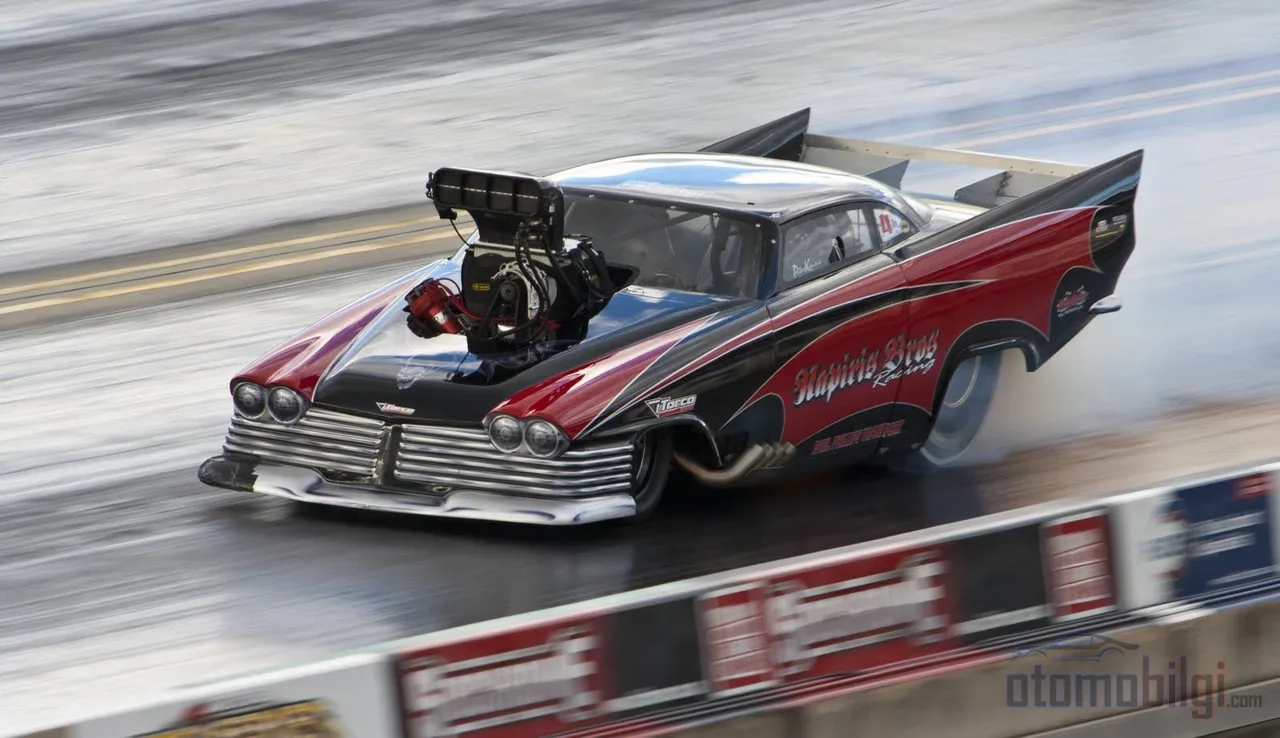
The list goes on in the hobby side as well: Top Alcohol Dragster (5.1 s / 285+ mph), Top Alcohol Funny Car (5.3 s / 270+ mph), Comp, Super Stock, Stock and bracket classes - Super Comp (8.90 index), Super Gas (9.90), Super Street (10.90) -, plus Top Sportsman, Top Dragster and Pro Mod, which runs 250+ mph in the high 5-second range. So the drag scene is not just a playground for professionals; there are also classes where you can take your weekend car to the track and race.
| Class | Example Time | Trap Speed | Notable Feature |
|---|---|---|---|
| Top Fuel | Under 3.7 s | 330+ mph | 11,000 hp, nitromethane |
| Funny Car | Around 3.8 s | 330+ mph | Closed body, no transmission |
| Pro Stock | Around 6.4 s | 215+ mph | Factory-looking, 1,300+ hp |
| Pro Stock Motorcycle | Under 6.8 s | 195+ mph | V-Twin or 4-cylinder |
| Top Alcohol Dragster | Around 5.1 s | 285+ mph | Mostly methanol, ~4,000 hp |
The Secret of 11,000 Horsepower: How Does Nitromethane Work?
Think of a Top Fuel engine: supercharged, purpose-built, 500 cubic inches and roughly 11,000 horsepower. Horsepower figures vary a bit between sources - official figures sometimes say 10,000, some go up to 11,000, even 12,000 - because these engines' power is not measured in a single dyno test; their instantaneous performance is estimated as they destroy their components throughout a run. That sound coming from the same 8.2-liter V8 is described as 'controlled chaos,' and I don't think there's a better description.
So where does this power come from? The answer: nitromethane. This fuel has a magical property - it contains its own oxygen. While gasoline depends on oxygen from the atmosphere, nitromethane carries part of the oxygen needed for combustion within itself. That means more energy can be packed into the engine with every intake stroke. Think of it this way: with normal gasoline you have to carry oxygen into the room to light a fire; nitromethane brings its own lighter along.
Supercharger and Injector Architecture
Modern Top Fuel engines use a 14-71 supercharger. This interesting naming comes from GM Detroit Diesel's two-stroke diesel superchargers - a nice example of how automotive history is interconnected. A nitromethane and methanol mixture is sprayed in liquid form through 42 mechanical injectors: some of them sit on top of the supercharger, the rest are located at the bottom of the engine. At full throttle the engine consumes up to 4.5 liters of fuel per second - meaning over a run (up to 15 gallons) it burns almost a small tank within seconds. If you compare with Top Alcohol Dragsters the picture becomes clear: they produce about 4,000 hp and mostly burn methanol; their times are around 5.090 s (quarter mile). The difference is entirely in the fuel and power level.
The acceleration figures are the icing on the cake: Top Fuel at launch 5 g generates power and finishes 0-100 in under 1 second. The fastest 1,000-foot pass was 338.17 mph; the fastest full run was 3.623 seconds. There's also an odd detail: due to a protective rule, Top Fuel and Funny Cars race over 1,000 feet, while the Top Alcohol classes run the full quarter mile. So the answer to 'which class runs what in the quarter mile' varies depending on the distance.
The Christmas Tree and the Art of Reaction Time: Why Do You Launch Before the Green Lights Up?
Two huge speed machines are lined up at the starting line and you're waiting for the green light... this is where the heart of drag racing beats. The starting system is called the 'Christmas tree'; each lane has a column with seven lights. The pre-stage lights are connected to an infrared sensor located 6-8 inches past the starting line, about 2 inches above the ground - when the car's wheel breaks the light beam, the system receives the 'I'm on the strip' signal. It's a small detail, but the first step of success lies right here.
There are two starting formats. In the sportsman tree, the ambers light up one by one, 0.5 seconds apart; the total time is about 2 seconds. Most racers launch on the last yellow. In the pro tree, three ambers light up simultaneously and the green comes 0.4 seconds later - meaning no waiting, just anticipation and reflexes. The striking thing is this: the best racers start moving before the green lights up. This isn't 'cheating'; when human reaction time is taken into account, a perfect 'kill' (a near-zero reaction) is only possible by anticipating the light cycle. We wouldn't be exaggerating if we said reaction time is the essence of drag racing.
How Can Reaction Time Be Improved?
Today's generation of racers relies on training, not luck. Thanks to practice tree apps and simulators, you can train both the sportsman and pro formats from your phone. Serious racers perform their physical and mental pre-race routines exactly the same on every repetition - from seat position to breathing rhythm. In bracket racing, the game is a bit different: for consistent good reactions and 'cutting', you need to deliberately aim for times close to the index; in Super Comp and Super Gas, electronic timers and adjustable throttle provide this consistency. So the goal isn't to be fastest every time, but to be the same every time - and you understand how difficult that is once you get on the strip.
How Do You Stop After 300 mph? The Role of Parachute Brakes
The primary braking system for stopping a Top Fuel or Funny Car from 330 mph is the pair of parachutes the driver deploys with a lever in the cockpit. Yes, you read that right: not the brake pedal, but parachutes. The NHRA rule is clear: a single parachute suffices for speeds between 150-199 mph, while dual parachutes are mandatory at 200 mph and above. Nitro cars can slow to nearly 200 mph with the parachutes without any brake application. They generate enormous braking force at high speeds, but their effectiveness drops off rapidly as speed decreases - which is why the conventional brakes come into play at lower speeds.
Parachute selection is not a simple accessory choice either. A hard-opening high parachute can lift the rear of the vehicle off the ground, and at 150+ mph this is extremely dangerous. The right size and the right installation are vital. The FIA's 2026 general technical regulations for drag racing confirm this seriousness: if specified in class requirements, a parachute from a recognized manufacturer is mandatory.
Records: Where Is the Limit of Pure Speed?
At the 2025 Sonoma Nationals, Brittany Force set the fastest pass in NHRA history at 343.16 mph (552.26 km/h) - a performance also ratified by the Guinness World Records. The Doorslammer (body-doored cars) quarter-mile world record, meanwhile, is in the hands of Jimmy Taylor: 5.114 seconds @ 262.79 mph at the World Cup Nationals. The limits of door-bodied, 'normal'-looking cars are also being pushed: the production car quarter-mile record belongs to the Koenigsegg Jesko Absolut, at 8.54 seconds @ 190 mph. Records from the tuning world's Dodson Motorsport are also impressive: a 2025 quarter-mile record of 6.482 @ 232.35 mph and a 2026 half-mile record of 263 mph.
These records show us something: the quarter mile has become the performance benchmark for the entire automotive world, from street cars to hypercars, no longer just the NHRA pro classes. The question of 'how long does 0-400 take' is now a standard question in showroom brochures too.
The Drag Scene in Türkiye: How Is the 2026 Season Going?
While talking about the world, let's not forget our own scene. In Türkiye, drag racing advances under the wings of two federations: on the motorcycle side, the Turkish Motorcycle Federation's (TMF) 2026 calendar features the Turkish Drag Championship as three rounds at the Antalya Kepez Drag Strip - May 9-10, June 6-7, and September 19-20. On the automobile side, TOSFED's 2026 autodrag calendar also shows a three-round championship, again at Kepez: May 2-3, June 6-7, and September 12-13. So this track in Antalya is the heart of the Turkish drag scene.
At the same time, the track infrastructure is also developing: the renovated Konya Drag Strip has come up in TOSFED's autodrag news. In Türkiye, there is now a broad community of racers who not only watch but take to the track and chase elapsed times. Is seeing a Turkish driver on NHRA strips a dream? For now there is no verifiable name, but the scene grows every year - perhaps one of those reading these lines.
What You Need to Know Before Hitting the Strip: A Quick Summary
Drag racing is engineering, reflexes, and passion condensed into 400 meters. Key points to remember: Top Fuel and Funny Car share the same 500-cubic-inch engine but represent different identities; nitromethane carries its own oxygen and is the key to reaching 11,000 hp; in a Pro tree, leaving without waiting for the green is a sign of mastery; twin parachutes are mandatory above 200 mph; and Kepez in Türkiye is set to host both car and motorcycle drag championships in 2026. As you watch the next run, you'll now also see the game behind the lights - which driver moved earlier, which one stayed true to their index? Next time, watch while tracking these, and I bet the race will look completely different.
Sources
- Drag Racing Classes
- Here's the Differences Between NHRA Top Fuel Dragster and a Top Alcohol Dragster (Autoweek)
- Christmas tree (drag racing) - Wikipedia
- NHRA Drag Racing Christmas Tree Explained - Team Ace Racing
- How 11000-HP Top Fuel Hemi Engines Continue To... - HOT ROD
- CHALLENGE OF: RETRO DRAG RACING - Race Engine Technology
- Selecting And Mounting The Right Parachute For Drag Racing - Dragzine
- Your Guide to Racecar Parachutes - Motion Raceworks
- FIA Technical Regulations for Drag Racing 2026
- Fastest speed in an NHRA Drag Racing Top Fuel race - Guinness World Records
- Koenigsegg Jesko Absolut quarter-mile record - Autoblog
- World Records | Quarter & Half Mile - Dodson Motorsport
- Drag Racing - Türkiye Motorcycle Federation
- Kepez's drag strip will leave its mark on the 2026 season - Kepez Municipality
- Otodrag Archives - TOSFED
- How to Improve Reaction Times - This Is Bracket Racing