Parachute and Engine-Cooling Details: What Happens When the Run Ends?
Share This Page
Crossing the finish line is not the end of a drag race; it is actually the beginning of the most critical part. A Top Fuel or Funny Car arriving at over 320 km/s cannot stop by braking; what slows it down is often a single giant parachute. And once the run is over, the real surprise begins: the engine is torn down, the pistons are replaced, and the team races against the clock for the next round. This is the overlooked final act of the quarter mile.
Highlights
- A parachute can slow nitro cars down to almost 200 mph without ever touching the brakes.
- During deceleration, the driver experiences forces of up to -6G. of force acting on it.
- 150 mph Parachutes are mandatory on vehicles capable of exceeding these speeds.
- Between rounds, Top Fuel teams completely rebuild the engine in 75 minutes. is completely rebuilt.
- A single run, including warm-up and burnout, can consume 45-86 liters of fuel.
Are the Brakes Not Enough? Why Is a Parachute Essential?
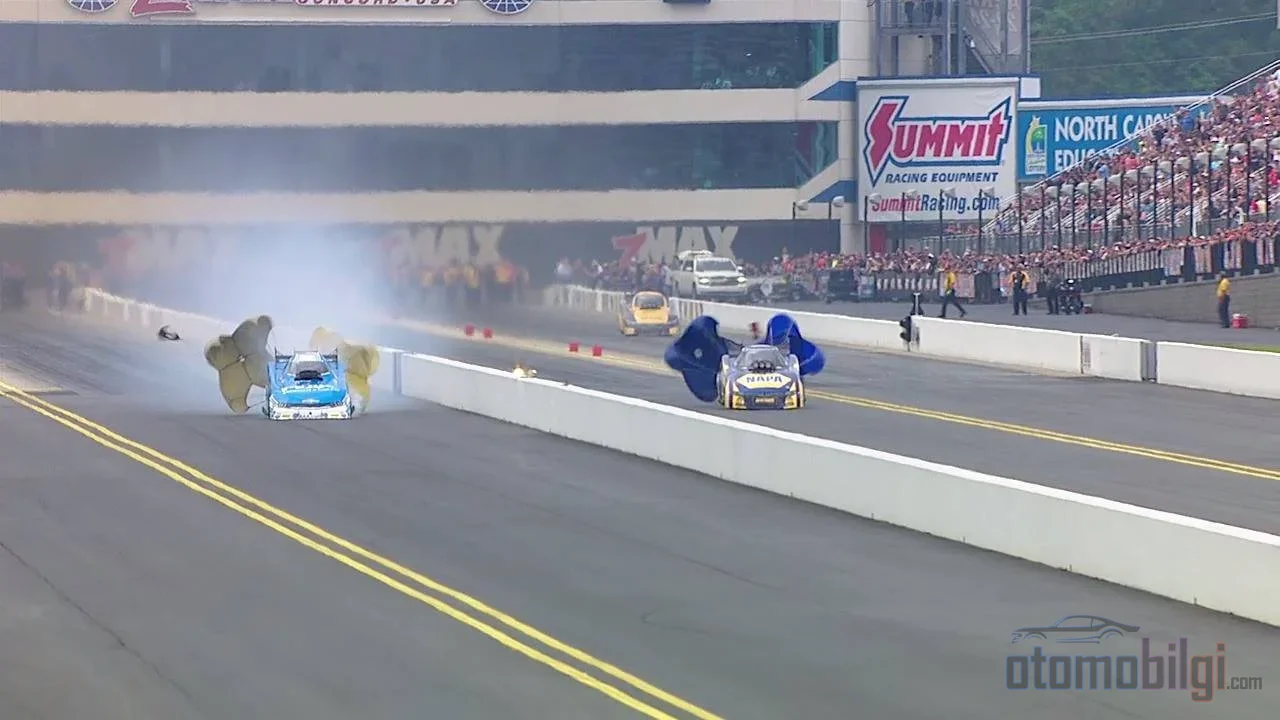
Think about it: in a normal car, the friction transferred to the wheels when you press the brake depends on the vehicle's weight and the grip of the road. In a dragster traveling at 300 mph, that is 480 km/s, the tires have very little chance of gripping the ground and aerodynamic load is almost nonexistent. Racing brakes simply do not work on their own at this speed; the discs wear out in a few seconds, the car locks up and starts to slide.
That is exactly where the parachute comes in. Its working principle is simple: the faster the car, the more air it captures behind the parachute and the greater the braking force. In physics this is called drag, and the force increases with the square of speed; that is, when speed doubles, resistance quadruples. At 300 mph this is a massive force, capable of subjecting the driver to a deceleration of up to minus 6G.
But there is another side to the coin: as the car slows down, the parachute's power drops rapidly according to the same formula. Below 100 mph it is no longer very effective, and it is at that point that the regular brakes complete the final deceleration. In other words, the parachute and brakes do not work alone but like a sequential duo: first the fabric in the sky, then the conventional braking system.
Where and at What Speed Does the Parachute Deploy?
The rulebooks are clear: parachutes are mandatory on all vehicles capable of exceeding 150 mph, that is 241 km/s, and the driver must have deployed it by the end of the speed zone, that is, the speed trap. When the driver pulls the cable with the mechanism in the cockpit, a small launch parachute, the drogue, shoots out first; once it catches the air, it pulls out and opens the main parachute behind it. Think of throwing a baseball: first you build up speed with a small sling.
Most cars use a single parachute for deceleration; the second one at the rear is carried entirely as a backup. A parachute that opens hard can in fact be strong enough to lift the rear of the car off the ground; at high speed this is a serious danger, which is why the second parachute is there purely as a backup for luck. The parachute also helps stabilize the car; if you have ever seen a dragster with its nose raised after the finish, it is largely this fabric that keeps it straight.
Shutdown Area: What Happens in the Seconds After the Finish?
The story doesn't end when a vehicle crosses the finish line and stops; now it needs to leave the track safely. This area is called the shutdown area, and an unusual etiquette applies here: the vehicle in the right lane must wait for the competitor in the left lane to finish closing out the track before moving into the left lane. There are multiple exits, or turnoffs, on the track; each vehicle uses the appropriate exit depending on where it slows down.
This area is also the control zone. On sanctioned tracks, every vehicle is inspected by the technical crew: battery hold-downs, seat belts, brakes, and tire condition are reviewed. There is also a subtle but important rule: teams that leave fluids on the racing surface or in the shutdown area can face penalties, because an oil spot on the track endangers the next racer and cleanup eats into everyone's time. Absorbent pads placed under the engine exist precisely for this reason; an oil spill can mean both a penalty and a loss of points.
The pit area has its own order too: the speed limit there is 10 mph, roughly 16 km/h. A team reaching 500 km/h in the race not going faster than walking pace in the pits seems funny at first, but it actually makes sense; chaos can only be managed with order.
Why Is the Nitromethane Engine Disassembled After Every Run?
Now let's get to the wildest part. The Top Fuel engine is based on the second-generation Chrysler RB Hemi, a giant 500 cubic inch machine, i.e. 8.19 liters; its estimated power is 8,500-10,000 horsepower, with peak values exceeding 11,000 horsepower even recorded in measurements. This power comes from the fuel itself: the fuel is mostly nitromethane, and since 2015 the NHRA has limited the nitromethane ratio in the mixture to a maximum of 90%.
Why is nitromethane so powerful? Due to its chemical structure, it can burn with far less air than gasoline; with the same amount of air, roughly 7.6 times more nitromethane can be burned compared to gasoline, which means an increase in power of up to 2.4 times. Add its high heat of vaporization, and the fuel practically cools the engine from the inside. The price, however, is dramatic: these engines are deliberately run at the limits of their components, sacrificing lifespan for power. The engine cannot run at its maximum power for more than 10 seconds; pushed beyond the limit, it either explodes or destroys itself.
The consumption figures are just as brutal. In a single run, including warm-up, burnout, and staging, 45-86 liters of fuel can be used. While exhaust temperature is around 260 degrees C at idle, it shoots up to 980 degrees C at the end of the run, nearly 1,800 Fahrenheit. An engine that survives these conditions of course demands a full service.
| Measurement | Value | When? |
|---|---|---|
| Exhaust temperature | ~260 degrees C (500 degrees F) | At idle |
| Exhaust temperature | ~980 degrees C (1,796 degrees F) | End of the run |
| Fuel consumption | 45-86 liters | Including warm-up, burnout, and run |
| Engine power | 8,500-10,000+ hp | Estimates and measurements |
| Nitromethane ratio | Maximum 90% | NHRA limit since 2015 |
| Maximum full-power duration | Less than 10 seconds | Engine endurance limit |
An Engine From Scratch in 75 Minutes: The Rebuild Routine
Top Fuel teams have a window of roughly 75 minutes to completely rebuild the engine between rounds. And they really take the engine down to zero: the supercharger is removed, the cylinder heads come off, pistons and rods are renewed, the clutch is serviced. Every part is inspected one by one; worn or damaged ones are replaced outright with new ones. This is not maintenance, it is practically a transformation operation.
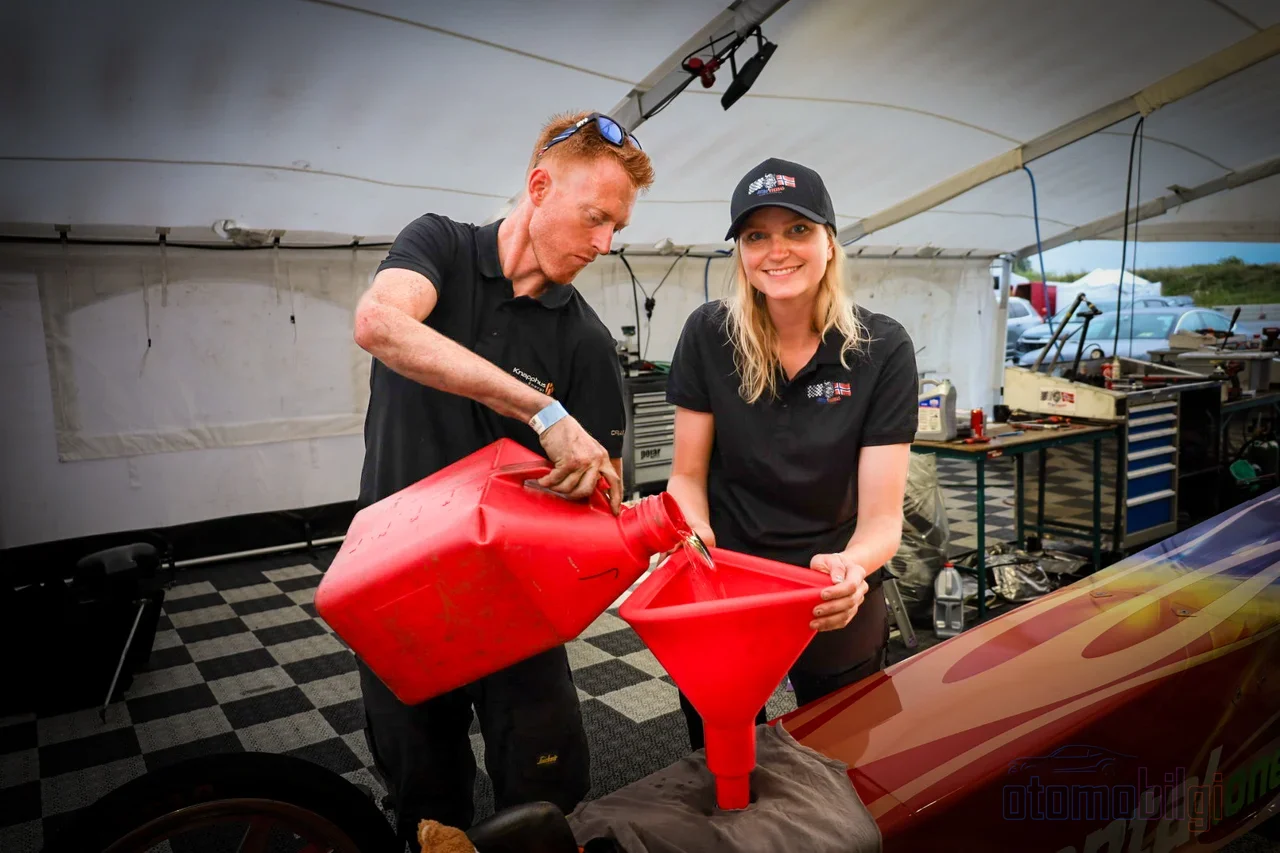
Even after the engine is assembled and seated in place, the work is not done: after warm-up, the valve covers are removed again, the oil is changed, and fuel is loaded. The picture is the same on the Nitro Funny Car side; teams tear the car down as soon as it arrives in the pit and rebuild the 12,000-horsepower unit from scratch. On the NHRA side, there are even pieces explaining the weeks of preparation discipline behind every three-second Funny Car run; in other words, the behind-the-scenes of a short run is a far longer story than the run itself.
So why is it like this? Because teams do not design the engine to be short-lived; as the price of increasing power, they run the parts at their limits. Although heavy restrictions have been placed on the engine configuration, fuel injection, clutch, ignition, and materials development keep advancing, which means more aggressive setups every round.
Why Did the Quarter Mile Get Shorter? The Traces of Safety
The classic distance is a quarter mile, that is, 402 meters. But since 2008 the NHRA has shortened the run in the top categories to 1,000 feet, that is, 304.8 meters, and this rule has also been an FIA standard since 2012. The reason is tragic: after Scott Kalitta's fatal crash at Englishtown, the distance was shortened to increase the slowing-down zone at high speed. Today the fastest Top Fuel cars turn in times of around 3.6 seconds over this 1,000 feet and reach speeds above 340 mph; Brittany Force's fastest run in history at 338 mph and the Guinness-verified peak of 343 mph are products of this new format.
The safety debate also extended to the fuel ratio: after a death in 2004, the nitromethane ratio was lowered, and in 2008 it was raised again following the teams' complaints about cost and failures. This balance between safety and performance is still a debated area, and I think it is precisely because of this that drag racing is interesting; there is engineering not only in top speed but also in post-finish safety.
So What Is the State of This Scene in Türkiye?
Don't worry, parachutes don't only open in America. The 2026 rounds of the Türkiye Musatti Drag Championship are run at the Antalya Kepez Drag Strip: the first round in early May, the second in June, the third in September, and the fourth at the end of October. The Kepez strip is 830 meters long and hosts seven championship rounds throughout the season. The Konya Drag Strip has also been renewed and continues to host autorace events.
Of course, the cars here don't reach 500 km/h or burn 45 liters of nitro, but the discipline after the finish is the same: shutdown area rules, technical inspections, and fluid spill penalties also apply at local tracks. At Kepez, pilots citing the asphalt patches and uneven surface as the cause of a crash after a race served as a reminder that track quality determines post-race safety as much as the run itself.
The Real Story Begins When the Run Ends
It seems that thinking of drag racing as just that 3-4 second explosion is the most fun but most incomplete way to see it. Every second after the finish line is a planned engineering scene: the chutes deploy, the -6G deceleration begins, the brakes complete the final step, the rules waiting in line in the shutdown area kick in, and the 75-minute rebuild marathon in the pits starts. Next time you watch a Top Fuel run, try watching what happens after the finish line; in my opinion, the real show starts there. Which do you find more impressive, the run itself or what happens behind the scenes?
Sources
- Top Fuel
- NHRA 101: Parachutes
- Tech Department Parachute Deployment
- Fastest speed in an NHRA Drag Racing Top Fuel race
- NHRA Racing Rules
- Current Racing Rules at Pacific Raceways
- Mid West Drag Racing Series Rulebook
- NHRA Rules For Newbies & Drag Racing Safety Requirements
- Top Fuel Dragster Engine Rebuild
- Why do top fuel dragster engines not last more than one race?
- Vandergriff: Seven-Day Pursuit Behind Every Three-Second Funny Car Run
- Kepez's Drag Strip Will Leave Its Mark on the 2026 Season
- Drag Racing - TMF