What Does a Season in the FIA European Drag Racing Championship Look Like?
Share This Page
The FIA European Drag Racing Championship is a championship series sanctioned by the FIA that has stood at the pinnacle of European drag racing since 1997; the season progresses through a points race across events held at a handful of legendary tracks in a few countries. In other words, instead of working with hundreds of classes like the NHRA, it operates with an elite class structure and an "small but ambitious" format.
Highlights
- In the 2026 calendar, there are three events : England, Sweden and Germany
- The fastest class is Top Fuel: over 10,000 horsepower of power, under 4 seconds 300 mph
- Valid qualifying run 20 points, event win up to 100 points up to
- Season finale: September 10-13, 2026, Santa Pod Raceway
- Drivers from outside Europe can also compete with an FIA international license
What exactly is the FIA European Drag Racing Championship?
I know that when drag racing in America comes up, everyone thinks of the NHRA. But the world stage isn't limited to that. The FIA European Drag Racing Championship (EDRC) is the International Automobile Federation's official European drag championship and has been considered the continent's most prestigious four-wheeled drag series since 1997. The organizational work is handled by Drag Racing Europe.
The philosophy here is very simple and, in my opinion, very elegant: instead of running a long calendar, organize truly major events at a few legendary tracks. In the past, the calendar reached up to six rounds across four countries; today it has taken a simpler form. Racers are divided into two main groups: professional and sportsman; in the professional category, two racers compete for the fastest time down the quarter mile. That pure, that clear.
The 2026 calendar: Three countries, three major stops
The FIA's official 2026 calendar consists of three events, and each one is a drag festival in its own right:
| Event | Track | Country | Date |
|---|---|---|---|
| FIA Main Event | Santa Pod Raceway | England | May 22-25 |
| Summit Racing Equipment Internationals | Tierp Arena | Sweden | August 6-9 |
| NitrOlympX | Hockenheimring | Germany | August 21-23 |
Let me explain all three names. Santa Pod Raceway is Europe's first permanent drag strip and, as a classic, is both the season opener and the season closer. The FIA/FIM Euro Finals will be run at Santa Pod again on September 10-13, 2026; the event brings together the continent's best more than 250 teams and 300 mph Top Fuelers. Tierp Arena is Sweden's super-modern facility where speed records are broken. The NitrOlympX at Hockenheimring, meanwhile, is the biggest festival on the scene: last season over 47,000 record spectators attended.
A small note: Stops that appear in records as belonging to past years, such as Alastaro Circuit in Finland, are not in today's official 2026 calendar. So the season passes with three major summits in three countries and wraps up with the finals at Santa Pod in September. The 2027 calendar is also expected to be announced soon.
Classes: Familiar from the NHRA but the European version
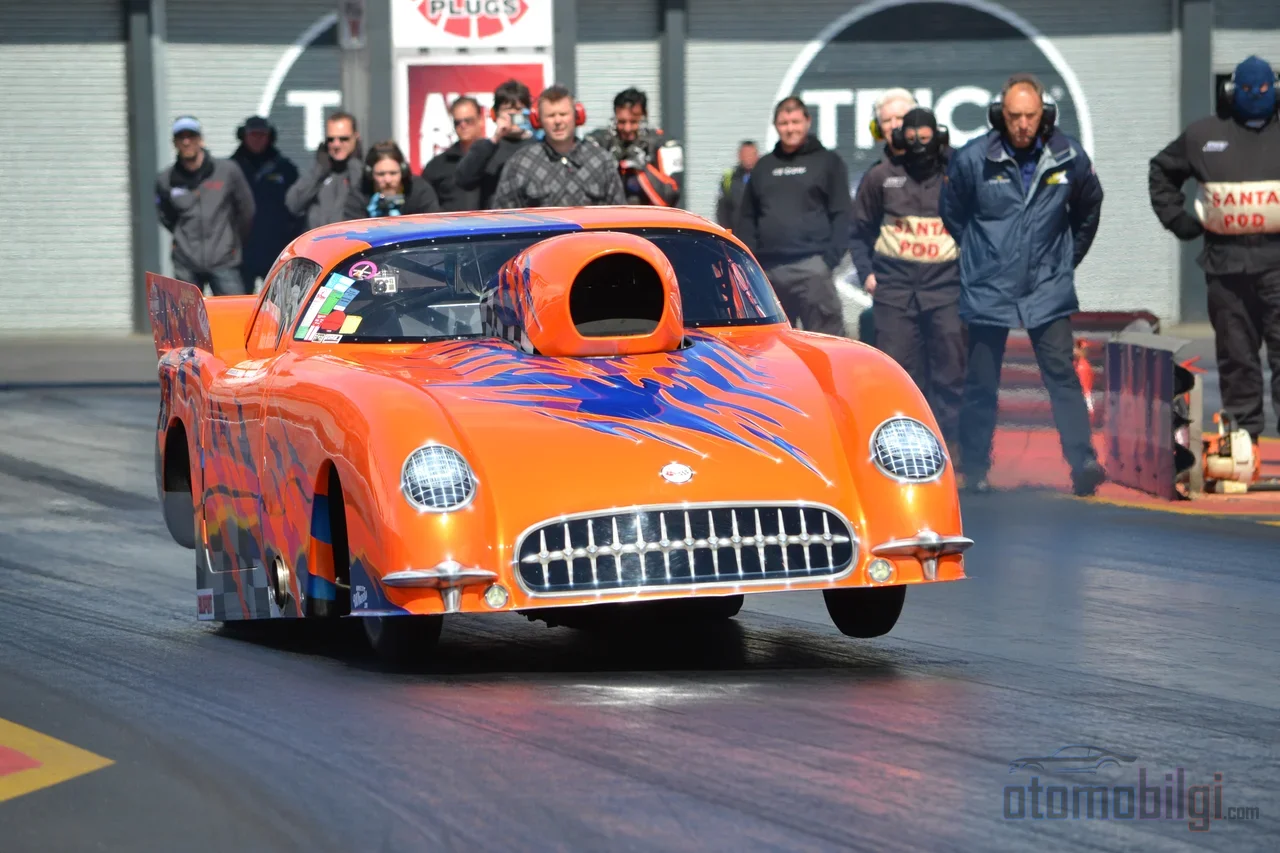
Five professional classes compete in the FIA EDRC, and their names will sound familiar to NHRA fans. But the beauty of it is that Europe runs these classes with its own rules and its own character. Let's get to know them all quickly:
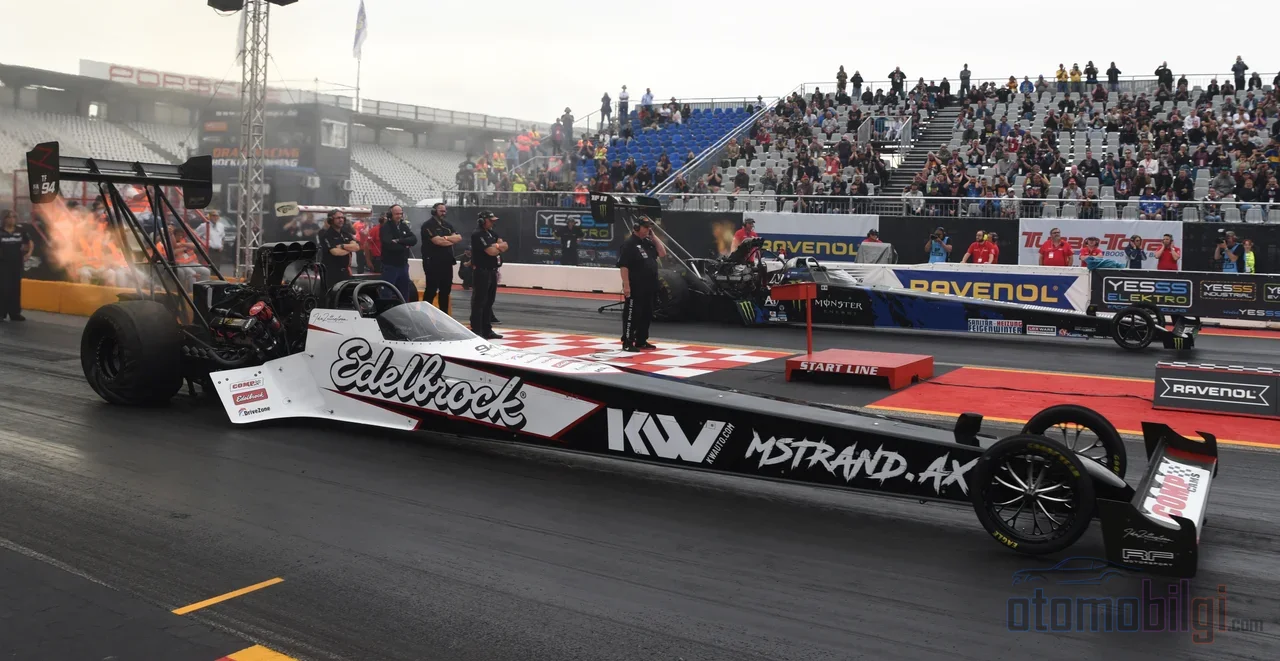
- Top Fuel Dragster: The series' runaway star. Rockets powered by nitromethane-burning, supercharged V8 engines producing over 10,000 horsepower. They launch from a standing start and can exceed 300 mph (approximately 483 km/h) in under four seconds. Drag racing's fastest class, without a doubt.
- Top Methanol Dragster and Top Methanol Funny Car: Methanol-fueled, slightly slower relatives of Top Fuel. They once changed their names: formerly known as "Top Alcohol," these classes were merged in 2017 and today run as a single class.
- Pro Modified: Pure race chassis and giant V8s. Five-second runs and speeds over 245 mph are routine business here.
- Pro Stock Car: Vehicles known as "door sluggers," entered through real doors. Their appearance and technical specifications are so tightly restricted by rules that this class is practically a bridge between a factory car and a drag strip.
According to the 2026 sporting regulations, the race distance for Pro Modified, Top Methanol Dragster and Funny Car is exactly 1/4 mile (402.33 m). In Top Fuel, due to modern safety regulations, time and speed measurements are recorded over 1000 ft; knowing this distinction will help you when reading the records.
Who holds the record board?
When the numbers speak, the seriousness of the matter becomes clear. The Top Fuel 1000 ft time record belongs to Ida Zetterström, who ran 3.773 seconds at Santa Pod in May 2023; the speed record was set by Duncan Micallef at Tierp Arena in August 2024 at 321.40 mph. Timo Habermann's 5.209 seconds in Top Methanol Dragster and Jan Ericsson's 5.724 seconds in Pro Modified stand out. Jimmy Ålund sits on the Pro Stock throne: 6.485 seconds and 215.09 mph, both from Tierp. A man whose speed practically needs to pass right before your eyes to be seen, literally.
How does the championship points system work?
Here is the series' least known but, in my opinion, cleverest aspect. Points come through two separate doors: qualifying rounds and the elimination rounds that follow. In other words, at an event you score not only the finals but also that solid run you made on Saturday morning. Every competitor who makes a valid run in qualifying receives 20 points; on top of that, 1st place in the order is worth 8 points, 2nd place 7, 3rd place 6. The three fastest pass times also earn 3-2-1 points.
Elimination points depend on which round you drop out in. The biggest pool is in the 9-16 vehicle range: the winner gets 100 points, the finalist 80, those eliminated in earlier rounds 60, 40 and 20. In events with smaller entries, the winner's points drop as low as 40, but the message is this: every round you run brings you a little closer to the championship.
- Tie-breaking has three stages: first, head-to-head wins during the season, then the most rounds won in elimination rounds, and finally event-based tie-break points (winner 5, finalist 3, semifinalist 2, quarterfinalist 1).
- If the event is postponed points also carry an unfeeling reality: if it is cancelled before qualifying begins, 10 points go to everyone who passed technical inspection; if it is cancelled after qualifying, only the qualifying and first round points count.
- Points cannot be transferred between competitors; your effort is yours, mine is mine.
What is the difference between the FIA and the NHRA?
Many people ask this, and rightfully so. The most striking difference is scale: in NHRA's major series 15 categories under more than 200 vehicle classes you can see. In the FIA European Championship, meanwhile, there are five professional classes and the season unfolds as a points race across a handful of events. You can think of one as a giant high school cafeteria and the other as an exclusive dining table.
On the regulations side, the distance is relatively short; the FIA usually adopts its rules about a year after the NHRA, and the two systems are technically very close to each other. The real gulf lies in budgets: for NHRA teams, the scale is a different league. That is why I think the most accurate way to frame the European scenes is as places where the same passion is lived with more limited resources but the same enthusiasm. Also, don't forget, FIA-licensed drivers can enter the races from outside Europe as well; the doors are not closed to outsiders.
Can Turkish drivers enter this stage?
Good question, and let me give you an honest answer: to date, we have no verifiable information about a Turkish driver having competed in the FIA European Drag Racing Championship. The scene in Türkiye is alive, and the 2026 calendar of the Türkiye Drag Championship includes rounds at Kepez Drag Strip; but that is a local championship, a separate organization from the FIA's European cup.
So is the door shut? No. According to the official rules, for a driver to enter the EDRC they need to obtain an FIA International Racing Licence specific to their drag category, and drivers from outside Europe are not excluded from the races. The championship registration fee 800 EUR + VAT level, and it must be paid at least 30 days before the event; normal race entry fees also apply separately. So in theory, the pit gate is open for a Turkish driver; what is missing is a name that has stepped through that gate yet. You may have heard that Seda Kaçan became the first female Turkish driver to win a European championship in 2024, but that is on the circuit racing side; it should not be confused with the drag scene. In my view, this gap is like an invitation waiting to be filled in the near future. Would you apply if you were in their shoes?
Who is on the throne in 2026? The reigning champions
If you are going to start following the season, it is a good idea to memorize the names. The reigning champions are as follows: Susanne Callin in Top Fuel, Sandro Bellio in Top Methanol, Robin Norén in Pro Stock, Jere Rantaniemi in Pro Modified. In the previous season, Jndia Erbacher won Top Fuel and Jonny Lagg won Top Methanol; Rantaniemi and Pro Stock legend Jimmy Ålund were champions that year as well.
I cannot mention Ålund only in passing: championships poured out in Pro Stock from 2009 to 2024 (2009, 2011, 2013, 2014, 2016, 2018, 2019, 2022, 2024), plus a Pro Modified crown in 2018. A driver who can switch classes and stay at the top, while also holding the records... Names like these are the backbone of the European scene, and racing against them at every event is an honor so heavy it is beyond even a dream for young drivers.
Why should you follow a season?
Because this championship offers drag racing in its purest form on a continental scale: a quarter mile, two cars, one winner. If you cannot hold your heartbeat until the amber lights of the Christmas Tree go out, watching a Top Fuel launch at Tierp will completely burn you up. The calendar is short, every stop is a separate adventure, and points are redistributed every round; meaning the championship cannot be guaranteed until the final event. On this journey that starts at Santa Pod in May and ends again at Santa Pod in September, I have just one piece of advice for you: save the calendar to your phone now, because in this lineup not even a single weekend is worth missing.
Sources
- FIA European Drag Racing Championship (official event page)
- 2026 FIA European Drag Racing Championship Sporting Regulations
- FIA European Drag Racing Championship
- FIA & FIM-E European Drag Racing Championship Calendar 2026
- FIA/FIM Euro Finals | Santa Pod Raceway UK
- NitrOlympX 2026 | Hockenheimring
- Points System FIA European Drag Racing Championship
- European Drag Racing Championship | Wikipedia
- NHRA Drag Racing Classes
- Pro Modified | EDRS Series
- TMF Türkiye Drag Championship calendar
- 2026 European Drag Racing Championship Calendar