The Scream of Nitromethane: The Anatomy of Top Fuel and Funny Car
Share This Page
Top Fuel cars are the fastest-accelerating race vehicles in the world: they cover the 1,000-foot distance in 3.641 seconds and reach speeds exceeding 340 mph (547 km/h) . Behind this performance is an 8.19-liter supercharged V8 running on nitromethane fuel that carries its own oxygen, capable of producing over 11,000 horsepower. So how do these engines survive a single run? Let's take a look inside NHRA's top classes.
Highlights
- Top Fuel dragsters finish the 1,000 feet in 3.641 seconds , averaging ~4 g of acceleration.
- Nitromethane allows 7.6 times more fuel to be burned than gasoline with the same amount of air.
- Peak power has been verified by sensor measurements at over 11,000 horsepower .
- In a single run, 45-86 liters of fuel are consumed; about 4 liters per second at full throttle.
- After every run, the engine is completely disassembled, inspected, and worn parts are replaced.
NHRA Class Structure: What Do Top Fuel, Funny Car and Pro Stock Do?
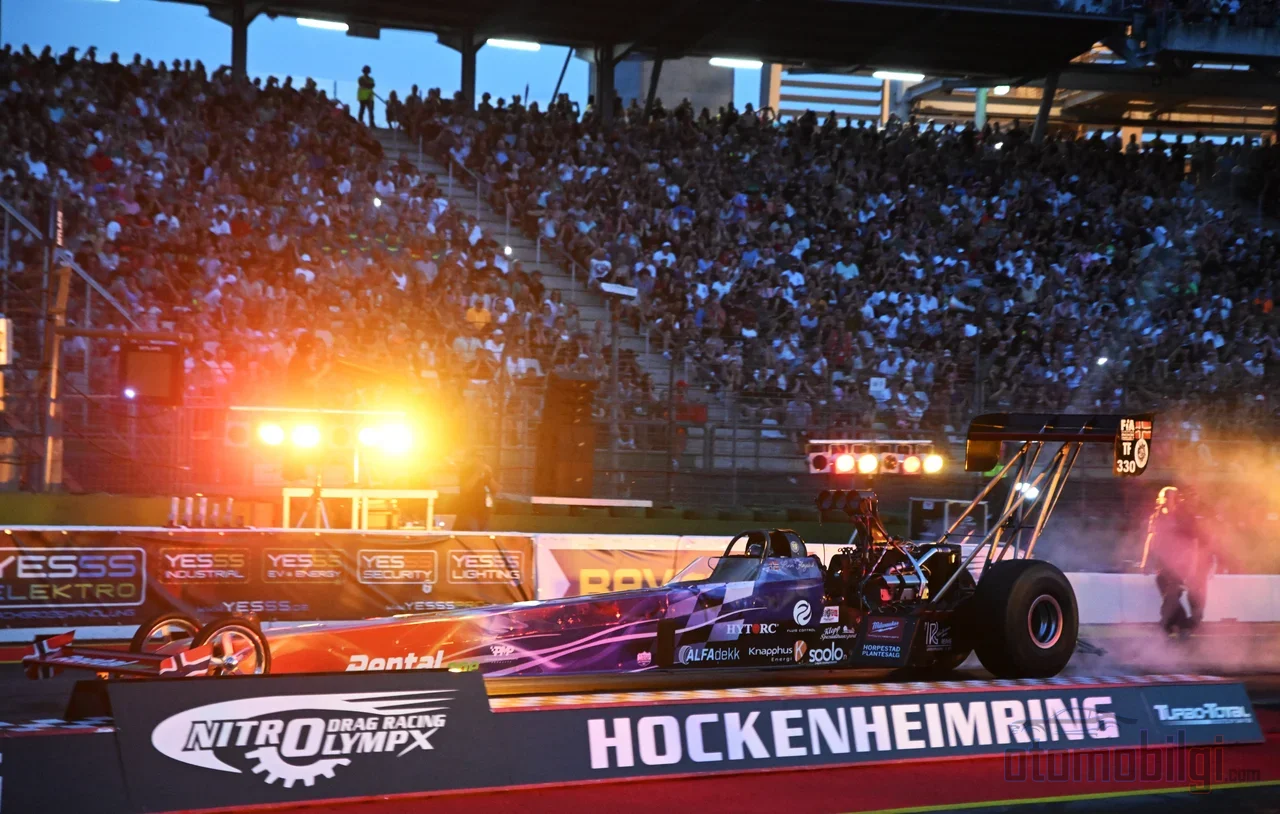
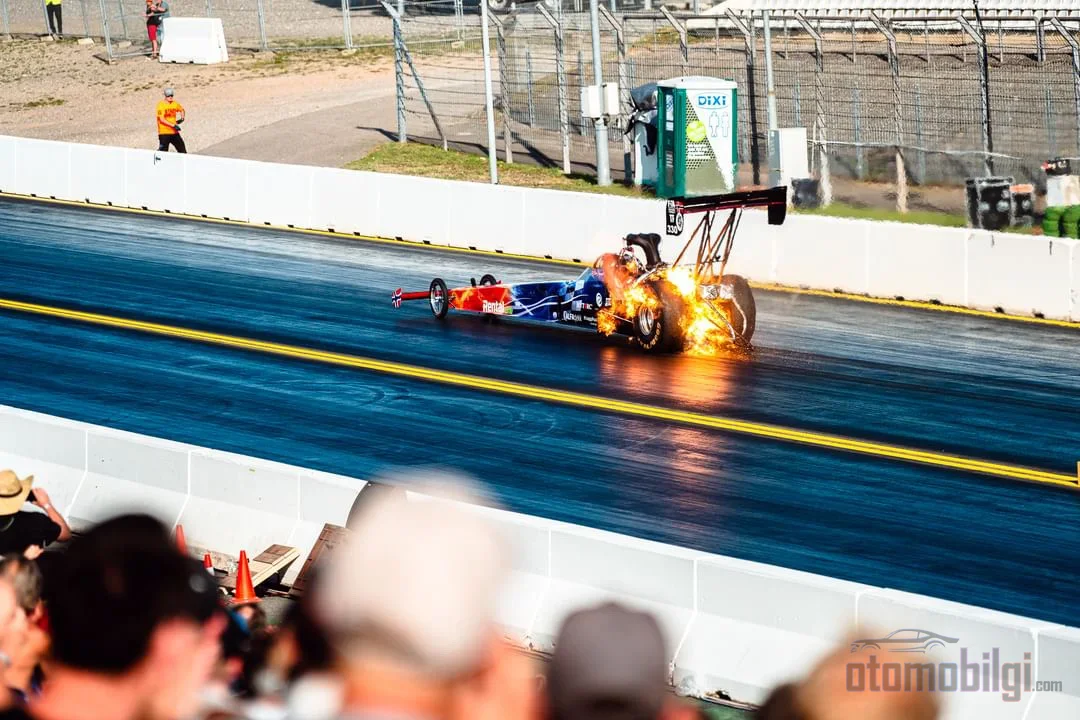
When thinking about the two classes at the top of the NHRA, I can make this comparison: a Top Fuel dragster is like a missile with an engine attached; a Funny Car is that same missile dressed in a car costume. Both are fed by the same basic heart: the same supercharged, fuel-injected 500 cubic inch (8.19 L) engine. The real difference lies in how the machine is laid out.
In Top Fuel, the engine is mounted behind the driver; the car is long, slender, and like a spear slicing through the wind. In a Funny Car, the engine is at the front and the car has a shell over it resembling a body. This positional difference and the different wheelbase are the main source of the performance gap between the two classes. Though this gap isn't as big as you might think: the difference between the times of a dragster and a Funny Car is usually only a few tenths. Modern Funny Cars can even occasionally catch up to and pass Top Fuel.
There's also Pro Stock. Compared to the top nitro duo, this class feels much more like a "real car" and, along with the sportsman classes, still runs the traditional quarter mile (1,320 feet, 402 meters). Top Fuel and Funny Car, however, have been running 1,000 feet (304.8 meters) since 2008 for safety reasons. This rule came after the fatal crash of Funny Car driver Scott Kalitta at Englishtown; the FIA also made this distance standard in 2012. So we can say the quarter mile's exact era ended in the nitro classes, but its spirit is still there.
| Feature | Top Fuel | Funny Car | Pro Stock |
|---|---|---|---|
| Engine position | Behind the driver | Front | Front |
| Engine | 500 cubic inch (8.19 L) supercharged | Same as Top Fuel | No nitro, gasoline approach |
| Distance run | 1,000 feet | 1,000 feet | Quarter mile (1,320 feet) |
| Transmission | None, direct via clutch | None, direct via clutch | Varies by version |
| Nickname | The kings of the sport | Times very close to the dragster | More of a factory-car look |
Why Does Nitromethane Produce So Much Power?
This is where the magical part begins. A gasoline engine needs oxygen from the air for combustion; if oxygen is limited, no matter how much gasoline you put in, power does not increase. Nitromethane, however, carries its own oxygen within its molecular structure. It is like placing a mini oxygen tank inside your engine's combustion chamber.
Let's look at the numbers: while gasoline's stoichiometric ratio with air is 14.7:1, nitromethane's is 1.7:1. That means, with the same amount of air, the engine can burn 7.6 times more nitromethane compared to gasoline. Nitromethane's energy density is actually lower than gasoline's (11.2 MJ/kg versus 44 MJ/kg), but the massive fuel flow more than compensates for this: the engine can produce up to 2.4 times the power compared to gasoline.
The fuel also acts as a coolant
What's even better: nitromethane's high heat of vaporization provides cooling even without water cooling in the engine. Because this block has no water passages; cooling is handled by the air/fuel mixture and the oil. The rich mixture also prevents pre-ignition (knock). The unburned nitro that escapes through the exhaust burns with a yellow flame at the pipe mouth; since it can produce hydrogen when oxygen runs out, a white flame can come out of the exhaust at night. If you see those flames while watching a night race, you now know why.
The fuel mixture is not free: since 2015, the mixture can be at most 90% nitromethane with the remainder largely methanol. The story of this upper limit is interesting: the 90% limit came in 2000, was lowered to 85% after a fatal accident in 2004, and then returned to 90% in 2008 due to teams' complaints about cost and failures. This is a sport where safety and cost always sit on the same scale.
Anatomy of the 11,000-Horsepower Engine
The engine's foundation is based on the second-generation Chrysler RB Hemi architecture: forged aluminum block, cast-iron cylinder liners, 8.19-liter displacement and approximately 6.5:1 compression ratio. The complete engine weighs no more than an average family sedan compared to a typical car engine, just 225 kg in total. While calculations put the power in the 8,500-10,000 horsepower range, measurements made with AVL Racing sensors confirmed that the peak power exceeds 11,000 horsepower . Torque is roughly around 7,400 lbf·ft . Imagine that, it feels like you could heat a mountain village with the torque from one run.
The blower that eats its own power
For air to enter, a 14-71 type Roots supercharger is mandatory. This blower is actually derived from GM's two-stroke diesel truck engines; funny but true, the heart of drag racing is a descendant of a truck part. Turning this supercharger alone consumes about 1,000 horsepower . That is, a thousand horsepower of the engine's power goes just to running the "breathing machine." Manifold pressure is generally kept between 56-66 psi, with a maximum allowance of 74 psi; against a possible overpressure, a 200 psi burst plate comes into play.
Ignition and fuel system
Since nitro burns slowly, ignition happens incredibly earlier compared to a gasoline engine: 58-65 degrees BTDC advance. Each cylinder has two spark plugs, two 44-amp magnetos and an 8,400 rpm rev limit. The fuel side is not that simple either: an engine-driven mechanical pump, around 42 injector nozzles and a constant-flow injection system capable of delivering 100 gallons per minute (at 500 psi pressure) at 7,500 rpm. On the exhaust side there is a "zoomies" header consisting of 8 open pipes; the exhaust temperature, around 500°F at idle, rises to 980°C (1,796°F) by the end of the run.
What Happens During a Run: Clutch, Suspension and Aerodynamics
Top Fuel and Funny Cars have no transmission. Power is transferred from a giant centrifugal clutch directly to the rear tires. This clutch in Top Fuel is reinforced with a pneumatic release bearing; that is, there is no gear change, and power gradually lays down to the tires as the clutch locks up. During this, an average of 4 g and over 5.6 g at peak of acceleration is experienced. Reaching from a standstill to 100 mph in 0.8 seconds feels nothing like twice the acceleration.
If you ask what the tire pressure is: rear tire pressure is regulated by Goodyear at a 7 psi minimum. The massive slick tires compress at launch and act as suspension. In the air it is another matter: the open exhaust headers produce 900-1,100 lbf of downforce at full throttle, while the rear wing provides a peak of approximately 12,000 lbf (53.4 kN) of downforce at around 330 mph. In other words, the car presses itself harder onto the track as it accelerates; otherwise it would easily lift off the ground with this power.
Now let's come to that question: why can't the engine survive a single run? Because the engine operates at the very edge of its stress level on every run. As soon as the run ends, the engine is completely disassembled, every part is inspected, and worn ones are replaced. A complete run cycle, including warm-up, oil change and refueling, takes approximately 80 seconds . So the preparation for a 3.6-second show takes minutes, and the engine's life is a single run. These engines can be thought of as single-use rocket parts; they are reborn on every run.
What Is the Drag Scene Like in Türkiye and Around the World?
So where is this nitro madness experienced? In Europe, the FIA European Drag Racing Championship 2026 calendar consists of four events across England (Santa Pod Raceway), Sweden (Tierp Arena) and Germany (HockenheimRing); the FIA/FIM Euro Finals at Santa Pod, running September 10-13 with more than 250 teams, features 300 mph FIA Top Fuel demonstrations on the program. Besides Top Fuel, the championship has four more classes, including Top Methanol Dragster. A footnote: it was announced that a championship title went to Estonia for the first time in the 2026 championship; since the sources' date information is unclear, it is not certain which season this belongs to.
In Türkiye the situation is more modest but developing. The 2026 rounds of the Türkiye Musatti Drag Championship are being run at Kepez Drag Strip (Antalya): round 1 on May 9-10, round 2 on June 6-7, round 3 on September 19-20. On the TOSFED side, there is news about auto drag races at the renovated Konya Drag Strip; KOMOSK has also announced a slalom race in Konya on November 21-22, 2026. The status of Top Fuel-like nitro classes in Türkiye is not yet documented; the Turkish scene is, for now, progressing through moto drag and auto drag championships. But imagine, one day listening to the 150-decibel scream of a Top Fuel in Antalya... Hearing that sound in the summer heat at Kepez would be a completely different experience, wouldn't it?
Meanwhile, the sound issue is no joke: at full throttle, engine noise is around 150 dB, which is above the threshold of physical pain and can cause permanent hearing damage. If you are going to the track, earplugs are a must, or even two.
Final Word: A 3.6-Second Engineering Feast
Top Fuel and Funny Car are the wildest answer to the purest question in the automotive world: how fast can you cover the distance between two points? 11,000 horsepower, exhausts at 980°C, engines torn down after a single pass, and a fuel that carries its own oxygen... These machines are reborn with every run, and at the end of every pass they write new stories with their thoroughly worn-out parts. Would you dare to sit in the seat and face 4 g of acceleration? I don't think I could resist trying it at least once.
Sources
- Top Fuel - Wikipedia
- Funny Car - Wikipedia
- Drag Racing Classes - NHRA 101
- How a Top Fuel Dragster Works - HowStuffWorks
- Top Fuel and Funny Car Engines - Engine Builder Magazine
- Top Fuel clutch construction - High Power Media
- Top Fuel Dragster Engine Rebuild - Hot Rod
- Some interesting facts about top fuel - Rf Motorsport
- 12,000 horsepower, the nitro secrets of Top Fuel engines - Rolling Steel
- What Is Nitromethane? - Competition Plus
- Drag Racing - Turkish Motorcycle Federation
- Otodrag - TOSFED
- 2026 Race Calendar - KOMOSK
- FIA European Drag Racing Championship Calendar 2026
- FIA/FIM Euro Finals - Santa Pod Raceway