How Does Reaction Time Affect a Drag Race?
Share This Page
In drag racing, the winning moment is often revealed not at the finish line, but at the starting lights. Reaction time is the value that measures the driver's millisecond response to the green light (actually the ambers), and the value considered perfect is 0.000 seconds; in most professional classes this number is the most critical data that determines the winner. Although the technology looking at the two cars is the same, the battle won against the starting lights happens entirely in the driver's head and foot.
Highlights
- Perfect reaction time 0.000 seconds; the light sequence is counted on the .500-based system.
- Average reaction times: Pro Stock .035 s, Top Fuel and Funny Car .079 s.
- In the Pro Tree, three ambers light up simultaneously and the green comes 0.4 seconds later.
- The driver who lights the staging light has 7 seconds to wait for their opponent.
- A driver waiting for the green is already late - the best ones move before the green lights up.
What Is the Christmas Tree and How Does It Work?
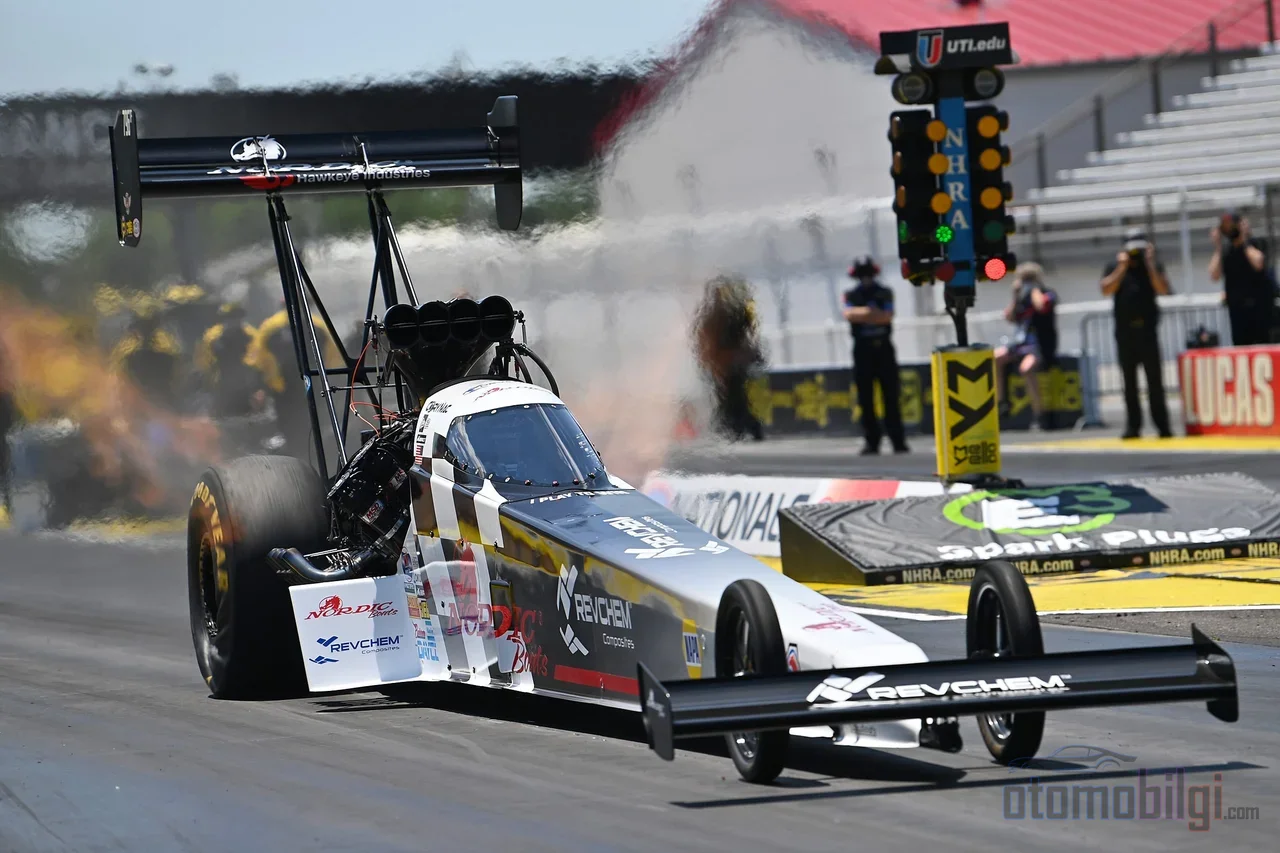
That vertical light tower standing in the middle of the track is called the Christmas Tree. The name is very fitting: it features a sequence of lights resembling Christmas tree bulbs. The system works with two light beams and photocells. When the front tire breaks the first beam, the pre-stage light comes on; this indicates that the driver is approximately 7 inches (180 mm) away from the starting line. When the tire enters the second beam, you are right on the line: you have staged, and the race is about to begin.
At the top are two blue light circles (pre-stage and staging), below them three large amber bulbs, then the green and red bulbs. Today's LED setup was introduced in 2011; before that, incandescent bulbs served the amber function. In fact, when the NHRA saw that the vibrations of the 11,000-horsepower Top Fuel and Funny Cars burned out the bulbs so easily, it switched to LED before the 2003 season. Think about it: a car vibrates so much that it can burn out lights!
When both vehicles have staged, the auto-start system initiates the light sequence within 1.3 seconds of the last car being in position. There is also a discipline rule: the driver who lights the staging light waits seven seconds for the opponent to stage as well. If the time expires, it's automatic disqualification - yes, even in qualifying.
Sportsman Tree or Pro Tree?
There are two different tree types, and each plays a completely different reflex game. In the Sportsman (Full) Tree, the three ambers light up in sequence, each 5/10 of a second apart; after the last amber, again 5/10 of a second passes before the green comes on. So the total wait is close to a second - making a prediction is somewhat easier. In the Pro Tree, however, the three ambers light up simultaneously and the green comes just 0.4 seconds later (in Super Street this is 5/10 of a second). Professional classes like Top Fuel, Funny Car and Pro Stock run in this sudden format; the only thing waiting for you is your own reflex.
Shallow or Deep? The Staging Tactics Battle
This is where things get really delicate. In shallow staging you place your tire just behind the first beam; in deep staging you deliberately pull further forward, so the tire sits close to the middle of the beam. The difference is millimeters, but the result is measured in hundredths of a second.
The most common argument for deep staging is this: tightening the reaction time in cars that are slow to react off the bottom bulb. Because the tire is further forward, the car exits the beam sooner, and the sync between the E.T. clock starting and your launch improves. Shallow staging typically plays to the speed side; the car exits the beam later, and the measured elapsed time improves slightly. So where's the trap? A car staged too deep can, in some cases, be penalized outright with the red light. Deep staging is a gamble - it can win you the round, or end it.
There is also a purely psychological game: double-bulbing. The driver rolls deep into the staging area and lights both staging bulbs at once. It leaves the opponent almost no preparation time; this is psychological warfare at the starting line. One famous incident: the tension between Todd and Beckman in a US Nationals final is remembered for games of this kind. There is a counter-move too: both drivers deliberately holding back, that is, the burndown. Sometimes the tactic works, and sometimes it angers the starter so much that both engines are shut off.
Does the Red Light Really Always Mean Disqualification?
No, and this is one of the details most spectators don't know. If a car crosses the starting line before the green comes on, the red lights up - a classic foul start. But the rule works like this: if the opponent also commits a foul (such as a lane boundary violation or hitting the barrier), the red light foul is voided. In a heads-up start, if both cars leave early, only the first one out is penalized with the red. And there is good news: in qualifying, the red light doesn't affect the run; the order is determined by the recorded time.
So what should you do against a fouling car? Even the opponent shutting off the engine and not completing the run is enough - making a legal pass suffices. So the red light is not as definitive a death sentence as you might think at first glance. In bracket racing, the matter goes even deeper: before the TruStart system, when the first driver out saw the red, the other was automatically shown the green. Under the new system, for example, if a 10.00-second car leaves with a -.005 and the 8.00 car with a -.015, the car with the lighter violation wins - meaning "the worst red" takes the penalty. Which system is fairer is still being debated in racer forums.
How Does Reaction Time Determine Results by Class?
In drag racing, two separate clocks run: one is the E.T. (elapsed time), the time from the moment the car leaves the staging beam to the finish line; the other is the reaction time. E.T. is the car's speed, reaction time is the driver's reflex. In professional classes, the official numbers tell it all:
| Class | Average Reaction Time | Performance |
|---|---|---|
| Top Fuel | .079 sec | 7,000 horsepower, under 3.8 sec, over 325 mph |
| Funny Car | .079 s | 4.0 s range, over 315 mph |
| Pro Stock | .035 s | 6.4 s range, over 210 mph |
| Pro Stock Motorcycle | - | Under 6.8 s, over 195 mph |
The conclusion from the table is striking: Pro Stock is the class where the battle at the launch is the most brutal. The same .035 second average - three percent of a second, about as long as reaching into the fridge to grab something - think about that. In Top Fuel and Funny Car, the cars are so powerful and unpredictable that an average of around .079 already reflects world-class standards. A small note: reaction time measurement can vary slightly from track to track. Some tracks start measuring from the green light, others count from the last amber; this is why a value like .496 in a .500-based system means a red light.
Let's clarify one detail: the E.T. clock starts when the car leaves the staging beam. So leaving slightly early at the launch ruins your reaction time, but the E.T. can still improve a bit. Intermediate times are recorded at the 60, 330, 660 and 1,000 foot marks and the quarter mile. In Top Fuel and Funny Car, the finish is at 1,000 feet; all other classes run the quarter mile. Speed is measured within the 66-foot "speed trap" ending at the finish line. In winning a race, reaction time and E.T. combine: in a heads-up race, leaving first means winning at the launch above all.
How Do You Train Millisecond Reflexes? Driver Preparation Routines
The limits of physical reflex are clear; the human nervous system can only react at a certain speed. That's why drivers focus on mind and body together in their training. There is a commonly repeated recommendation in general motorsport sources: take three deep breaths before getting into the car. Controlled breathing turns pre-race anxiety into focused energy; some drivers practice 15 minutes of quiet focus before a race. For a drag racer, the real critical mental moment is a few seconds before the run - all attention is gathered on that starting light.
Mental reset after the burnout is also part of the routine. As the tires heat up, the car vibrates, the smells sharpen, and you have to lock your mind completely onto that single amber. Physical fitness comes into play here: if your neck and abdominal muscles don't stay g-strong, mental clarity easily falls apart under 4 g launches. In reaction time training, drivers work with light simulators, learn their own reflex thresholds, and find out at what point they approach the risk of going red. Because the goal is not to see the green - it is to predict it. According to Autoweek, there's a well-known saying among racers: the one who waits for the green is already late. The best leave before the green comes on; but this line turns into red with a hundredth-of-a-second error.
Where Is the Starting Line Seen Today? The Türkiye and World Stage
This reaction game isn't played only in America. In Türkiye, the 2026 drag season appeared on screens at Kepez: Leg 1 was run on May 2–3, Leg 2 on June 6–7, and Leg 3 on September 12–13 at the Kepez New Drag Strip. The Leg 3 Race of the Türkiye Musatti Drag Championship also took place on September 19–20, 2026 in Antalya/Kepez. The Kepez Auto Drag Races under TOSF define drag as "the battle of power, grip and reaction time" - meaning the same threefold emphasis is at the core of the Türkiye scene as well. The KOMOSK 2026 calendar also includes the Auto Drag Race on October 10–11 and the Slalom Race on November 21–22.
On the European side, the FIA European Drag Championship was run over four legs in 2026: Santa Pod Raceway (England), Tierp Arena (Sweden) and HockenheimRing (Germany). Today's Top Fuel dragsters can go from a standstill to over 300 mph in under 4 seconds. At NitrOlympX, Erbacher passed Calin's 4.094 seconds with 3.973 seconds. So the same starting light game plays out on every strip from Antalya to Hockenheim - in different languages but with the same milliseconds.
What's the Difference Between a High School Hallway and the Starting Line?
Imagine it's a scorching hot day, you've got an energy drink in your hand and you're having a "who reacts faster" race with your friend. Your eyes are locked on a light, your finger on the button. Now picture it in the cockpit of a 7,000-horsepower Top Fuel dragster: the same light logic, but the green moment carries you to 325 mph and a .005-second mistake can end the run. Starting lights aren't a toy; they're the face of drag racing that is as human as it is technological. Next time you watch a drag video, don't just watch the finish line - watch those three ambers light up too, because by then the game has already been decided. If it were you, would you choose shallow or deep staging?
Sources
- How the NHRA Starting Lights Work
- Christmas tree (drag racing)
- NHRA 101
- Drag Race 101 - World Wide Technology Raceway
- How I learned to stop worrying and love reaction times
- TruStart Begins a New Era in Bracket Racing at the Spring Fling
- Staging: Deep or Shallow
- Drag Racing - TMF
- Kepez's drag strip 2026 season
- 2026 Race Calendar - KOMOSK
- The Main Event, 2026 FIA European Championship
- FIA European Drag Racing Championship: The Champions
- A Racer's Focus
- Mental Preparation for Racing Drivers: 2026 Techniques
- Mindfulness in Racing