How Did Drag Racing Originate and How Has It Evolved to Today?
Share This Page
Drag racing was born out of informal gatherings in the dry lake beds of 1930s California, where speed enthusiasts tested their engines, and took shape in America's abandoned air bases after World War II, becoming a legal, rule-based sport with the founding of the NHRA in 1951. Today, this discipline, run between the two ends of a quarter mile (or 1,000 feet in the fastest classes), stretches from illegal sidewalk racing on the streets to the professional world stage. So how exactly did this journey happen? Let's watch it from the beginning.
Highlights
- The first organized drag race in 1949 was run at a military air base in California.
- Wally Parks founded the NHRA to bring order out of chaos in 1951. founded.
- The traditional track length is 1,320 feet, which is a quarter mile.
- The 1964 Ford Fairlane Thunderbolt is considered America's first factory-built drag racing car.
- The NHRA is celebrating its 75th anniversary in 2026.
Where and how was drag racing born?
It all began on the vast plains of the California deserts. Dry lake beds like Muroc had been meeting points for hot rod enthusiasts since the early 1930s. As engines improved, speeds increased too; in the 1930s, cars began to exceed 100 miles per hour, roughly 160 km/h. For that era, this was practically science fiction. Just imagine: today you're doing 160 on the highway with a car from a high school parking lot - 90 years ago, that speed was something attempted at the risk of one's life on a desert plain.
But the real explosion came after World War II. The war was over, and America was full of unused military airfields. As a response to the automotive technology that had developed tremendously during the war, young people were modifying their cars and racing on the streets and abandoned runways. It is exactly this period that is considered when drag racing was "born on America's back roads."
The first step on the organized side was taken in 1949: the first organized drag race in the US was run at an air base in Goleta, California. The quarter-mile distance of the early races was actually a "randomly" chosen track length - this distance, equivalent to a city block, became standardized over time. Moreover, at that first event there were no barriers on the track, no stands, no safety measures. Just two cars, a straight strip, and a bit of courage.
Wally Parks and the NHRA: From illegal hobby to rule-based sport
The danger of illegal street racing was visible to everyone; by the late 1940s and early 1950s, this activity was already considered "wrong." Even today, unplanned street racing in the US carries serious penalties such as arrest, vehicle confiscation, and even the destruction of the vehicle. Right in this atmosphere of chaos, a name steps onto the stage: Wally Parks.
Parks was born in 1913 in the town of Goltry, Oklahoma, and his family moved to California in the early 1920s. According to NHRA historians, it is even possible to argue that "drag racing was born in Goltry in 1913" - what do we mean by that? In other words, Parks' life story is so intertwined with the story of the sport. In the 1930s he took part in the first dry lake speed trials, in 1937 he was among the founders of the Road Runners Club, and he helped establish the SCTA and became its general manager. The first SCTA "Speed Week" was held in 1949 at the Bonneville Salt Flats, and racers chased acceleration rather than top speed for the first time - racing "against the clock," so to speak.
In 1950, at an airfield in Southern California, the Santa Ana Drags began operating, captivating the Muroc crowd with its revolutionary computerized speed timers. Then Parks became the editor of Hot Rod magazine and in 1951 founded the National Hot Rod Association "to create order out of chaos." The goal was clear: to draw racers away from the dangers of the streets and the desert and into a legal, regulated, safe sport. The NHRA's first official race was run in April 1953 in the parking lot of the Los Angeles County Fairgrounds in Pomona - the same track would host the Winternationals and the Finals decades later. The birthday of the organization celebrating its 75th year today is also considered the birthday of modern drag racing. That is why Parks is called "the father of drag racing."
The quarter-mile standard and the first classes
So why do two cars always run in a straight line, along exactly 1,320 feet (about 402 meters)? The answer lies hidden in history: early racers chose the track length themselves, and this "random" choice - the length of a city block - eventually became the standard. In other words, there is no magical engineering calculation behind the quarter mile being the official distance of drag racing; it is purely tradition. I think this is one of the most romantic standards in history.
Throughout the 1950s, two basic racing classes developed: Unmodified Stock and Top Eliminator. Among the star vehicles of the era were the Albertson Olds and the Dragmaster Dart belonging to Dode Martin and Jim Nelson. In 1955, the first national event, the NHRA US Nationals, began in Great Bend, Kansas; in 1961 it moved to Lucas Oil Raceway in Indiana and is still considered the most prestigious event in professional drag racing today.
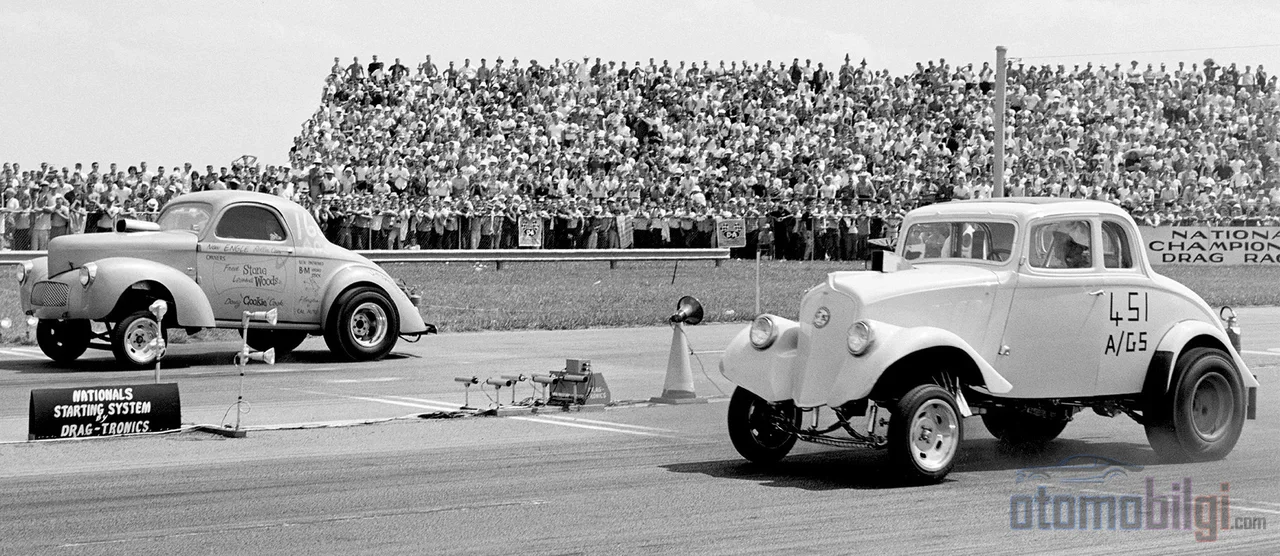
The starting mechanism also evolved. Until the 1960s, races were started by a starter with flags; then came the electronic lighting system. The "Christmas tree" we know today - the chain of colored lights descending from red to green - is a legacy of this era. From the pre-stage light showing that the vehicle is 7 inches (about 18 cm) from the starting line, to the elapsed time beginning as the car exits the starting beam, to speed being measured in the final 66 feet, every detail is part of this system. So although the track looks like a single line, it is actually a rich stage of technology.
The factory wars: the 1960s and the Funny Car revolution
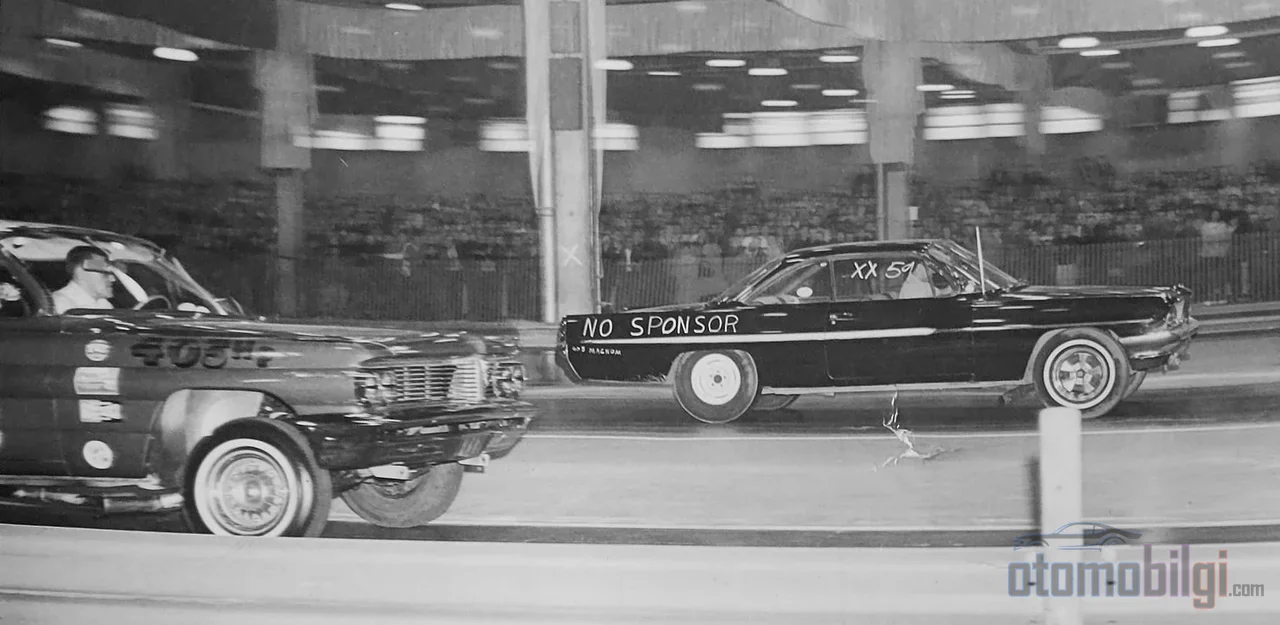
The 1960s were the decade of drag racing's technical leap. Car design evolved from "wide and short" to "long and slim." But the real bombshell came out of Detroit: the factory rivalry between Ford and Chrysler - namely "big business" - began to shake up the drag scene. In the early 1960s, Detroit was fighting for stoplight drag supremacy; the most powerful cars were produced with almost no publicity to the public. Then in 1964, the Ford Fairlane Thunderbolt went down in history as America's first factory-built drag race car.
In the same period, designs became so radical that the Funny Car class was born, featuring one-piece fiberglass bodies that lifted open so the driver could climb in. Even its name is full of humor: the car had been modified so much that a production car would make you ask "is that even it?" This class is still one of NHRA's most popular categories today - and the most vivid example for those wondering how the class concept came to be.
How an accident changed the sport
One of history's most painful turning points occurred in the 1970s. Legendary driver Don Garlits lost his right foot when his car split in two after a transmission explosion in his front-engine dragster. Many people could have walked away from the sport after that; Garlits did exactly the opposite and developed the rear-engine dragster. Within just two years, all dragster engines were moved behind the driver. Today, the reason for the long, snake-like design of Top Fuel vehicles stems directly from that accident - if the engine is in front of the driver, it acts like a shield protecting them at the moment of an explosion.
The 1970s also ushered in the era of sponsorship: volunteer crew members became salaried, trailers turned into mobile workshops, and as the NHRA found sponsors, it could offer larger prize pools. Additionally, in 1970, Larry Carrier founded the IHRA in the town of Norwalk, Ohio; this organization further expanded the sport with events stretching from the USA to New Zealand and Australia.
From past to present: the drag scene in Europe and Türkiye
Drag racing is no longer just an American sport. In Europe, the FIA-approved FIA European Drag Racing Championship is run by Speedgroup and has been held annually with six events across four categories since 1996. Among the recent champions, Swede Tony Bryntesson, with 355 points, became the European Champion while Habermann with 343 points finished second.
The scene is growing rapidly in Türkiye as well. Archive footage from 1998 belonging to the Türkiye Moto Drag Championship shows that drag culture in our country has a history of at least 25 years. The 2026 season of the Türkiye Drag Championship is being run on the new drag strip in Kepez, Antalya; over 100 athletes from 13 provinces took part in the 2nd and 3rd round races. Don't think of this as a school tournament; we're talking about a serious, organized, and growing scene. The Kepez strip is becoming the center of a new era in Turkish drag history.
| Period | Milestone |
|---|---|
| 1930s | First speed attempts on dry lake beds such as Muroc |
| 1949 | First organized race in Goleta; first SCTA Speed Week in Bonneville |
| 1950 | Santa Ana Drags opened with computerized speed timing |
| 1951 | Wally Parks founded the NHRA |
| 1953 | First official NHRA race at Pomona |
| 1955 | First US Nationals, at Great Bend |
| 1960s | Electronic starting system, factory competition, Funny Car |
| 1970s | Garlits' crash and the rear-engine dragster; founding of the IHRA |
| 2008 | Top Fuel and Funny Car distance shortened to 1,000 feet |
| 2026 | NHRA's 75th anniversary; record prize pool |
Why did the quarter mile drop to 1,000 feet?
Traditional drag strip 1,320 feet, in other words a quarter mile - but there is an exception. For the first time in NHRA history, in 2008, the race distance for some classes, including Top Fuel and Funny Car, was shortened to 1,000 feet (approximately 305 meters). The logic is simple: the cars in these classes had become so fast and powerful that the final 320 feet were now too risky a zone for drivers. By shortening the distance, they tried to balance safety and excitement in the sport. Even today's Top Fuel vehicles carry the engineering legacy of this era: they are built from chromoly steel tubing and carbon-fiber composite, 25 feet in length, and their race-ready weight is 2,330 pounds.
The NHRA's 2026 season, also boosted by the 75th anniversary celebrations, offers a record prize pool in its history: in the 20-race calendar there is a total of more than 27 million dollars in prizes and distributions. In addition, the "Wally Parks 75th Anniversary Appreciation Fund" was introduced to keep the founder's legacy alive. A story that began on a desert flatland in 1951 having turned into a multi-million-dollar professional industry today... in my opinion, you can't help but say "wow" when you read it.
What can we learn from the history of drag racing to today?
Watching a sport evolve is actually like understanding how an engine works: every part is connected to the one before it. Without the enthusiasts on dry lake beds, Parks' organizational move would never have happened; without the NHRA, the factories' war and the Funny Car revolution wouldn't have arrived so quickly; without Garlits' crash, today's dragster design would be completely different. When you watch the next race, pay attention to that brief silence at the launch - behind it, a story of roughly a hundred years is exploding along with the green light. So which chapter of this story did you like the most: the chaos born of the desert, or the order that rules the track?
Sources
- Drag Racing | History Detectives | PBS
- NHRA History
- Drag racing | Research Starters - EBSCO
- When Did Drag Racing First Start? - Jegs
- Born on the backroads - NHRA Museum
- Wally Parks - Motorsports Hall of Fame
- NHRA Drag Racing Classes
- Why an NHRA Drag Strip is 1000 Feet - Autoweek
- Race Distance Shortened to 1000 Feet - SEMA
- Louder, Lighter, Faster: Detroit's Early-'60s Drag Wars - Hagerty
- America's First Factory-Backed Drag Car - HotCars
- FIA European Drag Racing Championship Calendar 2026
- FIA European Drag Racing Championship Champions - Nitrolympx
- Drag Racing - Türkiye Motorcycle Federation
- Kepez's drag strip will leave its mark on the 2026 season - Kepez Municipality
- Wally Parks 75th Anniversary Appreciation Fund - DragZine