The First 60 Feet: Launch Physics That Wins Drag Races
Share This Page
In drag racing, the first 60 feet, roughly 18 meters after the starting line, is the section that most determines the quarter-mile result: the engine's power is transferred to the tires over this distance, suspension weight is loaded onto the rear wheel, and the wheelie bar controls the front lift. A car that manages its launch well doesn't just catch its rival over the remaining 390 meters - it opens up a gap. So what exactly happens in those few seconds? Let's take a step-by-step look.
Highlights
- An improvement in the 60-foot time of 0.1 seconds reflects on the quarter-mile ET as roughly 0.2 seconds reflects as
- On the drag strip, the coefficient of friction with a slick tire can exceed 1.25-1.30, while a street tire stays at around 0.8 Top Fuel cars complete 1000 feet in 3.6 seconds with approximately
- Top Fuel cars complete with approximately 11,000 horsepower The right tire pressure and launch RPM setting can alone improve the 60-foot time by more than
- The right tire pressure and launch RPM setting, on its own, can improve the 60-foot time by 0.1 seconds more than
Why Does the First 60 Feet Determine the Whole Race?
A drag race is not really a speed contest, but a contest of acceleration. The winner is not the car that reaches the highest speed at the end of the quarter mile, but the one that covers the distance to the finish line in the shortest time. The math behind this is Newton's Second Law: F=ma. The force produced by the engine is transferred to the car's mass through the tires gripping the track. With constant force, lower mass means greater acceleration; but if the tires can't hold the force, the formula remains on paper.
This is exactly why the 60-foot time is so important. This is the time it takes for the car to leave the starting line and pass the light at the end of 60 feet (about 18 meters). At launch, everything is already at its most difficult: the tires face cold shock, the engine demands nearly all of its power, and the car's weight is not yet in the right place. A car that gets through the first 18 meters poorly cannot fully make up for that lost acceleration.
The track side is part of the job too. Before the race, officials apply special traction-enhancing compounds to the starting section; the burnouts performed by the cars also leave tire rubber on the track. The grip is so high that it's possible to hear your shoes stick to the ground when walking at the starting line. Taking a low-grip tire onto this surface is like ice skating.
The Power Transfer Moment: Clutch, Torque Converter and Transbrake
The heart of the launch is that brief moment when the engine's power is transferred to the wheels. In a manual car, this job goes through the clutch: first gear is engaged with the clutch pressed, the RPM is raised, and the clutch is released at the right moment. For a perfect launch, the RPM, the clutch's engagement speed and tire grip must all be balanced at the same time - this is harder than it sounds, and consistency comes with the number of attempts.
In vehicles with an automatic transmission, the torque converter takes on the job. At launch, the torque multiplication kicks in and amplifies the torque delivered from the engine to the drivetrain; at cruising speed, the lock-up piston clamps to provide 1:1 mechanical efficiency. Inside the converter there is a pump, a turbine and a lock-up clutch; so it is far more than just a launch clutch. In high-power setups, advanced materials such as ceramic or Kevlar are used in the clutch plates; because ordinary material cannot withstand that torque.
In serious drag vehicles the scale of things changes: the transbrake. While the button is held, the transmission engages the first and reverse gear elements simultaneously, holding the car at the starting line. This allows the engine to build exactly the desired launch RPM. The instant the button is released, all the power is transferred to the drivetrain at once. This shift moment, measured in milliseconds, determines the fate of the launch.
Weight Transfer: What Does the Suspension Do at Launch?
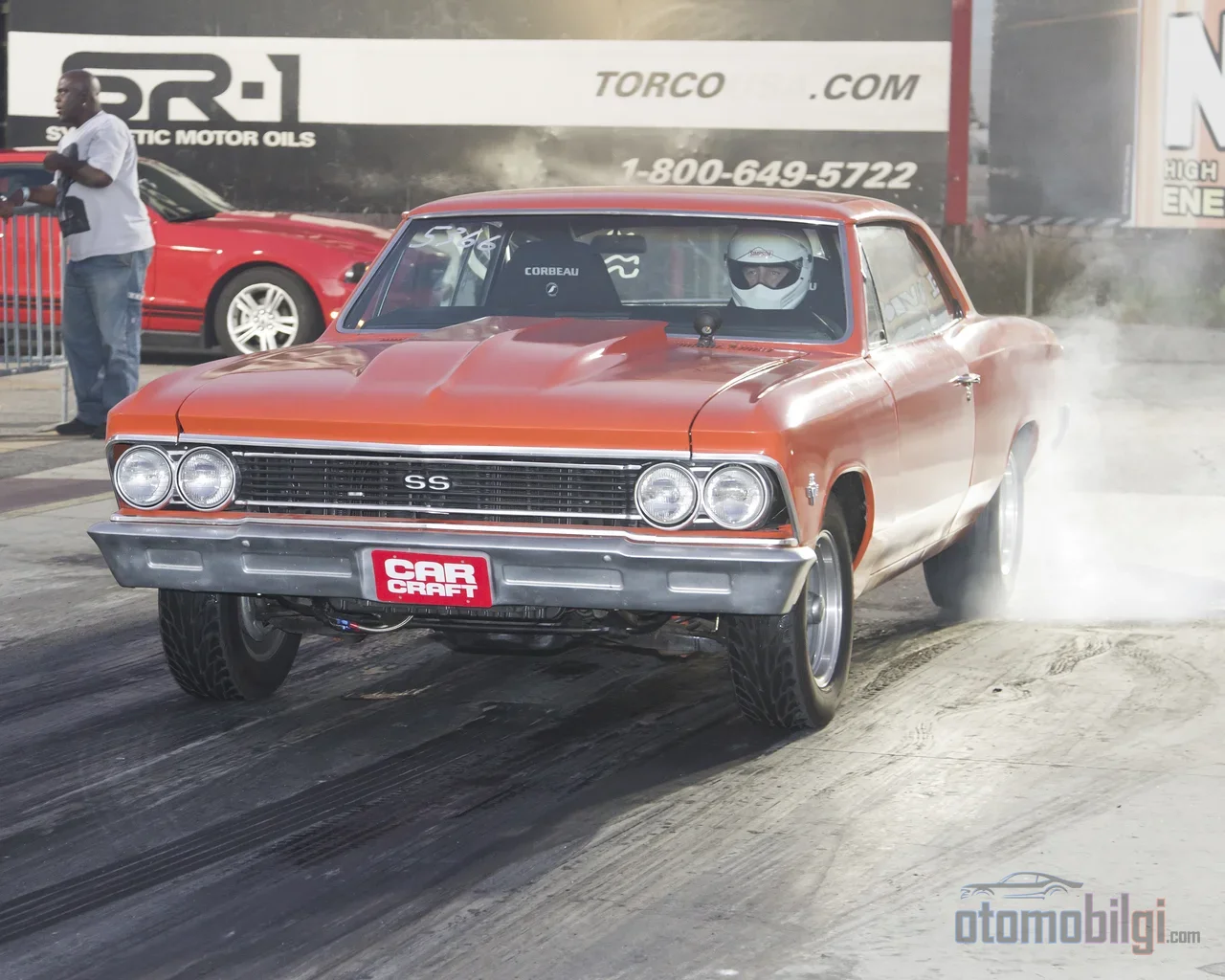
When you press the throttle hard, the front of the vehicle rises, the body squats rearward, and weight is loaded onto the rear tires. This weight transfer increases the vertical load on the drive wheels; as vertical load increases, tire grip and therefore acceleration also increase. Simply put: the harder you accelerate, the more weight is loaded on the rear tire - and that is a good thing, until it gets out of control.
The suspension's job is to carry out this transfer at the right speed and smoothly. If the rear end is left soft, weight is transferred to the rear easily and traction at launch increases; stiffening the front also supports the same transfer. The goal is to transmit to the tire just enough force to keep it from spinning, and to spend the rest on pushing the vehicle forward. In a vehicle with a sufficiently soft front setup, it is accepted that maximum weight transfer is completed within the first 2 feet of launch, that is, half a meter. Details such as pinion angle also directly affect the launch; a bad setup is reflected directly in the ET as lost time.
Is Lowering Always Good?
Lowering a vehicle in a street setting is popular from an aesthetic standpoint, but on the drag strip it can backfire. In one modeling example, lowering the vehicle's center of gravity by 2 inches (about 5 cm) reduced the launch propulsion force - meaning lowering harmed traction. As the center of gravity drops, the magnitude of the weight transfer also decreases; because the transfer is related to the product of height and acceleration. Also, the differential type is critical: an open differential directs torque to the tire with the least grip, so maximum propulsion force is limited by the least loaded wheel. A locking differential eliminates this loss entirely. The figures below clearly summarize the situation:
| Setup change | Maximum propulsion force | Result |
|---|---|---|
| Street tire, locked diff (coefficient ~0.8) | ~1640 lbs | Baseline reference |
| Slick tire, at the track (coefficient ~1.30) | ~2918 lbs | Propulsion force increases by nearly 80% |
| Vehicle lowered 2 inches (locked diff) | ~1612 lbs | Traction loss, a bad move |
Wheelie Bar: Who Reins In the Front End Lifting?
If a powerful vehicle uses too much weight transfer at launch, its nose rotates skyward; we call this a wheelie, and while it looks fun behind the camera, it's a serious risk on the track. That's exactly the most basic function of the wheelie bar: two wheeled rods extending from the rear of the vehicle and touching the ground behind it, protecting the car from flipping over if the front lift reaches extreme dimensions.
But the wheelie bar isn't just safety equipment; it's also a tuning tool. By changing its height, you affect two things: whether the car launches flat or with its nose slightly raised, and how high the front end can rise. A well-tuned setup keeps the car balanced in the first moment of launch. You should also know its side effect: when the wheelie bar touches the track, it can unload the weight on the rear slicks; in other words, traction force drops at that moment. That's why the setting must be established exactly in the middle - neither letting it touch nor leaving it free enough to flip. Suspension, wheelie bar, and throttle - the three together form the balance of the launch.
Tire Grip and the Track: The Secret of Wrinkle-Wall Slicks
Those wrinkles you see at launch on the sidewall of drag tires aren't a defect; they're the design itself. The slick that absorbs massive torque deforms dramatically, expands, and wrinkles to maximize the contact surface with the track. It's precisely this flexibility that converts power into forward motion at the most critical fraction of a second. Before a race, the tires are specially heated with a burnout; an ordinary road tire could never offer such grip.
The numbers show the size of the difference: while a reasonable performance radial gives a friction coefficient of about 0.8 on street surfaces, on a prepared drag strip with wrinkle-wall slicks this value can reach 1.25-1.30 and beyond. In the model example, raising the coefficient to 1.30 moved the maximum traction force of the vehicle with a locked differential from 1640 lbs to 2918 lbs - almost a doubling.
The power of launch tuning shouldn't be underestimated either: it has been shown that with just two adjustments - tire pressure and launch RPM - the 60-foot time can be improved by more than 0.1 seconds. The advice for beginners is clear: start the launch with a conservative RPM and increase the RPM gradually with each attempt. For those who want to try this in Türkiye, the stage is ready: in the Türkiye Drag Championship, the race length is 402 meters; 600 meters are reserved for braking, followed by a sand pit. In other words, after the first 18 meters or so of launch, being able to stop is part of the job.
Launch by Class: Different Physics from Rookie to Top Fuel
Launch physics works on the same principle in every class, but the scale changes. For someone entering drag racing with daily vehicles, the game is played with tire pressure, launch RPM, and suspension stiffness. As the class rises, each of these parameters goes to extremes, and engineering comes into play. The launch of top-tier vehicles is like a textbook on how much power you can grip:
- Rookie and street classes: Launch technique and consistency come to the fore; reaction time and 60-foot consistency are the mirror of launch success. Progress is made in early attempts with tire PSI, launch RPM, and clutch settings.
- Pro Stock: It stands out with its factory appearance; wheelie control at launch and extremely fine suspension settings are decisive. How Pro Stock will be positioned in NHRA's educational series is a separate topic.
- Funny Car: A monster with an enclosed body producing power in the 11,000 horsepower region; weight transfer at launch works like in Top Fuel, but the short chassis makes staying balanced difficult.
- Top Fuel: Its long, open-wheel chassis provides an advantage in launch stability. With approximately 11,000 horsepower, it completes 1,000 feet in 3.6 seconds; its launch is even more violent than the Top Alcohol Dragster's leap from around 3 g. It is estimated that approximately 50-60 liters of fuel are burned in a single launch - a controlled battle between power, grip, physics, and reaction time.
So launch physics is universal: in every class, force passes through the tires. What changes is the magnitude of that force and the complexity of the equipment that controls it.
How Does the 60-Foot Time Reflect on ET, and How Many Seconds Does It Save?
This is the most frequently asked question at the track: what does every tenth gained in the 60-foot turn into over the quarter mile? The common acceptance among racers is that a 0.1-second 60-foot improvement yields roughly 0.2 seconds in total ET. Some drivers see this ratio as closer to 0.15 seconds; the ratio varies depending on the vehicle, class, and track conditions. The common point is this: a slow 60-foot is almost always a sign of a bad launch and can be recovered by correcting tire pressure, launch RPM, and clutch settings.
One warning is also important: the 60-foot is not everything on its own. Trap speed completes the picture; a good 60-foot usually indicates that the car launched with more power, but acceleration continues through the end of the quarter mile as well. It is even said that focusing too much on the 60-foot around the track can sometimes be misleading - the real score is always the quarter mile ET. The result is affected by many variables, from air density to transmission settings. The right approach is to use the 60-foot as a diagnostic tool: if the times are good but the ET is slow, the problem should be sought not in the launch but in the rest of the run.
Now I ask you: is your car slipping or hooking in the first 18 meters? At the next track day, take another look at the 60-foot line on your time slip - a large part of the story of the race is written there.
Sources
- Chassis Tuning - Tire Grip & Traction - Physics & Formulas
- Tips for Fixing Basic Handling Problems in Drag Racing
- Top 5 Issues Impacting Your Drag Racing Suspension
- Why Drag Cars Wheelie on Launch: The Physics Explained
- Wheelie Bar 101: Installation and Top Tuning Tips
- Wheeling & Dealing: How to Set Up and Adjust a Wheelie Bar
- How to Nail the Perfect Drag Strip Launch in Any Manual Transmission Car
- TG's guide to driving: how to drag race
- ZF 8HP - architecture, mechanics, and origins
- Optimizing Your Car for the Best Drag Racing Times
- Understanding Trap Speed & How It Helps Make Your Race Car Faster
- Drag Racing Traction: Making a Pass
- Performance Tech | Drag Racing 102
- The Sixty Foot Myth
- To what degree do 60 ft times affect the 1/4 mile time?
- NHRA 101
- Here's the Difference Between NHRA Top Fuel Dragster and Funny Car
- Türkiye Drag Championship Racer Briefing
- Drag Race Launch Guide