Street-Legal Monster: Pro Stock's Garage Technology
Share This Page
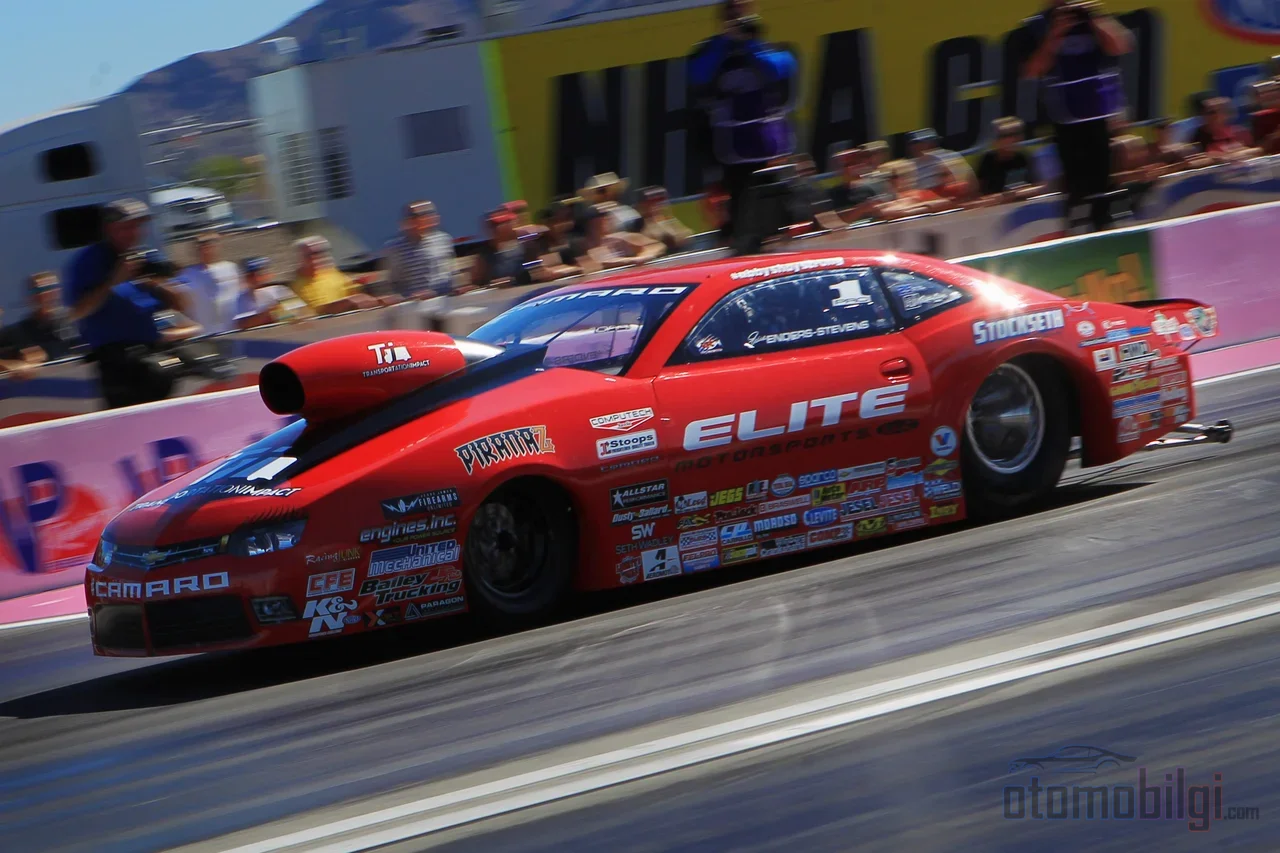
If you've ever found yourself at a track dazzled by the nitromethane cloud of Top Fuel and Funny Car, you've probably asked: "So what's the deal with those cars with flat door glass that look straight off the factory line?" Here's a clear answer: Pro Stock is drag racing's "factory hot rod" class; the most disciplined class, using no turbo or supercharger - meaning fully naturally aspirated (cool-speak for "all motor") engines - chasing six-second quarter-mile times while preserving the factory silhouette.
Highlights
- Pro Stock engines in the NHRA are subject to a displacement limit of 8.2 liters (500 cubic inches) and turbo/superchargers are banned
- The class switched from carburetor to EFI in 2016 ; in 2027 the hood scoop is returning
- Record pass: with Greg Anderson, 6.443 seconds / 212.06 mph
- Engine revs are limited to 10,500 rpm , manual gearbox mandatory
- A perfect reaction time on the Pro Tree is .400 seconds exactly
What Is Pro Stock? The Class With No Nitro But That Nobody Can Fool
Think about it: you have a 500 cubic inch V8, but turbo is banned, supercharger is banned, and filling it with nitromethane is banned. What do you do? The answer is very simple and at the same time very wild: you push engineering to its limits to squeeze the last drop of power from every cubic centimeter of the engine. Pro Stock is exactly the name of this game. That's why the class is called "factory hot rod"; the body still carries the silhouette of a model you'd see on the road, but underneath lies a monster with nothing to do with a road car.
This is a philosophy fundamentally different from Top Fuel and Funny Car. The nitro classes draw their power from the fuel itself: nitromethane, giant superchargers, and engines rebuilt after every pass. Pro Stock, on the other hand, is the class that says "I'll win with what I have." Cars with doors that open, a real cockpit inside, and manual gear changes. That's why teams are called "door-slammers, gear-jammers" - and this nickname is the class's signature.
Engine: How to Extract 1,400 Horsepower From 500 Cubic Inches?
The magic of the compression ratio
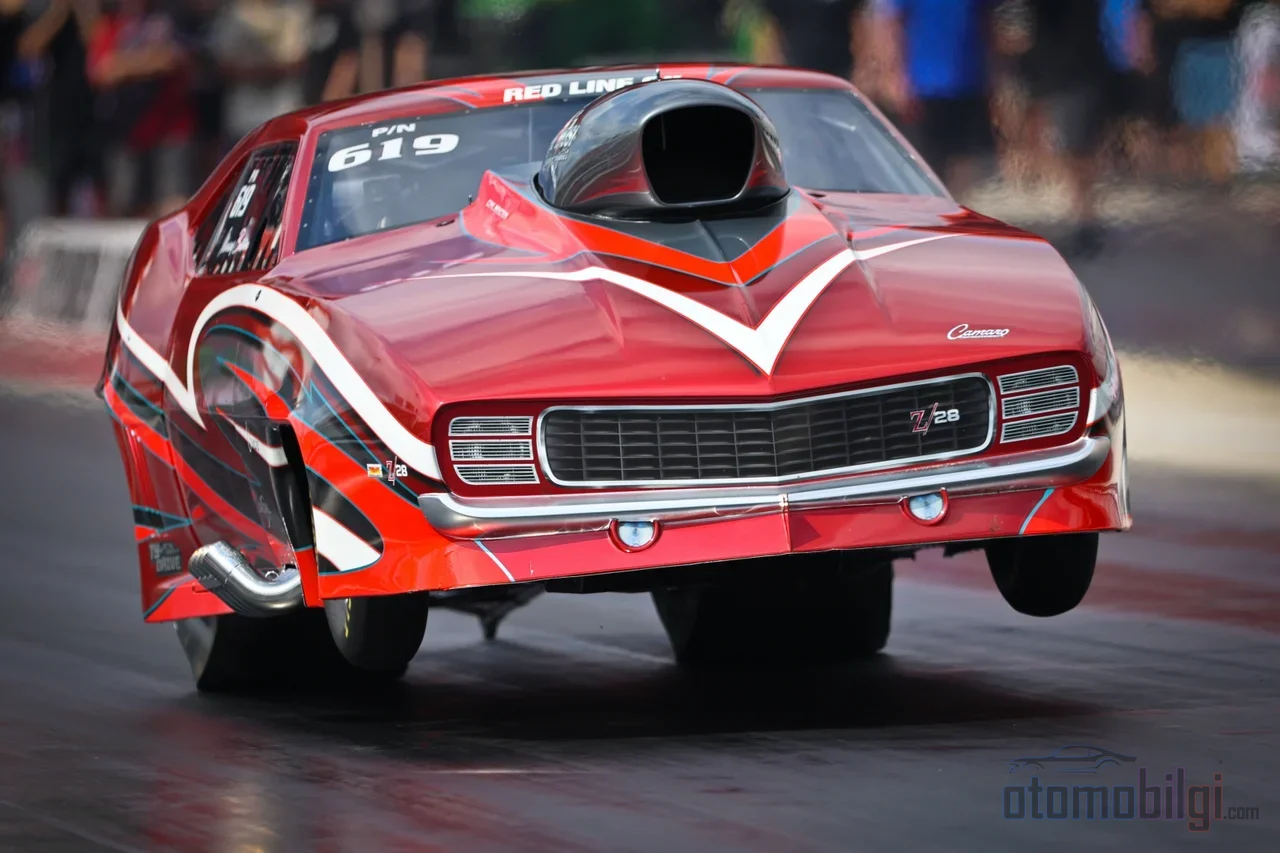
The secret to getting this much power from a naturally aspirated engine, roughly speaking, is compression and revs. While factory cars hover around a 10:1 compression ratio, Pro Stock engines run at unbelievable values like 15:1 to 16:1. In other words, you compress the fuel-air mixture almost to the point where it can't be compressed any further, to maximize the energy to be extracted as work. You can compare it like this: when throwing the same amount of wood into a fire, does chopping it finely produce more heat or throwing it in whole? High compression is that "fine chopping" in the engine world.
Let me give you a concrete example: Chevy's 500-cid DRCE race engine, per official figures, produces 1,400 horsepower at 10,000 rpm . In Europe, in FIA Pro Stock too, similar 1,400-horsepower figures are achieved with engines producing torque at around 8,000 rpm. In the carbureted era, however, high-horsepower combinations revving above 10,500 rpm with two carburetors and spec gasoline were the standard.
The valve mechanism: the engine's breathing path
The path for getting power into the cylinders runs through the valves, and in Pro Stock that path is extremely wide. A good example comes from the two-wheeled sibling: on the Pro Stock Motorcycle side, S&S's Polaris-based engine uses an intake valve with a 2,750-inch diameter and a magnificent 1.1-inch valve lift with 2:1 aluminum rocker arms. Even if you're at this level of generosity on a motorcycle, you can guess the logic of a chest-like breathing capacity on the car side. High compression + giant valves + 10,000+ rpm; the math of 6-second passes is simply the sum of this trio.
Let's also add this: in the world of motorsport there is another category called "Mountain Motor Pro Stock" that plays with even more radical figures like 18:1 compression and around 2,000 horsepower; that is a different branch from NHRA's factory-based Pro Stock. When reading the numbers, it's necessary not to confuse the two.
From carburetor to EFI: the Great Revolution of 2016
The biggest rupture in Pro Stock's modern history came in the 2016 season. With rules announced in August 2015, NHRA moved the class from carburetors to electronic fuel injection (EFI), and Holley was appointed as the sole supplier. The rule set was extremely specific: a spec Holley throttle body, ECU, injectors, crank/cam sensors and Smart Coils. Only 8 injectors could be used, and they were mounted outside the manifold runners. The throttle area was limited to a maximum of 25 square inches (approximately a 7x4.5-inch oval), was to be mounted facing forward, and had to fit under a stock-style hood. Hood scoops, meaning the air bumps on top of the hood, were banned; air intake would now be taken from the front grille.
The most debated item was the rev limit: an NHRA-controlled 10,500-rpm rev limiter came onto the agenda - because most teams were running above 11,000 rpm at the time, some above 11,500. It should also be noted that at first glance, what actually changed the game was not the EFI but the intake manifold design; the transition was seen as the most comprehensive change since the 500 ci rule of 1982. K&N being tasked with designing the intake system was also part of this transformation.
Trackside rules and strange details
The rule change did not end on its own. After 2016, a series of side rules also came to life: vehicles were parked in the pits with their noses facing out so that technicians could see the fans; the crew was forbidden from holding the car during the burnout; a manufacturer logo measuring 2.125-4.5 inches on the windshield became mandatory; wheelie bars were shortened. Although they may seem like small details, all were calculated moves to preserve the balance of the class.
2027: The Hood Scoop Is Coming Back, So Why Doesn't Everyone Agree?
Here's a story unfolding like a current TV series: In April 2026, the NHRA announced that the hood scoop will return for the 2027 season, and instead of a single forward-facing throttle, they will switch to two top-mounted four-barrel style throttles. EFI will stay, but throttle body, manifold and air intake rules will be relaxed. Let's also drop in a note: in 2018, the "any engine/any body" rule gave teams the freedom to use any approved engine combination with an approved body; in other words, the class rules don't stand still, they constantly evolve.
So how did this change divide the field? The NHRA's rationale is parity, lower costs, and increased participation. But there's a money dispute here that even someone who knows nothing about horse racing could smell. KB Titan Racing owner Eric Latino described the change as "a complete waste of money for all teams," saying that around $50,000 per team would be spent without gaining an edge; rival teams have so far gained only about 15 horsepower in testing. Matt Latino pointed to new intake manifolds, body/paint work and dyno time amounting to hundreds of thousands of dollars in R&D costs; he said he finds it financially pointless but views it positively if fans are excited.
The rule will help increase performance and reduce the ongoing R&D costs of the current format. We raced with a hood scoop until 2016; there's no big change from the driver's perspective, but visibility in the left lane will change and the "Pro Stock lean" will come back.
Elite Motorsports owner Richard Freeman also expressed hope that the change could balance the field. So the picture is clear: on one side are those saying "waste of money," on the other those saying "a cheaper and fairer future." Which is your favorite? Let us know in the comments!
Chassis Stiffening and Preparation: The Secret of 6 Seconds Isn't Just in the Engine
Power is essential for 6-second passes, but it isn't enough on its own. You need to transfer that power to the asphalt without harming it, and this is exactly where chassis stiffening comes into play. Pro Stock bodies are reinforced to act like a monocoque race car on the inside while maintaining a factory appearance; torsional rigidity ensures the car properly plants its own weight on the tires at launch. Wheelie bars (the rods extending rearward) are also critical parts that control the nose lifting - so much so that even shortening them in 2016 was a separate rule item.
The transmission side is the signature of this class. Unlike Top Fuel and Funny Car - Funny Cars don't use a transmission and send power directly to the rear tires - Pro Stock has complex, manually shifted gearboxes and gear changes made with the driver's arms. That's why the class is called "door-slammer, gear-jammer"; you're both like a road car with doors that close, and you're physically fighting the gearbox on every pass.
Reaction Time and Launch Setup: What Separates Two Identical Cars
The harshest truth of Pro Stock is this: you built a marvel of engineering, but the run will probably be decided by _thousandths of a second level of reaction will determine a difference. If two cars run the same ET, the one with the faster reaction moves ahead. The NHRA's official assessment points to the same conclusion: the driver's minimum job is to launch before the opponent; the bigger the advantage, the better. In a Pro Tree, a perfect reaction is .400 and elimination rounds are usually decided by the combined total of two runs - meaning a single bad light can take away the entire weekend.
So what is the relationship between launch setup and reaction time? According to experienced racers, clutch/grip setup directly affects the reaction; sometimes the setup needs to be changed to be able to creep at launch. In other words, you're not just waiting to press the gas; you're fine-tuning when and how the vehicle's power delivery engages, according to the rhythm of the light. The staging process itself is a separate art - serious enough to be worth explaining in NHRA's 101 series. For reaction practice, tools like the .000 Practice Tree and simulators are used; it's a skill that can even be worked on at home, nice, isn't it?
Putting the Nitro Giants and Pro Stock Side by Side
Even though they run on the same track, to see how different worlds Top Fuel, Funny Car and Pro Stock are, let the table speak:
| Feature | Top Fuel | Funny Car | Pro Stock |
|---|---|---|---|
| Fuel | Nitromethane | Nitromethane | Spec racing gasoline / EFI |
| Air supply | Supercharger | Supercharger | Naturally aspirated |
| Transmission | Complex setup | None, direct to the rear wheel | Manual, multiple gears |
| Body | Long slender design | Shell resembling a factory silhouette | Factory appearance mandatory |
| ET difference | Fastest class | Only a few tenths of a second behind Top Fuel in the modern era | In the 6.4-second range |
Of course, some ask "Why does Funny Car exist if it's slower than Top Fuel?"; but most of the ET difference comes from the cars themselves and each class plays its own game. Pro Stock's game is clear: winning with the least assistance, through the most engineering.
Final Word: Not a Simple Little Thing, but a Game of Intelligence
Pro Stock shows you drag racing's most honest face: no nitro clouds, no screaming supercharger sound - but every cubic inch of an 8.2-liter naturally aspirated engine is calculated, every gearshift is done by hand, and every light is a battle fought in thousandths of a second. The records stand at 6.443 seconds, the rules will be reshaped in 2027, and teams will either bet $50,000 or win a formula that balances the field. Which move do you think is the right one? Keep an eye on the door slammers at the next Gatornationals; you might just witness a new record in history that day.
Sources
- Hood scoops set to return to NHRA Pro Stock category in 2027 season
- NHRA Pro Stock Rule Change Draws Mixed Reaction
- NHRA Announces Pro Stock EFI System Rules & Requirements
- Holley, Teams Offer Insight Into New Pro Stock EFI Rules
- Inside Chevy's NHRA Pro Stock engine - The 500-cid DRCE
- Crunching 2024's final Pro Stock stats
- Greg Anderson sets Pro Stock E.T. National Record
- NHRA 101: Staging a Pro Stock Car
- Pro Stock - Wikipedia
- Pro Stock: The Complete Guide
- NHRA Drag Racing Classes
- Top Fuel and Funny Car Engines
- Reaction Time Tips
- Mountain Motor Information
- Pro Stock Engines: What's The Secret To Those Big Power Numbers?
- Inside the S&S Cycle Polaris Pro Stock Motorcycle Engine
- NHRA Announces 'Any Engine/Any Body' Rule
- FIA Pro Stock
- What is Australian Pro Stock
- Video: The Inner Workings Of A Pro Stock Transmission
- NHRA rule changes introduce new era of Pro Stock optimism