How Does an 11,000-Horsepower Clutch Survive?
Share This Page
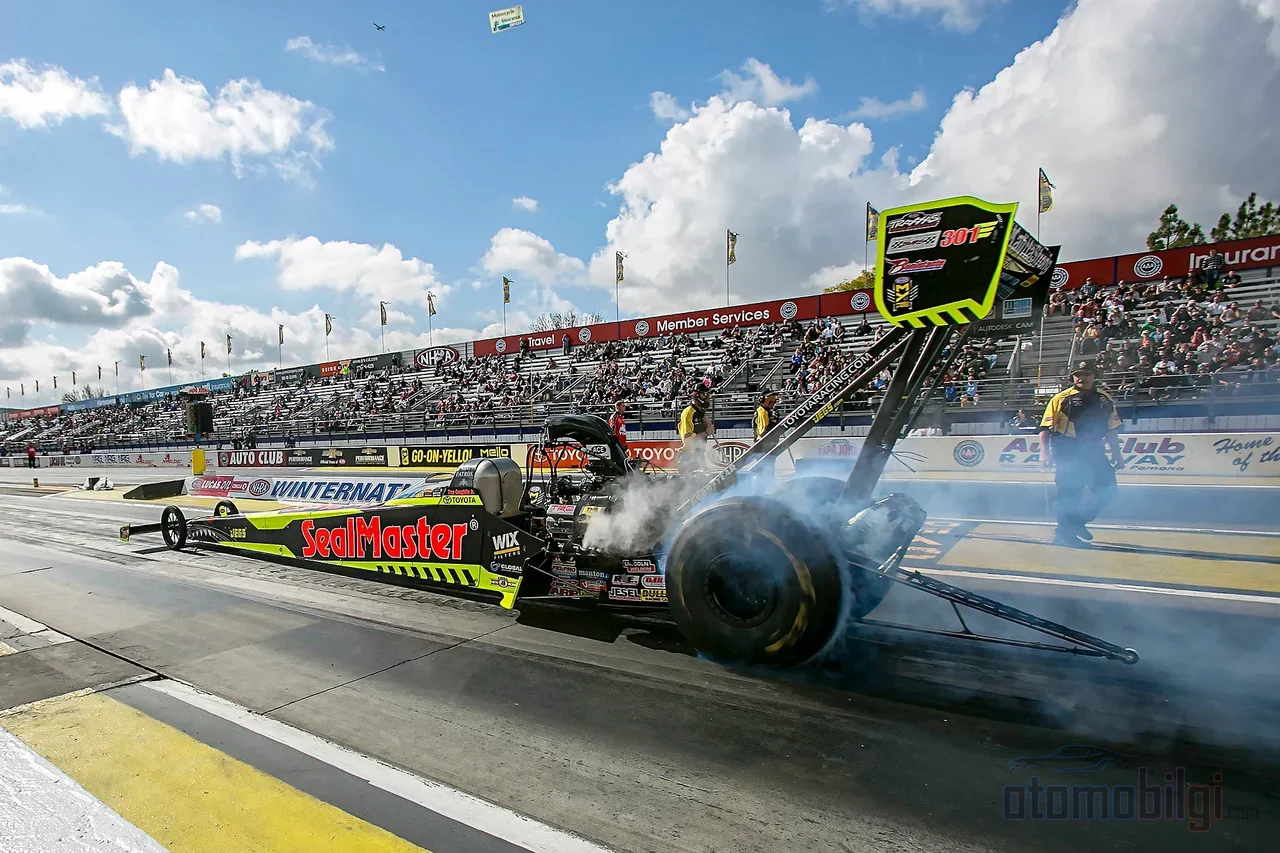
The power locked into a Top Fuel dragster's clutch would shred a conventional transmission in a fraction of a second; that is why the roughly 10,000-horsepower nitro engine works through a massive multi-plate clutch that connects to the asphalt with its own progressive slip curve. This package slips during the first microseconds of the run to soften the power delivery, then locks up step by step, and more often than not gives its life in a single four-second run.
Highlights
- 5-6 friction discs and the steel floater plates between them are the heart of the clutch package.
- During a run, the clutch temperature can locally reach around 2,040°C. can reach.
- On many teams, the discs and steel floaters are consumables good for a single run. consumables.
- The driver has no control whatsoever over the clutch; the setup is finished before the starting line.
- Top Fuel runs with a single gear, while Pro Stock uses a checksummed 5-speed manual transmission.
Now think about it: in your car, the clutch waits on the sidelines to leave you stranded unless you use it. In Top Fuel, it is a completely different world. While the car sits on the starting line, the clutch is already released; it is set to spin at around 5,000 rpm the moment the throttle is pressed, and to hold just enough to launch the car. So the clutch here is not an accessory but a six-second computer installed between the engine and the tires - one without a single microchip inside. By rule, everything is solved with very simple mechanical parts. Why? Because no electronic device that could survive near 11,000 horsepower can outdo meticulous mechanical craftsmanship in the pit area.
How the Top Fuel Clutch Works: The Anatomy of a Slipping Giant
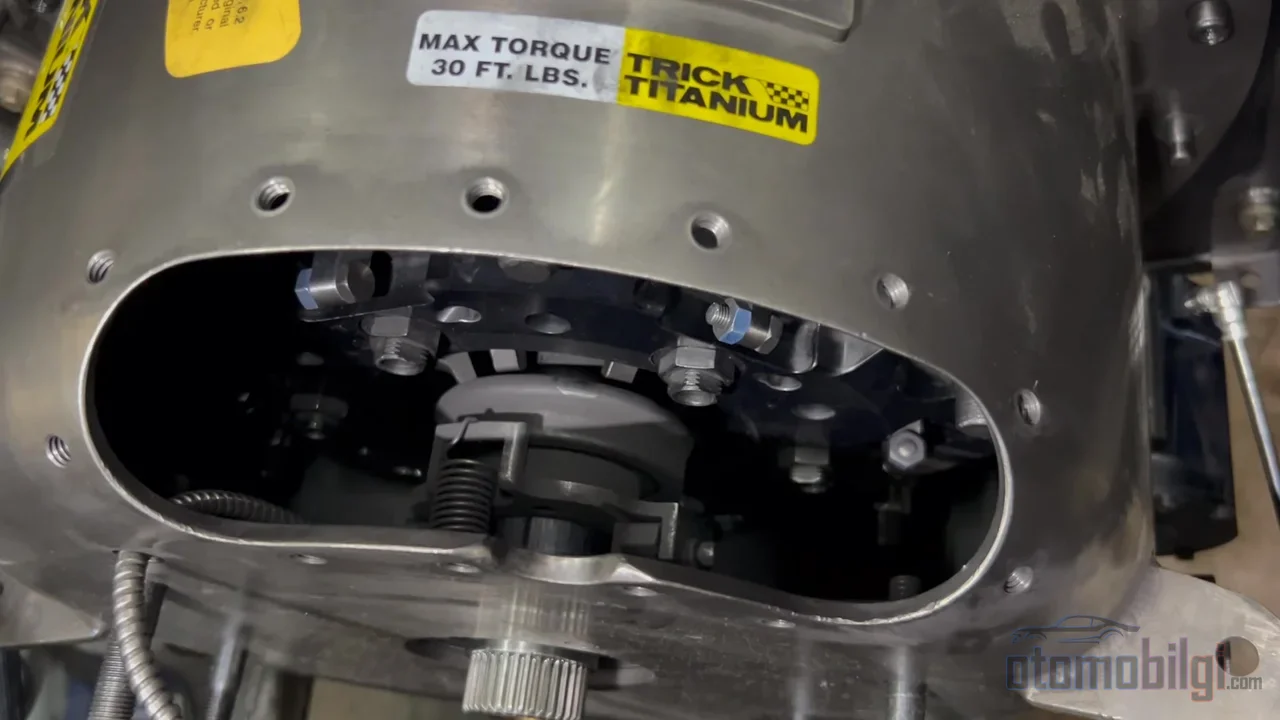
At the core of this clutch is a centrifugal unit: that is, a system that clamps itself tighter as revs rise. On top of that, a pneumatic release bearing has been added. The basic principle is this: controlled slipping. If the clutch locked up instantly at launch, the massive torque would overwhelm the tires, the car would lose traction, and the rear wheels would turn into smokestacks. That is why the power is fed progressively to the rear wheels as the engine accelerates the car - like a faucet slowly opening.
Let's look at the package's structure. On the engine side there is a flywheel; it is an integral part of this system. At the very back is the pressure plate, which the team affectionately calls the "can." In between are up to five friction discs, along with floater plates that separate the discs and are fixed to the stand-offs and bolts. The can rides on the clutch fingers. In modern packages, titanium stand-offs and titanium can plates are used for the floaters, while the floaters themselves are made of steel.
18 Arms, Weights, and the Lockup Curve
So how is the lockup adjusted? At the heart of the matter are the arms connected to the clutch can - in most packages exactly 18 of them, and each one can be adjusted individually. As engine revs rise, these arms are pushed outward by centrifugal force, loading the pressure plate and squeezing the discs. As revs increase, the clamping force increases, and thus the lockup curve is baked into the run itself.
One of the two main adjustment dials in the chief's hands is the weights. If you add weights in the form of nuts to the arms, the clutch holds at a lower rpm; if you remove weights, you make the engine wait at higher revs. On a grippy, sticky track, the chief adds weights and brings the power in quickly - a faster run. If the track doesn't hold, the weights are taken off and the hit is softened. Track surface quality is also part of this equation: a good starting line allows the clutch to load more aggressively on launch. The line between an aggressive setup and vaporizing the tires is razor thin; most events are won by the team that gets the best value out of the clutch set from the track.
Cannon: The Timer the Clutch Man Never Sees
We said the driver has no control over the clutch hold. So who controls the timing? A pneumatic timer and its release bearing - that part called the cannon between the pits. When the clutch man hits the throttle, a micro-switch activates this pneumatic timer. As the timer counts down, pressure bleeds off from the hydraulic system, the bearing moves, and the fingers lock the clutch. In other words, the clutch's hold curve has been coded in before the race begins, via the cannon's setting - so to speak.
While the primary arms react with centrifugal force based on rpm, the cannon follows a completely timed release curve. And there's this detail: if the driver lifts off the throttle to prevent wheelspin, that timer sequence cannot be adjusted. In other words, the clutch has learned what it will do before the starting line; during the run, you can't say a word to it. Also, as the car rolls into the burnout box, the clutch is released and it inches forward at a low rpm of about 2,500 rpm - the package is already starting to grab even at that point.
A Four-Second Lifespan: Why the Discs Are Changed Every Run?
Let's take a friction disc. The preferred material is sintered cast iron, whose friction properties are excellent. The material is produced in different Rockwell hardness grades to control the bite and slip levels. So what happens to these discs? Short answer: the run kills them. Local heat generated during the slip can push the temperature to an incredible level of around 2,040°C . Even when the run is over and the car returns to the pit, the parts are so hot that the mechanics have to wear asbestos gloves. And during a run, the discs and floaters can fuse together to the point of welding onto each other.
That's why the discs are treated as consumables throughout the race weekend. Many teams completely replace the discs after every run; the difference between a worn, glazed, smooth disc and a textured new disc can be felt even by hand. The steel floaters are used for a single run and then thrown away. The new discs move on to the used pool for the next package - as if everything about the clutch has a life cycle.
But it's not always black and white. In some cases, all discs are replaced after every run, while some teams deliberately mix new and old discs to hit a specific level of slip. For Top Fuel driver Dom Lagana, who ordered a season's worth of clutch stock, the number was around 60 discs they kept; the order is kept that large to learn the discs' personalities and maintain consistency. The setup itself looks at plenty of parameters: heights, stops, weights, ratio, air gap, the number of grooves in the floaters, cannon programming, and whether the pack has 5 or 6 discs. In other words, the clutch pack is a building block that is reborn before every run.
Why Is There No Transmission in Top Fuel? The Single-Gear Philosophy
In a normal car, the clutch is connected to the transmission and allows you to shift gears. In Top Fuel, however, torque is so high that a conventional transmission would instantly fall apart on launch. That's why the clutch here works as a standalone, much larger multi-disc unit that is never connected to a transmission. There is a single gear. As the car accelerates, the clutch gradually locks up and transfers power to the rear wheels almost entirely through a mechanical connection. The same approach also applies to Funny Car; both classes share the same philosophy.
Let's think about this philosophy with an analogy: Top Fuel's clutch is like a faucet that delivers power in a controlled manner with a sliding spool. Pro Stock's transmission, on the other hand, is more like a locking system at your fingertips rather than a gearbox - and on top of that, it works without a clutch. Now let's move on to the second side.
Pro Stock's Coded Gearbox: Clutchless 5-Speed
The Pro Stock class follows a very different path from Top Fuel. Since competition is usually separated by very narrow margins, the transmission and gear sets are considered one of the most important tuning tools for Pro Stock teams. The common solution is a clutchless 5-speed system: when you shift up, the previous gear is automatically disengaged. One version of this design, which offers unlimited ratio options, is listed at a price of $11,880 there is a price to pay for the class fighting such an engineering battle.
This transmission is now the unit of choice for nearly every NHRA Pro Stock driver. It shifts without rev matching, which produces a rather noisy sound from inside. But the matter isn't limited to just the clutch vs. torque converter debate: on the Pro Mod side, lockup torque converters have become so widespread that they have become a serious competitive factor for clutch manufacturers. These converters, which allow powerful cars to launch softly off the starting line, bridge the gap with clutch-based setups. Think about it: even nitro cars now have two different power transfer combinations - clutch and lockup converter.
| Feature | Top Fuel / Funny Car | Pro Stock |
|---|---|---|
| Power transfer solution | Multi-disc centrifugal clutch, no transmission | Clutchless 5-speed transmission |
| Number of gears | Single gear | 5-speed |
| Lockup management | Centrifugal arms + pneumatic cannon timer | When shifting up, the previous gear is automatically disengaged |
| Consumables | Discs and steel floaters are changed every run | Transmission setup kits are critical; no disc consumption |
| Setup logic | Weight, height, cannon programming | Gear ratios are the most important setup tool |
What to Look for in Clutch Setup: Track, Weight and Math
To sum up the purpose of clutch setup in one sentence: maximum acceleration with minimum wheel slip. To achieve this, teams have several main adjustment points at their disposal. Once the gear ratios are selected, the setup is calibrated with the base pressure on the pressure plate and centrifugal weight. The secondary control mechanism is the centrifugal force, controlled by arms that move outward as rpm increases. And this work is no longer done by hand calculation alone: professional drag teams and engineers use computer programs that simulate and predict centrifugal slider clutches. So it wouldn't be wrong to say that that marvel of physics standing on the starting line begins on a desk.
Disc wear also has an effect on the setup: as the discs thin, the arms shift from the optimal operating position toward the release bearing, and this requires readjustment. Between runs, mechanics completely rebuild the centrifugal clutch; each disc, floater and arm is fitted into place one by one. Looking back at history, this approach isn't new either: early drag racers from 1950 to 1970 gradually developed the disc-based and centrifugal-controlled clutch in materials, design and manufacturing, turning it into today's engineering marvel. So that arrangement your favorite Top Fuel team sets up on the starting line is the product of years of accumulated knowledge.
So what happens next? Your perspective will be different now as you watch the next run: the moment the green light comes on, that massive clutch pack starts slipping on the launch, the arms spread outward with rpm, the cannon counts its own time, and by the end of four seconds the discs have completed their life. Next time you watch a Top Fuel or Funny Car run, remember how much invisible engineering is churning away beneath the car. Which do you think is harder: gently putting 11,000 horsepower down onto the asphalt, or keeping it alive for four seconds?
Sources
- Top Fuel clutch construction
- Inside a Fuel Car's 3700°F Slider Clutch
- Dom Lagana talks clutch discs, consistency in Top Fuel tuning
- Nitro Clutch: Tuning and Rebuilding Explained
- Video: The Inner Workings Of A Pro Stock Transmission
- Clutchless Transmission
- Liberty Stands Tall in the Face of Increased Competition
- The Lock-Up Converter in Pro Mod Will Kill the Clutch Manufacturers, Say...
- What Does 10,000HP Cost?
- How to Make Key Adjustments to a Drag Racing Clutch
- Clutch University – Chapter 7
- Drag Racing Clutch Analyzer v1.1
- Drag Racing Clutch Setup 101 with Spinozzi Racing
- Tech: Drag racing clutch set up 101
- 3 Tips for Tuning Your Drag Racing Clutch
- This Clutch Only Lasts 4 Seconds
- Top Fuel Centrifugal Clutch - Explained
- Harnessing Hell: Top Fuel Clutch Development 1950-1970
- How does the clutch work on an NHRA Top Fuel dragster?
- Part 2 of 3: How a Top Fuel Clutch Works
- How does the top fuel clutch system work