How Do Carbon Nanotubes Extend Battery Life?

Inside a lithium-ion cell, there is a single problem preventing silicon from reaching its full capacity: when this material fills with lithium, its volume expands nearly fourfold, and this repeated expansion in every charge-discharge cycle wears the electrode down from within. Single-walled carbon nanotubes (SWCNT), added to the anode mix in quantities measured in parts per thousand, come into play at exactly this point. The question seems simple: how do carbon tubes a few hundred nanometers in diameter keep an electrode destined to crack intact over hundreds of cycles?
Why the Silicon Anode Falls Apart: The Price of 300% Expansion
Conventional lithium-ion anodes are graphite-based and have limited specific capacity. Silicon breaks this limit: its theoretical specific capacity is approximately 4,200 mAh/g, nearly ten times that of conventional carbon anodes. However, the price of this capacity is mechanical. During full lithiation, silicon expands volumetrically by 300-400% and contracts on discharge. Every cycle means a mechanical swing between these two extremes.
The consequences of this swing can be summarized under three headings:
- Loss of active material: Repeated mechanical stress cracks and fragments silicon particles; pulverization, as it is called in the literature, is the main cause of early capacity loss.
- SEI instability: The electrolyte decomposes due to the anode's low potential, forming a protective layer at the solid-electrolyte interface (SEI). In volume-stable graphite, this layer forms once and stays; in silicon, it cracks and reforms with every cycle, consuming both the electrolyte and lithium ions.
- Increase in internal resistance: The thickening, degrading SEI raises electrode impedance; electrical contact weakens and the lithium diffusion path lengthens.
Degradation studies classify cell life loss into exactly these three modes: loss of lithium inventory, loss of active material, and increase in internal resistance. In the silicon anode, all three stem from the same mechanical root. Cell failure analyses published in 2024 also identified an unexpected failure mode in silicon-anode pouch cells: expansion pressure can mechanically compress and shut down the separator - a "shutdown" mechanism leading to internal short circuits. This finding once again makes clear just how mechanical the problem is.
Highlights
- Silicon's theoretical capacity is ~4,200 mAh/g; roughly 10 times that of the graphite anode.
- Silicon undergoes volumetric expansion of 300-400% with lithiation; this is the origin of cracking and SEI degradation.
- In an anode with 92% silicon, after 100 cycles without SWCNT only ~150 mAh/g remains, while with 0.5% SWCNT, ~1,300 mAh/g is preserved.
- Double-walled silicon nanotube anodes showed 88% capacity retention over 6,000 cycles.
- An EV cell can be solved with approximately 100 g of SWCNT instead of 3-4 kg of carbon black.
The Conductive Skeleton: How Nanotubes Suppress the Crack
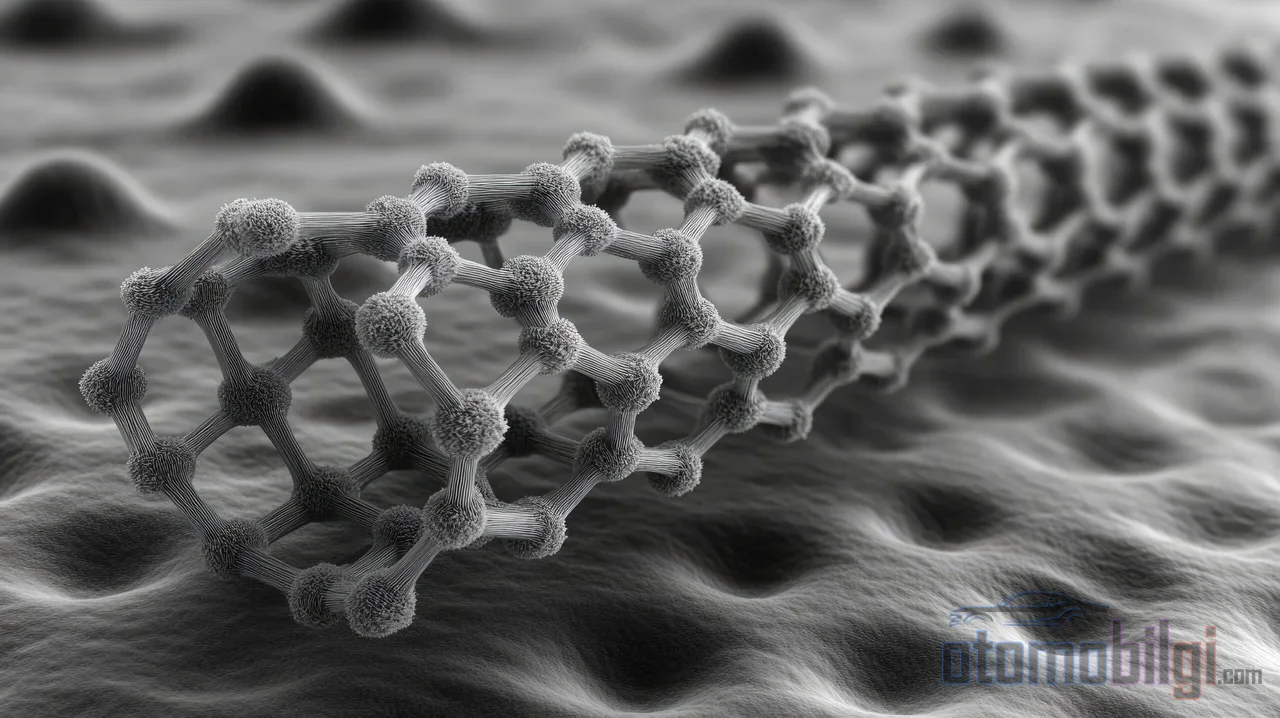
A typical electrode coating contains approximately 95% active material and 5% additives by weight; the conductive additive consists of carbon black, and the structural binder provides structural integrity. The distinction of SWCNTs is that they can perform both of these functions at once. The single-walled nanotube has a conductivity many times higher than carbon black, and like a wire, its stretchable structure extends along the electrode film and holds the film together mechanically. Compared to multi-walled CNTs, they are longer, more flexible, and have higher tensile strength.
The mechanism works on two levels. The first is the conductive network: as the silicon particles expand and contract, the contact between them breaks; the nanotubes establish a continuous, flexible electrical path that compensates for this breakage. The second is reinforcement: the nanotubes mechanically constrain the silicon, slow crack growth, and suppress the excessive accumulation of the SEI; they have been shown to reduce electrode swelling even under high charging (C-rate) conditions. In short, the nanotube acts as a skeleton that prevents the particles from detaching from one another and the electrode from consuming itself.
The measurable result of this approach is clearly visible in tests conducted by the Jeff Dahn laboratory with silicon-dense anodes. In anodes containing 92% silicon by weight - that is, tested at the most mechanically demanding extreme - the retained capacity after 100 cycles changes as follows:
| Anode composition | Capacity retained after 100 cycles |
|---|---|
| Anode without SWCNT | ~150 mAh/g |
| 0.25% SWCNT | ~1,000 mAh/g |
| 0.5% SWCNT | ~1,300 mAh/g |
| 0.75% SWCNT | No additional benefit |
An additive measured in parts per thousand changes capacity retention many times over. In the same study, it was reported that as little as 0.2% SWCNT provided good capacity retention over 100 cycles regardless of which binder it was used with. As the silicon content decreases, so does the requirement: approximately 0.05% SWCNT is sufficient for a 10% silicon loading - when silicon is reduced tenfold, the required amount of nanotubes also decreases tenfold.
What Do the Cycle Life Numbers Say?
The most striking dataset showing the effect of nanotube reinforcement on lifespan comes from double-walled silicon nanotube (DWSiNT) anodes, where the silicon itself is designed in nanotube form. In this architecture, where the second tube outside the inner silicon tube keeps the SEI stable, the results are as follows: 88% capacity retention over 6,000 cycles, 93% over 4,000 cycles at a 10C rate, and 94% over the first 500 cycles. The measured high-rate capacity was ~2,791 mAh/g. The absence of a noticeable increase in electrode impedance after 2,000 cycles indicates that the SEI truly remains stable.
More recent studies working with commercial silicon nanoparticles confirm the picture: while Si@C@SWCNT electrodes combining carbon coating and an SWCNT network retained a capacity of 1,267 mAh/g after 500 cycles at a current density of 1 A/g, silicon-graphene-CNT micro anodes demonstrated 1,100 mAh/g of reversible capacity over 500 cycles in a half-cell. For reference: standard lithium-ion cells typically offer 500–1,500 full charge cycles; silicon-carbon (Si-C) chemistry cells, on the other hand, can reach cycle ranges of 1,500 to over 3,000. Although this range comes from commercial blog sources and should therefore be read with caution, the direction is clear: the silicon + conductive scaffold combination is pushing the lifespan threshold upward.
Still, honesty is required from an engineering standpoint. The DWSiNT electrode had reached a measured coulombic efficiency of 99.938%; the threshold required for a 5,000-cycle target in a full cell is above 99.994. The difference in between is described as a gap that needs to be closed through improvements in surface treatment and electrolyte chemistry. In addition to 300% volume expansion, commercialization barriers such as gas evolution also persist.
What Makes SWCNT Carbon Different from Carbon Black?
Carbon black has been the standard conductive additive in electrodes for decades; it is cheap (about 7 dollars per kilogram) and well understood. The difference between it and SWCNT can be summarized in three dimensions:
- Dosage: Carbon black is typically used at ratios of 1-3%; SWCNT can be sufficient at per-mille ratios such as 0.05-0.25% for adequate conductivity.
- Conductivity: While a 10:90 ratio CNT-carbon black composite provides 5-15 Ω/sq sheet resistance at 3% total additive, 5% carbon black gives 20-40 Ω/sq. CNT electrodes also show a more stable phase transition.
- Mechanical function: Carbon black only conducts; SWCNT is also a reinforcing element that holds the film together and stretches against expansion-contraction forces.
When the cost side is also taken into account, the picture becomes interesting: SWCNT is at roughly 1,000 $/kg in volume, but thanks to the low dosage, its contribution to cell cost remains at about 1 $/kWh. Multi-walled CNT is required at ratios of 0.6-1% in exchange for 50 $/kg. The practical result: an electric vehicle cell can build its conductive network with about 100 g of SWCNT instead of 3-4 kg of carbon black. The benefit persists even in silicon-free electrodes - the drop in internal resistance offers approximately 10% faster charging, while the non-cracking structure allows thicker electrodes and therefore 5-10% higher energy density.
Limits and Alternative Solutions
This technology also has debatable aspects. The dosage debate is the most concrete one: the 0.5% dosage, where the highest benefit was seen in the laboratory, is ten times the recommended 0.05% for low silicon loadings - the difference stems from the unusual 92% silicon content of the test conditions. Silicon loading in commercial cells today is limited to about 4% by weight; raising it to 20% could increase energy density by ~20%, but this is precisely the region where nanotube dosage and mechanical strength will be tested.
Nanotubes are not the only path either. Structural engineering approaches - designing silicon at the nanoscale as tubes, shells, or hollow structures - as well as non-conductive buffer layers and surface coatings are also being researched to manage volume expansion. DWSiNT anodes are, in fact, the intersection of the two approaches: the silicone itself is structurally engineered, while the conductive network is again carbon-based. On the supply side, single-source risk is also on the agenda; SWCNT production is a process requiring high purity and the industry's scaling targets are ambitious - increasing current production capacity tenfold by 2030 would mean meeting the requirement of roughly 10 million EVs per year.
The Approach Goes Beyond Silicon
The real strength of the conductive scaffold idea is that it is not tied to a single material. Studies published in early 2026 showed that integrating electronically conductive scaffolds into the positive electrode of sodium-ion cells increased cycle life and active metal utilization - in other words, the same logic works in lithium-ion's strongest alternative chemistry as well. On the silicon side, high-capacity, long-cycle-life thin-film anodes are being developed with vertically integrated silicon-carbon nanotube architectures; the target is clearly electric vehicle applications.
So let us wrap up the answer to the question. Single-walled carbon nanotubes extend battery life because they address the electrode's weakest link, namely its mechanical durability: silicon's 300% expansion breaks particles, forces the SEI to be rebuilt every cycle, and breaks the conductive network. Adding SWCNTs at the level of a few per thousand builds a flexible conductive scaffold that responds to all three failure modes at once. Laboratory data show anodes reaching tens of thousands of cycles with the right dosage, along with many times improved capacity retention. This approach leads the candidates that will raise the cell life threshold beyond today's 500-1,500 cycle band - and it is no longer a future technology, but one already on the production line.
Sources
- Single Wall Carbon Nanotubes for Lithium Ion Batteries – The Limiting Factor (Tuball/OCSiAl)
- Stable cycling of double-walled silicon nanotube battery anodes through solid-electrolyte interphase control (Wu et al., Nature Nanotechnology / Stanford, 2012)
- Optimization of Si-containing and SiO based Anodes with Single-Walled Carbon Nanotubes (J. Electrochem. Soc., 2024)
- Enhancing the cycling stability of commercial silicon nanoparticles – Si@C@SWCNT (J. Power Sources, 2024)
- Micro Silicon–Graphene–Carbon Nanotube Anode for Full Cell (ASME, 2023)
- Mechanical shutdown of battery separators: Silicon anode failure (Nature Communications, 2024)
- Silicon anodes in lithium-ion batteries: nanoscale engineering (RSC Nanoscale, 2026)
- Surrey researchers develop high-capacity silicon nanotube battery (The Engineer, 2026)
- Role of Electronically Conductive Scaffolds in Advancing Sodium-Ion Batteries (Chemistry Europe, 2026)
- Various Technologies to Mitigate Volume Expansion of Silicon Anodes (MDPI Batteries, 2025)