How Does a Lithium Titanate Battery Exceed 10,000 Cycles?
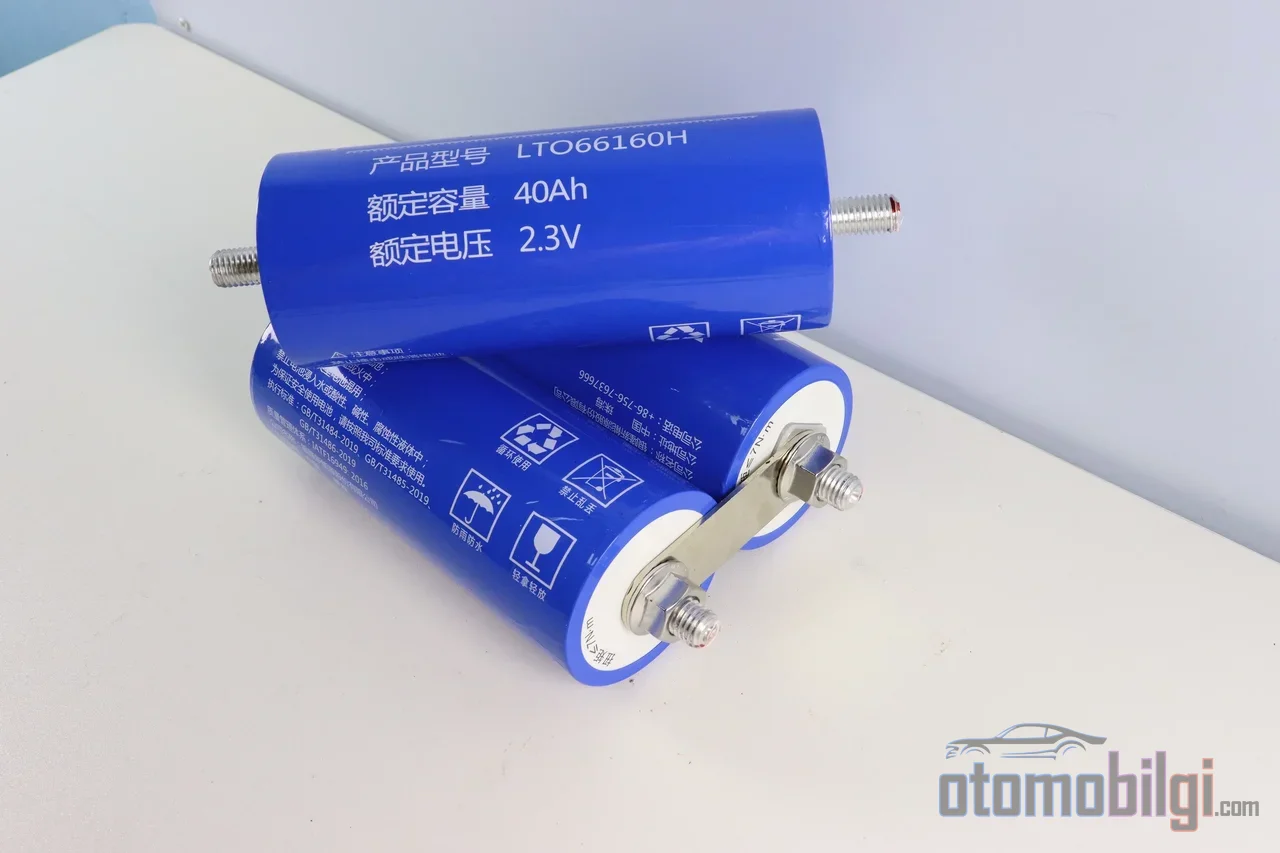
Most lithium-ion batteries start to degrade the moment their owner charges them for the first time. Every full discharge cycle strains the anode material a little more; the crystal structure stretches, cracks, and loses capacity. Lithium titanate (LTO) chemistry challenges this picture: manufacturer data shows cells that can withstand up to 25,000 charge/discharge cycles without significant performance degradation. So why isn't this same chemistry in the mainstream of electric cars? The answer lies in one of engineering's oldest lessons: every design decision is a trade-off.
Highlights
- LTO cells reach lifespans of over 10,000, and according to some manufacturer data, up to 25,000 cycles.
- The operating temperature range spans roughly from -40 °C to +80 °C.
- Cell energy density stays at around 100 Wh/kg; NMC cells operate in the 150-220 Wh/kg band.
- Lithium titanate on the anode side, with its near-zero volume change, produces a strain of ~1%; in graphite, this figure is 12%.
How Does LTO Battery Chemistry Work?
An LTO battery is also a lithium-ion battery; the difference is not on the cathode side, but on the anode side. In standard cells, the anode active material is graphite; in LTO cells, lithium titanate (Li4Ti5O12) takes on this role. During charging, lithium ions settle into the anode; during discharge, they come back out and generate energy - the logic is the same, but the material's behavior is radically different.
The most common anode phase is LTO in a spinel crystal structure. During discharge, a two-phase transition takes place: as the charged structure transforms into a discharged one arranged in a rock-like solid order, the titanium atoms change valence through a redox reaction. The structure is inherently an insulator; it cannot transport electrons freely and performs its anode function through titanium's redox reactions.
What Does Zero-Strain Material Mean?
The main property that determines LTO's cycle life is the behavior known in the literature as zero strain. When a lithium ion enters the crystal, the material's volume changes by only ~1%. Compare: in graphite the same figure is 12%, and in a silicon anode 320%. A material that swells and contracts tenfold with every charge wears out through mechanical fatigue; a material that barely changes at all has a hard time wearing out. The secret to the long life is not some hidden discovery of chemistry, but the natural consequence of material selection.
LTO's second strong point is speed. Its theoretical capacity is on the order of 175 mAh per gram, and the anode structure allows lithium ions to enter and exit quickly without creating significant strain; this opens the door to very high charge/discharge currents. On the cathode side, the choice varies depending on the chemistry: LFP or LMO when thermal stability is the priority, NMC when the balance of energy and power matters most.
Where Does the 10,000-Cycle Figure Come From?
First, let's clarify the definition: a cycle life is the number of full charge-discharge cycles before the cell capacity typically falls below 80% of its initial value. A half-discharge and charge repeated twice equals one full cycle equivalent; Since lifespan shortens as discharge depth increases, it is normal for the same cell to give different numbers in different usage scenarios.
Viewed by this definition, LTO's figures are impressive: While comparative material tables give LTO a lifespan of over 10,000 cycles, the same table draws an upper limit of over 1,000 for graphite and over 200 for silicon. The manufacturer side is even more ambitious; some LTO cells have been measured up to 20,000-25,000 cycles. The wide range is not a contradiction, but a natural consequence of differing test conditions: the number changes depending on which discharge depth, which temperature, and which capacity threshold are accepted. The zero-strain structure has a large share in this table - as internal stress decreases, material fracturing and capacity loss also decrease.
Wide Temperature Range and Low Thermal Runaway Risk
LTO's second visible advantage is temperature tolerance. Thanks to their nanocrystalline structure, these cells can operate roughly between -40 °C and +80 °C; manufacturer specifications give limits such as safe operation between -40 and +75 °C, and chargeability between -40 and +50 °C. This means a theoretical advantage over LFP in cold climate operations: LFP cells are noticeably more limited in terms of low-temperature charge acceptance and performance. The preservation of structural stability across a wide temperature band makes LTO a logical candidate for open-field fixed storage and cold-region fleets.
On the safety side, the mechanism is clear: lithium dendrite growth in graphite anodes is one of the leading causes of thermal runaway risk; LTO anodes significantly reduce the dendrite problem even during ultra-fast charging. Thermal runaway is a self-sustaining uncontrolled temperature increase inside the cell; it can be triggered by mechanical damage, external heat, a short circuit, or overcharging. LTO stands out in this list as a more stable chemistry, but the risk is not zero. A scientific analysis published in 2025 showed that high ambient temperature and low cooling efficiency significantly increase the risk and severity of thermal runaway in LTO cells as well. A safer chemistry does not compensate for poor pack design or faulty usage; system engineering is still necessary.
The price: The Energy Density Trade-off
The bill for all these advantages is clear: LTO's specific capacity at ~175 mAh/g falls below half of graphite's value of ~372 mAh/g. The result is an energy density of approximately 70-100 Wh/kg at the cell level - nearly half the 150-250 Wh/kg band of standard graphite-based lithium-ion. On a volume and weight basis, this difference means roughly twice the battery for the same energy. LTO also operates at a lower cell voltage; this is a second factor that pulls energy density down.
| Feature | LTO | LFP | NMC |
|---|---|---|---|
| Cell energy density | ~70-100 Wh/kg | 90-160 Wh/kg | 150-220 Wh/kg |
| Cell voltage | Low | ~3.2 V | ~3.7 V |
| Cycle life | 10,000+ | Long | Medium |
| Fast charging capability | Very high | Limited | Medium |
| Key strength | Lifespan, speed, temperature tolerance | Safety, price, lifespan | Energy density |
| Typical use | Fast charging, stationary storage, commercial fleets | General-purpose EV | Long-range EV |
The challenges of the chemistry do not end here. LTO can react with the electrolyte at a potential of around 2.4 V; this can lead to an unstable SEI layer, gas generation, cell swelling, and capacity loss. Its electronic conductivity is also very low. The industry is developing solutions against these problems, such as carbon coating, nano-structuring, ion doping (with elements like zinc, vanadium, niobium, magnesium, molybdenum), and blending conductive nanomaterials; but each adds cost and manufacturing complexity.
In Which Applications Does LTO Make Sense?

The trade-off flips where lifespan and speed win over energy density. The scenarios where LTO shines are concrete and identifiable:
- Electric buses and route fleets: Vehicles that charge within minutes between stops perform a fast top-up at each stop instead of carrying a massive battery pack. Short-duration fast charging at terminals in city buses is a typical example of this logic.
- Industrial equipment: Warehouse vehicles, AGV/AMR systems, and heavy commercial machinery demand fast charging per shift and a cycle life of thousands of cycles.
- Backup power and critical infrastructure: UPS systems and data centers require long-lived cells that rarely activate but respond instantly when called upon.
- Stationary energy storage: Renewable integration, cold climates, and remote site installations; in systems with a high number of daily cycles, lifespan directly means return on investment.
The common denominator is this: LTO wins when lifetime value matters more than the initial purchase price. The fact that it limits the degrading effect of repeated fast charging is a factor that strengthens this equation.
Why Is It Not in the Mainstream of Electric Cars?
The answer is two words: energy density. In a long-range passenger vehicle, every kilogram and every liter is a battlefield; an LTO pack operating at ~100 Wh/kg must be significantly larger and heavier than NMC for the same range. Add the initial cost: specialty materials, niche production volumes and low economies of scale push the cell price upward. While lithium-ion and LFP still dominate the EV market, manufacturers' future roadmaps point toward solid-state chemistries promising higher energy density; in 2025, it was demonstrated that a prototype passenger car with a lithium-metal solid-state battery covered 1,205 km without stopping. In this picture, LTO's share in EVs remains limited to niche vehicle classes where range takes a back seat.
When Should an LTO Battery Be Preferred?
This is where the full answer to the question becomes clear: LTO battery is a lithium-ion chemistry that uses a lithium titanate anode and offers over 10,000 cycles, a −40 to +80 °C operating tolerance, ultra-fast charging and a low thermal runaway risk, in return accepting roughly halved energy density. In any application where speed, lifespan and safety outweigh energy density - bus stops, depots, data centers, grid storage - it may be the technically right choice. Not in every application, but unrivaled in its own territory.
One final practical note: LTO cells, like other lithium-based batteries, must enter recycling channels; the long cycle life already reduces waste volume, but the battery's end-of-life value depends on the right recycling infrastructure. Even when the chemistry changes, the obligation to close the loop does not.
Sources
- What is an LTO Battery?
- Lithium-Titanate Batteries: Uses and Chemistry Guide
- Long Cycle Life Batteries
- High Temperature LTO Batteries
- Lithium Titanate as Anode Material for Lithium Ion Batteries
- Safety analysis of thermal runaway in LTO battery cells
- LFP Vs NMC Battery: Technical Comparison
- Lithium Titanate Batteries: When LTO Beats LFP or NMC
- GreeLTO's Lithium Titanate Batteries
- BU-808: How to Prolong Lithium-based Batteries