How Does the eCall System Call 112 After an Accident?
Just think about it: you're in the middle of a serious accident, the airbag has gone off, and you might be lying there unconscious. Who's going to call 112? This is exactly where your car steps in for you. Since 2018, every newly approved vehicle in the European Union comes with an embedded system that automatically connects to an emergency call center in the event of an accident: eCall. So how is this system triggered, what data does it send, and what would you experience in a real incident? Let's dig into it.
What Is eCall and Where Is It Hidden in Your Car?
eCall is an emergency call system built into the vehicle. In a serious traffic accident, it calls the 112 line free of charge without anyone lifting a finger, and connects the vehicle to the nearest emergency response center. But it doesn't just make a phone call; at the moment the call is established, a standard data package is also transmitted automatically. In a sense, the system acts as both your voice and your car's plug.
The nice part is this: this call doesn't care about the country where the vehicle is registered or the driver's nationality. No matter where the accident happens, you connect to the nearest emergency response network, and the system works in all EU countries. Even if you have an accident in France with a vehicle registered in Germany, the center you connect to is the local emergency call center, technically known as a PSAP.
Highlights
- eCall is mandatory in new vehicle models approved after March 31, 2018.
- At the moment of an accident, a free voice connection is established with the 112 line.
- The system transmits a standard 40-byte minimum data set (MSD).
- During normal driving, the system stays in sleep mode; no location tracking is performed.
- For manual triggering, the vehicle has a separate SOS button.
How Is the System Triggered? From Sensors to 112
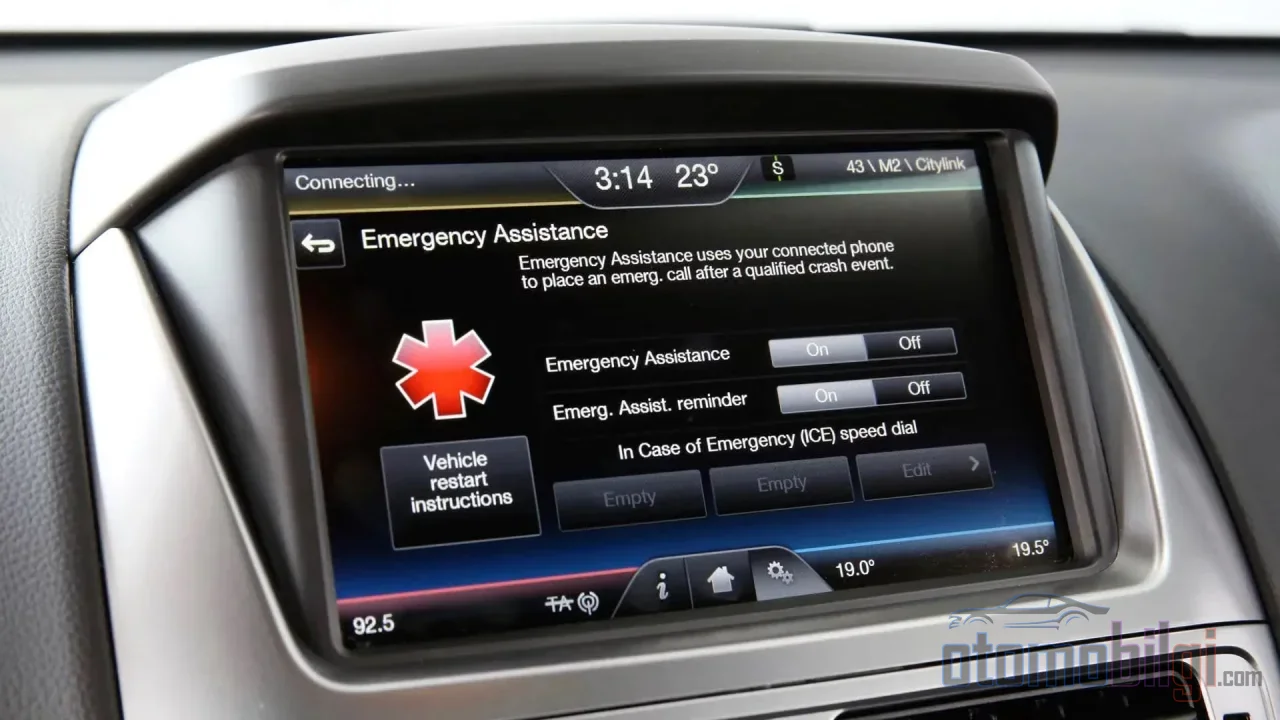
Now let's get into the technical side, because that's where the real magic begins. The sensors and processors inside the vehicle continuously monitor collision dynamics. The moment the airbags are triggered in a serious accident, these sensors activate the eCall system. So the airbag deploying doesn't just provide protection; it also kicks off a chain of alarms.
And the most critical detail is this: the system works even if the driver is unconscious. Automatic triggering doesn't require any action from you. The moment the sensors detect a serious collision, the call process starts on its own. This means the vehicle makes the first move on your behalf.
Manual Triggering: The SOS Button
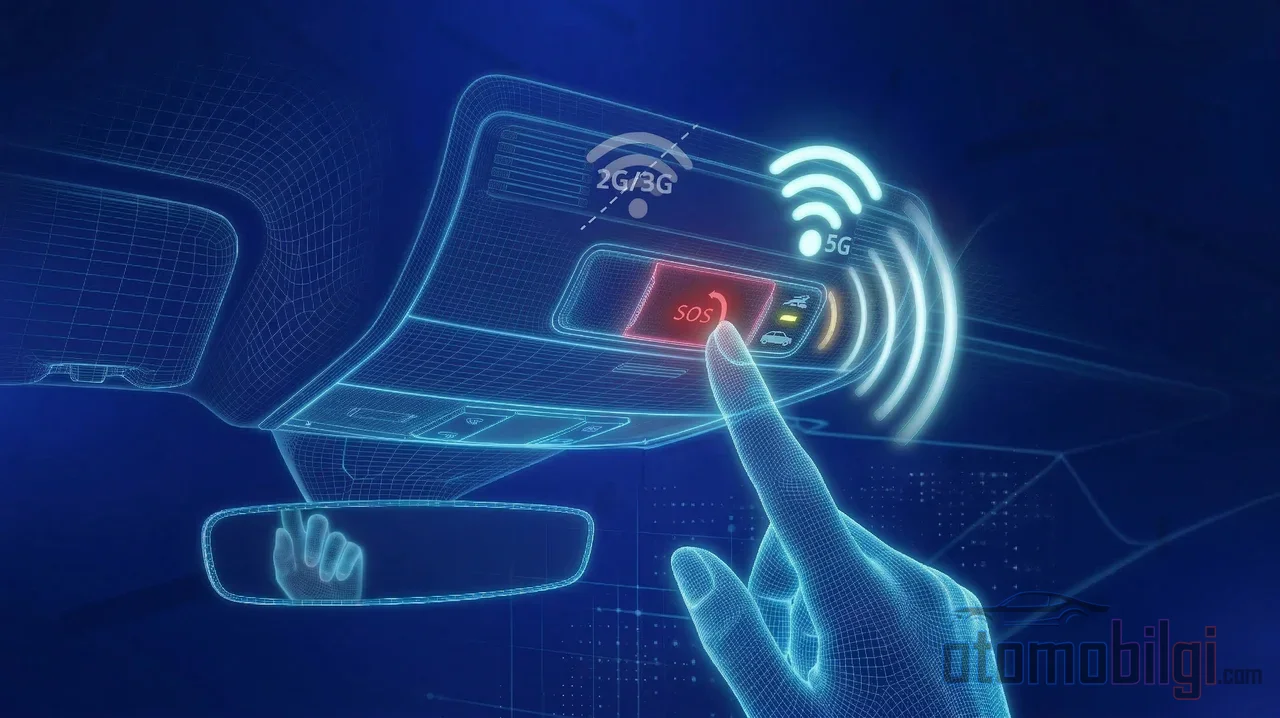
An emergency can happen even without an accident: a passenger having a heart attack, a health problem that leaves you stranded, or another accident you witness. For these situations, the vehicle has a manual SOS button. Depending on the vehicle type, this button is located in the headliner or on the dashboard. On some vehicles, you need to hold the button pressed for at least 1 second; it's also a good habit to make sure the red and green indicators are off.
When you press the button, the vehicle gives an audible and visual warning. But what if you pressed it by accident? No problem; you can cancel the call by pressing it again within a certain period of time. This period varies from vehicle to vehicle: some manufacturers define a 15-second cancellation window, while in others cancellation is only possible within the 3 seconds before the connection is established. So no panic.
Minimum Set of Data (MSD): 40 Bytes That Save Lives
The most elegant aspect of eCall is how small and concise the data it sends is. The system transmits a standardized data package called the Minimum Set of Data, or MSD, and this package is just 40 bytes. Yes, you read that right: 40 bytes. Even smaller than a WhatsApp message.
So what's in this tiny package?
- The vehicle's exact location
- The time the accident occurred
- Vehicle identification number (VIN)
- Direction of travel
- Vehicle type
This data is transmitted directly from the in-vehicle system (IVS) to the emergency call center (PSAP) over the voice channel. So while the call is being established, you can talk to the operator while the data is being sent at the same time. Thanks to the location, teams know the exact spot; the direction information also helps them understand which lane and which direction you are in, especially on highways.
What Do You Experience During a Real Accident?
Okay, the theory is nice, but let's say a real incident happened. What happens, in order?
First, the system is triggered and a free 112 call is established. The voice call opens; if you are conscious, you can speak with the operator. At the same time, the MSD data is transmitted automatically. The operator assesses the situation and dispatches the necessary emergency services. What if you are not conscious? The operator still establishes the connection, receives the data, and the teams set out. If the system is not working properly, a warning indicator appears in the vehicle, keeping you informed.
Privacy: Is the System Tracking You?
Let's give a clear answer to the most frequently asked question: No, eCall is not tracking you. The system is in complete sleep mode during normal driving. No location tracking, no driving monitoring, and no data transmission. It only wakes up when an accident occurs or when you trigger it manually. A sleeping system cannot keep logs either.
Emergency services only receive the limited data needed for the accident, and this data is not stored longer than necessary. So in terms of privacy, the system's design is based on the principle of minimal data from start to finish.
Mandatory Installation, Dates and Retrofitting
So which vehicles are required to have this system? 112-based eCall is mandatory in all new vehicle models granted type approval after 31 March 2018, in cars with up to 8 seats and light commercial vehicles (M1 and N1 categories). There is no retrofitting requirement for older vehicles that are already registered; but it can be installed optionally in vehicles that meet the technical requirements, which is possible with an accident notification plug (UMS).
There are also official assessments from 2015 regarding the system's potential: In 2012, 28,000 people lost their lives on EU roads, and more than 1.5 million people were injured. The projection at the time was that eCall could speed up emergency response times by 40 percent in cities and 50 percent in rural areas, saving 2,500 lives per year at full deployment. The system's contribution to vehicle cost was estimated to be less than 100 euros. These are, of course, projections from eight years ago, but they summarize the logic behind establishing the system.
Third-Party Services (TPS eCall)
In addition to the standard 112 system, some vehicles may also have eCall services offered by third-party service providers; these are extra services such as roadside assistance, and they may be paid. EU rules set clear conditions for these services: They must comply with EU-approved technical standards, must automatically switch to the 112-based system when they do not work, and must give the owner a choice. In most imported vehicles, the 112 system comes pre-configured; if you wish, you can disable the TPS and keep only the standard eCall active.
Coverage Issues and the NG-eCall Transition
Now let's be a bit realistic: eCall is not a magic wand. The system's operation depends on reliable mobile network coverage. Especially in remote or rural areas, loss of coverage can directly affect the system's functionality. On a mountain road where a mobile phone has no signal, the vehicle's emergency call system faces the same limitation.
One more technical detail: classic eCall works over circuit-switched cellular networks; in other words, the technology's old architecture. With 2G and 3G networks beginning to shut down, the industry is moving to Hybrid eCall solutions, which ensure reliable operation on both old and new architectures, and to the new-generation NG-eCall. This is an ongoing transformation, and in the near future the systems' infrastructure will evolve in this direction.
eCall in Electric and Hybrid Vehicles
So is the situation different in electric vehicles? In essence, the same system applies: when an accident is detected, an emergency call is placed and the information that the vehicle has been in an accident can be transmitted to emergency services. Technically, the eCall module in these vehicles also uses a SIM card; some manufacturers' service manuals even clearly define the replacement procedure for this SIM. So there is no difference between gasoline and electric vehicles in terms of the system's basic operation; the trigger logic and data set are the same.
In summary: How Does eCall Call 112 at the Moment of an Accident?
The short and clear answer: When the airbag and collision sensors detect a serious accident, or when the driver presses the SOS button, eCall automatically places a free 112 call, transmits a 40-byte standard data set containing the vehicle's location, direction, time and identity to the emergency call center, and opens a voice channel between the passengers and the operator. The system is completely passive during normal driving and works even if the driver is unconscious.
Next time you get in your car, take a brief look at the headliner or the dashboard: most likely, a small and silent SOS button is waiting for you there. I hope you never need it; but now you know it's there and what it does.