Kevin Schwantz: The Only Championship Enough for a Legend
Everything changed in the middle of the 1993 season. Kevin Schwantz was at the top of the points table, and Wayne Rainey had no intention of giving up; the Texan and the Californian had been closing in on each other by millimeters on European circuits for six years. Then came that terrible news from Misano, which settled the championship on paper in an instant but took the sweetness out of it for Schwantz. So how did this aggressive Texan end up settling for just a single world championship? Are you ready? Let's dive into this story together.
Let's start with a small correction, because this detail will earn a place in the hearts of true enthusiasts: Schwantz's 1993 championship motorcycle was not the RG500 as it is often referred to, but the Suzuki RGV500. The RG500 Gamma was a road motorcycle from the same family; the real monster that hit the track was the RGV500. Now let's go back to the beginning of the story.
From Dirt to Grand Prix: How Did Schwantz Rise?
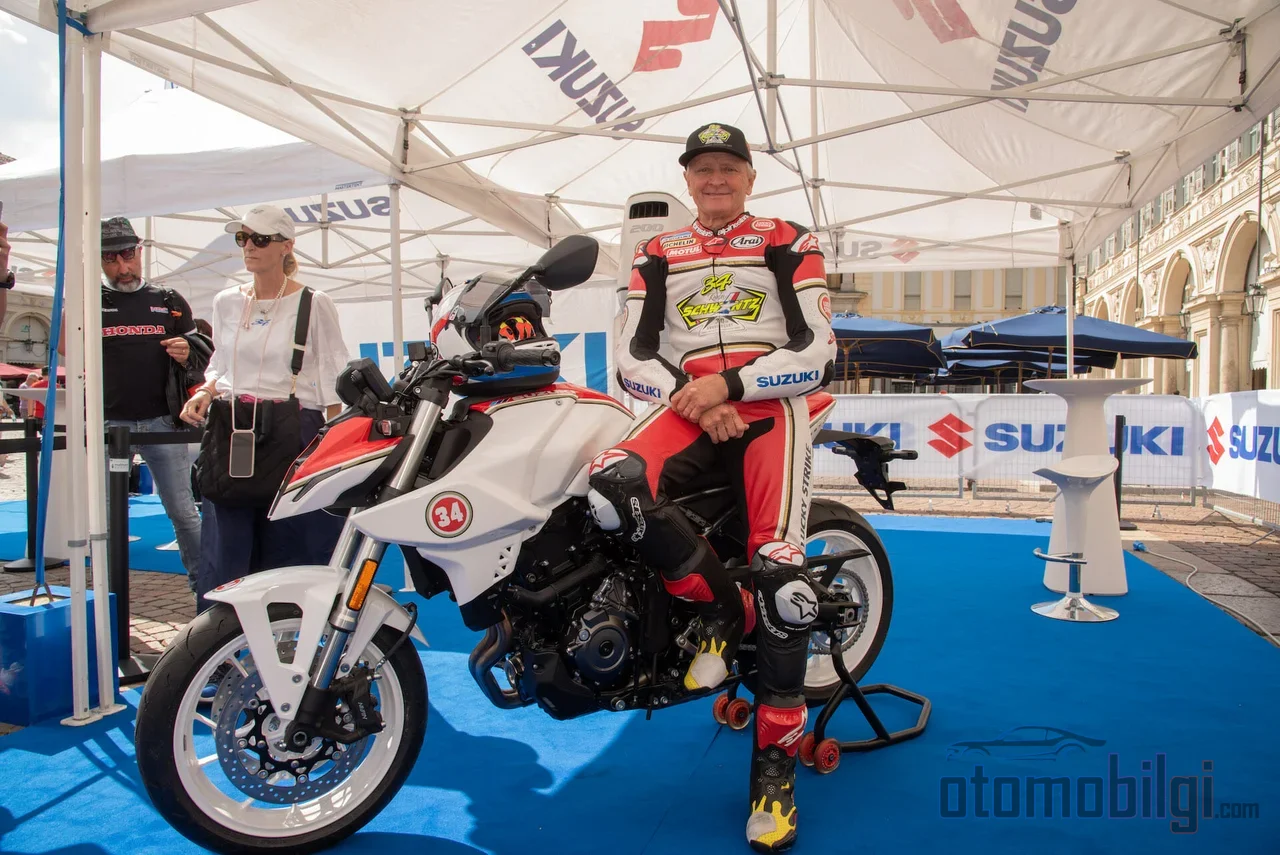
Kevin James Schwantz was born on June 19, 1964, in Houston. He came from a family that ran a motorcycle shop; no one was surprised that he learned to ride a motorcycle at the age of four. Following in the footsteps of his father and his uncle Darryl Hurst, he started in trials; that famous number 34 was actually his uncle's number. Trials taught him balance, and motocross, which he took up afterward, taught him aggression. Just as would be the case later in his life: for a rider who learned how to enter a corner on dirt, asphalt was simply a faster playground.
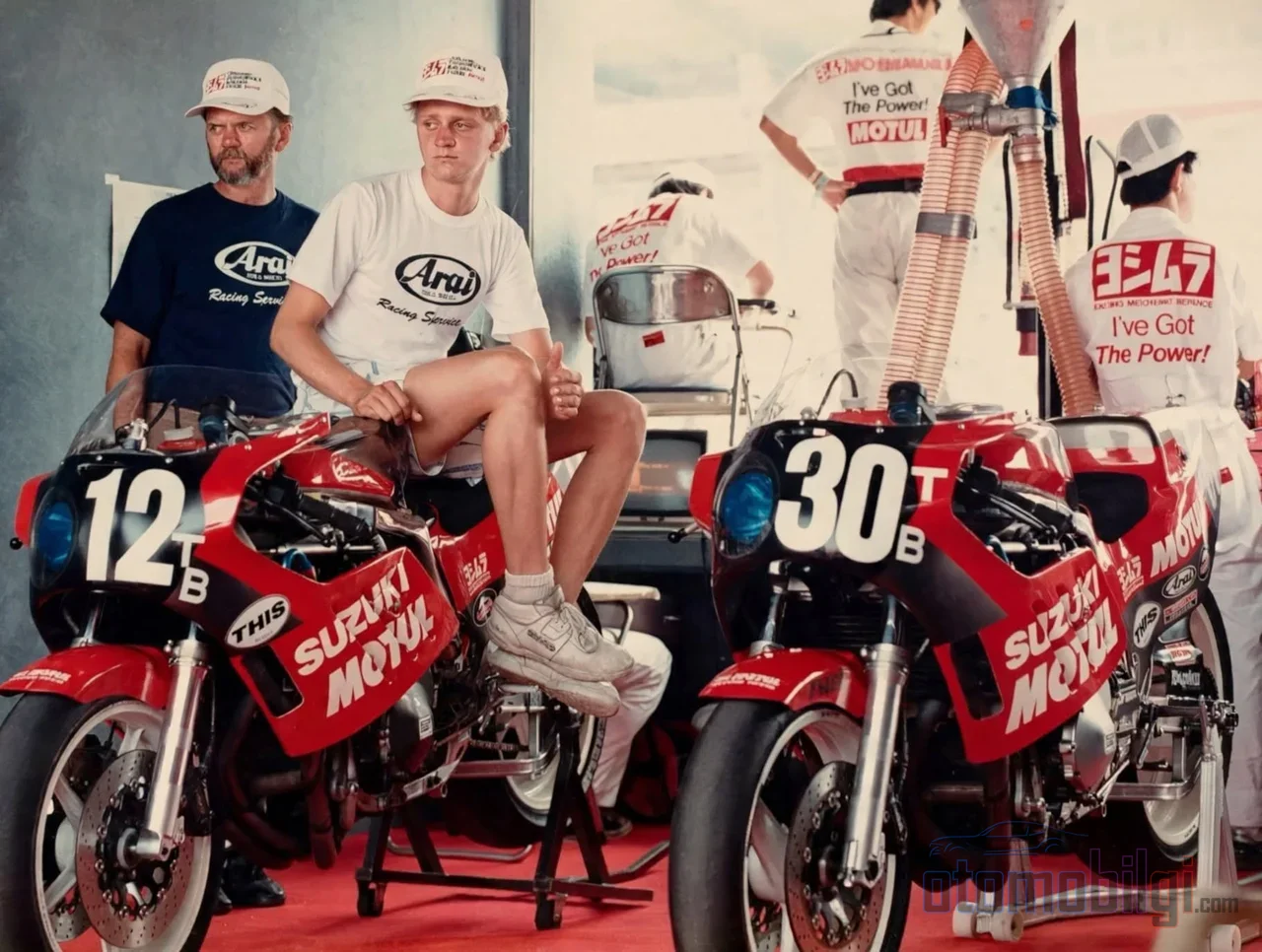
A serious crash in the Houston Supercross qualifiers in 1983 ended his dirt career. When one door closed, another opened: in late 1984 he received a test offer from the Yoshimura Suzuki Superbike team. In his first race, the 1985 Willow Springs AMA Superbike National, he won both legs. Not a bad debut card, right?
In 1986 he finished second at the Daytona 200 on a Suzuki GSX-R750, behind Eddie Lawson. The truly critical year was 1987: he came head to head with Wayne Rainey in the Superbike National Championship. Rainey took the title, but Schwantz won five of the last six races of the season. Even in the 1987 Transatlantic Trophy, where they were theoretically on the same team, neither gave the other an inch. The seed had been planted; its fruit would be reaped in Grand Prix.
The Legendary Rivalry with Wayne Rainey
In 1988 both stepped into the 500cc class: Schwantz with Suzuki, Rainey with Team Roberts-Yamaha. For the next six years, these two Americans defined the battle at the heart of Grand Prix. Rainey was smooth, calculating, and cool-headed; Schwantz, on the contrary, was a storm swept along by his instincts. This contrast made the rivalry all the more captivating.
Rainey won his first championship in 1990; Schwantz finished second with five victories, but the points gap was around 67. Schwantz was often ahead in race wins, but it was always Rainey who took the crown. In a three-season stretch, Schwantz raised his win count to 19, while Rainey pocketed three championships. That's the cruelest arithmetic in the sport: The fastest one and the champion are not always the same person.
Hockenheim 1991: The Do or Die Style
If I had to sum up Kevin Schwantz's riding style in a single race, I would choose the 1991 German Grand Prix. His pass on Rainey on the final lap at Hockenheimring came as his rear tire slid at the very edge of control. Schwantz would set up his Suzuki to excel in braking zones and corners; on straight-line speed he would fall behind Rainey and Mick Doohan. That's why every corner was a battlefield for him, and every braking point an opportunity. He himself tells that when he started racing on dirt, he rode it like sliding in the dirt, and entering corners he would lock the rear brake and try to stop the bike by hopping it. Was it elegant? Not exactly. Was it impressive? Enough to build a worldwide fan base.
Highlights
- Schwantz became the 500cc world champion in 1993 with the Lucky Strike Suzuki RGV500, with 248 points.
- Throughout his career he took 25 Grand Prix victories, 51 podiums and 29 pole positions.
- The 1993 season: 14 races, 4 wins, 11 podiums, 6 pole positions.
- Out of respect for his popularity, the FIM retired his race number, number 34.
- His rival Rainey's win count was 24: Schwantz won one more race than him but trailed 3-1 in championships.
The 1993 Championship Season: Milestones
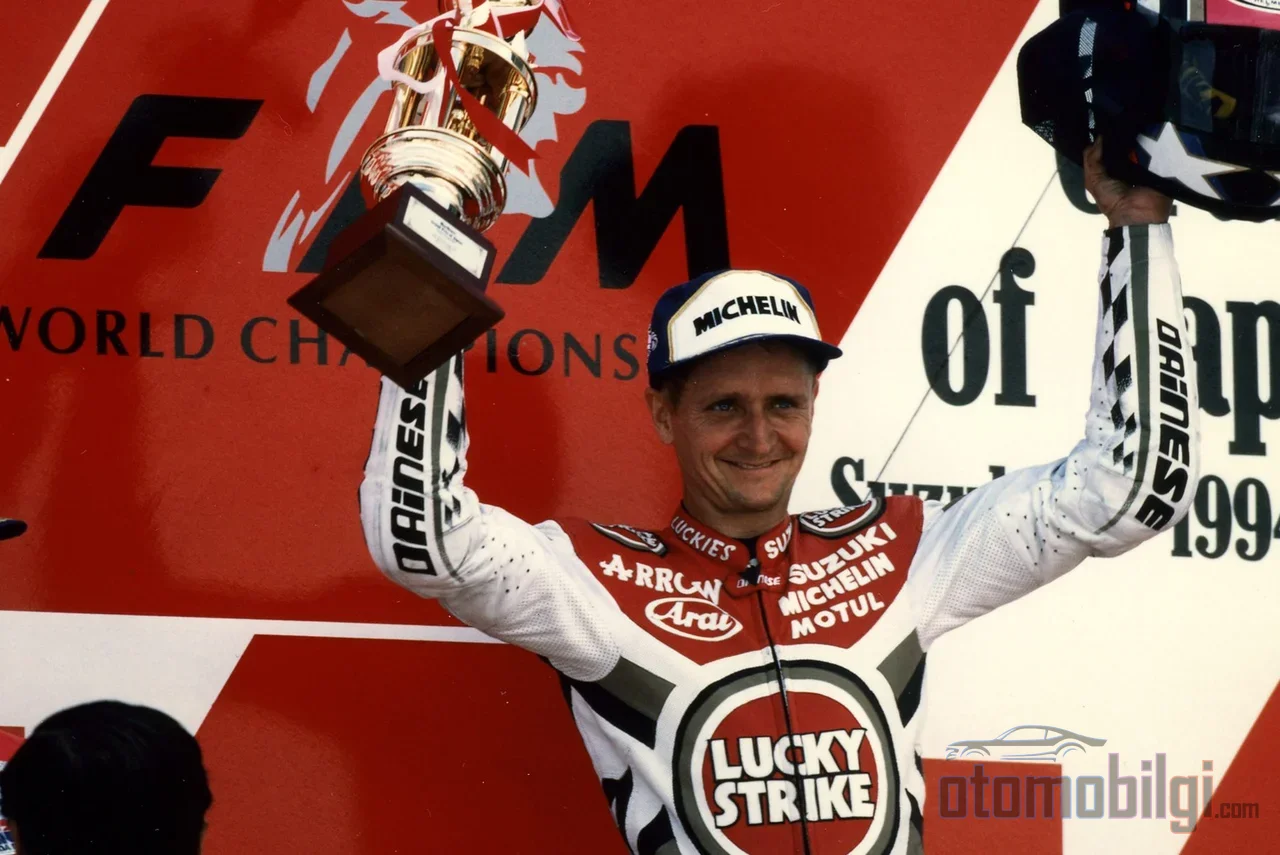
1993 was the season when every piece of Schwantz's puzzle fell into place. In the first half of the season he took four wins in a row; unlike his rivals who knew their limits well, he raced one step beyond the limit, and this time he wasn't going overboard. Over the season he recorded 4 wins, 11 podiums, 6 pole positions and 2 fastest laps in 14 races; he reached the championship with a total of 248 points.
The results table looked like this: Rainey second with 214 points, Daryl Beattie third with 176 points, Mick Doohan fourth with 156 points. Rainey had also won four races during the season; what created the points gap was not the win count, but Schwantz's stubborn podium consistency.
Breakthrough at Donington, Darkness at Misano
The season was not smooth. At Donington Park his ankle was injured when Mick Doohan hit him, and he had to retire from the race; this event gave Rainey an advantage in the championship. Then came the most painful day of the season. Rainey was paralyzed from the chest down after his crash at the Italian Grand Prix at Misano, and his career ended at that moment. The championship was settled mathematically, but for Schwantz the taste of victory was never complete. Even years later he said it openly: he would rather have raced Rainey to the end than win the championship at the cost of Rainey not being able to continue. Rainey, for his part, argues the other way around, saying Schwantz never got the credit he deserved for the 1993 championship. This mutual respect between the two rivals is the most beautiful face of competition.
The Championship Motorcycle: Suzuki RGV500 XR79
So what was the machine behind this victory? The Lucky Strike-painted RGV500 was a two-stroke engine in a 70-degree V4 layout with big-bang firing. Big-bang means the four cylinders fire at close intervals to one another; this makes the power delivered to the rear tire more manageable and smooths out traction on corner exits. Let's make a simple analogy: instead of hitting the tire with hard individual punches, the engine spreads its power over a wider time window; it treats the tire much more gently. In the 500cc prototypes of that era, this meant the courage to open the throttle early mid-corner.
The engine was equipped with improved electronic power jets and the Power Chamber. So how powerful was it? This is where the measurement point matters: it is said to produce a value of over 165 horsepower at 12,800 rpm when measured at the rear wheel; values measured at the crankshaft reach 185 horsepower at 12,500 rpm. The two figures do not contradict each other; they were simply measured at different points; drivetrain losses explain the difference. It also granted its rider extra revs: to reduce gear changes, nearly 1,000 rpm above the maximum could be used.
| Feature | Value |
|---|---|
| Engine | 70° V4 big-bang, two-stroke |
| Cylinder dimensions | 54 x 54.5 mm |
| Power (rear wheel) | Over 165 hp @ 12,800 rpm |
| Power (crankshaft) | 185 hp @ 12,500 rpm |
| Wheelbase | 1,400 mm |
| Weight (without fuel) | 130 kg |
Imagine 165-185 horsepower in a 130-kilogram motorcycle; a far crazier balance than today's hypercar power-to-weight ratios. Torque, 0-100 acceleration, and consumption figures were not disclosed by the manufacturer, as it was a racing prototype. After all, the RGV500's concern was not km/h, but corners.
Why Did a Second Championship Never Come?
Here is the most heartbreaking question of this article. For a rider who touched the summit in 1993, why did 1994 turn into a nightmare? The answer is not a single cause, but several misfortunes piling on top of each other.
First, injuries. The wrist problems that began at Donington in 1993 never left him throughout the 1994 season; the pain in his wrists in particular made even holding the handlebars of a motorcycle as physical as a 500cc difficult. In 1994 he suffered crash after crash; with two victories and 169 points, he could only finish fourth. His final Grand Prix victory also came that season, at the British Grand Prix.
Then, the motorcycle. Suzuki was behind its Yamaha and Honda rivals in straight-line speed; Schwantz made up for this deficit with his braking and cornering performance. This style worked as long as the motorcycle was kept at its limit, but the price was frequent crashes. His determination to win at any cost brought him victories and fans, while putting his championship calculations in jeopardy.
The deepest wound, however, was Rainey's accident. For Schwantz, the rivalry itself was the core of his motivation; when his rival could no longer race, the meaning of competing was diluted. He started 1995, but only three races later, after a conversation with Rainey, he quit racing. In his own words, he had effectively stopped racing after Misano; he simply was not aware of it at the time.
After the Championship: Regrets and Legacy
Schwantz never drifted away from racing. He designed the Circuit of the Americas track together with Tavo Hellmund and Hermann Tilke, and ran a riding school in Alabama. Yet the racer inside him never went quiet. In a statement he gave in 2026, he described continuing to race after dislocating his hip in the superkart crash at Laguna Seca as the most wrong decision of his life, thinking the recovery period would be long; because in that condition he had also endangered the other riders on the track. Moreover, not being able to finish even a single Grand Prix at Phillip Island remains the only regret stuck in his mind even years later.
In summary: Schwantz closed out his career with 105 starts, 25 wins, 51 podiums, 29 pole positions and 26 fastest laps. The 25 wins were one more than his rival Rainey's, making him the second most successful American road racer after Eddie Lawson. The FIM retired the number 34 from all racing as a tribute to his popularity; he was honored with the AMA Motorcycle Hall of Fame in 1999, the FIM Legend title in 2000, and the Motorsports Hall of Fame of America in 2019. It is thought he deserved more championships, but he happened to come along precisely in an era spent in the shadow of giants like Doohan, Rainey and Spencer; he was fast, he crashed often, and that combination made him one of the most beloved riders in the world.
Why Is a Single Championship a Sufficient Legacy?
Let's give the short answer: Kevin Schwantz won the 500cc world championship in 1993 with the Suzuki RGV500 on 248 points, and for the rest of his career, no second crown came due to injuries, Suzuki's straight-line speed disadvantage, a magnificent rival lineup, and the motivational void left by Rainey's tragic crash. His career statistics seem to whisper to him that a single championship was an injustice; but that single championship is the signature of a legend considered the fastest rider of his era.
And since you're a motorcycle enthusiast reading this page, let's leave you with a question too: 25 wins and 1 championship, or 24 wins and 3 championships? Schwantz's story is unforgettable precisely because it asks exactly this question.
Sources
- Kevin Schwantz - Wikipedia
- Kevin Schwantz - MotoGP Riders
- 500cc Grand Prix Standings 1993
- Kevin Schwantz 1993 Suzuki RGV500 XR79 - Australian Motorcycle News
- Rainey: Schwantz deserves more credit for 1993 title - Autosport
- Kevin Schwantz: How I rode - Motor Sport Magazine
- Kevin Schwantz - AMA Motorcycle Hall of Fame
- Kevin Schwantz reveals his silliest decision - MotoGP News