Pocono Tricky Triangle: NASCAR's Demanding Triangle
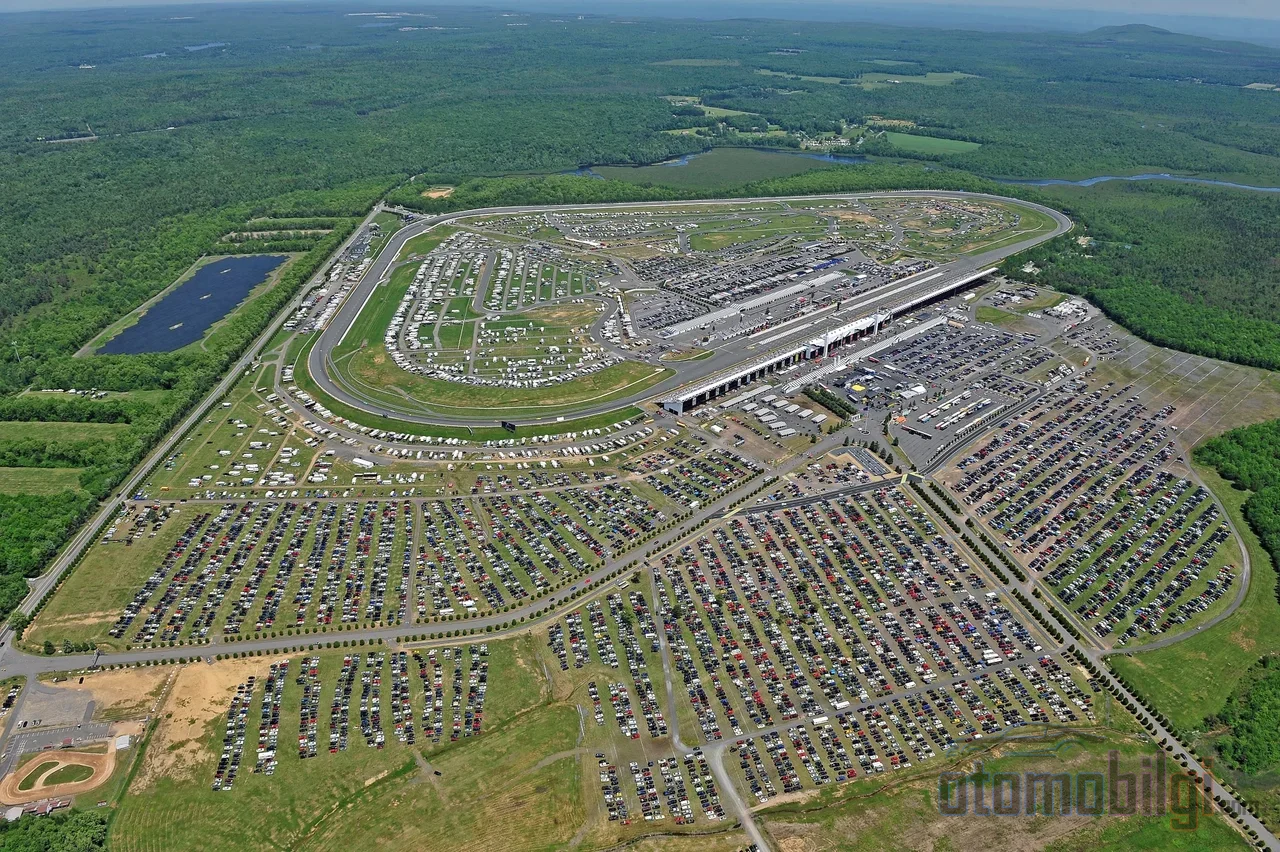
Say you're thinking about an exam where studying a single subject isn't enough: math, history and physics on the same paper, on the same day, and every question demands a different method. That's exactly the exam NASCAR drivers face every June when they head to the wooded region of Pennsylvania. Pocono Raceway looks like no other track on the calendar because its three turns are completely different from one another, and for over 50 years it has remained the only three-turn track in NASCAR. So why is this triangle so difficult? The answer isn't something that fits in a single sentence; so let me walk you through a lap from start to finish.
What Is the Tricky Triangle, and Where Did It Come From?
Pocono Raceway was built between the Blakeslee and Long Pond areas of Pennsylvania, on 1,025 acres of forest and spinach farmland purchased by businessmen in the 1960s. First, a three-quarter-mile oval was completed here in 1969; the 2.5-mile (4.023 km) tri-oval we know today was finished two years later, in 1971. So in fact the track wasn't born all at once, but in two stages.
The founders' goal was clear from the start: not to look like everyone else. Instead of a classic oval with four identical turns, they designed each of the three turns inspired by three different world-famous tracks. The result was a triangle unlike anything else in NASCAR, and it went down in history with the nickname it earned: the Tricky Triangle. The track is still a family business today; it remains one of the few family-owned major tracks in NASCAR.
Key Highlights
- For over 50 years, Pocono has been NASCAR's only three-turn track.
- The banking of the turns is 14, 8 and 6 degrees: each turn is inspired by a different track.
- The frontstretch, at 3,740 feet, is one of the longest straights in NASCAR.
- At 2.5 miles long, Pocono is the longest non-superspeedway track on the calendar.
- In 2026, Denny Hamlin reached his record eighth Pocono victory.
Three Turns, Three Different Characters
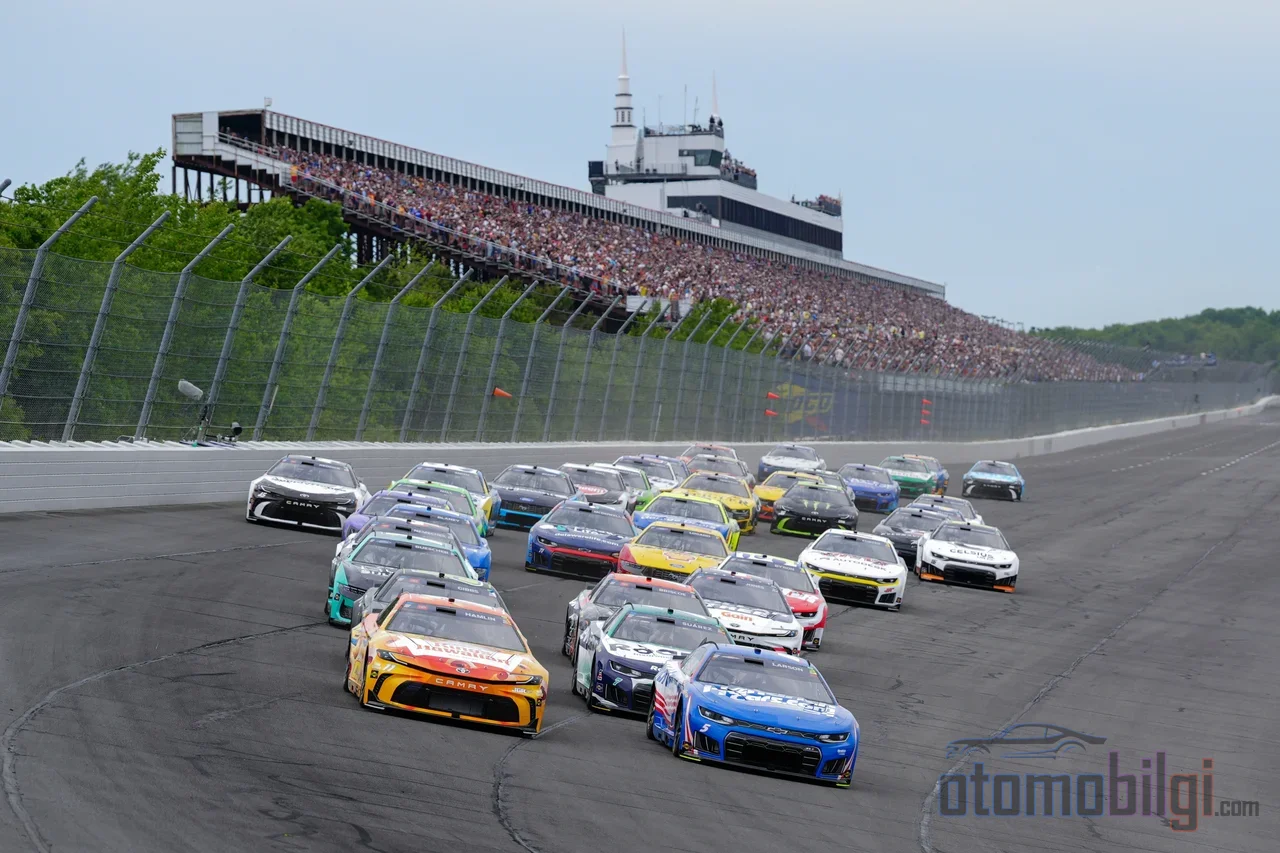
To understand Pocono, you need to get to know the turns one by one. Just imagine: a layout that makes you feel like you're racing on three different tracks in a single lap. Let me explain each turn to you with an analogy from everyday life.
Turn 1: The Wide Corner with a Superspeedway Heart
The first turn was inspired by Trenton Speedway. With 14 degrees of banking and a 675-foot radius, it is Pocono's most banked, most open corner. It gives a Daytona-style superspeedway feel; drivers can enter and exit here at high speed, almost without touching the brakes. It wouldn't be wrong to call it the place where the lap takes a relaxed breath.
Turn 2: The Famous Tunnel Turn
While the story of the second turn is beautiful in its own way, its difficulty is a separate reality. Inspired by Indianapolis Motor Speedway, this corner has 8 degrees of banking and a 750-foot radius, and it's called the Tunnel Turn because Long Pond Road passes through a tunnel beneath the track at that point. Because of its speed and approach angle, it's considered one of the hardest corners in NASCAR; it behaves like a short oval corner, and the smallest mistake comes at a high price. Some call it the hardest corner in motorsport. The fate of the race at Pocono is often decided here.
Turn 3: A Tight, Road-Course-Style Bend
The third turn was inspired by the Milwaukee Mile. With 6 degrees of banking, it is the steepest corner on the track and, in character, resembles a road course turn. The critical point here is exit speed: If you can't exit Turn 3 well, you'll hand everyone a pass on the long straight ahead. Being the final corner of the lap also makes things harder; there's no chance to recover from a mistake.
| Turn | Banking | Radius | Inspired by | Character |
|---|---|---|---|---|
| Turn 1 | 14 degrees | 675 feet | Trenton Speedway | Superspeedway feel, little braking |
| Turn 2 | 8 degrees | 750 feet | Indianapolis | Like a short oval, the hardest corner |
| Turn 3 | 6 degrees | - | Milwaukee Mile | Road course feel, exit speed is critical |
Straights and the Speed Balance
The straights are as much a part of the story as the corners. Pocono's three straights come in three different lengths: The 3,740-foot frontstretch (the frontstretch is the track's start-finish straight), the 3,055-foot backstraight and the 1,780-foot final straight. As for length: the frontstretch is generally cited as the longest straight in NASCAR; it's sometimes noted as being close in size to Daytona's back straight, and depending on the measurement method it's ranked either first or in the top three. In short, when it comes to straights, Pocono is always at the top of the list.
One more interesting detail: the track is topographically very flat, and its banking figures look weak next to giant superspeedways like Daytona or Talladega. The turn radii spread across a wide range of 675 to 800 feet; compared with Daytona's closely matched turn radii, it becomes clear just how uneven Pocono's geometry is. The same is reflected in the speeds: the speeds seen at superspeedways can't be sustained here. At 2.5 miles, Pocono is not the longest superspeedway on the NASCAR calendar.
Why Is a Perfect Car Setup for Every Turn Impossible?
This is where the magic of the Tricky Triangle begins. When setting up a race car, suspension geometry, aerodynamic balance and gearing all work together; but at Pocono, it's impossible to optimize these variables for three different turns at the same time. A car that fits one corner perfectly is left helpless in another. For crew chiefs, this is a puzzle that seems unsolvable; the Rubik's Cube comparison is no coincidence. There is no way to set up the car to be good in all three turns, and every team has to choose its own priority: deciding which turn to sacrifice is half the race.
That's why ready-made recipes don't work here. A short oval setup loves the Tunnel Turn but gives up speed on the long straights; a superspeedway setup loves the straights but makes the car sluggish in Turn 3's tight bend. The drivers aren't idle either: they have to constantly adjust the braking point, throttle and racing line on every lap. The bumps on the track and the low banking figures are icing on the cake.
The result? Pocono races usually unfold with a heavy emphasis on strategy: fuel calculations, the pit window and track position take center stage, surprise names shine, and dramatic finishes become inevitable. That close finish in the 2026 race, where Ryan Preece was beaten by a margin of 0.022 seconds, is the latest proof of this tradition.
The Track's Journey: From a Spinach Field to the Present Day
Pocono's history is as winding as its corners. The first Indy Car race was the Schaefer 500, run in 1971; on the NASCAR side, the Pennsylvania 500, run here in 1974, was the series' first 500-mile race at Pocono. In 1982, a second Cup race was added to the calendar. Legends like Bill Elliott, Rusty Wallace, Tim Richmond and Darrell Waltrip tasted victory here.
The track also went through hard times: The damage from Hurricane Agnes and the economic crisis of the 70s brought owners Joe and Rose Mattioli to the point of selling. But instead of selling the track, the couple chose to recreate it from scratch. The official reconstruction that began in 1990 was completed in about 10 years and at a cost of roughly 30 million dollars; over the following 30 years, an average of another 3 million dollars was spent annually. With new crash walls, new asphalt, a paddock area showing cars to fans from a distance of about 56 feet, and 1,000 new restrooms replacing the old 375, the track was practically reborn.
And there is a nice rumor, too: it is said that the track was actually going to be built with a fourth corner, but rain that started as the third corner was being completed changed the plan. This story circulates as a hypothesis; though the "where is Turn 4?" joke among fans has already become legendary.
Where Does Pocono Stand on the NASCAR Calendar Today?
As of 2026, the track is hosting the Cup Series for the 53rd consecutive year. The Great American Getaway 400, run on June 14, 2026, consisted of 160 laps and 400 miles, and this race was held at the track for the third consecutive year; the event draws hundreds of thousands of NASCAR fans to Pennsylvania. During the 2026 weekend, the O'Reilly Auto Parts Series also raced alongside the Cup; the ARCA Menards Series is also a regular guest of the track. For the next meeting, the calendar has a weekend dated June 11-13, 2027.
As for the winner of the 2026 race, they became the first name that comes to mind when Pocono is mentioned: Denny Hamlin won his record eighth Pocono victory and extended his winning streak to three. The title "Master of the Tricky Triangle" is now fully deserved.
In short: Why Is Pocono NASCAR's Most Difficult Oval?
Let's make the answer clear: Pocono is difficult because it does not behave like a single track. The angle, banking and radius of its three corners are completely different; Turn 1 behaves like a superspeedway, Turn 2 like a short oval, and Turn 3 like a road course, and combining these three characters in a single lap imposes a compromise unlike any other track, for both driver and engineer. Off-the-shelf setup recipes do not work, every lap turns into a problem-solving exam, and the winner is usually not the fastest car but the team playing the smartest strategy.
A track with three corners should not work; but Pocono has been running for years and continues to offer the most unique puzzle on the NASCAR calendar every June. When you watch the next Pocono race, you'll now know: that small mistake in the turn or that bold decision at the pit wall was actually a response to the big test posed by three different tracks under one roof.
Sources
- Why Is Pocono Raceway Called the 'Tricky Triangle'? - Yahoo! Sports
- PA's Tricky Triangle - Pennsylvania Center for the Book, Penn State
- Why does Pocono Raceway only have three turns? - NASCAR.com
- Pocono Raceway by the Numbers - Building Speed
- NASCAR Returns To Pocono Raceway June 12-14 - poconoraceway.com
- 2026 Great American Getaway 400 at Pocono - Jayski
- The Great American Getaway 400 Returns - PA DCED
- How To Race Around A Scalene Triangle: NASCAR Physics - The Autopian
- Pocono Raceway Track Details & History - 877stockcar.com