Bristol Motor Speedway: NASCAR's Half-Mile Madness
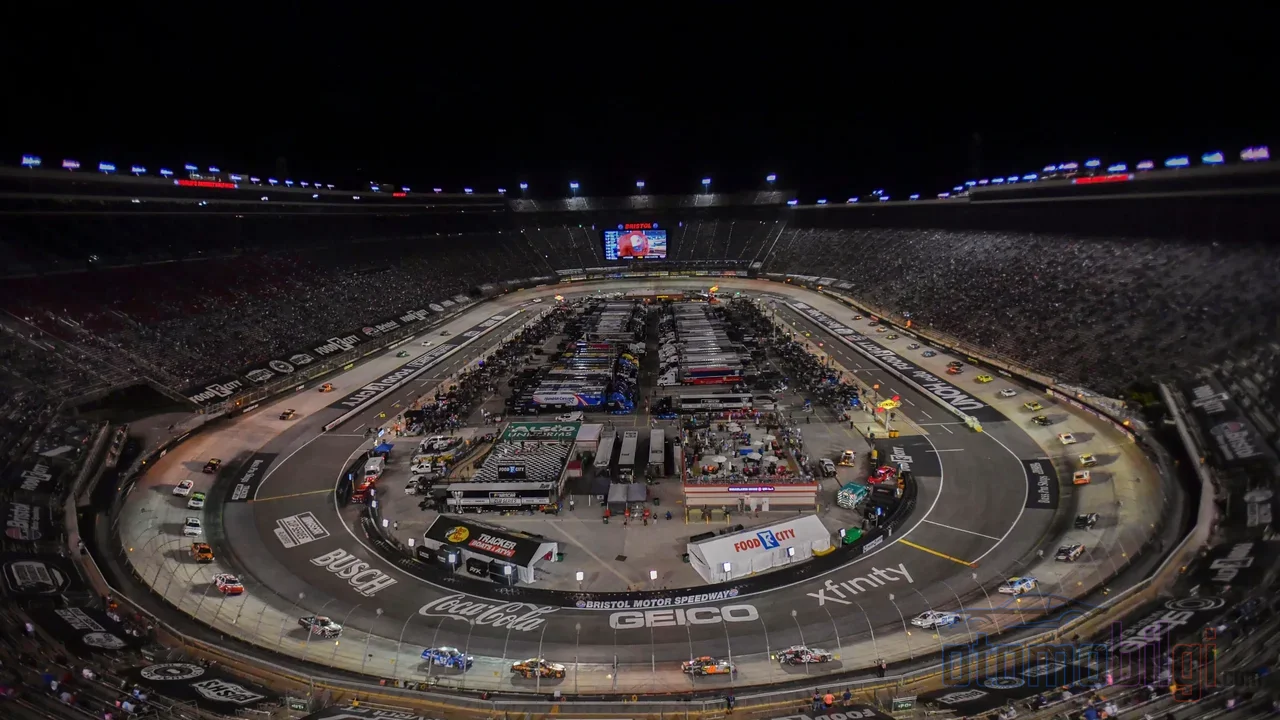
Half a mile. Yes, you read that right: half a mile. While drivers spend seconds taking a single turn on NASCAR's giant superspeedways, when they come to Bristol Motor Speedway they complete a lap in roughly 15 seconds. In this tiny bowl nestled among Tennessee's mountains, the turns are banked at 24-28 degrees, the surface is entirely concrete, and the grandstands are so steep that the track is trapped inside like a bowl. We've already covered the Darlington and Pocono stories; now it's time for what may be NASCAR's most madcap experience. So what exactly makes Bristol legendary? Is it the banking, the concrete, or the night race atmosphere? The answer is all of them and none of them; let's start from the beginning.
What Is Bristol Motor Speedway, and Just How Crazy Are the Numbers?
Bristol Motor Speedway is a short oval located in Bristol, Tennessee, with a length of 0.533 miles (0.858 km). The banking in the turns ranges from 24 to 28 degrees; on the straightaways, the banking is 4 degrees at the bottom and 8 degrees at the top. If those numbers feel cold to you, think of it this way: Daytona's turns are 31 degrees, but the track is twice as long. Bristol compresses big-track physics into a tiny space. These steep banks subject drivers to nearly 3 G of lateral force while also keeping the cars on the track. This is a physics lesson so serious that comparisons with astronauts in a space shuttle seat are even made.
The speeds? Roughly 140 mph on the straightaways, around 115 mph in the turns; a fast lap takes about 14.5 seconds. The Cup Series lap record, meanwhile, is the 14.945 seconds set by Kyle Larson in 2018. And the most absurd statistic: In a 500-lap race, drivers turn a full 1,000 corners and swing between high and low G forces every few seconds. Imagine an exam that lasts for hours, with no luxury of closing your eyes.
Highlights
- Bristol is a concrete short oval 0.533 miles in length, with turns banked at 24-28 degrees
- In a 500-lap race, drivers take a full 1,000 corners, and a fast lap is about 14.5 seconds
- The track was asphalt until 1992; today it is covered with concrete roughly 9 inches thick
- Bristol is the only track on the NASCAR calendar that uses a split pit road
- The giant 30x63-foot Colossus TV screen hangs above the track
Why Is the Track Concrete? The 1992 Decision That Changed the Story
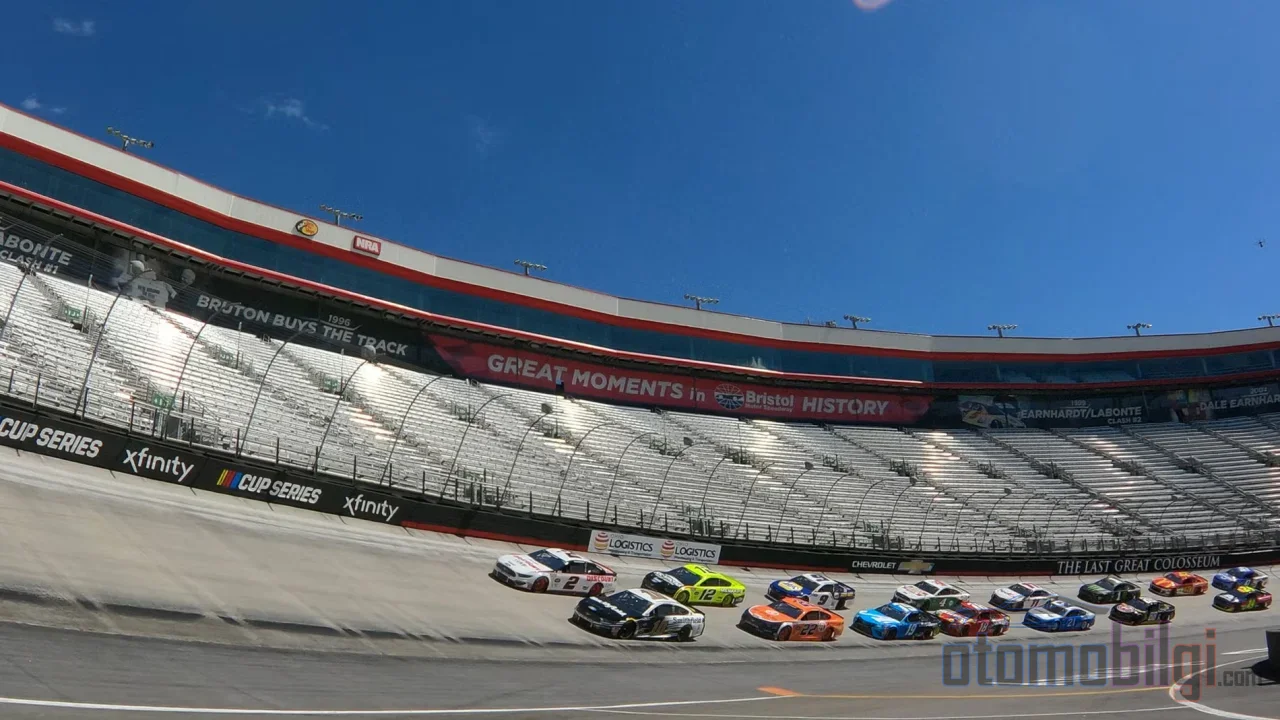
Bristol wasn't always concrete. From 1961 to 1992, the track was asphalt, but over the years the asphalt kept getting bumpy again and again, and teams and drivers complained. After the 1992 Food City 500, track boss Larry Carrier made a radical decision: to pave the surface with concrete. Completed in July 1992, this change permanently rewrote Bristol's character.
So what's the difference between concrete and asphalt? Asphalt softens as it heats up; concrete doesn't soften. The concrete layer, roughly 9 inches thick, usually stays 10-15°F cooler than asphalt on race day, and this directly affects tire behavior. The concrete surface is also harder and more abrasive; the grip it gives the tire is high, but it takes its toll on the tires. During long green flag runs, tire temperatures can climb up to 240°F. So at Bristol, tires are a consumable item; who knows when and how much they'll use them?
Innovation Comes with Concrete: The Variable Banking Debate
With the 2007 repave, the track switched to a variable banking system: the corners were spread across 24-30 degrees and the racing surface was widened from 40 feet to 43 feet. But this modernization didn't make everyone happy. The fan base, who felt that the hard, single-groove, bumper-to-bumper racing style Bristol was famous for had weakened with this change, reacted strongly; in fact, track management was forced to pull back the variable banking in 2012. So even legendary tracks pay the price of modernization. Also, it later became clear that the true value of the banking marketed in earlier years as 36 degrees was around 30 degrees; so even the numbers had become a bit legendary.
The Tire Game: At Bristol, the Winner Is the One Who Manages His Tires Well
The 2025 and 2026 seasons have once again brought Bristol's biggest agenda item on this front into the spotlight: tire wear. Goodyear used a different right-side tire compound targeting more wear than in the spring in the 2025 fall race, and the result was a race that tested NASCAR's best in a way not seen for a long time. In 2026 too, the tires settling onto the track's concrete surface and laying down rubber visibly showed how grip improved; tire management was the main topic of the race.
This deliberate degradation design also sparked debate. Some argue that the difficulty of the race is the very point of the place; others see the deliberate tire consumption as a safety risk. My take? Bristol isn't an easy track anyway, and the dose of difficulty here is part of its character. But the suspension side isn't empty either: the Next Gen car's independent rear suspension and 18-inch wheels remain an adjustment issue that teams are still working on to handle the concrete's hardness.
Racing the High Line: Living on the High Groove
When Bristol comes up, one of the first images that comes to short oval fans' minds is high-line racing. Drivers can carry roughly 4-5 mph more speed in the upper groove than in the lower groove; the banking is so steep that the car turns almost as if leaning against the wall. The diamond line, which takes a shortcut with a cross entry into the 3-4 corners, is among the tactics that work for drivers. Famous names: drivers like Kyle Larson openly say that the track's intense traffic and high-tempo nature suit their styles.
Traffic never ends on the short track: when 40 cars squeeze into a half-mile space, everyone is nose to nose with everyone. What matters here is skill, what old NASCAR names call "branding": hitting your braking point and turn-in point with millimeter consistency in every corner. According to Kyle Petty, branding is never as critical on any track as it is at Bristol. Two corners per lap, 500 laps; meaning you have to repeat the same precision 1,000 times.
Why Pit Strategy Requires Thinking Twice?
Bristol is the only track on the NASCAR calendar that uses a two-section pit road: the pit lane is split into front and back straights, and teams have to adapt to different entry angles. With lap times under 15 seconds, pitting can mean losing two full laps. On top of that, an average of 10-12 cautions fall in every race; missing the timing by one lap means leaving the group ahead behind. For crew chiefs, Bristol is a chess game; they make their moves calculating tires, traffic and the chance of a caution all at once.
The Night Race: A Legendary Atmosphere Under the Lights
Bristol's night race culture goes back to 1978: the first night race was held with temporary lights set up for the Volunteer 500, and since that day the autumn classic has been run in the night format. Today this atmosphere is far more organized: the bowl-like grandstands rising above 140 feet trap sound and air inside the track, and the 30x63-foot Colossus TV screen hung over the track as part of the project lets you follow every moment on a giant screen. The nicknames Last Great Colosseum and The World's Fastest Half-Mile are not for nothing.
The spectator experience is part of this legend too. At its peak capacity can reach up to 162,000; today's 146,000 spectators in the grandstands are so close to the cars and the race that watching NASCAR feels like watching a stadium match. Light, shadow and reflections also require drivers to relearn the track: the reference points you learned in daylight change at night, and you have to readjust your turn-in points.
From Napkin Sketches to the Summit: A Brief History of Bristol
In 1961, Larry Carrier, R. G. Pope and Carl R. Moore designed the track from sketches drawn on paper bags. Construction began on January 25, 1961, the cost was 600,000 dollars, and the track opened on July 23, 1961; the first major NASCAR event was held on July 30, 1961. The initial capacity was 21,000; in 1996 Bruton Smith bought the track for 26 million dollars and raised the capacity from 81,000 to 146,000, up to 162,000 at its peak. The road from a tiny Tennessee project to NASCAR's biggest bowl took less than eighty years.
Meanwhile, the track has taken on different roles over time: between 2020 and 2023 a temporary clay (dirt) surface was used instead of concrete, banking was reduced to 16-19 degrees on dirt, and then it returned to concrete. In 2025, Bristol hosted the Atlanta Braves-Cincinnati Reds matchup, the first regular season MLB game in Tennessee, and the Braves won 4-2. The track also hosted the NASCAR All-Star Race on a short oval for the first time; with a fast 140-lap format. So this arena continues to be a lively venue outside racing as well.
So Why Are Bristol's Concrete Banks Legendary? Here Is the Answer
Let me sum it up, because this question deserves a one-sentence answer: Bristol compresses half a mile of 24-28 degree concrete banking, 1,000 corners of physical load, 3 G of lateral force, deliberately wearing tires, and a colosseum atmosphere of 160,000 people into the same space. No track offers an experience of this intensity; that is why it is a legend.
Nothing easy ever becomes a legend. Bristol made toughness its identity with its banking, the bold concrete decision made in 1992, years of contentious repave adventures, and breathtaking night races under the lights. Taming Darlington is one art, solving Pocono is another puzzle; but at Bristol you are battling not just the track, but physics, the tires, and a holistic experience created by traffic and the crowd. And the moment you see the checkered flag from inside the bowl-shaped collapsing grandstands, you understand why millions of people adore this half mile.