Why Can't NASCAR Race in the Rain?
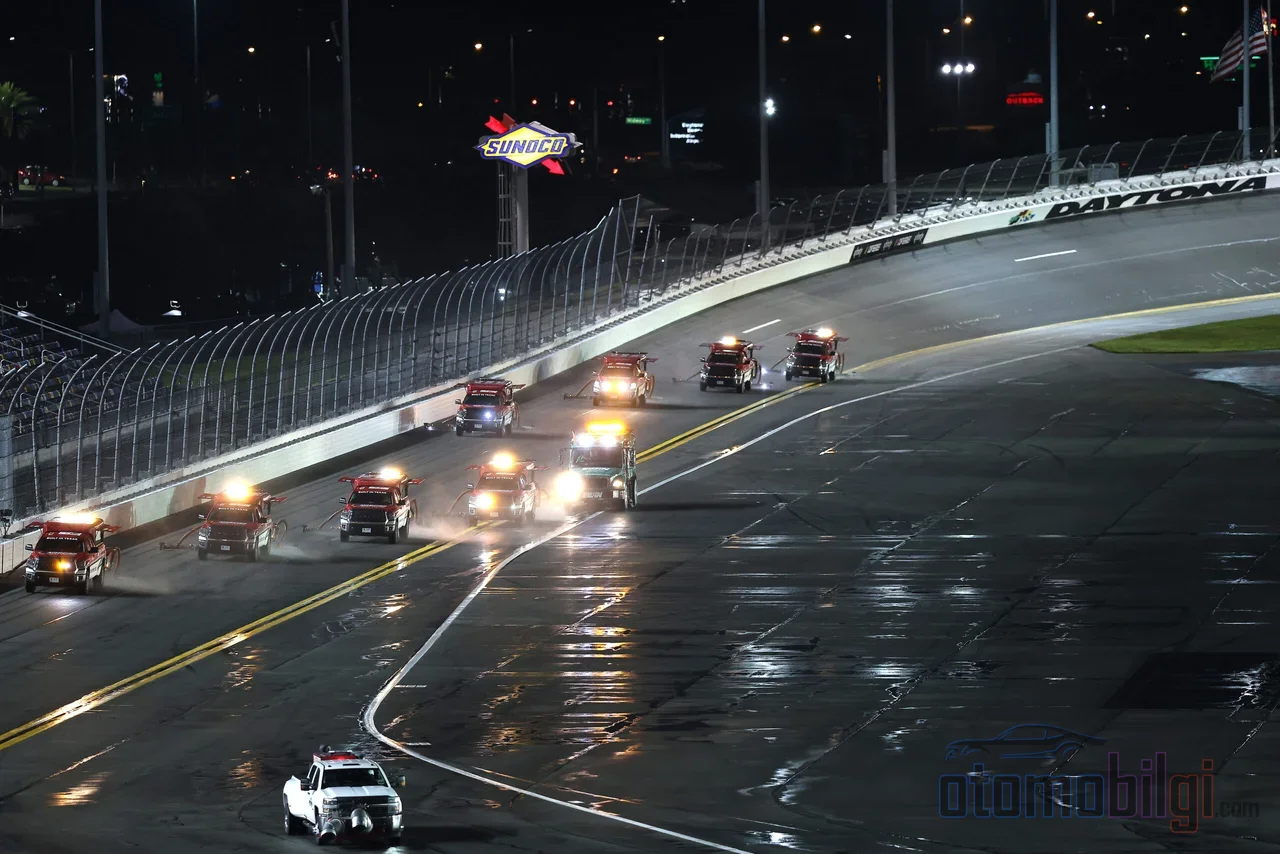
The rain starts, the red flag comes out, millions of fans watching their screens sigh as giant stock cars - without even wipers - are dragged toward the garage along pit road. But wait a second: If Formula 1 cars stay on track even in pouring rain, why do these American monsters reaching 300 km/h retreat to the garage at just a few drops? The answer isn't as simple as you might think; there's physics, tire technology, track geometry, and even a bit of marketing logic involved. If you're ready, let's unpack NASCAR's battle with rain... pardon, its struggle with rain, layer by layer.
Slick Tires and Hydroplaning: The Brutal Physics of the Oval
Let's start with the most fundamental issue: the tires. The slick tires NASCAR uses in oval races have, as the name suggests, a completely smooth contact surface. They lack the ability of an ordinary road tire to channel water away through grooves; their sole job is to provide maximum grip on dry asphalt. On a dry track, these tires achieve roughly 1.5 g of grip in corners and braking; the slip angle is only around 2-4 degrees. In other words, the tolerance range in which the car can hold onto the track is incredibly narrow. On a wet surface, this window approaches zero and the control in the driver's hands completely evaporates.
So what happens on ovals? It's believed that high banking - the banked corners - doesn't hold water, but the truth is: due to the banking, a strip of water can form flowing from the track surface toward the infield. For a car entering that strip at 300 km/h, the picture is grim: hydroplaning - the tire sliding over the water without ever touching the asphalt. On top of that, add the painted surfaces and lane markings on the track; when wet, they become as slippery as an ice rink. So on an oval, rain doesn't just mean "a bit of slipperiness" - it means a trap lurking at a different spot every lap.
There's also the racing culture side of things. NASCAR cars rely more on mechanical grip than aerodynamic grip, and drivers can therefore engage in aggressive contact. Imagine a grid of 40 cars, a race lasting hours, and constant side-by-side battles. When you take that to a wet oval, the result technically turns into a feast of wreckage; contact chaos is already part of NASCAR's nature, and rain multiplies that chaos. IndyCar doesn't race in the rain on ovals either; so this isn't a NASCAR-specific whim, it's a reality born from the very structure of oval racing.
Highlights
- Oval racing slick tires have no water drainage grooves; on wet surfaces, the grip window is almost reduced to zero.
- NASCAR's Air Titan drying system was introduced in 2013; large tracks can still take 2-2.5 hours to dry.
- The 2012 Daytona 500 was postponed for a day for the first time in its 54-year history.
- On September 16, 2026, NASCAR left the wet-weather tire decision to the teams' discretion.
Rain Tires Work on Road Courses, So Why Don't They Work on Ovals?
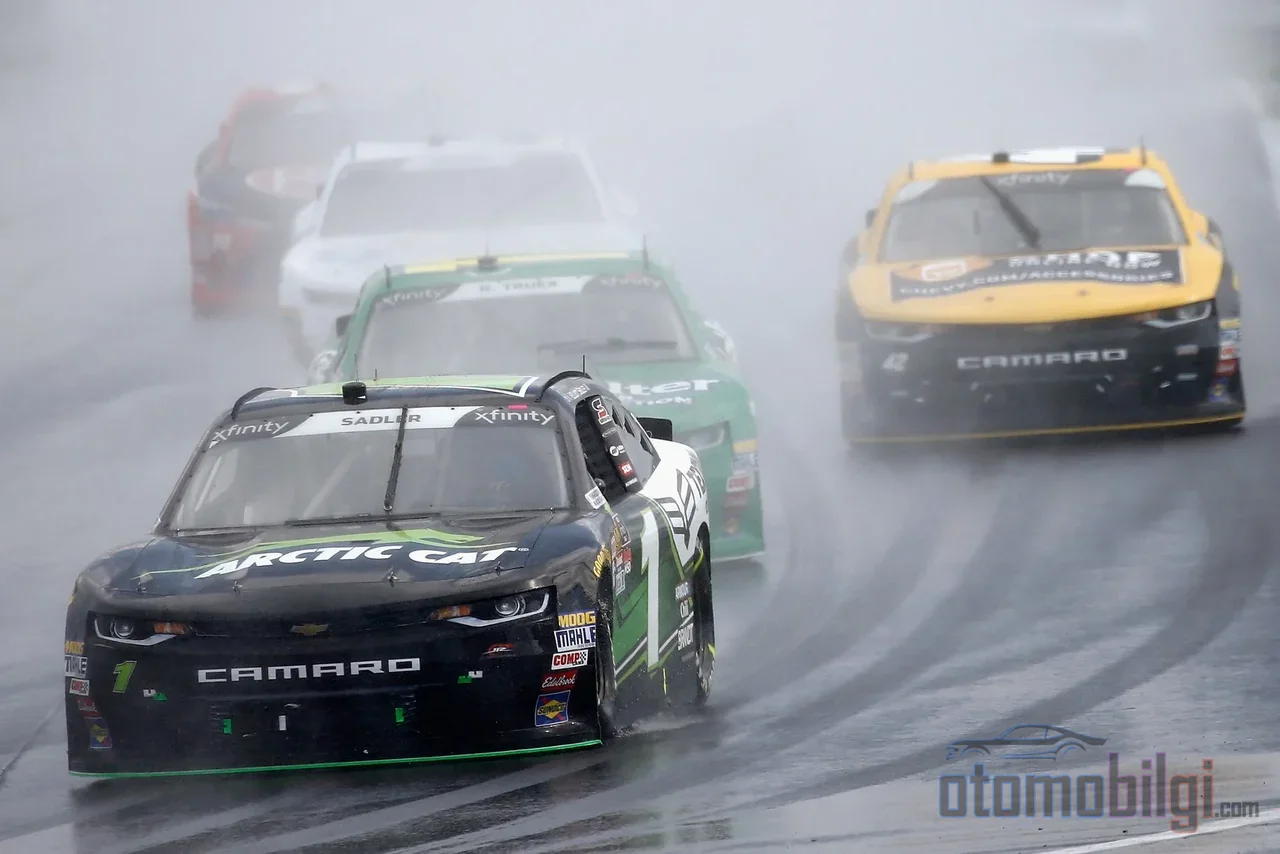
This is where most fans get confused, and you're right, it seems contradictory at first glance. NASCAR has been able to race in wet conditions for years by using rain tires on road courses and Rovals. The cars even now have a full wet weather kit: grooved tires, a windshield wiper, a defroster, and blinking rain lights at the rear. So the statement "NASCAR can't race in the rain" is no longer entirely accurate; it should rather be "it can't race on ovals depending on conditions."
So what's the difference between an oval and a road course? Road courses offer a variety of fast and slow corners; in the wet, a driver can choose the right pace according to speed. On ovals, however, everyone is forced to run at maximum speed every lap; there is nowhere to escape or slow down. Also, the blocks on wet tires flex to both drain water and maintain tire temperature. But at the constant high speeds of ovals, these blocks can tear off piece by piece; this is called chunking, and you end up mid-race with a tire falling apart in your hands. Grip with rain tires also drops to 1.0 g; combined with the narrow slip window of an oval, the math simply closes off.
The New Experiment at Short Ovals
This is where the exciting part begins. Inspired by the road course package, NASCAR has developed a wet weather package for short ovals as well: grooved Goodyear rain tires, a wiper, and auxiliary equipment. Wet weather oval racing can currently only be tried at short ovals; superspeedways are absolutely off-limits. At tracks like Martinsville, 0.526 miles long, wet weather tires are kept on hand for Cup races, and new tires are being tested at Richmond in the hope of racing in damp conditions. The objection of those looking at it with F1 logic is justified: even a few formation laps on wet tires disperses most of the water on the track. But NASCAR's calculation is different; reducing delays and keeping the show going.
Air Titan: The Giant Track-Drying Machine
Even when the rain stops, the job isn't done; next comes drying the track. NASCAR's secret weapon in this matter is the Air Titan: a compressed air-based drying system developed by NASCAR's R&D center and introduced in February 2013. Its working principle is elegant: the system sends compressed air through a series of hoses onto an air knife pulled behind it, and this wall of air pushes the water from the racing surface toward the apron area on the inside edge of the track. There, vacuum trucks collect the accumulated water; sweeping vehicles and additional equipment drying the pit lane also support the crew.
In the era before Air Titan, the job belonged to jet dryers: these vehicles, producing heat of about 1100 degrees with J34 jet engines, dried the entire track in roughly 90 minutes, but operating costs were painfully high. Air Titan significantly shortened this time; still, keep in mind that drying can extend to 2-2.5 hours at large tracks. After a normal rain, NASCAR usually gets an oval race-ready in 1-2 hours; severe storms naturally extend the time.
How Does a Rain Delay Work? Rules and Process
As soon as the slightest precipitation appears on the track, NASCAR throws the red flag and immediately calls the cars to pit road. What follows is a chain of protocols: NASCAR sets the "adverse conditions time" clock, announces a grid start with wet weather tires depending on conditions, and once the track has been dried, the race resumes. On road courses, when wet conditions are declared, the cars are also required to be fitted with rain flaps.
On the postponement side, the logic is as follows: NASCAR first tries to complete the race within the same day. If that fails, the race is mostly pushed to the following day, usually Monday. For a race to be considered complete due to rain, the halfway point of the distance or the end of the 2nd stage, whichever comes first, must be reached; if the weather interrupts the race before this point, the event is postponed. For example, a Dover Cup race was postponed due to rain and resumed from the lap where it was left off, on Monday at 12:00 ET. At tracks like Daytona International Speedway, the Weather Protection Program comes into play: grandstand tickets unused on the postponed date can be exchanged for a future NASCAR race. So the spectators are not left empty-handed either.
The Daytona 500 and Weather: Historic Delays
The Daytona 500, NASCAR's biggest race, has written the fraught relationship between itself and the weather into the pages of history. In 1965, rain stopped the race after only 133 of the 200 laps and the race was shortened. In 1995, rain that arrived on lap 70 cut the race by 2 hours. In 2003, the race was stopped at 109 laps, making it the shortest Daytona 500 in history. In 2010, the weather caused problems even in an indirect way: a pothole that formed between turns 1-2 caused a 40-minute delay.
The truly symbolic moment came in 2012: for the first time in its 54-year history, the Daytona 500 was postponed by a day. In 2014, the race started in daylight and ended at night; a six-hour rain delay completely changed the course of the race, and Dale Earnhardt Jr. went on to his second Daytona 500 victory. In 2020, the race was again moved to the following day, and in 2021 there was a 5-hour delay; during that wait, some drivers even had fast food brought into the pit area. From a five-minute delay to six hours of drama, Daytona's weather record is full.
The New Rule Arriving in 2026: The Decision Is Now in the Teams' Hands
And now we come to the most recent development. On September 16, 2026, NASCAR announced a significant change to the wet weather tire protocol: when track conditions transition from wet to dry, the decision to switch from Wet Weather tires to Prime tires, or vice versa, is no longer dictated by NASCAR; that choice has been left to the teams' discretion. The change gives the teams more control in line with road and street course policies, and aims to facilitate wet-dry transitions on designated ovals. The strategy game has completely changed: from now on, the team that switches to the right tire at the right moment will win, much like a well-timed pit stop.
The Short Answer: Why Can't NASCAR Race in the Rain?
Let's wrap it up. There is no single reason why NASCAR cannot race in the rain on ovals; slick tires without water drainage grooves, the risk of hydroplaning, wet painted surfaces, and rain dispersing tire blocks at high speed combine so that a wet surface on an oval does not allow for a safe race. Wet weather packages developed for road courses and short ovals, along with the new team discretion protocol in 2026, are gradually changing the picture. So the most accurate summary is this: It is not that NASCAR cannot race in the rain, but that NASCAR cannot yet race safely in the rain at the high speeds of ovals. But tires are improving, drying systems are getting faster, and the rules are loosening. Perhaps one day we will see the red flag waved for accidents only, not for rain.
Sources
- NASCAR changes wet-weather tire protocol
- Why can some series race in the wet and others can't? - RACER
- Why Doesn't NASCAR Race in the Rain? - HowStuffWorks
- NASCAR Will Finally Race in the Rain With New Wet Weather Kit - The Drive
- NASCAR unveils 'Air Titan' track-drying system
- How Does NASCAR Dry a Wet Track? Inside the Air Titan - Yahoo Sports
- First Time In History - Daytona 500 Postponed Due To Rain - CBS News
- Daytona 500 history with rain, bad weather, delays - News-Journal
- Wet-weather 101: Tire procedures for Martinsville Speedway
- Weather Protection Program - Daytona International Speedway