Darlington Raceway: One of NASCAR's Most Challenging Tracks
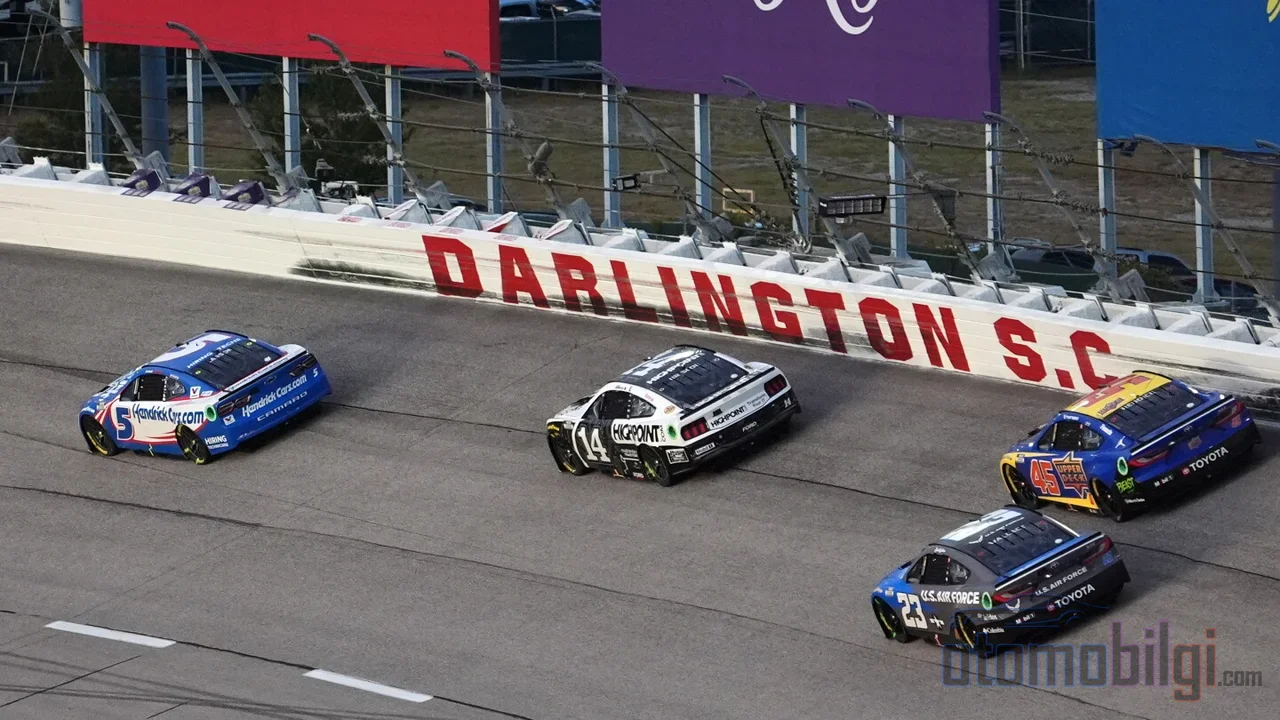
Imagine you're handed a piece of paper and a pencil, and told to draw a race track. You'd most likely draw a perfectly symmetric oval, with two turns that are exact copies of each other, and that would be it. But what if one day you couldn't get permission to tear down the fish pond in the middle of the track? Yes, you heard that right: The egg shape of Darlington Raceway, one of NASCAR's most legendary tracks, exists because of a small pond where minnows live. But the beautiful part of the story (or the terrifying part, in the drivers' eyes) is that this accidental shape made Darlington one of the most difficult tracks in the world. So why has no one ever been able to fully "tame" this track?
The Anatomy of the Track: The Numbers That Make Darlington Darlington
Located in the town of Darlington in rural South Carolina, this track is a 1.366-mile (approximately 2.198 km) long asphalt oval with 4 turns. Now comes the really interesting part: Turns 1-2 are banked at 25 degrees, while turns 3-4 are banked at 23 degrees. The front and back straightaways are banked at only 6 degrees. Tight turns on one end, wider curves on the other: In race engineering, that's a difference as big as night and day.
The widths are asymmetric too: While turns 1-2 are about 79 feet (24 meters) wide, turns 3-4 are about 62 feet (19 meters). So one end of the track is both wider and more gently curved, while the other end is narrower and tighter. Let's compare it to everyday life: it's as if you were trying to walk one lap around a column in a huge hall, and another lap in a narrow corridor. Same car, same speed, but two completely different problems.
| Feature | Value |
|---|---|
| Length | 1.366 miles (2.198 km) |
| Turns 1-2 banking | 25 degrees |
| Turns 3-4 banking | 23 degrees |
| Straightaway banking | 6 degrees |
| Turns 1-2 width | 79 feet |
| Turns 3-4 width | 62 feet |
| Capacity (2021) | 47,000 |
Highlights
- Darlington's egg shape was born from the condition of preserving a minnow pond on the purchased land.
- The two sets of turns have different banking and width: 25° / 23°, forcing teams to solve two different problems with a single setup.
- The first Southern 500 was run on September 4, 1950 with 75 cars; it was NASCAR's first superspeedway race.
- The Darlington Stripe is the mark of scraping the wall, and is considered a badge of honor among drivers.
- The race record: 0:28.332 (Denny Hamlin, 2018 Southern 500).
How Did the Egg Shape Come About? The Story of the Fish Pond
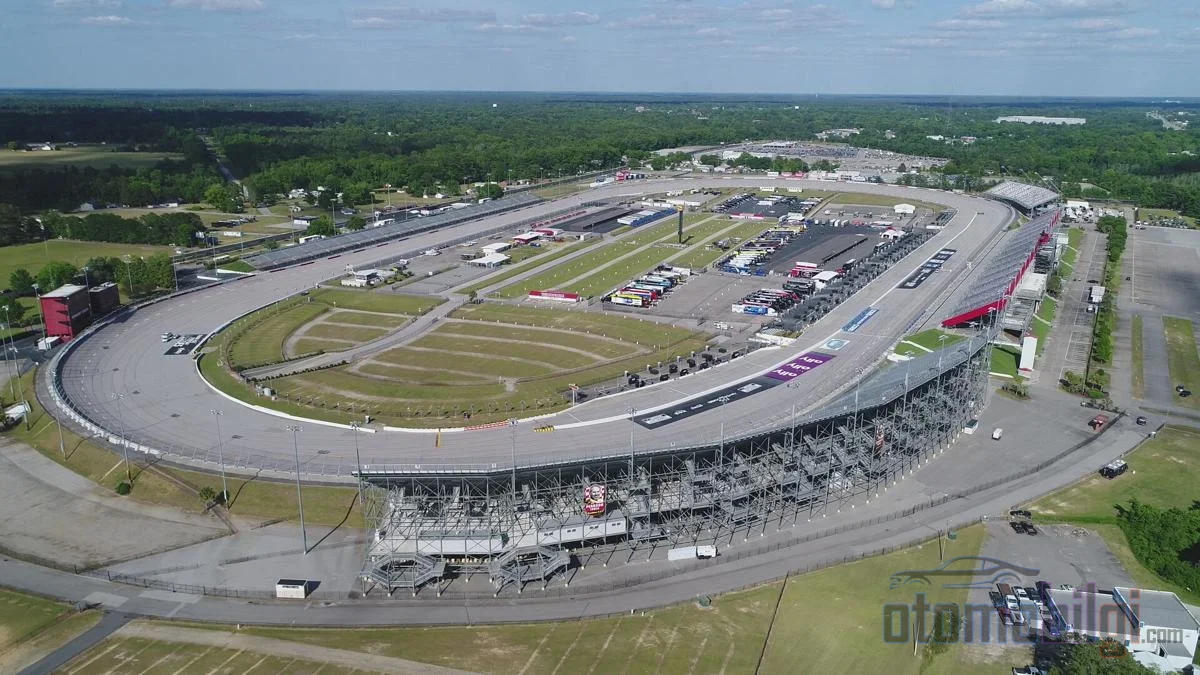
Around 1949-1950, Harold Brasington bought land from farmer Sherman Ramsey to build NASCAR's first superspeedway. The story goes that Ramsey had only one condition: the minnow pond (a small pond for raising bait fish) where he often fished would never be disturbed. Brasington accepted this condition and had to route the track around the pond. The result? Tight corners at one end, wider sweeps at the other: the track's characteristic egg shape.
The details of the story vary slightly depending on the source. According to one account, the purchased land was 70 acres; according to another account, the land acquired with a handshake was about 105 dunams (42 hectares), and while the grading of turns 3-4 was being completed, when Ramsey grew worried about what would happen to his pond, Brasington tightened the radius of turns 1-2. Whichever version is true, the fish pond at the center is the same: the track's most famous feature is not the product of design genius, but of the respect shown to a farmer's fish.
The track opened its doors on August 19, 1950 under the name "Darlington International Raceway"; at the time it had roughly 10,000 seats and the track was measured at 1.25 miles. In later years the track evolved in both shape and size, reaching its present form.
An Engineering Nightmare: Asymmetric Load and the Setup Dilemma
Why Is There No Single Correct Setup?
Now let's talk a bit of engineering, but don't worry, I'll explain it simply. On a normal oval, since both sets of turns are similar, teams set the car to a single balance point: the nose presses a little less, the rear grips a bit more, done. At Darlington, however, the radius of the first two turns is wider than that of the last two. For this reason teams usually have to sacrifice performance in one set of turns to run better in the other. In other words, engineers make a choice before the race: will we be strong in turns 1-2 or in turns 3-4? There is a lap time split down the middle, and you decide which half to give up.
There is also a physical dimension to the job. An abrasive asphalt surface eats the tires quickly; the driver has to cope, all at once, with the load imbalance of the asymmetric shape, the fading tires, and a racing line very close to the wall. When these three problems pile on top of each other, mastering Darlington is much like trying to keep three balls in the air with one hand: you live with the risk of dropping two while saving one.
Where Do the Legendary Nicknames Come From?
The track has two famous nicknames: "Too Tough to Tame" and "The Lady in Black". It is not known for certain who derived the first one or when; "Lady in Black" is said to have appeared in a newspaper column dated 1965. In any case, the nicknames are not for nothing: the track is described as fast, unforgiving and treacherous; it shows no mercy even for the smallest mistake. Among drivers it is also considered one of the toughest tracks on the calendar. David Pearson dominated this track so thoroughly that he is called the "Darlington Master"; it is said that to this day no one has been able to tame this track as much as he did.
Darlington Stripe: Why Is Scraping the Wall a Badge of Honor?
Let me tell you about one of NASCAR's most charming traditions. The Darlington Stripe is the black tire mark and scrape mark that forms when the right side of the car touches the outside wall. It may seem counterintuitive, but at Darlington this stripe is not always a sign of a crash; quite the opposite, it can be counted as proof that the driver is running at the limit of the car, close to maximum. The more Darlington Stripes you have in racing folklore, the greater the respect you have earned from the track. Hard walls giving stock cars their "wrinkles" for decades has been part of this track's identity.
Folklore also tells that the winner of the 1950 race discovered that contact with the wall could even contribute to speed. So that infamous line is, in a way, the track's secret handshake: get close and I'll reward you, but get too close and the wall will correct you. The fact that the preferred racing line runs so close to the wall is the third component of Darlington's difficulty formula: an asymmetric shape, an abrasive surface, and a dance with the wall.
Southern 500: The Birth of a Crown Jewel
First run on September 4, 1950, the Southern 500 was NASCAR's original superspeedway race and the first 500-mile race for stock cars; 75 cars entered and the first winner was Johnny Mantz. The race quickly became the sport's biggest event, and today it is regarded as a "Crown Jewel" on the NASCAR calendar, run over 367 laps and 501 miles (806 km).
The road was not easy, of course. In 1957, a second Cup race (Goodyear 400) was added to the calendar. In 2004, following the Ferko lawsuit, the fall race was moved to California Speedway; in 2015 the Southern 500 returned to its traditional Labor Day weekend, and the Goodyear 400 rejoined the calendar in 2021. There has also been a claim here and there: in 1997 the start-finish line was moved from the frontstretch to the backstretch, and the corner numbers were swapped. Today NASCAR's return to Darlington is planned for April 2-4, 2027.
Darlington in the Next Gen Era: Can It Get Any Harder?
So, have modern cars fallen in love with this egg? The short answer: no, but that is not a bad thing. In spring 2026, the largest set of changes since the Next Gen car's debut came onto the agenda, and NASCAR's new package, according to the teams' joint assessment, made the track even harder. While the egg shape forces teams to deal with the track's two very different ends, the abrasive surface accelerates tire wear and rewards smart strategy. The rapid tire wear experienced during the March 2026 visit even led to stretched pace.
For the playoff opener, Goodyear increased the number of tires teams can use due to the high tire wear at Darlington, and Cup Series teams are preparing to use the exact same tire setup from the March visit. In short, as technology advances, the track does not back down; on the contrary, every new generation of cars has to solve from scratch the problem posed by the egg shape and the hard surface.
Why Can Darlington Still Not Be Tamed?
Now let me give a clear answer to the question at the beginning: Darlington is considered NASCAR's hardest track because the asymmetric egg shape born from a fish pond, unequal banking angles of 25 and 23 degrees, hard asphalt that eats tires quickly, and a racing line at zero distance from the wall all come together. Teams are trying to solve two different corner problems with a single setup, while drivers walk the car's limit trying to stay clear of the wall. Talladega intimidates with its speed as a massive 2.66-mile superspeedway, and Pocono with its long straights; Darlington, on the other hand, forces you to drive two different tracks in a single lap. Perhaps that's why its nickname still fits: this really is a track too tough to tame. And thanks to a Frankenstein-shaped egg, it will stay that way.
Sources
- How Darlington's distinctive design was made
- Darlington Raceway
- Darlington Raceway
- Darlington Raceway: "Too Tough to Tame"
- Nobody Tamed NASCAR's 'Track Too Tough to Tame' Quite like David Pearson
- Why Darlington Raceway Got The Name 'The Lady in Black'
- How Darlington is "Too Tough to Tame"
- What Is the Darlington Stripe? NASCAR Term Explained
- 75th Anniversary Timeline
- Goodyear tire notes: New twist to Darlington's challenge