Should battery cells be prismatic or cylindrical?
If you look under an electric car, you are actually seeing the result of thousands of small decisions. And the quietest but biggest of those decisions is this: what shape should the battery cell be manufactured in? Cylindrical, prismatic, or the pouch form? No joke, this is a question that has divided the engineering teams of every major player, from Tesla to BMW, from BYD to Samsung SDI. Some travel with thousands of pencil-sized metal tubes, while others prefer giant rectangular boxes arranged like matchboxes. So which one is right?
Here is the beautiful part: each of these three forms is genuinely good at one thing and genuinely weak at another. The cylindrical cell shines in cooling and durability, the pouch breaks records in energy density, and the prismatic makes things much easier on the cost and packaging side. So there is no "definite winner," but there are plenty of details that complicate things. If you are ready, let us dive into this hidden competition of the battery world.
Three cell forms, three different philosophies
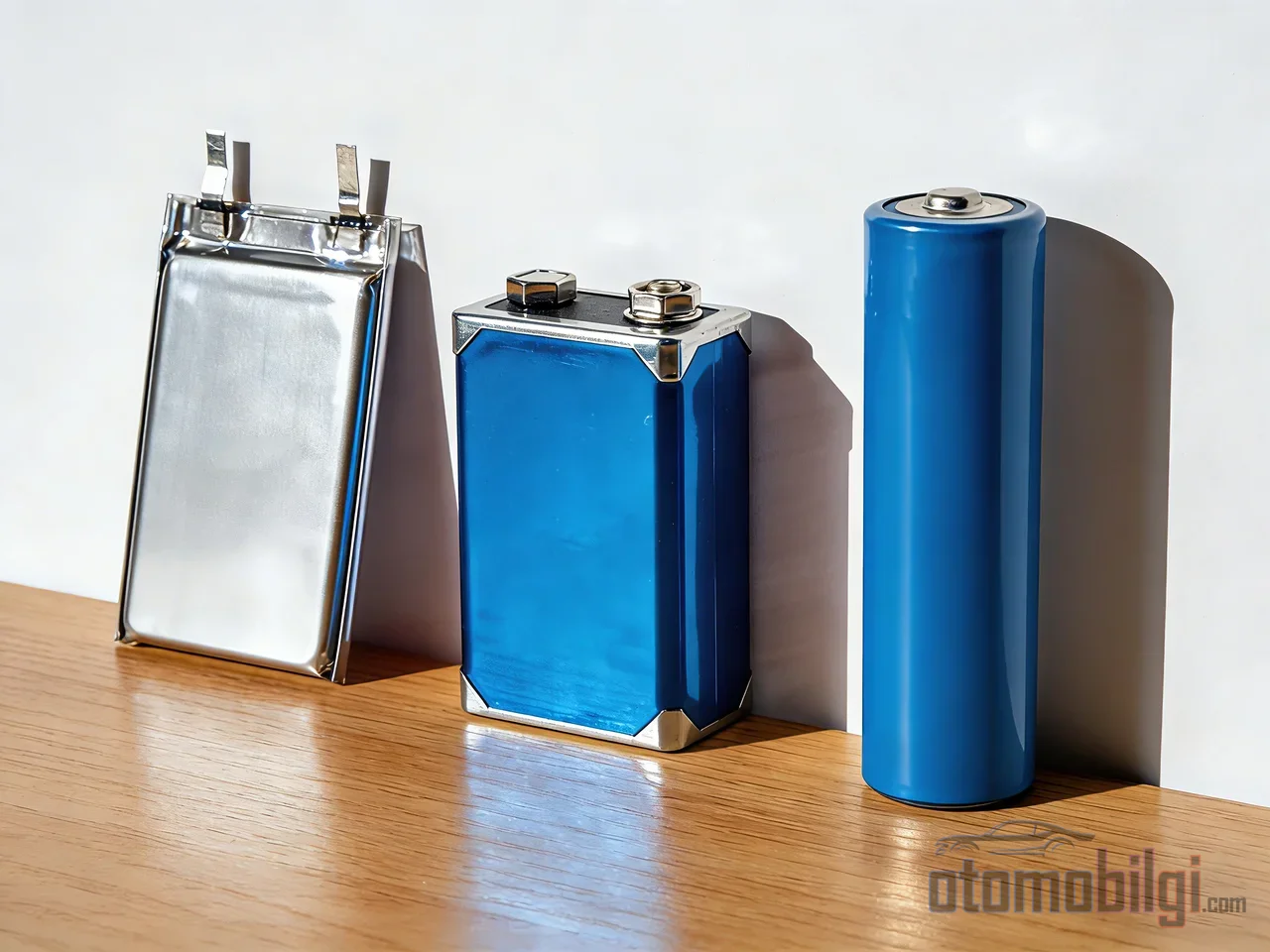
First, let us get to know them quickly, because the concepts can get confusing. The cylindrical cell, as the name suggests, is a small cylinder with a metal tube casing: the classic example is 18650, a cell 18 mm in diameter and 65 mm in length. Later came sizes like 21700 and 26650. The prismatic cell, on the other hand, is a rectangular unit wrapped in a rigid aluminum or steel casing; inside them there are either stacked electrodes or a flattened roll. The pouch cell is the softest of them all: imagine an envelope wrapped in flexible aluminum-polymer foil, with no rigid casing.
Let us make a nice analogy: cylindrical cells are like a box of pencils, prismatic cells are like a book, and pouch cells are like thin notebooks not yet placed in a binder. Which is easier to keep in a drawer, to carry around, to protect from water? Well, manufacturers ask exactly these questions on a scale worth billions of dollars.
Energy density, volume, and durability comparison
Let us talk numbers, because guesswork does not settle this matter. Energy density, that is, how much energy a cell fits into a given volume and weight, differs significantly by form:
| Form | Volumetric density | Gravimetric density | Notable feature |
|---|---|---|---|
| Cylindrical | 200-250 Wh/L | 150-200 Wh/kg | High mechanical durability |
| Prismatic | 250-300 Wh/L | 170-220 Wh/kg | 50-100 Ah+ single-cell capacity |
| Pouch | 300-350 Wh/L | 200-260 Wh/kg | Highest packaging efficiency |
Highlights
- Pouch cells offer the highest energy density at 300-350 Wh/L.
- Compared to a cylindrical arrangement, the prismatic design leaves 10-15% less dead space within the pack.
- Tesla's 4680 cell is 5.5 times larger in volume than the 21700.
- The evolution of cell form factor can save more than 500 euros per vehicle.
- By general consensus, cylindrical cells are the safest format in terms of accident and fault tolerance.
The table gives a serious advantage to the pouch side, so why does not everyone use pouch cells? Because cell form is a chain of trade-offs: when you gain energy density, you pay for it somewhere else. The pouch's victory starts sweating when it's squeezed inside a pack, but we'll get there.
Thermal management: Why does the cylindrical cell stay cool?
In the battery world, heat is destiny. If a cell keeps heating up, both its lifespan shortens and the safety risk grows. And this is exactly where the form factor comes into play. a sturdy metal casing, small size, and even distribution of internal pressure are a powerful combination. thanks to their small size, round shape, and metal casings, they distribute heat quickly and evenly. The gaps between the cells allow airflow, and coolant can even be placed directly between the cells. A technical detail: in a cylindrical cell, thermal conductivity along the axial direction is higher than in the radial direction; this makes it easier for heat to be expelled.
With prismatic cells, things turn the other way around. They have less surface area relative to their volume, and when packed tightly, heat starts accumulating at the center of the pack. That's why prismatic packs demand more sophisticated, more precise cooling systems. Pouch cells, when standing alone, dissipate heat quite well thanks to their large flat surfaces; just think of the battery in my phone. But when compressed inside a pack, they run into the same heat accumulation problem.
Cold weather also creates an interesting distinction: cylindrical packs heat up more evenly in use, and their behavior in the cold is more predictable. Prismatic and pouch packs, on the other hand, may need an integrated heater for charging in the cold. So it makes a difference in winter.
Durability and damage tolerance: Which form is forgiving in a crash?
Here's the most serious part of the form factor debate. By general consensus, cylindrical cells are the safest format: a sturdy metal casing, small size, and even distribution of internal pressure make a powerful combination. Each cell has its own pressure relief vent, and when one cell fails, that failure doesn't easily spread to the entire pack. That's exactly the advantage of thinking small.
A single failure in a prismatic cell can release much more energy at once, because the cell itself is already large. Large surfaces are prone to swelling - bloating - and when large relief vents open, toxic gas can escape. The pouch side sits at the very end of the risk spectrum: the most fragile form in mechanical and thermal safety. In case of puncture, rapid gas accumulation, swelling, or fire can occur; since there's no relief vent, if pressure gets out of control, the result can be catastrophic. That's why pouch cells need special restraint mechanisms and compression within the module for mechanical integrity.
One more detail: pouch and prismatic cells expand as they age. Pressure builds up inside the pack, and performance drops. Rigid-cased cells also swell, but you can't see it from the outside, which is a whole separate debate in itself.
What's the situation on the cycle life side?
In the longevity race, quality cylindrical LiFePO4 cells can endure more than 10,000 cycles at 80% depth of discharge. Modern prismatic cells operate beyond 5,000 cycles. Pouch cells, meanwhile, generally have the shortest cycle life under demanding conditions. Safety tests also confirm the differences between formats: in thermal abuse tests conducted in laboratory settings, fully charged (at 100% state of charge) 21700 cells showed violent fire and explosion, while empty or sub-20% cells never did. So state of charge is just as decisive as the form.
The cost reality: What does the form factor say to your wallet?
Here's where things get confusing. On the cost side, two facts can be true at once, because they measure different things. The cylindrical cell is cheap when considered per cell: thanks to standardization, a mature automated production line and a broad supply chain, its initial cost is low. But assembling thousands of small cells for a vehicle means assembly labor and a more complex battery management system. So the total cost per kWh can rise surprisingly.
With prismatic cells, the picture reverses: a complex casing can make the cell 10-15% more expensive per unit, but large-scale production lowered costs, and today prismatic stands out as one of the most cost-effective options per unit of energy. Fewer cells, fewer connections, simpler packaging. Pouch production is relatively economical in terms of material use; but custom-designed pouch cells can be the most expensive on the lists.
And there's the bigger picture: the heaviest component of battery cost is not the form factor, but the cathode active material. In NMC chemistry, the cathode accounts for 40-50% of cell cost; in LFP, 25-30%. The form factor is the margin for improvement in this huge pie. And that margin is too big to underestimate: according to industry analyses, the evolution of cell form factor can deliver savings of more than 500 euros per vehicle.
Why are manufacturers betting on different forms?
Around 2020, the market was almost split in two: prismatic led with roughly a 40% share and pouch around 35%, with cylindrical behind. But since then, the pieces have shifted considerably.
Tesla was the name carrying the cylindrical cell's banner, and in 2022 it began production of its new large cylindrical cell called 4680 in California and Texas. But note, it did not tie itself to a single strategy at once: in the same period it also sourced prismatic cells from CATL, and it was reported that it would use prismatic cells for the Model 3 produced in China. Tesla's use of readily available standard cylindrical cells gave it a flexibility advantage over rivals locked into their own custom prismatic or pouch designs.
The 46 mm wave: The era of large cylindrical cells
The most pronounced trend of recent years is large cylindrical cells with a 46 mm diameter. The 4680 (46 mm diameter, 80 mm length) is 5.5 times larger in volume than the 21700. LG Energy Solution is standardizing the 46 mm diameter on its 46-Series platform and offering cells in different sizes; Samsung SDI, meanwhile, introduced its four-size 46-series (4680, 4695, 46100, 46120) in 2025 and began production. BMW announced that it has moved to two new 46 mm cylindrical cell designs in its sixth-generation battery technology; Rivian is also offering vehicles with these cells.
So what is the logic behind this trend? A large cylindrical cell reduces the assembly burden of the small cylindrical form while largely preserving the cooling and durability advantages of the round form at scale. The manufacturing processes of the tabless internal structure used in these cells have now also been published in detail in the academic literature; in other words, the technology is maturing. On the other hand, market analyses indicate that in the long term the trend may turn in favor of the prismatic form: pouch and small cylindrical cells struggle to scale to very large capacities, and most Western manufacturers are moving toward prismatic. There are even comparative academic studies comparing BYD's prismatic Blade cell with Tesla's 4680; the industry has carried this debate up to the level of scientific papers.
So which form should win? The answer lies hidden in the question itself
The short and clear answer is this: there is no universal winner; while the cylindrical cell stands out with safety, cooling, and manufacturing maturity, the prismatic cell leads in cost-effectiveness and packaging efficiency, and the pouch cell leads in energy density. The right form varies according to the vehicle's priority: those who want safety and predictable cooling lean toward the cylindrical form, area- and cost-focused mass production leans toward prismatic, and niche designs seeking maximum range and lightness lean toward pouch.
And as of 2026, what is really changing seems to be the question itself. The debate is no longer "which one is better" but shifting to "how to move to large cells." The 46 mm cylindrical cells and large prismatic cells are narrowing the differences between forms and bringing manufacturing economics to the forefront. The coming few years will be the years when these two large-cell approaches compete on the mass production line. As for me, I am settling comfortably into my seat; because believe it or not, the winner of this competition will be the price and range of the car you drive.
Sources
- Pouch vs. Prismatic vs. Cylindrical? Your Lithium Battery Cell Guide
- Prismatic vs Pouch vs Cylindrical Lithium Ion Battery Cell
- Prismatic Cells vs. Cylindrical Cells: What is the Difference?
- BU-301a: Types of Battery Cells
- The future of affordable EVs: Breakthroughs in battery pack costs
- Design, Properties, and Manufacturing of Cylindrical Li-Ion Cells
- Contrasting a BYD Blade prismatic cell and Tesla 4680
- SAMSUNG SDI Begins Production of 46-Series Cylindrical Cells
- What is LG Energy Solution's 46-Series?
- Li-ion Pouch Cell Thermal Abuse Test - Sandia National Laboratories