Type 2 Cable Guide: Amperage, Phase and Cross-Section Calculation
The options you face when buying a Type 2 charging cable look simple at first glance: 16A or 32A, single-phase or three-phase, 5 meters or 7 meters. But when you tick the wrong box, what you notice is usually silent yet costly: a thin-gauge cable heats up all night, trips the breaker, or your car never draws the power it is ready to draw. Choosing the right cable does not increase charging speed; it prevents the wrong cable from suppressing it. In this guide, we will go through the four variables of amps, phases, gauge, and length one by one, calculating which combination is sufficient for whom.
The Type 2 Connector and the Amp-Phase Relationship
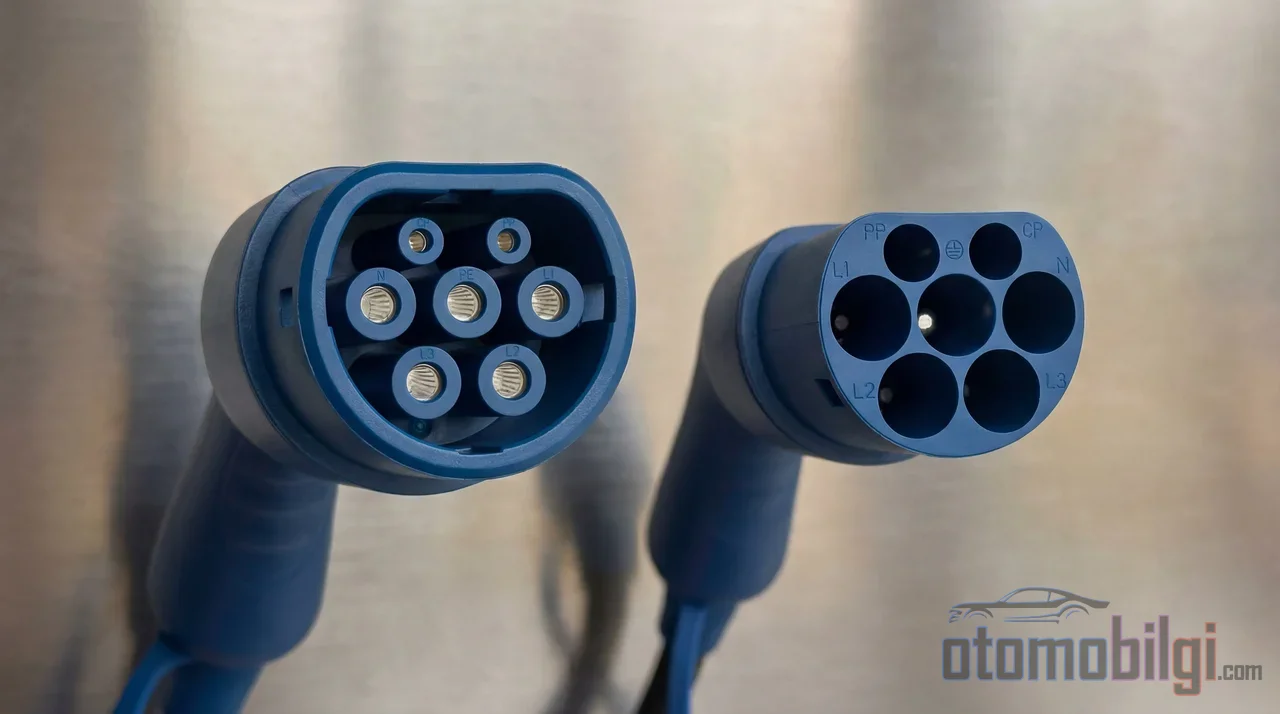
The Type 2 connector is the de facto standard for AC charging in Europe, and the technical reason is clear: its 7-pin design supports both single-phase and three-phase power. Type 1's 5-pin design is limited to single-phase and has a 7.4 kW ceiling; Type 2 goes up to 22 kW on three phases. This flexibility turns the connector from a one-size-fits-all part into a choice matrix.
The matrix's two axes are amperage and the number of phases. The power calculation is simple: kW = V × A ÷ 1000. Single-phase voltage is 230 V, and three-phase line-to-line voltage is 400 V. ("220 volt" and "380 volt" in Turkish are old habits; modern grid values are 230 and 400 V.) Four common combinations appear clearly in the table:
| Combination | Voltage | Current | Power |
|---|---|---|---|
| Single-phase 16A | 230 V | 16A | ~3.7 kW |
| Single-phase 32A | 230 V | 32A | 7.4 kW |
| Three-phase 16A | 400 V | 3 × 16A | 11 kW |
| Three-phase 32A | 400 V | 3 × 32A | 22 kW |
To understand why power jumps so dramatically on three phases, think of the per-phase current logic: in an 11 kW charge, the car draws 16A per phase; at 22 kW, 32A per phase. Three-phase 32A transfers roughly six times more power than single-phase 16A. However, this table only shows the ceiling the cable allows, not the power the car will draw. Understanding what happens below that ceiling is the most critical step of the purchase.
What Actually Determines Charging Power?
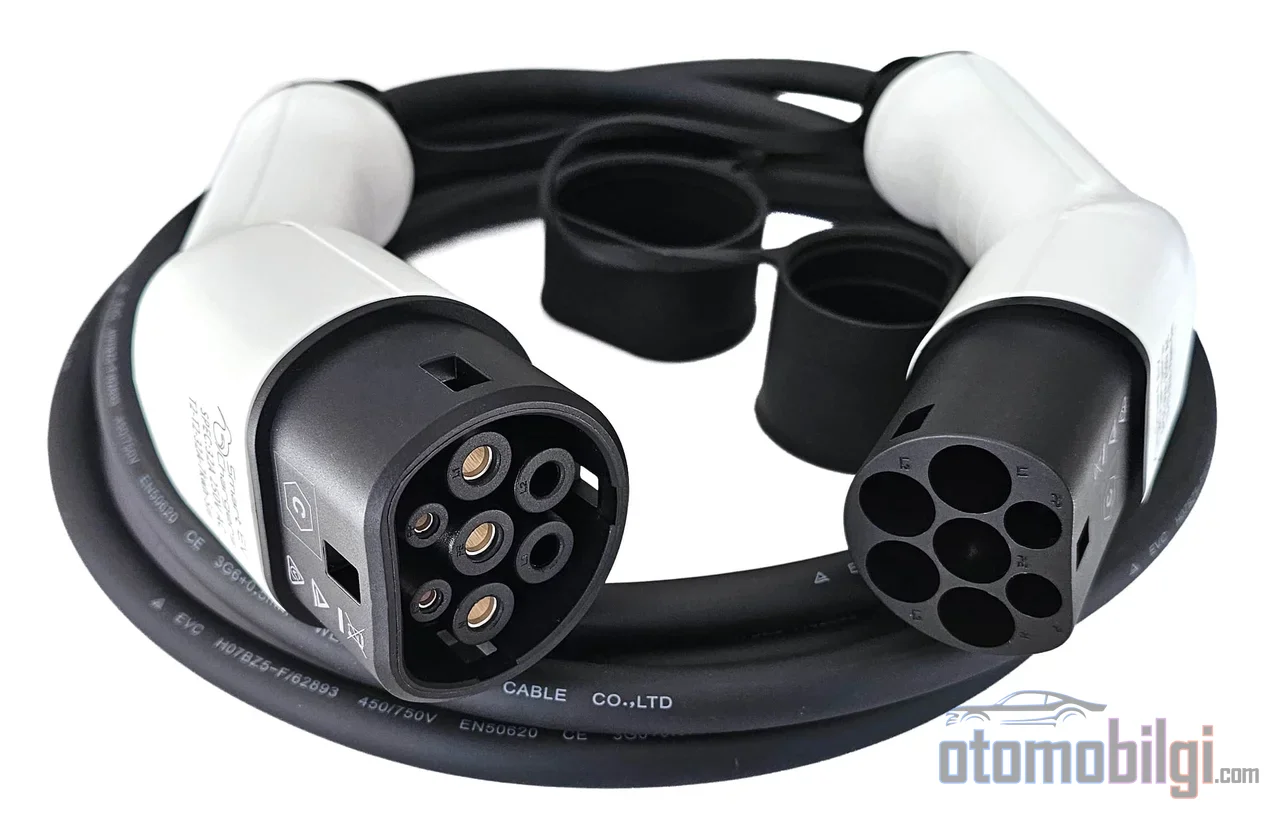
EV charging is a chain of four elements: home installation, wallbox (EVSE), cable, and the vehicle's on-board charger (OBC). The actual charging power is always limited by the smallest of these four limits. Replacing a 50 Euro cable with a 200 Euro one does not strengthen the weakest link in the chain; it only moves the link somewhere else.
Key Takeaways
- The actual charging power is limited by the lowest limit of the installation, wallbox, cable, and vehicle charger.
- Single-phase 32A = 7.4 kW, three-phase 16A = 11 kW, three-phase 32A = 22 kW.
- A 32A cable can also be used safely at 16A points; it is the most flexible option.
- A thin-gauge cable heats up, degrades the insulation, and can char the plug.
- If the car is limited to 11 kW, a 22 kW cable offers no speed advantage.
The Car's Limit: The On-Board Charger
A car with a 7.4 kW OBC charges at 7.4 kW even when plugged into a 22 kW station. If the vehicle only supports single-phase charging, it draws current from only one phase while connected to a three-phase station: At the 16A setting it receives about 3.5-3.7 kW, and at the 32A setting 7.4 kW. Having a three-phase home and a 22 kW station does not change this picture. Before starting cable selection, confirm your vehicle's OBC value from its technical specifications; the entire selection only makes sense below or above this single number.
A Cable Sets a Ceiling, It Does Not Add Speed
A common mistake is assuming that a higher-amperage cable speeds up the vehicle. The logic is simple: a cable is like a wide water pipe. Enlarging the pipe does not increase water pressure; it only allows a higher flow rate. A 32A cable does not force the vehicle to charge at 32A, it only allows that current. The vehicle and the station regulate the current automatically via the communication protocol. That is why a 32A cable can be used with complete safety at 16A points too, and is in practice the most flexible choice. By contrast, buying a 22 kW cable for an 11 kW vehicle means paying money for a capacity that will never be used.
A Thin Cable Heats Up: Cross-Section, Voltage Drop, and Fuse
The number other than the cable's rating is the conductor cross-section, and it directly determines the safety side. A cable with an insufficient cross-section heats up during long charging sessions. Moderate overheating degrades the insulation over time; severe overheating can char the plug or cause the cable to fail. The bad news about heat is this: when the current doubles, the heat produced roughly quadruples. In other words, 32A means twice the current of 16A but roughly four times the heat load. Using a thin-conductor cable designed for 16A in a 32A system is therefore not a gamble, but a scheduled failure.
Cross-section values are hierarchical and clear:
- 2.5 mm²: not suitable for 32A, the voltage drop falls outside tolerance.
- 4 mm²: 20-25A, up to about 5.5 kW; not the standard for 32A.
- 6 mm²: the standard for 32A; carries 7.4 kW single-phase or 22 kW three-phase.
- 10 mm²: for long lines and needs above 32A.
Why are the numbers so sharp? When dropping from 6 mm² to 4 mm², the voltage drop rises to about 2.92% and hits the compliance limit; at 2.5 mm² the drop is clearly outside tolerance at 4.67%. In practice, a 25-meter 4 mm² cable loses about 281 W as heat at 32A. This loss is not just wasted energy; all the lost energy turns into heat inside the cable and feeds the wear cycle described above.
The same physics applies on the installation side: trying to increase charging power by enlarging the fuse without enlarging the cable cross-section creates a serious overheating risk. This intervention is a job for a qualified electrician. The contracted subscription power is also a link in the chain: in the evening hours, the boiler, air conditioner, and charging together can exceed the contracted power and trip the fuse. The solution is either to limit the load with a charger that has adjustable current, or to contact the utility company and change the subscription power.
Length and Quality: 5 Meters Enough, or 10 Meters Necessary?
The idea that a long cable slows charging is widespread and has a physically true core: length adds resistance, and resistance increases voltage drop. However, on a properly rated cable with the correct cross-section, this effect has no practical significance at standard lengths. The decisive factors are three variables evaluated together: cross-section, current and length; when a quality cable is properly designed, length does not limit charging speed. Adding an extension cord is a completely different matter and is not recommended.
For practical length selection, 5-7 meters is the ideal range for most users; 6.5 meters stands out as a good compromise in terms of parking positions. If the cable falls short, no cross-section can save it; but buying 10 meters is not necessary for everyone either. If there is a fixed point on the garage wall, 5 meters makes sense; with variable street parking positions, 7 meters is logical. On the quality side, what to look for: the cable's compliance with IEC 61851-1 and IEC 62196-2 standards and certifications such as CE and TUV. Quality insulation and a wide cross-section do not speed up charging, but they keep it stable and predictable for years. With a cheaper, uncertified cable, the invisible risk is greater.
Which Cable Is Enough for Whom?
Single-Phase Home and 7.4 kW Vehicles
If your vehicle has a 7.4 kW single-phase OBC and your home is single-phase, a 32A single-phase cable is the answer for the whole system; a 22 kW three-phase cable is a waste of money. The answer to whether your home is single-phase or three-phase lies on the label of the electricity meter: if it says 3x230/400 V, the installation is three-phase; if it only says 230 V, it is single-phase. The number of poles of the main fuse or the subscription details also give the same result.
Three-Phase Home and 11 kW Vehicles
If you have a three-phase home and a vehicle with an 11 kW OBC, a 16A three-phase cable uses the full potential. The 11 kW option is the most balanced point in terms of the speed-practicality balance and avoids the cost of unnecessarily expensive 22 kW technology. 22 kW only makes sense if both the vehicle and the installation support this power; for example, some vehicles accept 22 kW AC, but these are a minority. For those who want flexibility in the long term, a 32A three-phase cable is a future-oriented choice: a vehicle charging at 11 kW today may change tomorrow, the cable remains.
Does a Three-Phase Cable Work on a Single-Phase System?
Yes, it works. When a three-phase cable is plugged into a single-phase wallbox or socket, it draws current through only one phase, the other two phases remain idle, and this is completely safe electrically. Speed drops to the single-phase system's limit and the ceiling becomes 7.4 kW. This compatibility is the second reason that makes the three-phase cable the long-term option. The decision to switch to three-phase is not as urgent as thought: if the vehicle is single-phase, switching provides no speed gain at all.
Short Answer: How Many Amps Are Enough?
The summary in one sentence is as follows: The cable should be at or above the vehicle's OBC rating and the wallbox current; for most users, three-phase 16A (11 kW) is sufficient, and a 32A three-phase cable only makes sense for those who want long-term flexibility. The decision becomes clear in three steps: Find out your vehicle's OBC power, confirm the current of your wallbox or public charging points, then get a cable equal to or larger than the smaller of the two. A quality 7.4 kW cable of 5 meters covers home wallboxes and most public points with cable sockets. Buying a 22 kW cable unnecessarily means paying in advance for power your vehicle will never draw. Heated plugs, tripped breakers, and slowing overnight charging almost entirely stem from skipping these three steps.
Sources
- 1-phase vs 3-phase charging & 16A vs 32A - Voldt
- Single-Phase vs Three-Phase EV Charging - Elevocharge
- Single-Phase or Three-Phase? Choosing Home EV Charging - WiseCar
- Can I use a three-phase EV charging cable in a single-phase charging box? - Voldt
- How Cable Cross-Section Impacts EV Charging Speed and Safety - Voldt UK
- EV Charging Cable Voltage Drop Chart - evcablehub
- Do I Need a 22kW EV Charging Cable? An Honest Answer
- How Many Amps and How Many Meters Should a Charging Cable Be? - Bemis E-V Charge