Is Your Home's Electrical Wiring Sufficient for a Wallbox?
Share This Page
There are four technical criteria that determine whether your home's electrical installation is sufficient before installing a wallbox: the total capacity of the fuse panel, the cable cross-section, whether your connection is single-phase or three-phase, and the contracted power registered on your electricity subscription. If even one of these four fails to meet the required value, no matter how high-quality the device is, installation either cannot be done or will not operate safely and efficiently. This page addresses, one by one, these pre-installation hurdles that socket-vs-wallbox comparisons usually skip.
Highlights
- A typical apartment in Türkiye is single-phase, and the contracted power is usually limited to 5-6 kW; this is insufficient for an 11 kW wallbox.
- In fuse selection, the circuit is sized to at least 125% of the charger's current: a 40 A device requires a 50 A circuit.
- For three-phase 11-22 kW installations, fully copper cable of at least 5x6 mm² is used up to 50 meters, and 5x10 mm² for longer distances.
- In residential subscriptions, a power upgrade does not incur a monthly extra charge; only the guarantee fee difference is paid at the initial stage.
- A standard home installation takes on average 2-4 hours with a licensed electrician.
What Should the Home Electrical Infrastructure Check for a Wallbox?
An electric vehicle charger is not, under the European standard, an ordinary household appliance; it is considered a permanent electrical installation element. IEC 61851 and IEC 60364 standards and national electrical regulations apply; a compliant installation means a dedicated charging circuit, correct fusing, residual current protection (RCD), appropriate cable cross-section, and a licensed electrician. This framework means the installation decision is made based on the current state of your wiring rather than the device price.
The order of checks is logical: first the panel's total capacity, then the current of the circuit to be allocated, then cable length and cross-section, and finally your subscription's contracted power. Each step changes the outcome of the previous one. If the panel is insufficient, a circuit cannot be added; if the subscription power is insufficient, even the most accurate cable cross-section will not run the device at full power.
Is the Fuse Panel Capacity Sufficient? How Is the Load Calculation Done?
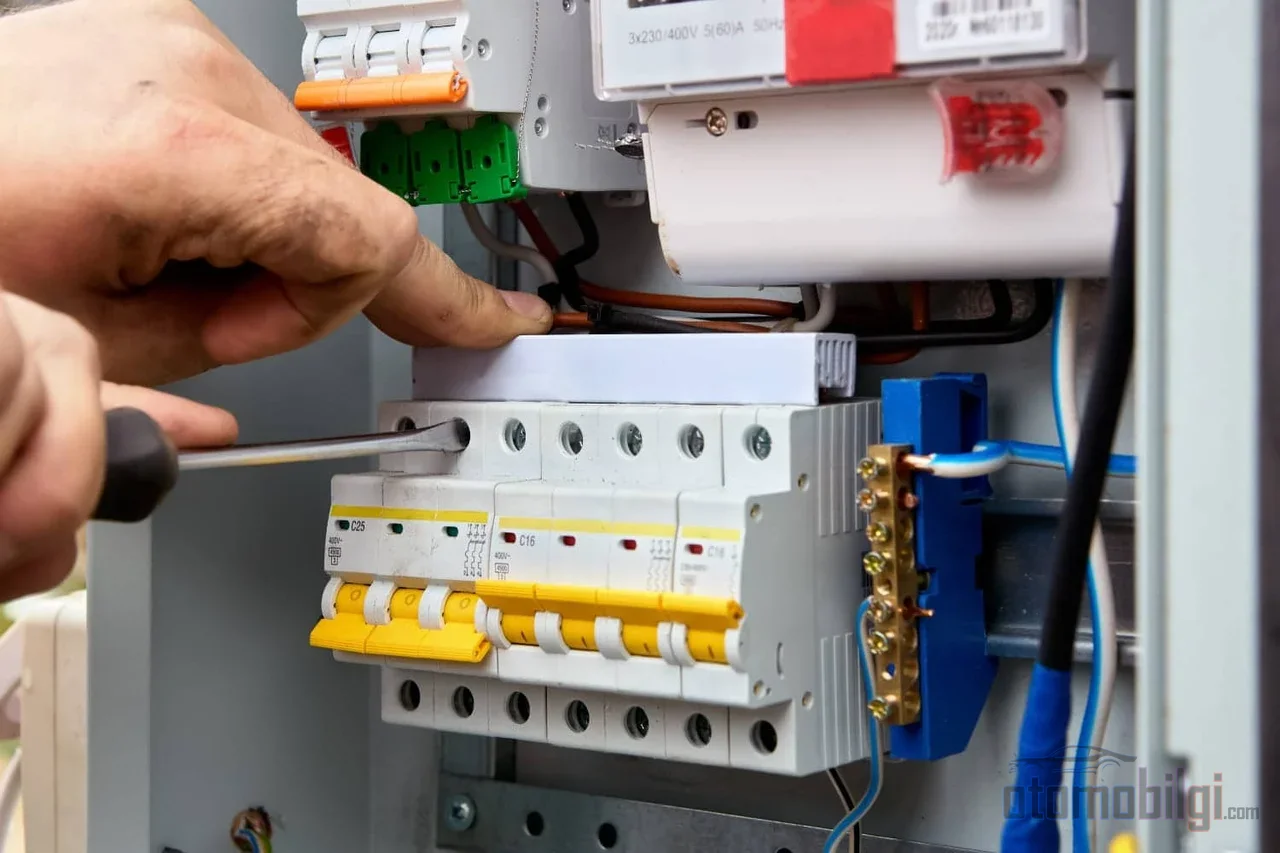
The electrical panel is the central unit that distributes its own fuse to every circuit in the home. The total amperage capacity of panels is typically at the 100, 150, or 200 ampere level; 100-ampere panels are common in buildings built before 1980. Most home chargers, on the other hand, require a dedicated circuit at the 40-60 ampere, 240 volt level; the exact value depends on the device model and the vehicle.
Reading the capacity on paper is not enough; the electrician performs a load calculation: the remaining capacity is determined by evaluating the current consumption of air conditioning, heating, white goods, and lighting. A conservative calculation assumes the worst-case scenario in which all large appliances run simultaneously. As a general reference, most modern homes with a 200-ampere panel support a charger without a major upgrade; however, about 20% of homes need additional electrical infrastructure. A 100-amp panel may often be sufficient depending on the use of other devices, but a home with limited capacity cannot safely carry a 40-amp charging circuit.
What If the Panel Is Insufficient, and How Much Does It Cost?
If the panel capacity is insufficient, the solution is to replace the panel with one of a larger capacity. This job requires coordination with the electric utility company: power shutoff, meter replacement, and reconnection steps typically span a planning process of 1-2 weeks. In terms of cost, there is a big difference between a simple fuse addition to the existing panel and a full panel replacement; the former is a low-cost transaction, while the latter is a significant investment. It is also possible to proceed without upgrading the panel at all: choosing a lower-amperage charger or using load management and circuit sharing systems are commonly used approaches in homes with limited capacity.
Circuit Breaker and Cable Cross-Section: What Do the Numbers Say?
The basic rule in breaker selection is this: the circuit breaker is sized to at least 125% of the charger's continuous current. Accordingly, a 40-amp charger requires a dedicated 50-amp circuit. On the European side, the practical equivalents are also clear: for 11 kW chargers, a 16 A breaker is used, and for 22 kW units, a 32 A breaker, and in most countries each wallbox must have its own breaker.
Cable cross-section depends not only on the current but also on the distance. In home charging installations, 6 mm² or 10 mm² armored cable is usually required. For short distances, 6 mm² copper cable is common for a 7.4 kW installation; however, long line runs, high ambient temperature, or local regulations may make switching to 10 mm² mandatory. For distances over 30 meters, 10 mm² copper cable is often recommended to reduce voltage drop. Practical values from Türkiye point in the same direction: in three-phase 11-22 kW installations, minimum 5x6 mm² full copper is used up to 50 meters, and 5x10 mm² for longer distances; on the breaker side, 3x32 A or 3x40 A Type C is selected. When the distance between the panel and the unit reaches 100-150 meters, the cross-section increases again. The exact calculation always belongs to the electrician; cable cross-section, installation method, continuous load, voltage drop, and local regulations are evaluated together.
Single-Phase or Three-Phase? Effect on Charging Speed
A single-phase connection uses a single alternating current line at 230 volts. A three-phase connection uses three lines simultaneously and delivers significantly higher power within the same device class. This difference directly affects charging time and determines the choice of unit.
| Connection Type | Typical Unit Power | When Is It Sufficient? |
|---|---|---|
| Single-phase | 7.4 kW | Usually sufficient for single-vehicle households that charge overnight |
| Three-phase | 11 kW | The most common residential solution in Europe |
| Three-phase | 22 kW | Requires sufficient capacity and the vehicle accepting 22 kW AC |
There is a critical warning on the 22 kW side: If your vehicle's AC onboard charger does not accept 22 kW, the extra cost you will pay for this installation provides little benefit. For this reason, the AC capacity of the vehicle's onboard charging unit must be verified before making an installation decision. For those driving more than 100 km per day or for households with two vehicles, the speed advantage of three-phase charging becomes truly decisive.
Obstacles Encountered in Apartments and Detached Houses in Türkiye
A typical apartment in Türkiye is single-phase, and the contracted power is usually limited to 5-6 kW. This value is designed to be sufficient for the daily consumption of a standard home; however, it is insufficient for an 11 kW wallbox. If you are planning a wallbox in your apartment, the real obstacle is often not the cabling or the panel, but this contracted power registered to your subscription. While it is true that home-type single-phase charging stations work with the existing infrastructure in most homes in Türkiye, this statement applies to low-power devices; if you are aiming for a high-power device, the same infrastructure will not suffice.
In detached houses the picture is more flexible: there is usually the option to request a three-phase connection and expand the panel according to needs. Even so, in buildings constructed before 1980, the 100-amp panel limitation and long cable runs require the cross-section calculation to be carefully redone in detached houses as well.
Installation in an Apartment: The Permit Process
A homeowners' association general assembly decision is required for the installation of charging stations in shared parking areas. In individual installations, the apartment owner applies in writing to the building management for the mounting of a wallbox in their own parking space. There is also a regulatory step that facilitates the process: The Ministry of Environment, Urbanization and Climate Change sent a circular to 81 provinces, making it easier to install electric vehicle charging units in residential complexes and apartment buildings. The suitability of the electrical installation and the use of CE/TSE certified devices are mandatory in the installation; an 11 kW wall-mounted charging unit in an enclosed parking lot is at the level of a typical case cited by the regulations. For most residential applications, an ingress protection rating of IP65 is recommended for outdoor installations.
Electrical Subscription Power Upgrade: Process and Cost
If the contracted power is insufficient, the subscription power must be increased before wallbox installation by applying to the electricity distribution company; for example, for an 11 kW device, a power upgrade is made accordingly. The process involves a request to the distribution company, payment of project and connection fees when necessary, and meter and insurance arrangements. There is an important mitigating factor for residential subscriptions: the increased contracted power does not bring a monthly fixed power fee; only the security deposit difference is paid at the initial stage. In other words, the power upgrade does not add any extra cost to your monthly bill.
The cost dimension is calculated based on the security deposit: for 2026, the residential security deposit is at the level of 263 TL/kW. Labor and material items also affect the budget as much as the power increase; panel upgrades, additional cable runs, wall drilling, grounding improvements, protective devices, testing and certification, and permit fees are among the hidden costs of installation. Conscious choice is also required on the RCD side: depending on the device's design, a Type A RCD or Type B RCD is used, integrating 6 mA DC leakage current. Some wallboxes include an internal RCD; but if local regulations already require an external RCD, paying extra for a more expensive model with an internal RCD makes little sense.
Pre-Installation Checklist: How Do You Know If You're Ready?
- Load calculation: Have a licensed electrician perform a load calculation including current consumption (air conditioning, heating, white goods, lighting); does the remaining capacity support the device current you're targeting?
- Dedicated circuit and breaker: Can a dedicated circuit with its own breaker, sized at 125% of the device's continuous current, be planned?
- Cable cross-section and distance: Measure the panel-to-device distance; on runs exceeding 30 meters and in three-phase installations reaching 100-150 meters, the cross-section may need to be increased.
- Connection type: Are you single-phase or three-phase? Evaluate the target power together with your vehicle's AC capacity.
- Contract power: Check the power in your subscription; if a 5-6 kW apartment subscription is insufficient for an 11 kW device, apply to the utility company for a power increase before installation.
- Permits: If you live in an apartment building, submit a written application to the management board and, when necessary, initiate the process for a general assembly decision.
If you've passed this list in order, the installation itself is quick: a standard home installation is completed by a licensed electrician in an average of 2-4 hours. Most of the time goes into verifying the adequacy of the electrical system and, if necessary, completing power increase and permitting processes. This is the right order: infrastructure first, device second.
Sources
- Getting Started with Home EV Charging
- Home EV Charger Setup: Costs, Cable, and Breaker Tips
- Why a Circuit Breaker is Crucial for Safe Charging
- Do You Need an Electrical Panel Upgrade for Your EV?
- Can Your Electrical Panel Handle An EV Charger?
- 1-phase vs 3-phase charging & 16A vs 32A
- Single Phase Vs Three Phase EV Charger: The Ultimate Guide
- What Size Armoured Cable For EV Charger?
- EVSE installation guideline
- Conditions for installing charging units in sites and apartment buildings simplified
- Installing a charging unit at your home: regulations and requirements
- Home Charging Station Installation
- Does a Power Increase Increase the Bill?
- Electricity Subscription Guide