When Should Brake Discs Be Replaced?
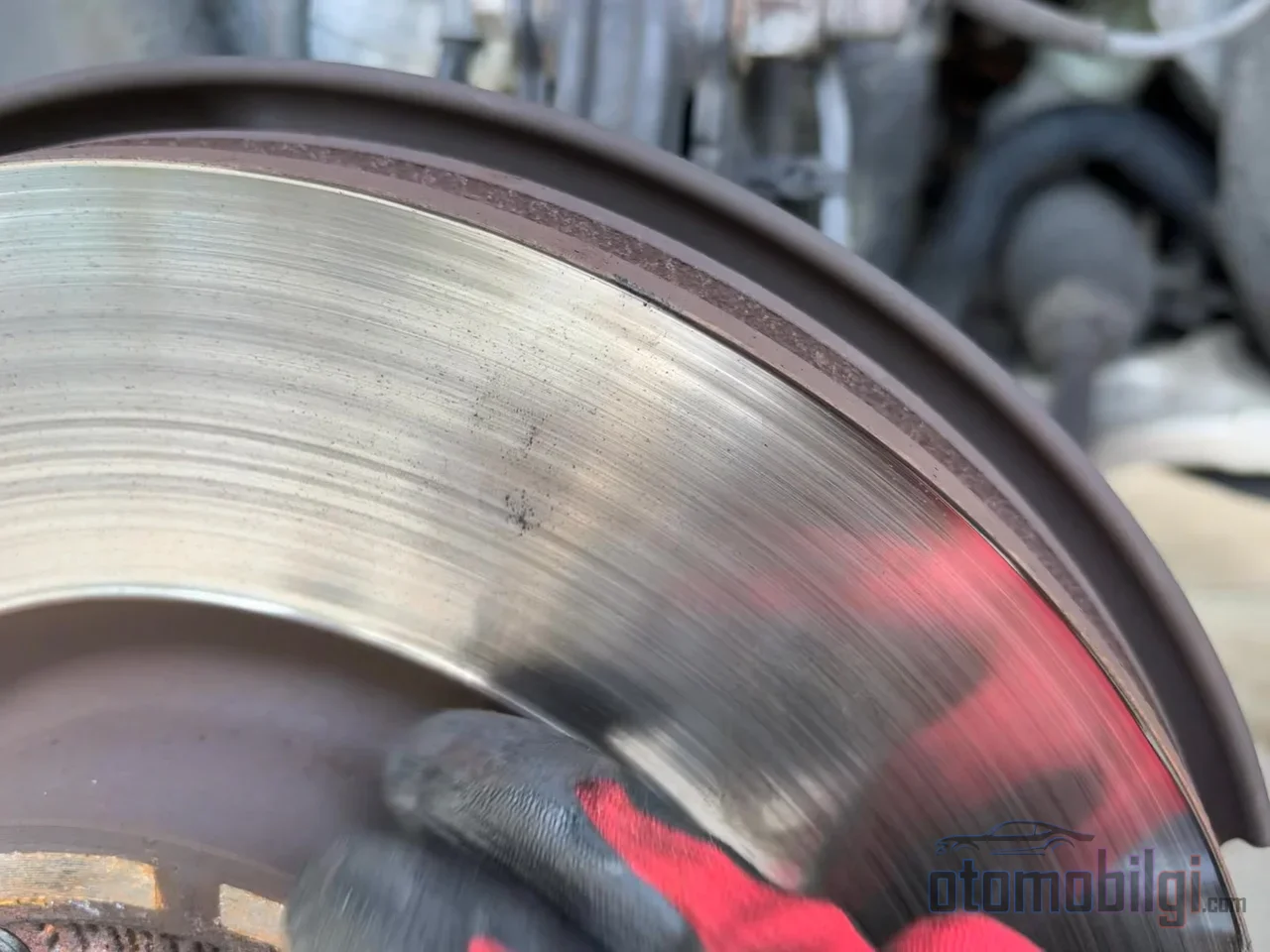
Most drivers keep track of brake pad wear; when the pad thickness decreases, they go to the service, consider the job done. Yet the system's real silently wearing component is the disc itself. Since it does not visibly thin out like the pads do, the question of when the disc needs to be replaced is often either never asked or answered too late. Let me say this as someone who has been in this trade for thirty years: in the old days the disc was never looked at; pads were fitted and off you went; today the manufacturers' minimum thickness values, measurement methods, and rules about replacing them together are so clear that not knowing the disc's condition is no longer an excuse.
Does the brake disc actually wear out, or is it a lifetime part?
Contrary to popular belief, the brake disc is not a lifetime part. The pad slowing the wheel by clamping the disc is a friction event, and the disc takes its share of the wear from that friction. Since the pad is softer, it is consumed faster; the disc wears more slowly, but it does not go on forever. In other words, the disc, like the pad, is a consumable part with a limited lifespan; the only difference is that its replacement interval is longer.
Every disc has a minimum thickness value set by the manufacturer, and this value is physically written on the disc itself. To find this mark, engraved on the surface, between the vanes, or on the center hub, it is enough to run your hand over the disc; it usually bears the expression MIN TH along with a millimeter value. A disc that has gone below this value has begun to lose its heat dissipation capacity and mechanical strength.
I can illustrate just how insidious thickness loss is with a simple example: let's say a new disc is 10 millimeters thick. By the time it drops to 9 millimeters, it may have reached the replacement or machining limit. In other words, 1 millimeter of wear can effectively render the disc unusable. That difference is not a distance you can distinguish with the naked eye or by touch; a proper measuring tool must absolutely come into play.
How is disc thickness measured?
After removing the wheel, the job belongs to a disc brake micrometer. As important as where the measurement is taken is how many measurements are taken: since the goal is to find the thinnest point of the braking surface, measuring from a single spot is misleading. Taking measurements from at least 3-5 different points and going by the lowest value is the correct method; the measuring tool is also expected to have a precision of 0.1 millimeters.
When measuring, there are two classic mistakes. The first is measuring near the inner and outer edges of the disc: since the pads never touch those areas, the thickness there does not reflect the actual wear. You need to measure a few millimeters in from the edge, on the band where the pad makes contact. The second is, on drilled or slotted discs, aligning the measurement with the holes or slots; the measurement should always be taken between these interruptions, on a smooth surface.
If the lowest value obtained is below the manufacturer's stated minimum, there is nothing to discuss: the disc gets replaced. If it is just above the limit, machining may still be an option; but nowadays many services prefer outright replacement over machining, because a machined disc without sufficient margin left reaches the limit again much sooner.
Key Highlights
- Every disc has a minimum thickness value (MIN TH) engraved on it; a disc that falls below this must be replaced.
- Even 1 millimeter of wear can be the replacement limit; the difference is measured only with a micrometer.
- General rule: disc thickness should be checked at every service, and the disc itself roughly at every second pad change.
- Rotor life varies between 48,000-112,000 km depending on driving style.
- An overheated disc; can cause a complete loss of braking through cracking, warping, and boiling of the brake fluid.
How can you tell a worn brake disc at the wheel?
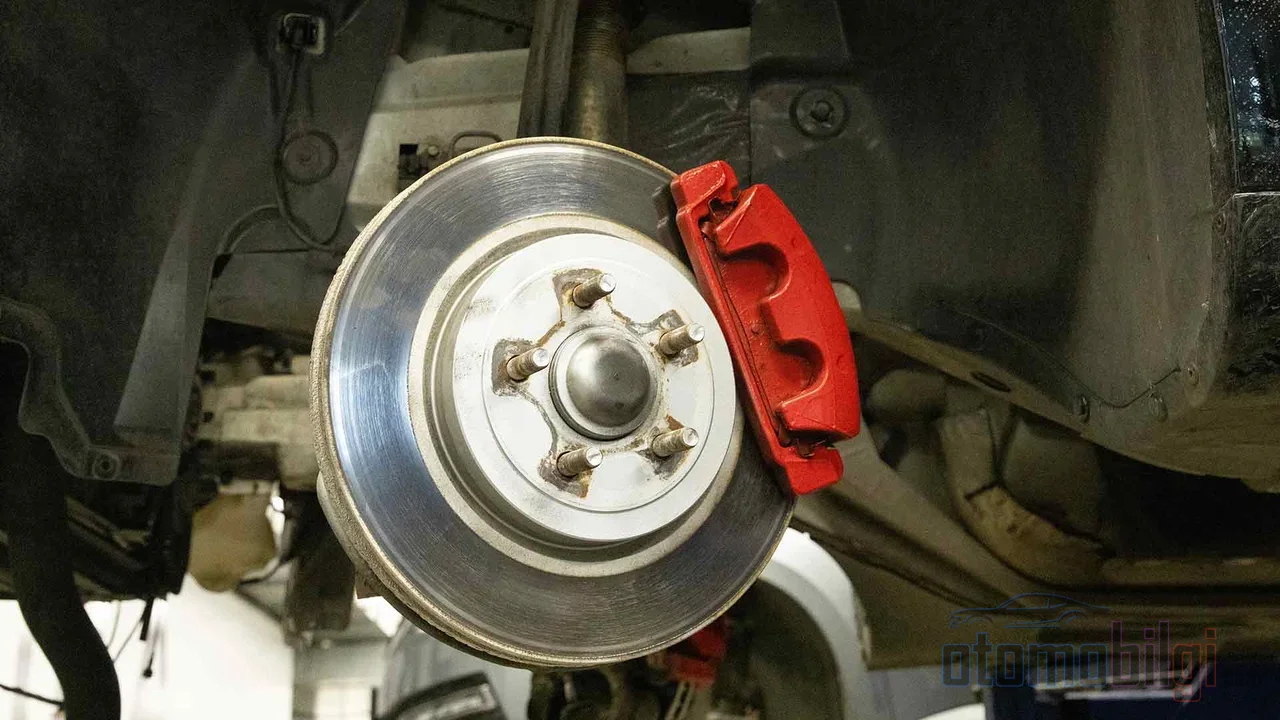
Even without a micrometer, there are strong clues about the disc's condition. The most practical one is the lip check: while the inner area where the pad makes contact wears down, the edge band does not wear. Over time, a noticeable step forms on the disc surface, running inward from the edge, which can be felt with a finger. When you remove the wheel, slide your finger inward from the edge of the disc surface; if you feel a distinct lip, the disc is severely worn. This lip is not a cosmetic flaw, but a sign that replacement is around the corner.
Symptoms felt while driving are just as meaningful. Discs usually announce these symptoms in the following ways:
- Vibration in the steering wheel and a pulsating feel in the pedal during braking, meaning the pressure rhythmically stiffening and softening
- Squealing noises, banging sounds during braking
- Lengthened stopping distance and pulling to one side while braking
- Scratches, deep grooves, and bluish discoloration on the disc surface
- Illumination of the ABS warning light
Pedal pulse also deserves special mention. On a warped or unevenly worn disc, the pedal rises and falls every time you press the brake; on front discs this is usually accompanied by steering wheel shake, while on rear discs it is felt more in the pedal. This vibration, which disappears when you are not braking, is the clearest clue distinguishing it from tire imbalance.
What is the cost of continuing to drive with a worn disc?
When the disc falls below the minimum thickness, not only does the stopping distance increase somewhat; the entire system is put at risk. The heat dissipation capacity and mechanical strength of the thinned disc decrease; thermal cracks can form on the braking surface, and the disc deforms, producing vibration and noise. Pedal travel increases, and at an advanced stage the caliper piston may lose its seal, the pad may come out of its housing, or seize.
Fading and vapour lock: the pedal going to the floor
The most dangerous effect of a worn disc is related to heat. High temperature lowers the friction coefficient of the pad and braking power decreases noticeably; this is called fading. The even more critical point is the brake fluid exceeding 200 degrees Celsius: in the hydraulic circuit vaporization occurs, meaning air bubbles form, and this is called vapor lock. If there is not enough deceleration even though the pedal is pressed all the way down, the heat game has truly turned against you. Both of these phenomena show themselves most often on long and steep descents; taking a car with limited discs onto a mountain road means preparing yourself for exactly this.
When should the brake disc be checked and replaced?
To give a practical schedule: disc thickness should be checked every 16,000 km or at every pad change; you are removing the pads anyway, so the measurement is a few minutes' work. When a pedal pulse, squealing noise, or pulling to one side is noticed, however, it should be inspected without waiting for the schedule. As a general industry rule, discs are renewed roughly every two pad changes.
As for disc life, giving an exact mileage would be misleading; but it is possible to state a healthy range. A typical disc lasts between 48,000 and 112,000 km. Pads have a shorter life, generally falling below the range of 48,000 to 120,000 km. The following table summarizes what the difference between the two figures means:
| Part | Typical life | Inspection frequency |
|---|---|---|
| Brake pad | Approximately 48,000–120,000 km | At every periodic service |
| Brake disc | Approximately 48,000–112,000 km | At every pad change, with a thickness measurement |
| The relationship between the two | Roughly one disc for every two sets of pads | The disc is renewed at every second pad change |
Driving style shifts this range. In stop-and-go city traffic and in heavily loaded, towed vehicles, discs reach their limit earlier; in a mild climate and in use where flat routes predominate, life is extended. So rather than relying on mileage, looking at the value measured on the disc is always a more accurate guide.
Should the disc and pads be replaced together or separately?
The answer to this question often turns into a cost debate, yet the technical side is clear. For a new pad to seat properly, meaning to make uniform contact across its surface, a smooth and even disc surface is required. Fitting fresh pads onto a worn, scored disc means the pad only touches certain regions of the disc surface; this brings inefficient braking and uneven wear.
Replacing the two discs on the same axle together is also not a matter of debate: if there is a thickness difference between the left and right discs, braking force is distributed unevenly between the two wheels and the car may pull to one side when braking. If one disc has fallen below the minimum, both sides of the axle should be renewed together, even if the opposite one still looks sound.
When it comes to replacing the pads and disc together, however, a bit more flexibility is possible. If the measurement shows that the disc is clearly above the minimum and its surface is smooth and free of scoring, replacing only the pads is a legitimate way to save on labor and parts. But if the margin is small, most mechanics recommend replacing both at once; work is done at the same time, and the cost of two separate trips is also eliminated. Common practice can be summarized as roughly two sets of pads per disc.
Do drilled and slotted discs really brake better?
Drilled and slotted discs, which feature abundantly in the catalogs of performance brands, frequently turn into a symbol of power in the eyes of the ordinary driver. The truth is more measured. Drilled discs help with heat dissipation and with shedding the water film on wet surfaces; slots, meanwhile, can support contact by sweeping gas and dust away from between the pad and the disc. They are two engineering solutions with different purposes, and their actual design rationale is track and heavy-duty use.
By contrast, the claim that these discs measurably increase stopping power in ordinary use is an exaggeration. The common observation of experienced mechanics is harsher: drilled and slotted surfaces reduce the friction area, wear the pads out faster, create a risk of cracking at the hole edges, and produce more noise and dust. Moreover, it should not be forgotten that the companies marketing these products also share a financial interest in the performance-gain narrative. My honest position is this: for daily driving, a quality, standard (plain) disc is sufficient; drilled and slotted discs are part of track days and heavy-duty scenarios, not of showy aesthetics.
In short: when should you replace the brake disc?
The practical answer, as summarized by thirty years of habit, is this: if the disc thickness has fallen below the minimum value the manufacturer engraved onto the disc, if a distinct lip you can feel with your finger has formed on the surface, if brake pedal pulsation and steering wheel vibration have begun, or if you see deep grooves and cracks on the disc surface, the time has come to replace the disc. If none of these signs are present, it is enough to have the disc thickness checked with a micrometer at every pad change, to plan for the disc to be renewed roughly every two pad lifetimes, and to stick to the rule that the two discs on the same axle must never be replaced separately. Without succumbing to the appeal of drilled and slotted discs, trust the measured value: in braking matters, it is not feelings that speak, but millimeters.