How Does a Car Behave When Its Shock Absorbers Fail?
Share This Page
When shock absorbers wear out, the car can no longer settle over bumps on the road; it keeps bouncing after a bump, the front end dives uncontrollably to the ground under braking, the car sways in corners and the tires lose contact with the road. Since wear develops gradually, the driver usually notices this change in behavior slowly rather than all at once; and that is exactly why recognizing the symptoms matters, more for safety than for loss of comfort.
Highlights
- Worn shock absorbers can significantly increase braking distance depending on conditions; according to one manufacturer's data, a single worn shock absorber can increase stopping distance at 80 km/h by more than 2 meters.
- The earliest symptom is bouncing more than once after a bump and a harsh, choppy ride feel.
- Sawtooth, cupped tire wear (cupping) is the classic sign that the shock absorber is failing to keep the tire on the road.
- There is no fixed replacement mileage; the common recommendation is an inspection around 80,000 km, with the decision based on symptoms.
- Seeing oil leakage on the shock absorber body is a warning that should be checked without delay.
How a Car Behaves When Its Shock Absorbers Fail: Symptoms Noticed in Everyday Driving
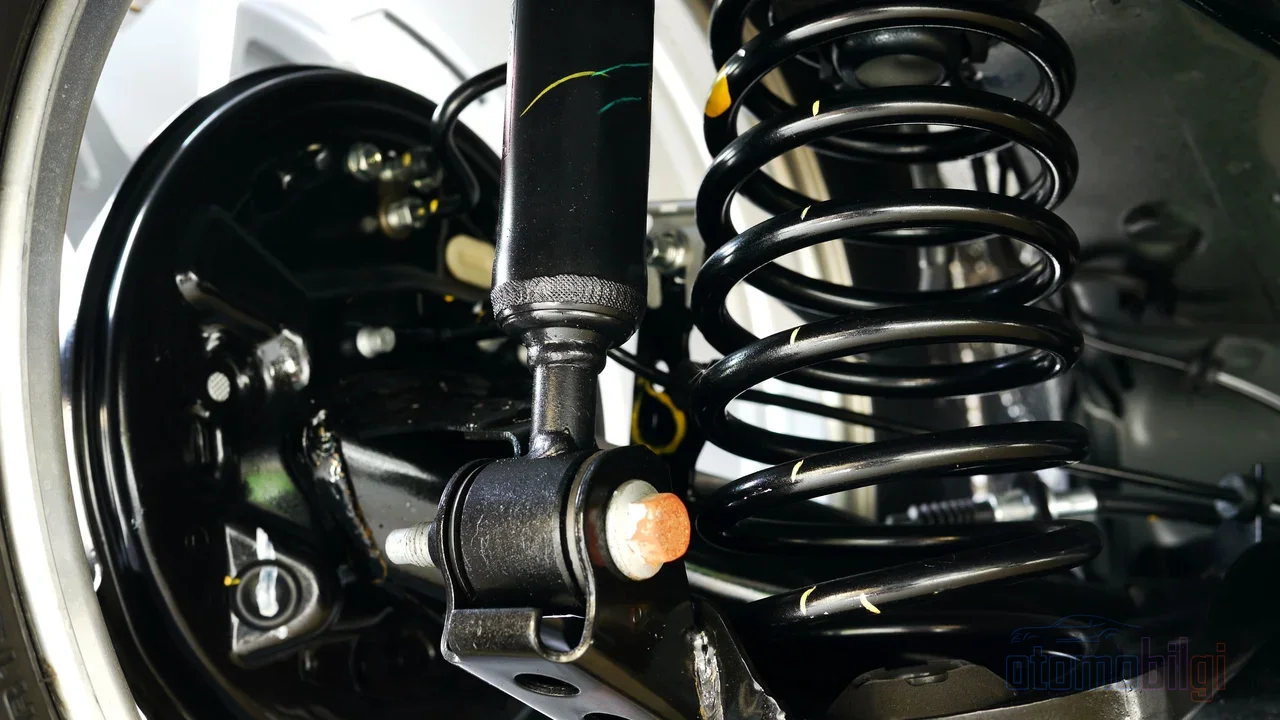
The job of the shock absorber is to dampen the spring's oscillation and keep the tire in constant contact with the road. The hydraulic fluid inside it does this work; when the seal fails, the fluid leaks out and the suspension's control gradually loosens. We have been in this business for over thirty years, and we can say this with confidence: years ago, when cars rode on firmer suspensions than today's, everyone could feel a worn shock absorber; today, comfort-oriented setups make early-stage wear almost imperceptible. That is why knowing the symptoms is half the job.
A vehicle that keeps bouncing after a bump
This is the earliest and most reliable sign. A vehicle with healthy shock absorbers settles immediately after passing over a bump; it does not bounce repeatedly or sway. If the car keeps rocking with repeated bounces, the ride feels harsh and choppy, or the steering "floats" or feels vague, the suspension is trying to tell you something. At this stage the car still seems manageable; and that is precisely why the problem is usually ignored until more advanced symptoms appear.
Front dive under braking and rear squat under acceleration
The rapid dive of the front end toward the ground during braking is called nose dive. The forward shift of weight transfer is a natural physical phenomenon; the real task is for the shock absorbers to control this transfer. When a worn shock absorber cannot do this, the dive becomes uncontrollable and stopping distance increases; which is why it is considered dangerous. The reverse of the same mechanism occurs under acceleration: the rear squats excessively and the front lifts. This can cause nausea for passengers and puts unnecessary load on the rear suspension components.
Body roll in corners, steering vibration and noises
A vehicle that cannot control weight transfer in corners leans to the side; the driver feels a loss of control, and steering input increases. If you feel vibration in the steering wheel even on a flat road, the shock absorber, or the strut and steering stabilizer that work integrally with it, may be worn out. A metallic rattling or clicking sound over bumps is also on the list of signs: these sounds are heard when the shock absorber bottoms out and makes metal-to-metal contact, or when worn bushings and mounting parts come loose.
Tire Wear Patterns: What Uneven Wear Tells You
A tire's wear pattern is the suspension's health report. A bouncing vehicle constantly interrupts the tire's grip on the road; as the tire makes and breaks contact with the road, pieces are torn away, creating a jagged, scooped-out wear pattern. This is called cupping or scalloping, and it is the most concrete proof that the shock absorber cannot keep the tire on the road. When you see this type of wear, replacing the tire does not solve the problem; without fixing the source, the new tire will wear out the same way. Driving with worn shock absorbers also causes premature wear in other suspension components; in other words, the delay is not just a comfort cost, it is a chain reaction of repair bills.
Visual inspection is equally instructive. If you see oil traces or leaking hydraulic fluid on the outside of the shock absorber body, it is certain that the seals have failed. The moment it loses fluid, a shock absorber's performance drops noticeably; this is a situation that calls for immediate inspection, not waiting.
Effect on Braking Distance and Safety on Wet Roads
The shock absorber may not seem to have a direct connection to braking; yet the mechanism is simple. Braking happens through the force the tire transmits to the road. If the tire is in the air or has weakened contact, no matter how new the brake pads and discs are, that force cannot be transferred to the road. Since worn shock absorbers cannot keep the tire in constant contact with the road, weight transfer cannot be balanced during braking and the stopping distance increases in emergency braking.
It is reasonable to approach the figures on this subject with caution. Some service publications claim that worn shock absorbers can increase braking distance by up to 20-30%, but no verified independent test report on this figure is known. A more measured figure from the manufacturer is as follows: At a speed of 80 km/h, a single worn shock absorber can increase the stopping distance by more than 2 meters. Although the exact percentage is debated, the direction is common: when the tire loses contact with the road, the braking distance inevitably increases.
Is braking the only factor? The risk of slipping on wet roads, that is, aquaplaning, also increases; body roll grows in corners, and loss of stability is reported in emergency maneuvers. A shortcoming that can be compensated for on dry asphalt cannot be compensated for in the rain at all. Looking back at how things used to be, today's vehicles equipped with wide tires and high-performance brakes rely far more on the health of their suspension than older ones did, despite the increased mass.
When Should Shock Absorbers Be Replaced: The Mileage Debate and a Realistic Recommendation
There is no single answer in the industry on this subject, and honestly, there should not be one anyway. The common manual recommendation is to have the shock absorbers inspected after approximately 50,000 miles (80,000 km); continuous use on rough roads or towing work shortens their lifespan. A manufacturer's replacement recommendation has the same effect: after 50,000 miles. In contrast, some independent technicians argue that this mileage serves the manufacturers' commercial interests, and that the actual lifespan can be much longer depending on the vehicle and usage conditions; some sources state the lifespan varies between 50,000 and 100,000 miles (80,000-160,000 km), while some parts sellers give a range such as 80,000-150,000 km and explicitly emphasize that there is no fixed replacement mileage. It is already an accepted fact that the wear rate varies according to road conditions, driving style, and vehicle load.
The advice we have been giving our readers for years consists of these three points:
- an inspection around 80,000 km is a must; this is not a replacement obligation, merely an inspection.
- Base the decision on symptoms, not mileage: bouncing, dipping under braking, tire cupping, oil leakage.
- Shock absorbers are generally expected to wear at the same time; to avoid mixing old and new, replacing them on one axle or all four at once is a more consistent solution in the long run.
Simple Checks You Can Do at Home
You can do two checks yourself before going to a service center; both take a few minutes and require no expertise.
- The bounce test: Park the vehicle on a flat, even surface. Press down on the bumper at one corner with all your strength and release it. If the vehicle bounces more than once when released, the shock absorber at that corner is weak; a healthy suspension settles in one go.
- Visual inspection: While the vehicle is parked, look at the stance balance between the corners; beware if one corner is noticeably sagging. Then check the shock absorber body for oil leakage and physical damage.
These tests serve as guidance rather than a definitive diagnosis. If any doubt remains, the condition of the shock absorbers and bushings is clearly visible within minutes once the vehicle is put on a service lift.
Frequently Asked Questions
My car feels normal - should I still replace my shock absorbers?
Because wear develops gradually, the driver may not notice the difference under normal conditions; the vehicle slowly adapts to the change and a "this is how it normally feels" sensation forms. This is exactly what experience tells us: a driver who knows the car when it was in good condition notices the difference right after replacement in the very first corner. If you are approaching the mileage limit or your tires show uneven wear, do not delay the inspection.
Is driving with worn shock absorbers safe?
You can get the car down the road, yes; but no one can claim it is safe. When you factor in increased braking distance, higher risk of skidding on wet roads, and loss of stability in corners and emergency maneuvers, this becomes a matter of risk management. Moreover, the damage it causes to the other components of the suspension and to the tires increases the cost of the postponed replacement. Having the necessary replacement done as soon as possible is the smartest decision both for safety and for your budget.
Do faulty shock absorbers damage the tires?
Yes, they do. The scalloped, hollow wear pattern known as cupping shortens the tire's service life and leads to early replacement. The tire is the suspension's accounting ledger; take seriously whatever its pattern is telling you.
In summary: Listen to the Symptoms, Not the Calendar
The shock absorber speaks where the car doesn't: in the swaying after a bump, in the diving front hood when the brake pedal is pressed, in the body leaning in a corner, and on the scalloped surface of the tire. Write a checkup into your calendar around 80,000 km; but base the decision on the symptoms listed on this page. Mileage doesn't count the same for every vehicle, yet the importance of healthy suspension is the same in every vehicle.
Sources
- Signs of Bad Shocks & Struts – Monroe
- Consequences of Driving with Worn Shocks & Struts – Monroe
- 8 Signs of Bad Shock Absorbers: Damage & Wear Explained – Kwik Kar
- How Long Do Shock Absorbers Last? – Trodo
- DidYouKnow stopping distance – KYB Suspension
- Reasons to replace your shocks – KYB
- How to know when your shocks or struts need to be replaced – Firestone Complete Auto Care
- How Long Should Shock Absorbers Last? – Cars.com
- How to do your own shock absorber 'bounce test' – Seattle Times
- How to Check the Shock Absorbers on Your Car – wikiHow
- Do Shocks and Struts Affect Braking Distance – Genuine Car Care
- The Dangers Of Driving With Worn Shock Absorbers – Midas