Why Can't Cell Health Be Measured in Hybrid Batteries?
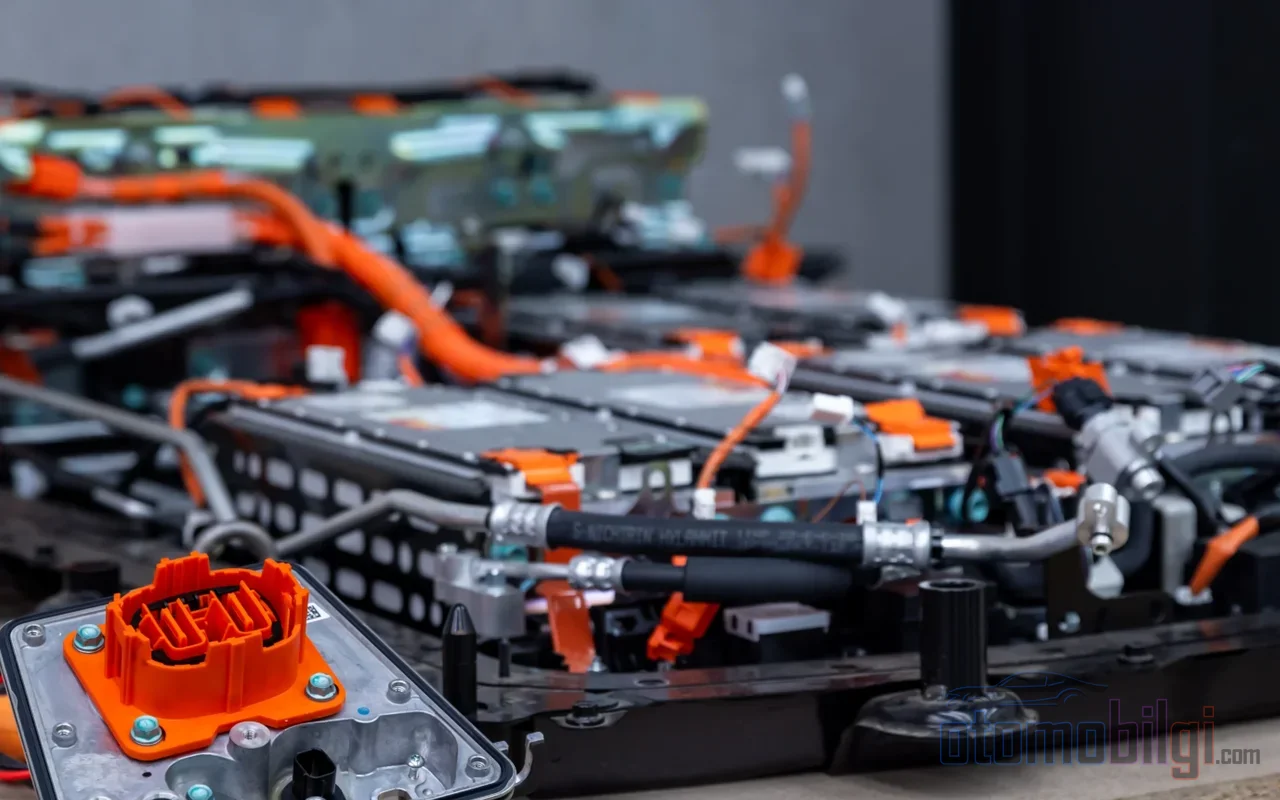
When you look at a second-hand hybrid vehicle, the seller tells you that the battery health is 82 percent. So what exactly does this number measure? The answer is more ambiguous than most people think: a hybrid battery pack consists of hundreds, sometimes thousands of cells, and the health percentage you are given is based not on the average of these cells but on an estimate relating to the entire pack. Three cells inside the pack may be dead; the pack-level value does not show this. In this article, we explain what the SOH value actually tells you, why cell-level diagnosis is still not possible, and how electrochemical impedance spectroscopy (EIS) is beginning to fill this gap.
What Does the SOH Percentage Actually Measure?
SOH (State of Health) is the ratio of the battery's current maximum energy capacity to its capacity when new; it is a calculated percentage, not a precise measurement read with a single device. The critical point is this: SOC (state of charge) and SOH cannot be measured directly. The battery management system (BMS) estimates these two values starting from measurable quantities such as current, voltage, and temperature. In other words, the percentage you see on the instrument panel is not a direct reading of a physical reality but the output of a model.
The practical consequence of this is: an aging battery can show a 100 percent charge but may be holding noticeably less energy than on day one. The charge indicator tells you the momentary fill level, while SOH describes long-term capacity loss; the two are frequently confused with each other.
Highlights
- SOH and SOC cannot be measured directly; they are estimated from current, voltage, and temperature data.
- When capacity loss exceeds 10 percent, the performance of estimation methods falls below an acceptable level.
- In parallel-connected cells, variation between cells cannot be calculated without individual cell data.
- The SOH reported by the BMS fails independent verification; warranty systems do not systematically catch the most worn vehicles.
- EIS has become a pioneering diagnostic method capable of evaluating the battery's internal state without causing damage.
Why Is SOH Estimation at Pack Level Difficult?

The estimation problem seems easy when the battery is young. The trouble begins as degradation deepens. A study on deeply degraded lithium-ion batteries reveals important findings from plug-in hybrid data monitored with 0-30 percent capacity loss over up to 2100 cycles: when SOC and SOH are estimated together, the observability of capacity remains weak and capacity estimation becomes dependent on the usage profile. The observability of internal resistance, on the other hand, is higher than that of capacity; therefore, internal resistance estimation gives more reliable results.
To express it in numbers: when capacity estimation is decoupled during the charging phase using a fixed-point iteration method, the error drops below 3 percent; however, despite this improvement, SOC estimation exceeds an error margin of 5 percent after 600 cycles, and the model parameters need to be reset periodically. The general rule is also clear: with capacity loss exceeding 10 percent, the performance of estimation methods drops below an acceptable level. Moreover, most model-based estimation studies in the literature are limited to healthy or lightly degraded batteries, that is, those with SOH above 90 percent; the number of studies examining capacity loss beyond 50 percent can be counted on one hand.
Plug-in hybrids add an extra challenge: these vehicles constantly switch between charge-depleting and charge-sustaining modes. These transitions stress SOC estimations designed for a single usage profile. The battery's own limits come on top of this: cutoff conditions trigger early due to faulty cells, and the measured capacity and energy decrease; in other words, a single weak cell group lowers the reported value of the entire package, but it remains invisible which one it is.
Why Is Cell-Level Diagnosis Still Not Possible?
A hybrid battery pack consists of a large number of cells organized into modules, and in these modules some of the cells are connected in parallel. Parallel connection is a fundamental obstacle from a diagnostic standpoint: as long as only a single signal can be measured at the module level and there is no individual cell data, cell-to-cell variation (CtCV) and the SOH value of individual cells cannot be calculated. Sparse sensing in the modules, especially in parallel cells, causes critical conditions to go unnoticed.
The cost side is as decisive as the technical side. Allocating a separate sensor and measurement channel to each of thousands of cells is both expensive and bloats the BMS hardware. For this reason, manufacturers keep measurement density at the module level; the result is not a per-cell view, but a group average. Moving from cell to module, and from module to pack, SOH estimation becomes exponentially harder.
The consequences are serious not only for second-hand buyers, but for the industry as well. Most techno-economic studies examining second-life scenarios for batteries are limited to pack- or module-level reuse because cell-level SOH assessment is not performed. Even more importantly, a study published in 2026 shows that SOH values reported by the BMS fail independent verification tests; this diagnostic mismatch causes warranty systems that rely on BMS SOH to systematically fail to detect the most heavily degraded vehicles. Today, manufacturers generally tying battery replacement warranties to capacity falling below 70-75 percent does not change the fact that pack SOH alone is not a definitive diagnostic tool.
EIS: Verifying Pack Quality with Impedance Spectroscopy
So, is there a tool to fill this gap? Electrochemical impedance spectroscopy (EIS) is a method that applies small-amplitude AC signals to the battery and measures its response; today it stands as the leading technique for evaluating the battery's internal state without causing damage. The method helps predict degradation rates and detect manufacturing defects that affect quality and safety.
The power of EIS lies in its ability to combine different measurements in a single quantitative analysis. In an NCM811 lithium-ion module of a hybrid vehicle, EIS combines DC internal resistance (DCIR) and SOH data in a single low-complexity analysis, enabling degradation diagnosis and durability assessment; the analyses are repeated at points such as 0, 400 and 800 cycles to plot an aging curve. In low-impedance electric vehicle cells, EIS measurements show good repeatability, and the linearity of the measurements is verified with the Kramers-Kronig validity test.
There are also promising results in field conditions. Impedance values obtained from driving cycles give very close results, such as 0.123, 0.125 and 0.123 Ohms; this spread within 1.6 percent shows that the method is consistent in real-world use. It has also become possible to reconstruct EIS curves from time-domain signals in a 3.7 kWh module and compare them with experimentally calibrated data through DRT analysis. In other words, EIS is leaving the laboratory and moving toward in-vehicle diagnostics.
How Should a Used Hybrid Buyer Evaluate Battery Health?
All this technical background points to a single practical conclusion: Do not read the SOH percentage as an absolute truth. Evaluate the value against the level considered normal for the vehicle's model, age and mileage, and try to check several signals together rather than a single number.
Frequently Asked Questions
Which SOH values are normal, and which indicate a problem? Values above 80 percent are considered normal age-related decline. The 70-80 percent range requires planning a replacement in the near future but is not urgent. A concrete example of service application: If the SOH is between 60 and 85 percent, fewer than 4-5 of the 28 modules are weak, and the internal resistance is high but not excessive, the battery is considered a candidate for reconditioning.
Is the percentage given by the seller reliable? On its own, no. A scenario frequently encountered on forums is the seller's claim that the battery is sound not matching the measurement. Base your decision on your own measurement or the result of an independent test instead of the seller's report; and be sure to check the service records.
How can a test be done at home or during purchase? The easiest first step is to check the instrument panel; battery failures often manifest themselves with the check engine warning light. Beyond that, an OBD-II scanner provides battery voltage and charging data in most modern hybrids; devices such as OBDeleven or Autel can perform quick health monitoring on some brands. In addition to the SOH percentage, look at the cell voltage spread: if the voltage difference between modules is wide, there is an imbalance even if the pack average looks good.
What about the warranty and cost dimension? Manufacturers typically replace the battery under warranty when capacity drops below 70-75 percent. The typical estimate for hybrid battery life is 8-10 years or 160,000 km; in temperate climates this period can extend by 50 percent to as much as 240,000 km. Replacement cost, depending on the vehicle and the battery option, is in the low thousands of dollars; a refurbished pack, at a cost of $1,800, can keep a $7,000 car on the road for another five years. In fully electric vehicles, this figure climbs to a range of $10,000-20,000 depending on capacity. Keep in mind: the total cost is not just the battery price; labor, diagnostics and electrical system checks are also part of the equation.
Can We Extend Battery Life?
Partly, yes. In hot climates the vehicle requires measures such as cooled thermal management, keeping the maximum charge level below 90 percent during hot periods, and using the charging window consciously; avoiding parking in extreme heat or cold is also recommended. There is also a surprising finding: regenerative braking generally reduces battery aging, because as recovered energy increases, discharge depth and the risk of lithium plating decrease. Control software also manages this consciously; when SOC exceeds 95 percent, regeneration is restricted, and at 100 percent it is disabled entirely. The contribution of regeneration is still limited by the battery's charge acceptance, engine capacity and tire grip.
Conclusion: A Single Percentage Is Not Enough
The inability to measure cell health in a hybrid battery is not a technological shortcoming but a diagnostic limit inherent to the structure itself: SOC and SOH cannot be measured directly, parallel-connected cells cannot be monitored individually, and the estimate produced by the BMS at pack level loses its reliability under deep degradation. Pack SOH is a starting point, not a diagnosis. The right approach before purchase is to interpret the SOH percentage based on age and mileage, check the cell voltage spread and service records, and, if necessary, have an independent test performed. As impedance-based methods such as EIS become widespread, this picture will change; but until that day, the strongest weapon of the used hybrid buyer is not a single percentage but multiple signals that corroborate one another.
Sources
- State-of-Charge and State-of-Health Estimation for Li-Ion Batteries of Hybrid Electric Vehicles under Deep Degradation (PHM Society 2024)
- Battery health reporting fails independent validation (arXiv, Park 2026)
- Estimation of Cell-to-Cell Variation and State of Health for Battery Modules with Parallel-Connected Cells (arXiv)
- Why we need a standardized state of health measurement (Nature, 2025)
- Integrated Analysis of EIS, DCIR, and SoH for Degradation Diagnosis and Durability Assessment of NCM811 Lithium-Ion Batteries (MDPI Batteries)
- Evaluating Battery Health for Electric Vehicles Using EIS Measurements (Spectroscopy Online)
- 5 Things Your Free Diagnostic Revealed About Your Hybrid Battery (GreenTec Auto UK)
- Car Warranty Coverage for Hybrid and EV Batteries (Kelley Blue Book)
- Hybrid Car Battery 101 (Mitsubishi Motors Canada)
- Aging of Lithium-Ion Batteries in Electric Vehicles: Impact of Regenerative Braking (MDPI WEVJ)