Why Can't Treadwear Values Be Compared Between Different Brands?

If you have ever glanced at your tire sidewall, you have probably seen a phrase like "TREADWEAR 320 TRACTION A TEMPERATURE A" right next to the size and load index codes. Most drivers either never read that line or, upon seeing the number 320, simply think "must be a good tire." Yet those three letters and numbers are the grades the American Uniform Tire Quality Grading system, or UTQG, stamps onto the product, and they offer a hint about tread life - the only area not covered by the A-E label system in Europe. But that hint is not as precise a measure as it is thought to be. That is exactly what this article is about: what the treadwear number says, what it does not say, and when it is reliable.
What Is UTQG, and What Is Written on the Tire Sidewall?
UTQG is a three-part rating system developed for passenger tires: treadwear indicating tread life, traction indicating braking force on wet surfaces, and temperature indicating resistance to heat at high speeds. Together, the three appear as a single line on the tire's sidewall markings. This declaration is mandatory for passenger tires; however, the system's scope does not include every tire. Winter tires, light commercial and medium truck tires, trailer tires, and tires produced in rim diameters smaller than 12 inches are outside the scope of UTQG. Therefore, looking for a treadwear number on a winter tire's sidewall is a waste of effort; that tire has not been given such a grade.
How Is the Treadwear Number Calculated?
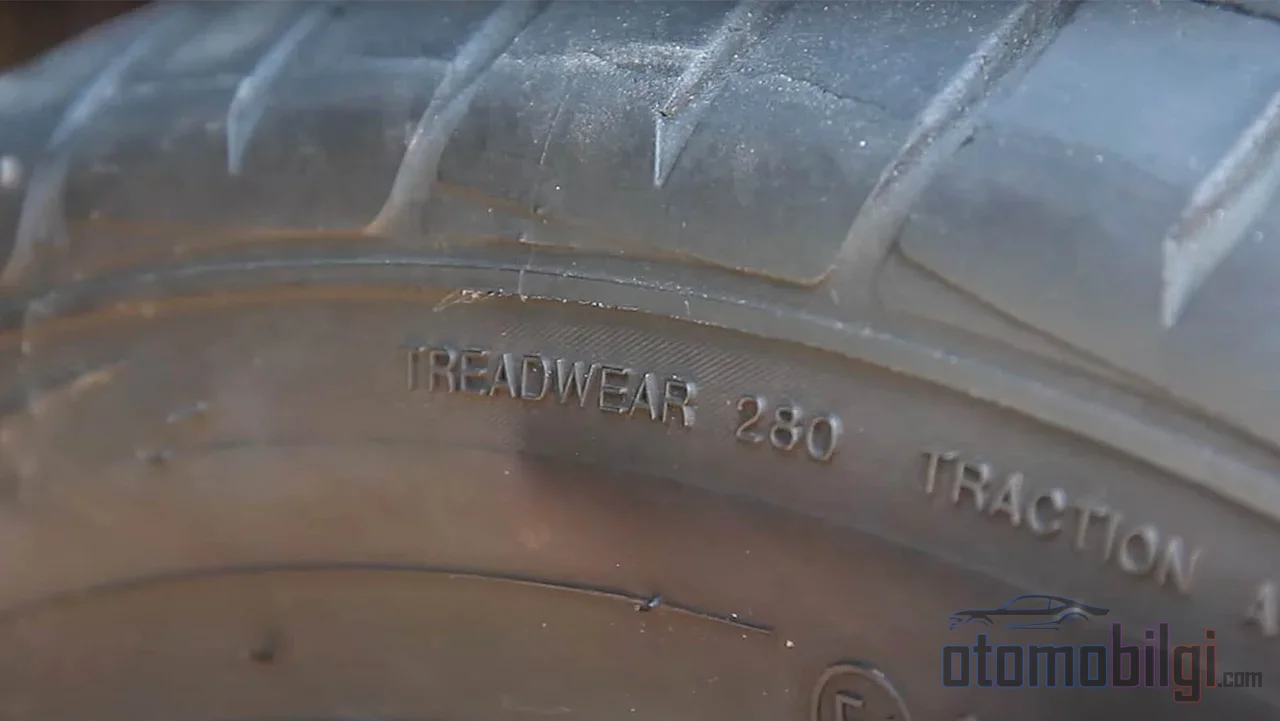
The logic of the system is simple: there is a 100-point reference (control) tire. If the tested tire wears out over the same lifespan as this control tire, it gets 100 points; if it lasts twice as long, 200 points; three times as long, 300 points. In practice, values on the market are mostly in the range of 100 to 800, with declarations reaching up to 1000 at the extremes.
The test procedure works as follows: the test tires cover a total of 11,520 kilometers over a course of approximately 640 kilometers designed to represent conditions on public roads. Tread depth is measured every 1,280 kilometers, and based on these measurements, the tire's estimated tread life is calculated. It sounds solid; so far there is nothing illogical about the system either. The problem starts with who conducts the test. We will get to that; but first, let us get to know the other two grades.
Key Highlights
- The treadwear grade is a relative score: the reference tire gets 100, a tire lasting twice as long gets 200.
- The tests are conducted by the manufacturer itself or by an independent company it hires; comparison across brands is not reliable.
- Traction grades are AA, A, B and C; they measure braking force on wet asphalt.
- Temperature class A covers speeds above 115 mph, while class C covers the 85-100 mph band.
- Winter tires, light commercial tires and trailer tires are outside the scope of UTQG.
What Do Traction and Temperature Grades Measure?
Traction: Braking on Wet Surfaces
The traction grade classifies the braking force measured on wet asphalt and concrete surfaces and consists of four levels: AA, A, B, and C. The test is based on measuring the g-force generated by tires towed behind a vehicle at 40 mph on a special trailer during locked-wheel braking. An AA rating requires a coefficient above 0.54 on asphalt; a C rating is given to tires that fall below 0.38 on asphalt. This is a narrow measurement that shows only straight-line wet braking performance, not the tire's cornering grip or water evacuation capability.
Temperature: Heat Resistance at High Speed
The temperature grade has three levels: A, B, and C, and indicates how well the tire withstands the heat it generates under high speeds. The test is performed by rotating the inflated tire against a high-speed drum in a laboratory setting. While an A-class tire can perform at speeds above 115 mph, B-class stays in the 100-115 mph band, and C-class remains in the 85-100 mph range. Even for those driving at speeds exceeding Türkiye's highway speed limits, all three are sufficient; which is why the temperature grade is less decisive than traction in practical purchasing.
Why Can't Treadwear Numbers Be Compared Across Brands?
Here is the system's Achilles' heel. The UTQG tests are carried out by the tire manufacturer itself, or the manufacturer commissions an independent testing company. The regulatory authority has the power to review the data declared by the manufacturer and impose penalties when it detects inconsistencies; but the test itself is conducted by the manufacturer. That is precisely the system's design intent: UTQG was developed to allow a brand to compare its own models internally. Comparing the same manufacturer's 300-point model with its 500-point model is meaningful; putting the 300-point tires of two different manufacturers on the same scale is not. One manufacturer's 300 treadwear tire may last longer than another manufacturer's 400; because the control tire each manufacturer uses in the test is its own reference.
Tests by consumer organizations that place this limitation at the center of the issue confirm the same picture: the treadwear grade is a comparative tool and cannot tell how many kilometers a tire will last. This is exactly the most common mistake made in tire purchase debates; ranking two different brands' tires based solely on the treadwear number on the sidewall.
Is It Possible to Go from the Number to Kilometers?
There are practical formulas circulating for converting the treadwear score into absolute kilometers, and they do not all agree. A common approach holds that a 400-point tire will last twice as long as a 200-point one, and that roughly 40,000-60,000 miles can be mentioned. Another approach equates 100 points to 30,000 miles and calculates from this that 200 points would yield 60,000 miles. In academic literature, however, a peer-reviewed 2025 review estimates that service life is roughly the treadwear rating times 100 miles; that is, an expectation of around 40,000 miles for a tire rated 400.
All of these figures are estimates and none are guaranteed; because actual wear depends on many variables, from driving style and tire pressure to road quality, the vehicle's suspension settings, and even the camber angle. The assumption that a high treadwear score guarantees long life collapses when combined with improper air pressure or aggressive use. The figure is a laboratory comparison; it does not tell the story of what happens on your car.
Does a High Treadwear Always Mean a Good Tire?
The short answer to this question is no. There is a fundamental trade-off in tire chemistry: a soft tread compound provides a higher coefficient of friction, and therefore shorter braking distances, while wearing out faster; a hard compound wears more slowly but gives up grip. As a general rule, it is known that a lower treadwear rating is associated with a higher coefficient of friction, that is, a shorter braking distance. So a tire rated 700 can last far longer than a 300-rated performance tire; but it may take longer to brake on wet surfaces.
This does not mean the high-treadwear tire is bad. For a driver whose priorities are quietness, comfort, and long-term economy, a highly rated all-season tire can be exactly the right choice. If performance and safe braking distances come first, the picture changes. There is also no uniform data quantifying the exact ratio of the relationship between grip and life; the existence of the relationship is common knowledge, but its coefficient is disputed. The right question is not "which is the better tire," but "does this tire suit my usage."
How to Combine UTQG with the European Label?
On tires sold in Europe, the label system shows three things: fuel efficiency, wet grip (both rated A to G), and the external noise value. The wet grip classification is conceptually the closest equivalent to UTQG's traction rating; but the European label's tests are conducted to a more rigorous standard than UTQG, which is based on manufacturer declarations and has limited comparability. Therefore the two systems are not rivals, but two separate windows that complement each other.
| Feature | UTQG | European Label |
|---|---|---|
| Wear life | Treadwear (score between 100-1000) | None |
| Wet braking | Traction (AA-C) | Wet grip (A-G) |
| Heat and speed resistance | Temperature (A-C) | None (speed class is coded separately) |
| Fuel efficiency | None | Rolling resistance class (A-G) |
| Noise | None | External noise value (decibels) |
| Who conducts the test | The manufacturer or a test company hired by the manufacturer | Standardized label test |
The practical usage is this: For wet braking and noise, look at the European label first; because in these two areas the label is a more reliable comparison. As for wear life, there is no data on the label, and the only thing you can do is compare treadwear scores between models of the same brand. When you combine the two pieces of information, a much fuller picture emerges of both the tire's braking capability and its expected lifespan. There are also comparison tools on the market that show a tire's European label and UTQG ratings in a single table; they are useful for a quick scan before purchase.
Conclusion: How Much Should You Trust Treadwear?
The summary of the summary is this: The treadwear rating is useful for comparing wear rates between models of the same brand, but as a manufacturer statement it is powerless to tell how many kilometers a tire will last on its own. Directly comparing the treadwear scores of different brands is a use contrary to the rules of the UTQG system and brings you to the brink of making a wrong decision. For grip and wet braking, the European label is a more solid reference. Make your purchase decision by reading the two systems together and determining your own usage priority: comfort and longevity, or braking distance. The three letters and three digits on the sidewall can guide you in making this decision; but they cannot walk the road for you.
Sources
- Uniform Tire Quality Grading - NHTSA
- UTQG - Yokohama Tire
- What are UTQG ratings? - Kal Tire
- UTQG Uniform Tire Quality Grade - Good Sam
- What Are The Uniform Tire Quality Grade (UTQG) Standards? - Tire Rack
- Understanding the UTQG System for Car Tires - Consumer Reports
- Tire Wear, Tread Depth Reduction, and Service Life - MDPI (Giechaskiel, 2025)
- UTQG Treadwear Rating - TireBuyer
- -