What Is Aquaplaning and How to Drive Safely on Wet Roads?
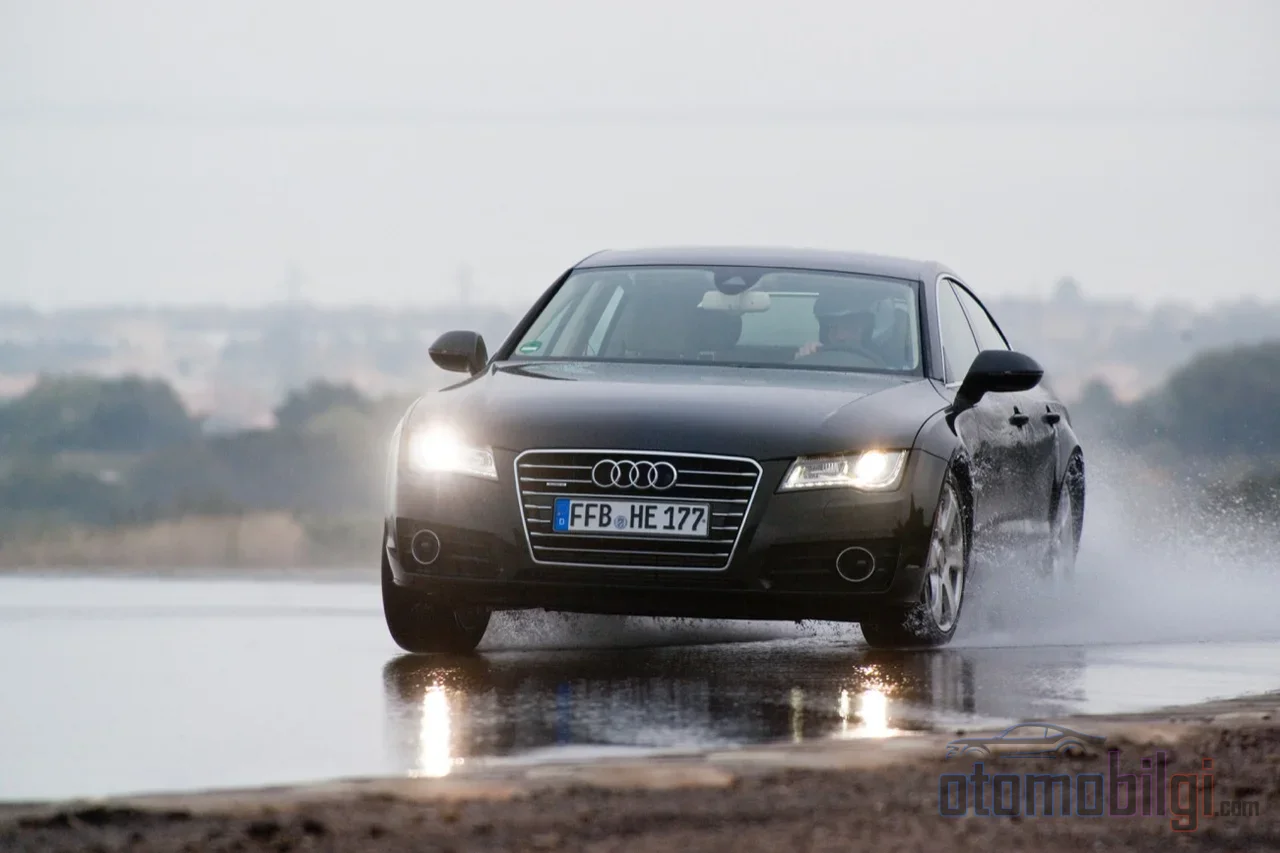
On a wet highway, the steering wheel suddenly loses its weight. The steering wheel in your hands drops into emptiness in an instant, the car ahead begins to wobble, and for a second nothing you do seems to make the vehicle respond. That moment is aquaplaning itself, the act of skating on water. Most drivers have heard of this concept, but few know that skidding is actually not a braking error but a pure matter of physics: an invisible film of water entering between your tire and the asphalt temporarily lifts your vehicle off the road.
On this page, we will cover how aquaplaning forms, at which speeds and tire conditions it begins, what you absolutely must not do at the moment of skidding, and which variables shift the risk threshold all the way down to pressing the accelerator. Because when it comes to this topic, the right knowledge is useful not in an accident courtroom, but in the middle of the road.
The Physics of Aquaplaning: Why Does the Tire Lift Off the Ground?
Aquaplaning is the situation in which a tire cannot drain away the water it encounters at the speed it faces it. A layer of water builds up between the contact patch and the road surface, this water wedge lifts the tire up from the ground, and the tire starts to behave almost like a water ski. Grip is the product not of gravity but of the direct contact between two surfaces; the moment water gets in between, that contact ends.
The mechanism is simple but merciless. The water reaching the front edge of the contact patch must either be channeled into the grooves or pushed to the sides. At low speeds this is possible. As speed increases, the water begins to accumulate at the front edge instead of escaping. Water is an incompressible fluid; the moment the accumulated hydrodynamic pressure equals the contact pressure pushing the tire onto the road, the tire lifts off the surface and spins freely on a water film thinner than 1 mm. The sudden lightness of the steering is precisely this moment reflected in the steering wheel.
This is exactly the reason the tread pattern exists. On dry ground, a treadless tire, namely a slick, is superior in every metric; the tread exists solely to manage the water film. Groove geometry is more decisive than the tire's width: at the same pressure and speed, narrow tires show less aquaplaning tendency than wide ones, because a wide tire has to drain a greater volume of water.
Key Points
- Aquaplaning can begin even at low speeds such as about 56 km/h
- When tread depth drops below 3 mm, water drainage capability deteriorates significantly
- Pressure below 30% of the recommended level sharply increases the risk
- At the moment of skidding, the accelerator is released, the steering is held steady, and sudden braking or sharp corrections are avoided
- Cruise Control is not used in wet conditions; stopping distances become roughly three times longer than on dry ground
At What Speed Does Aquaplaning Start?
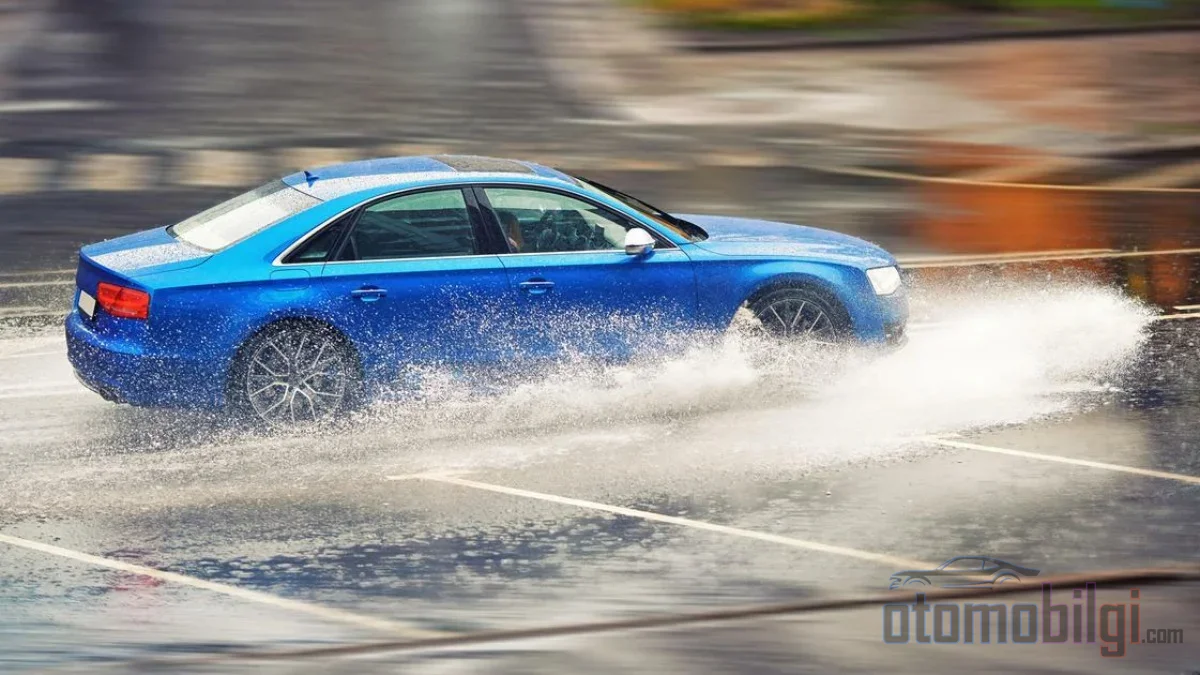
There is no fixed threshold, and this is the most misunderstood aspect of the subject. NACA and NASA research conducted for wet track safety in the 1960s and 1970s revealed that the onset speed depends largely on inflation pressure and tread depth. The classic formula from aviation gives the takeoff speed in mph as 9 times the square root of the pressure; current aviation training has revised this coefficient to 8. On a 35 psi tire, this works out to roughly 53 mph with the coefficient of 9, and roughly 47 mph with the coefficient of 8.
The practical table provided by tire manufacturers is even more striking: depending on tread depth, pattern, and the amount of water on the road, aquaplaning can occur even at low speeds such as 35 mph, that is approximately 56 km/h. When the water thickness on the road exceeds 1/10 inch, the risk deteriorates rapidly. Here is how the speed scale works: at 60 km/h, a tire with good tread manages most of the water; at 90 km/h, full aquaplaning can begin on a worn tire; by the time you reach 110 km/h, the safety margin has almost entirely disappeared.
Tread Depth: The Backbone of the Risk
In wet-road safety, tread depth is the single biggest factor. Deep channels offer more drainage area for water; though it may look like a superficial sentence, there is a clear geometry behind it. A new passenger tire leaves the factory with a tread depth of 8-10 mm. When the groove drops to 2-3 mm, the tire's ability to channel water is significantly impaired; many tire engineers consider 4 mm the practical wet-weather safety threshold.
Wear not only reduces depth, it also distorts the geometry of the channel. A groove that drops from 8 mm to 3 mm has lost more than half the water volume it could carry, and it has also lost its sharp edge that cuts through the water film. In other words, the same old tire pumps less water and manages the remaining water worse.
Legal limit, or safe limit?
In many markets, the legal minimum tread depth is 1.6 mm. However, 1.6 mm is a legal boundary, not an engineering boundary. Below 4/32 inch, approximately 3.2 mm, channels cannot drain water reliably; consumer databases show that replacing tires at this depth improves wet braking distance and reduces aquaplaning risk. The findings of consumer tests point in the same direction: on a tire with 4/32 inch of tread, stopping distance on wet roads increases, aquaplaning begins at 40 mph and worsens at 60 mph. Replacing tires at this measurement is the smartest move made without waiting for a legal obligation.
How Does Tire Pressure Shift the Threshold?
The takeoff speed scales with the square root of the inflation pressure. Viewed with the same formula, a takeoff speed of roughly 49 mph at 30 psi rises to roughly 57 mph at 40 psi. A concrete example: Taking 35 psi as the reference, running the tire at 26 psi lowers the takeoff speed from 53 mph to 46 mph, roughly by 13%. It may not seem like much, but in a wet corner, the difference is the difference between a crash and no crash.
Low pressure makes the water's job easier because it reduces the force pressing the tire onto the road. Manufacturer data shows that at values more than 30% below the recommended pressure, the risk increases sharply. Overinflation, on the other hand, is the other side of the coin: increases launch speed but shrinks the contact patch, impairing dry grip. The correct pressure is written on the label on the driver's door pillar; the number on the sidewall is the tire's maximum pressure, not the recommended pressure. Confusing the two is a classic mistake that has persisted for years.
Pressure also varies with the season. Roughly 1 psi is lost for every 5-6°C drop in temperature; a driver who doesn't check pressure when moving from autumn to winter is, without realizing it, getting a little closer to aquaplaning. A shortfall of 10 psi alone noticeably reduces wet performance.
The Right Response When Sliding: Step by Step
In the moment of aquaplaning, panic is more dangerous than the event itself. Because grip doesn't fail on all four tires simultaneously; a sharp correction or hard braking made just as the slide ends can start throwing the car sideways. The correct response sequence is as follows:
- Release the accelerator gently and completely; engine braking is sufficient.
- Avoid slamming the brakes.
- Hold the steering wheel firmly but without forcing it, keeping it steady in the current direction.
- When the steering feels heavier again, that is, when the tires find the road, brake gently and progressively.
The event usually lasts 1-2 seconds; this explains why the correct response is so decisive. Small and steady steering inputs reduce the chance of a sudden jolt when grip returns. ABS works at the threshold of zero grip on a water film but dramatically extends the stopping distance; meaning the presence of ABS is not permission to brake.
Special case for front-wheel drive vehicles
In a front-wheel drive vehicle, the front tires simultaneously handle steering, braking, and traction. When the front axle enters aquaplaning, all three functions are lost at once and the engine rpm suddenly rises; the sound is the quickest way to notice the situation. It is not easy to predict where a front axle that has lost three tasks at once will go. That is exactly why the tread condition of the front tires is the maintenance item you should prioritize and load onto the vehicle.
Practical Rules for Protecting Against Aquaplaning
Prevention is easier than reaction and is almost entirely about habits:
- Reduce your speed in the rain; do not use Cruise Control on wet roads.
- Avoid puddles and standing water; if the water's appearance hides the road texture, slow down or change lanes.
- Increase your following distance; stopping distances on wet surfaces increase roughly threefold.
- Measure tread depth regularly; plan a replacement at the 3-4 mm level, don't wait for 1.6 mm.
- Check the pressure with cold tires and once a month; use the value on the door pillar as the basis.
Drivers used to manage this by intuition; now we know the formula, the thresholds, and the limits of tire technology. Applying that knowledge is still up to us.
In short: What Is Aquaplaning and How Do You Get Through It?
Aquaplaning is when the tire cannot drain the water, a film of water enters between the road surface and the contact patch, and the tire lifts off the ground on this film. Risk increases as speed rises, as tread depth decreases, and as tire pressure drops. The moment a skid begins, the accelerator is released, the steering wheel is held steady, and sudden braking and sharp corrections are avoided; you wait until the tires find the road again. Everything else is preparation done so that moment never happens at all: correct pressure, sufficient tread, and a speed appropriate for wet weather conditions.
Sources
- Hydroplaning | Preparation for Driving in Rain - Bridgestone Tires
- What is aquaplaning - Continental
- Tire Tread Depth: Legal Limits and What to Know - Michelin
- Hydroplaning Explained: Wet-Road Grip Physics
- Hydroplaning Speed Formula: Tire Tread Design Engineering
- Minimum Tire Tread Depth: 2026 Safety & Legal Guide - Geotab
- Tire Safety Ratings and Awareness - NHTSA
- How Does Tire Air Pressure Affect Wet Performance? - TireRack