Why Do Pit Stop Strategies Work Differently in F2?
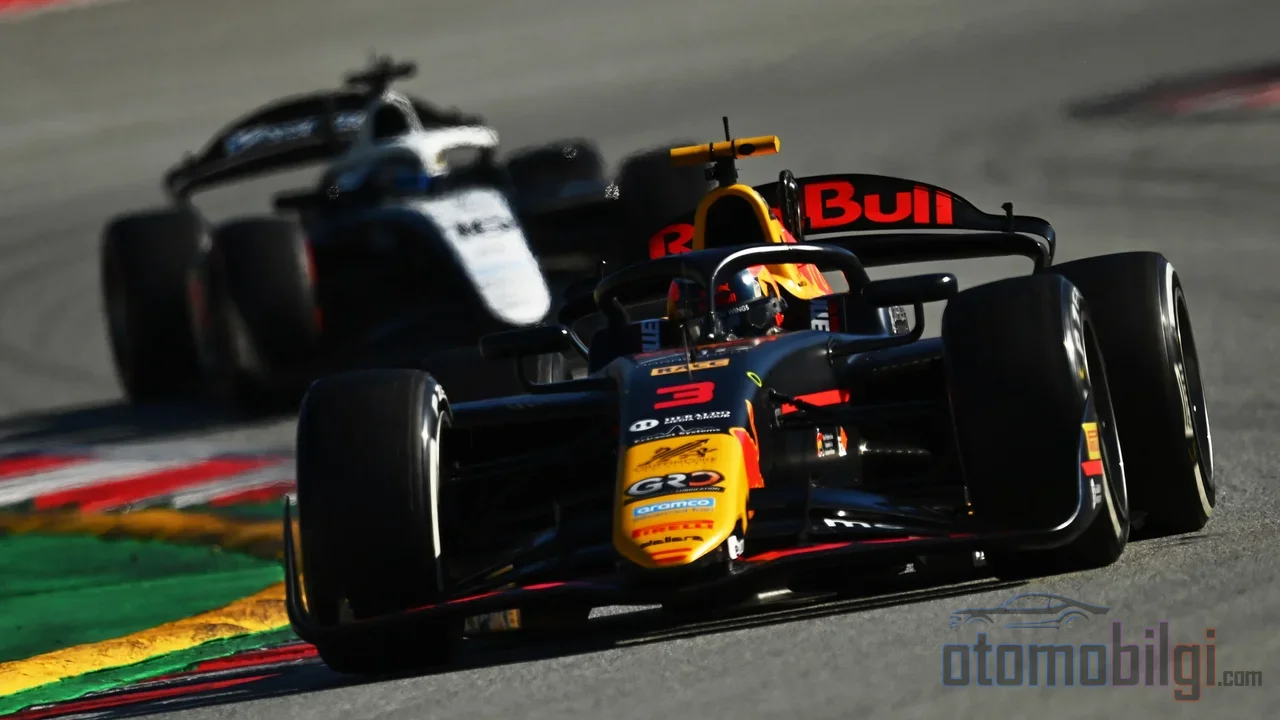
Share This Page
A pit stop takes 2 seconds but can change the outcome of the entire race. So why is the same move a trump card in Formula 1 and a completely different calculation game in F2? The driver who takes pole position in Friday's qualifying sessions may start the Saturday race from second-to-last. What's more, the mandatory pit stop exists in only one of the two races. If you're confused, you're right; let's unpack this two-race format.
Why Does an F2 Weekend Consist of Two Races?
To understand F2's race strategy, we first need to look at how the calendar works. Each F2 round coincides with a Formula 1 race weekend, and two races are run in each round: the Sprint Race and the Feature Race. There are 28 races in total in a season; meaning drivers battle for the podium almost every weekend, twice.
These two races are not copies of each other. The Feature Race is the main event, run over a long distance and worth big points; the winner takes 25 points, just like the distribution in F1. The Sprint Race is a shorter contest, and 10 points are enough for its winner; points are distributed down to 8th place. Since the two races differ in length, format and rules, strategy is built twice, in two different ways. This is where the first code that makes F2's approach to pit stops different begins: same car, same track, but two separate games.
Why Is the Mandatory Pit Stop Only in the Feature Race?
F2 regulations are clear: in the Feature Race, every driver is required to make at least one pit stop. More precisely, all four tires must be changed unless wet-weather tires are used. Everyone racing on a dry surface must use two different tire compounds before the race ends; this rule works on the same logic as the one in F1. So in the Feature Race, a pit stop is not a choice but a duty.
In the Sprint Race, however, the picture changes completely. There is no mandatory pit stop and no tire requirement. That's why the center of strategy in the Sprint race shifts away from the pit stop to tire management and race pace. When deciding how much to conserve their tires and when to push, drivers face a single question: will this compound last until the end of the race? Sometimes a driver who starts on the harder compound can complete the entire race without stopping at all.
Let's think of it with an analogy from daily life: the Feature Race is like a long journey; taking a break is mandatory, the only question is when to take it. The Sprint Race is like a short run in the schoolyard; no breaks, and whoever shares their breath at the right moment wins. Using two different strategy playbooks in the same weekend is one of the fundamental features that sets F2 apart from other series.
Key Takeaways
- The mandatory pit stop in F2 exists only in the Feature Race; all four tires must be changed.
- The Sprint Race grid is formed by reversing the top 10 positions of qualifying.
- Since 2022, the mandatory pit stop in F2 cannot be made during a safety car period.
- In F1, the average pit stop is 2-2.5 seconds; in F2, what really matters is the timing of the stop.
- In the 2026 Catalonia F2 race, Camara on lap 23 and Dunne on lap 13 pitted, following opposite strategies.
How Does the Reverse Grid Rule Change the Strategy?
Now we come to the most colorful part of the matter: the reverse grid. In F2, the results of Friday's qualifying sessions determine the starting grid for Saturday's Sprint Race; but not straightforwardly - the first 10 positions are reversed. So the driver who is first in qualifying starts the Sprint from 10th position. The aim is to remove qualifying from a monotonous pattern where the leaders always start up front, balance the racing field, and give everyone a chance to overtake.
So what does this have to do with pit stop strategy? A great deal. The reverse grid rewrites the calculation in drivers' minds. Since a fast driver cannot start at the front in the Sprint, they have to work their way through the race; and because there is no pit stop here, their only weapon is getting tire management and pace right. In the Feature Race, the classic grid applies and the mandatory stop is on the table. In short, the reverse grid separates the strategic identities of the two races even further: one is a pure management race, the other a battle of stop timing.
This rule is so well established in F2 and F3 that when F1's reverse grid Sprints from 2027 onward came up for discussion, a serious debate began. Aston Martin saw it as the risk of F1 becoming F2-like; George Russell argued that the reverse grid would not work in F1. Those on the other side say it gives points chances to the lower teams and reduces its impact on the championship. So the rule you see as ordinary in F2 is still a hotly debated topic in F1. Meanwhile, F1 Academy also brought back the reverse grid from 2025; Race 2 is run with a grid where the first 8 are reversed.
Safety Car and the Free Pit Stop Ban
The sweetest dream of pit stop strategy is this: the safety car comes out, the whole field slows down, and you pit almost without losing any time. In F1 this is still possible; a safety car period covering the full lap length can reduce the gap between the leader and the last car from about 75 seconds to 22 seconds. In other words, most of the advantage accumulated on track is wiped out and the cost of a pit stop nearly disappears.
In F2, however, that door is closed. With the 2022 regulation update, the mandatory pit stop can no longer be made during a safety car period. According to the regulation, cars that must enter the pit lane after the safety car has returned to the pits resume the race from the end of the pit lane. This rule was introduced to prevent that famous free pit stop advantage. So in F2, delaying your stop and waiting for the safety car to make it cheaper does not work; you really have to get your timing right.
Stop Early or Stop Late? The Logic of the Undercut and Overcut
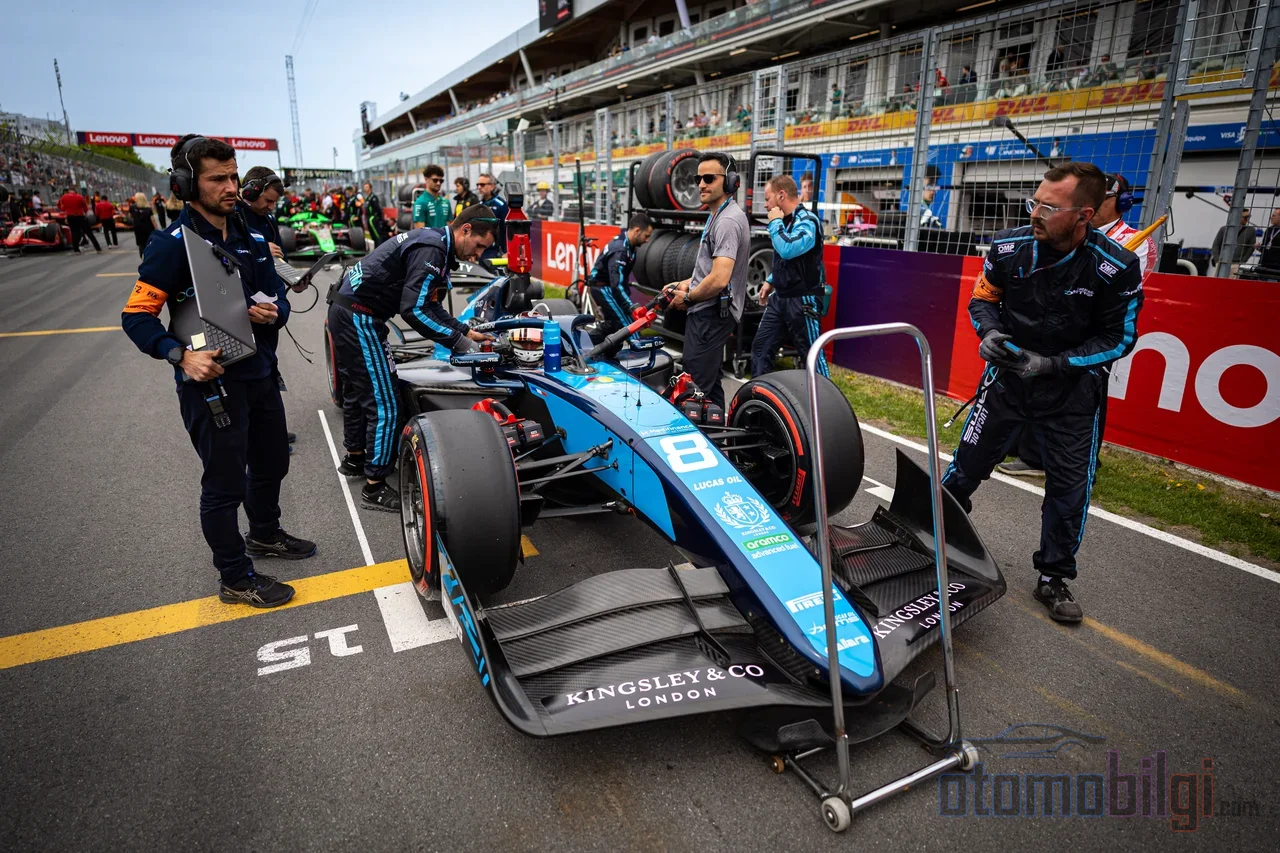
In races where a mandatory stop exists, the real question is this: when should you return to the pit lane? Two classic moves come into play here. Undercut means pitting before your rival, setting fast laps on fresh tires, and catching them. Overcut, on the other hand, is quite the opposite; staying out on older tires to keep pace for longer during the pit window, then pitting to overtake the rival. The basis of both moves is the time difference lost between a pit stop and a normal lap, in other words the delta calculation.
These calculations can be seen concretely in F2. The 2026 Catalonia F2 Feature Race is a fine example of this: in hot weather and high track temperature conditions, Rafael Camara started on soft tires but delayed his pit until lap 23, then switched to the hard compound. Alex Dunne pitted on lap 13, and Gabriele Minì on lap 14, applying an early version of the same strategy. Camara went from pole to victory. While a three-stop strategy won on the F1 side that same weekend, a single stop and tire management proved decisive in F2; a picture clear enough to summarize in one sentence the difference in the strategic DNA of the two series.
How Does the F2 Pit Stop Differ Structurally from F1?
Now we come to the main question of this page. F2 pit stop strategy works differently from F1, because the difference arises from several structural layers stacking on top of each other. F2 is a spec series: everyone races the same car, and performance differences come largely from the driver and tire management. There is no refueling, so the pit stop is focused entirely on tire changes; in F1 too, refueling has been banned since 2010, so here the two series resemble each other. But when the mandatory stop being required in only one of the two races is combined with the reverse-grid Sprint format and the safety car rule, a strategy layer that does not exist in F1 emerges.
The short and clear answer is this: In F2, the pit stop is not a move within a single race; it is a strategy game spread across the whole weekend, embedded in tire management, the reverse grid, and the sprint-feature format. While strategy engineering in F1 revolves around the pit delta, in F2 you must also read the rhythm of the week. Pit stop history sums up this transformation nicely: in the 1950s a stop took about 67 seconds, it dropped to 8 seconds during the refueling era between 1994 and 2009, and today the average is 2-2.5 seconds. McLaren holds the world record with a 1.80-second stop at the 2023 Qatar GP. As speed increased, the weight of strategy shifted from the pit itself to its timing; F2 turned that timing into a completely different game with its own rules.
The Difference Is Even Clearer Compared to F3
If we step one rung down the ladder, the picture gets even more interesting. There is no pit stop at all in Formula 3; tire management and race pace alone are decisive. Three cars run per team, so the calculations within a team also work differently. The Sprint grid is likewise set by reversing the order, as in F2, but in F3 this reversal is based on the fastest 12 drivers; in F2 the number is 10. So F2 is a unique middle ground that combines all the rules that make the pit stop exist yet strip it of being a classic F1 move.
That is why watching F2 is perfect for learning strategy. On one side, Sprint drivers saving their tires without stopping at all; on the other, drivers delaying their stop to lap 13 or lap 23. Feature calls that decide whether it's done in that lap, on top of safety car rules with a free stop door slammed shut. A series where F1 is about much more than the pit; and in this 28-race season, this game is played twice every weekend. Which do you think is more exciting: saving tyres without stopping at all, or stopping at the right second and turning the race upside down?
Sources
- The Rules and Regulations - FIA Formula 2
- 2025 FIA Formula 2 Championship Sporting Regulations
- The beginner's guide to Formula 2 - Formula1.com
- Tyre strategy delivers Hamilton's first win in red - Pirelli Press
- Update to the F2 Sporting regulations for Zandvoort - r/F1FeederSeries
- A Thorough Analysis of the Pit Stop Strategy in Formula 1 - Statathlon
- F1 Race Strategy Explained - FormulaDream
- F1's reverse grid sprints could be "slippery slope to becoming F2" - Motorsport.com
- How Does a Race Weekend in Formula 3 Work Differently Than in F2? - Otomobilgi
- How does an F2 weekend work? - FanAmp