How Is Pirelli Determining the Fate of F2 Racing?
Share This Page
Pirelli is the sole tire supplier for Formula 2 and deliberately designs its tires to be prone to wear, so that race strategy, pit stop decisions, and tire management skills become the real deciding factors of the championship. In short, in F2 it is not just the driver who pushes the throttle hardest who stands out, but the one who uses their tires most intelligently.
Highlights
- Pirelli in F2 and F3 Sole supplier until 2027; agreement extended for F1, F2, F3 and F1 Academy until the end of the 2028 season. was extended.
- At an F1 race weekend more than 100 sets of tires are used, and all of them are recycled.
- Tire warmers (blankets) are banned in F2; in F3, only a single compound is brought to each weekend.
- Supersoft and Soft compounds were taken to Melbourne for the 2026 F2 season opener.
Why Does Pirelli Deliberately Use Fast-Wearing Tires in F2?
Let me explain this by thinking of a party balloon: if you never deflate it, it is boring; if you deflate it in a controlled way, you have to plan when and how to deflate it. F2 tires are designed exactly like that. Pirelli's goal is not to make the tire last forever; it is to keep wear at a predictable level and force the driver to manage their tires. That is why the compounds are deliberately developed to degrade.
I can almost hear the next question: So what does this give the drivers? As Pirelli itself states, tires designed to wear force young drivers to learn tire management skills, and these skills become more critical with every step up the FIA ladder. In other words, since F2 is the final rung of the ladder to F1, this educational tire philosophy is not by chance, but by design.
There is also an operational side to this, and it is incredible: at an F1 race weekend more than 100 sets of tires are in circulation. Dry tires that go unused over the weekend are analyzed and tested, and can be reused during the season. All used tires are sent back to the technical center in England; raw material for plastic floors and asphalt comes from there. The tire cycle is also designed with the environment in mind, which I quite like.
How Do the Tire Approaches of F1, F2 and F3 Differ?
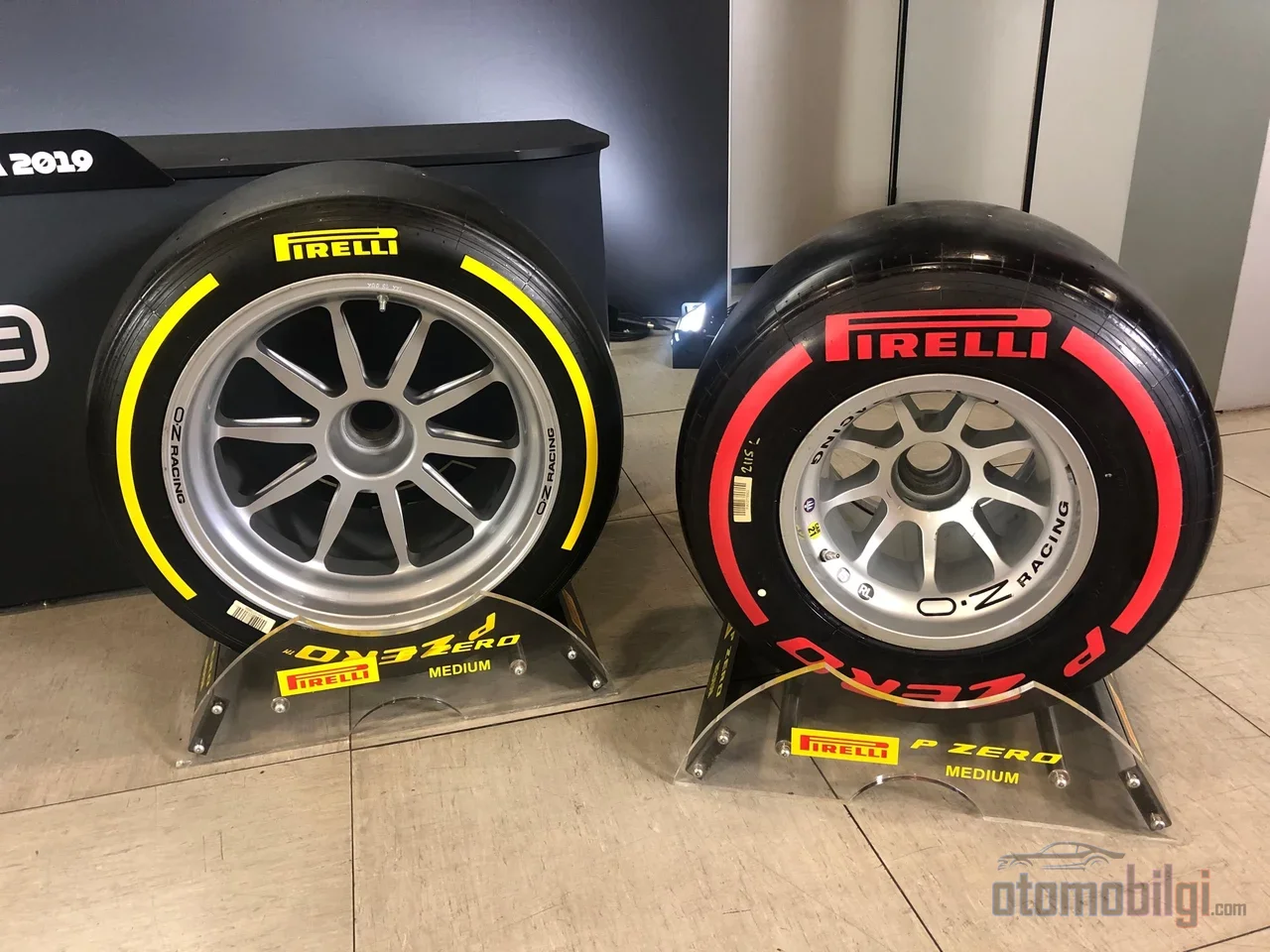
You can think of the three series as three different lessons. F1 is a cutting-edge strategy war, F2 is the school of that war, and F3 is a more fundamental introductory lesson. F2's biggest distinction is that tire warmers (blankets) are banned. A tire taken out without heating starts cold, and the driver has to learn to wait for it to warm up; this requires a completely different philosophy for designing tires. In F3, things are even simpler: there are three slick compounds (soft, medium, hard), but only one type of tire is brought to each weekend. So in F3 there is no compound selection strategy, but a lesson in adapting to the tire.
| Feature | F1 | F2 | F3 |
|---|---|---|---|
| Number of compounds | Five slick compounds (C1-C5) | Multiple compound selection | Three compounds but one type/weekend |
| Tire diameter | 705 mm (2026) | - | - |
| Warmer (blanket) | Used | Banned | - |
| Rim size | 18 inches | 18 inches | 16 inches (from 2025 onward) |
| Strategy depth | Mandatory two-compound rule | Degradation-based planning | Compatibility with a single tire |
An interesting choice was made for the 2026 season opener in Melbourne: the Supersoft and Soft compounds, with no gap between the compounds. This kind of choice reshapes strategy; if the two compounds are close to each other, the compound choice becomes less decisive than usual, and how the tire behaves that weekend becomes far more decisive.
Undercut, Overcut and Pit Stop: Who Wins the Race?
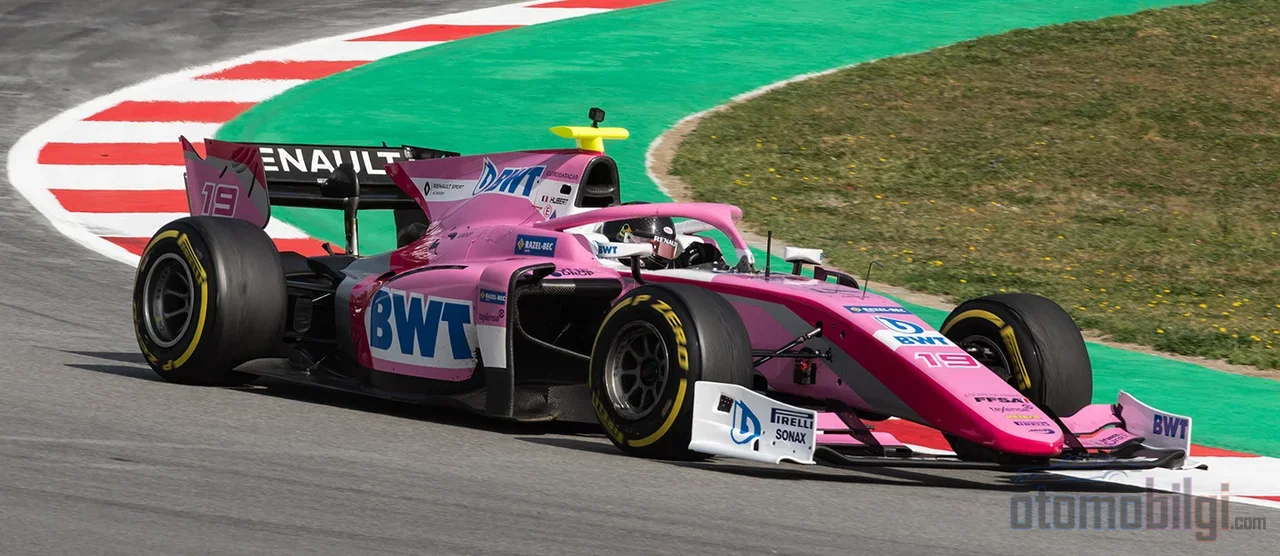
In F2, race results are largely shaped by the tire degradation curve. Think of it this way: when switching from one compound to another, you want to release the balloon's stopper slowly; if you release it too early, the compound runs out before the tire finishes you off, and if you release it too late, you lose out on track. The tactic of pitting early and accelerating on fresh tires to pass the car ahead is called the undercut, while the tactic of pitting before the fresh-tire runner, holding pace on track and passing later is called the overcut. Let me give an example from the 2026 F1 season, because the lesson is the same: in Austria, with 36°C air temperature and 55°C track temperature, a one-stop became impossible, Ferrari, which used the undercut, stood out with three stops, and the overcut attempts did not deliver the expected return. F2 drivers study exactly these lessons at this school.
It would not be an exaggeration to say that tire degradation is more predictive than qualifying. Qualifying order is static; but tire degradation patterns evolve throughout the race and telegraph in advance who will pit when. That is why the gap that opens up over time between two drivers using the same compound is usually tire management, not the car.
Why Is Tire Management a Critical Indicator for the Move to F1?
When F2 champions describe the secrets of their success, they most often emphasize the importance of tire management. The logic is simple: in F1 too, a driver who cannot manage the tires cannot score points, even if they are physically fast. A driver who is good at tire management, on the other hand, gains a serious advantage over their rivals, especially toward the end of the race. In other words, winning the F2 championship means passing not only a driving test but also a test of tire intelligence.
The Spa example is the most vivid illustration of this lesson: in a period when the season was largely unpredictable, there were 9 different winners in 12 races, and at Spa there was no relief from tire management at all. A driver who establishes dominance one week can fade in the standings the next week because of the tires. A bad tire day is the day that tests a driver in the most merciless way.
In fact, similar debates continue in F1 as well. Max Verstappen, who criticized the 2025 tires, explained that he could not go full throttle even for a single lap because of tire management; following that, F1 and Pirelli worked on a completely new tire for 2025. Pirelli plans to return to higher tire degradation rates in 2027. So the debate of controlled degradation versus driving freedom continues in the big league too - and F2 students are growing up right in the middle of this debate.
What Is the Purpose of Pirelli's Single-Supplier System?
The single supplier system may seem boring at first, but it actually puts the race's true hero in the spotlight: the driver and the team. If everyone uses the same tyre, the difference comes down to how the tyre is used. Pirelli's F2/F3 deal runs until 2027, while the deal covering four series including F1 was extended until the end of the 2028 season. In 2026, when the new engine and chassis regulations came into effect, the single supplier strategy was preserved on the grounds of continuity. In addition, the 2026 F1 tyres were resized according to the regulations: the front tyre narrowed by 25 mm, the rear by 30 mm, and the diameter dropped from 720 mm to 705 mm. The compounds go through the official homologation process every year in line with the technical regulations.
Istanbul Park and the Türkiye Connection: The Track That Wears Out Tyres
Türkiye has a place in this story that should not be overlooked. Istanbul Park is described as a very demanding track for the tyres; its high-speed corners fatigue the tyres, and the track bears the signature of Hermann Tilke, regarded as one of the finest designers in the world. There was even an interesting crisis in November 2020: Pirelli learned too late that the asphalt would be renewed and had to choose the three hardest compounds for the race. The texture of the asphalt can change the tyre choice that much - the track surface is actually the tyre's biggest rival.
Track championship culture is also alive in our country: on August 30, 2026, TOSFED organized the 3rd round of the AVIS Türkiye Track Championship at Istanbul Park. In other words, the lesson in tyre management is taught not only in Europe but also on our own tracks every weekend.
Conclusion: The Tyre's Bad Day, The Driver's Real Test
In F2, the tyre is not just a component; it is the scriptwriter of the race. Pirelli's wear-prone compounds, the blanket ban, and the mandatory pit stop combine to produce a chess match where every lap is calculated. A driver who stands firm on a bad tyre day will also survive in F1. If there is a secret to championships, that secret lies in the tyres.
Sources
- The life of a Pirelli Formula 2 tyre before, during and after a race weekend
- 'We are preparing young drivers for F1': Pirelli on the season
- WHAT TO WATCH FOR: All the key points ahead of Melbourne
- Our Champions share their secrets for success in F2
- The beginner's guide to F1 tyres
- Pirelli reveals 2026 F1 tyres
- Formula 1 for dummies: how tyres are chosen for a GP?
- Pirelli learned too late that Istanbul Park would be resurfaced
- F1 and Pirelli are working on a completely new tyre for 2025
- Pirelli's 2027 high-wear plan
- Pirelli's 2026 Formula 1 tyres
- AVIS 2026 Türkiye Track Championship, round 3
- No Relaxing at Spa for Tyre Management
- The Art of Tyre Management