Why Do New Drivers Joining F2 Struggle in Their First Season?
Share This Page
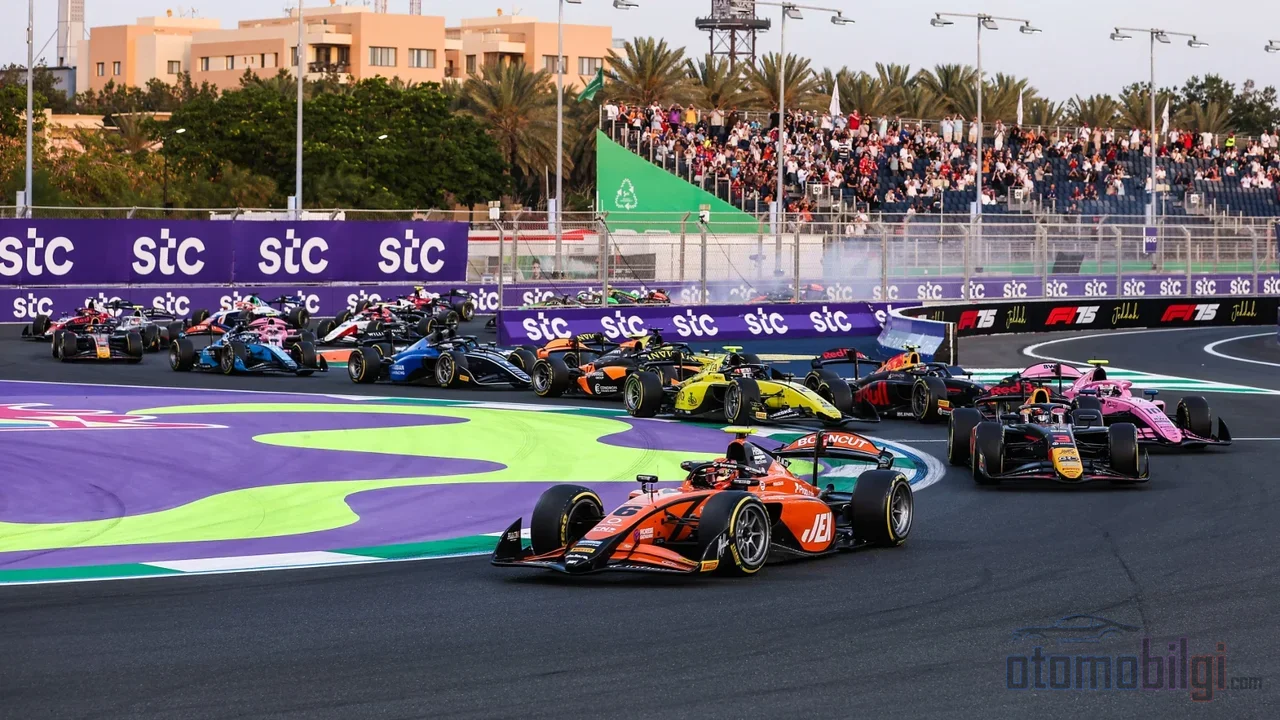
Drivers moving up from F3 to F2 struggle in their first season, because they are climbing not just one step but practically several steps at once: they move to a car with roughly 60% more power, they dive into corners with much higher downforce, they go from racing on a single tire compound all weekend to managing multiple compounds, and on top of that they find themselves in competition where passes happen by the slimmest of margins. That's why the rookie year in F2 is almost always regarded as a learning year in motorsport.
Highlights
- The F2 car produces approximately 620 hp while the F3 car stays at ~380 hp ; F1 hybrid power units, meanwhile, sit around the ~1,000 hp mark.
- The F2 car 335 km/h can reach a top speed of; in F3, this figure is 300 km/h.
- In F2, multiple tire compounds are managed over the weekend; in F3, a single compound is used.
- The F2 championship alone is worth 40 super license points - meaning it can open the F1 door in a single season.
- Oliver Bearman said the toughest aspect of his rookie season was tire wear and tire management.
What Exactly Is the Difference Between F2 and F3 Cars?
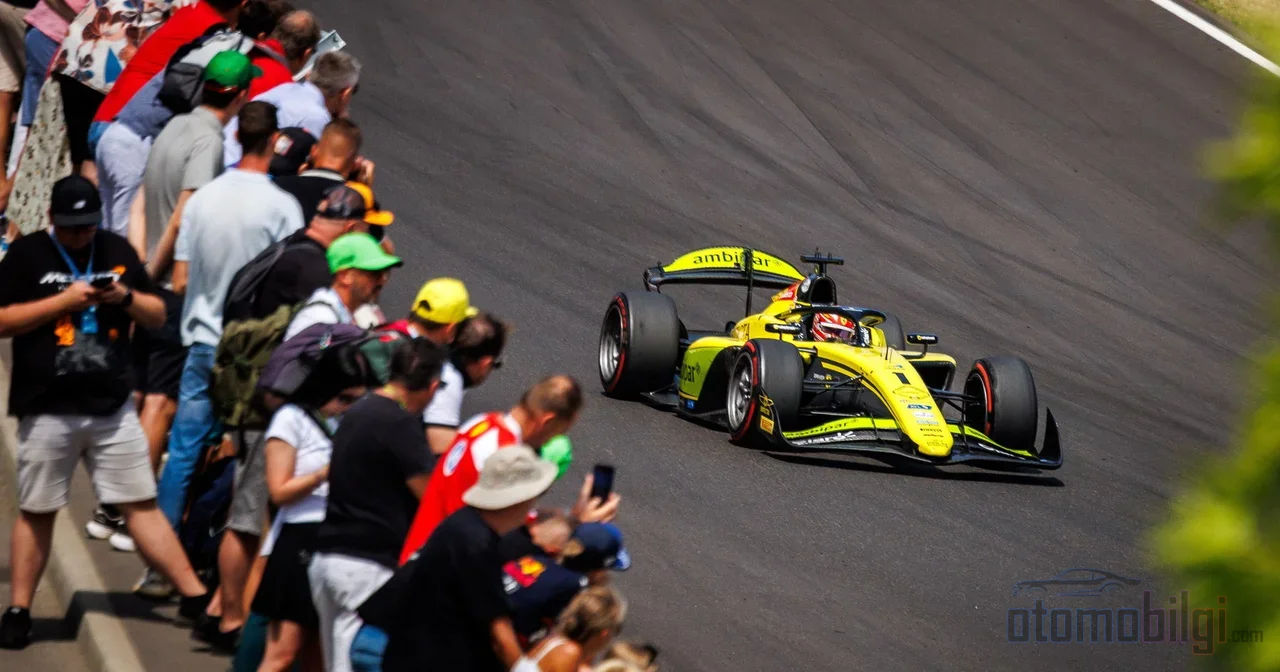
Let's start with the numbers, because the difference is truly significant. The F2 car has a 3.4-liter turbocharged Mecachrome V6 that produces around 620 hp. In F3, it's also a 3.4-liter but naturally aspirated Mecachrome V6, meaning no turbo and power around 380 hp. Just think about it: the same engine displacement, but one is turbocharged. It's like having driven both the naturally aspirated and turbo versions of the same brand - both are fast, but one pins you to the seat.
| Feature | F3 | F2 | F1 (for comparison) |
|---|---|---|---|
| Power | ~380 hp | ~620 hp | ~1,000 hp |
| Engine | 3.4L naturally aspirated V6 | 3.4L turbocharged V6 | Hybrid power unit |
| 0-100 km/h | 3.1 s | 2.90 s | 2.4-2.6 s |
| 0-200 km/h | 7.7 s | 6.60 s | - |
| Top speed | 300 km/h | 335 km/h | ~370 km/h |
But it's not just about the engine. The real game is in downforce, meaning the force with which the car presses onto the road as speed increases. FIA F3 Technical Director Pierre-Alain Michot summarizes these steps very well: when drivers come from the bottom of the pyramid to F3, they find another level of downforce and have to adapt to the increased cornering speeds; as they move up, there is yet another step with an even more efficient car. In other words, at every level, what the car is telling you changes.
That's why the F3 car was deliberately designed as preparation for F2: the steering ergonomics were matched to F2, and the electronics were also geared toward F2 preparation. But the F3's floor is simpler and its downforce is lower. Additionally, F2 has two rear wing specifications - standard and low downforce; in F3, a single wing concept covers the entire calendar. This means that setup and package complexity increase significantly in F2. Teams have to choose the right package for each track - and for a rookie, that means yet another variable they've never had to think about before.
Why Does the Rookie Year Become a Learning Year?
For a pilot newly promoted to F2, the most talked-about topic in their first season is undoubtedly tire management. In F3 there are soft, medium, and hard compounds, but only a single compound is used per weekend. When you move up to F2, you need to manage multiple compounds within the weekend - you have to learn when to push on which compound and when to conserve the tires. It's a completely different skill that is never tested in F3.
Oliver Bearman put it very candidly when talking about his rookie F2 season:
Understanding the races took me a bit longer; tire wear and tire management... but I think it has now settled in my head.
The process Bearman went through in his rookie year is not an isolated example. The same lesson repeats in F1: it was being said that Oscar Piastri lost races in his rookie year due to tire management, and that McLaren saw it as a major learning process. McLaren openly said that in Piastri's first year there were still things he needed to learn about in-race tire management, and that he was being caught and overtaken by Lando Norris. In other words, even the brightest names of the biggest academies encounter this step.
Not just tires: race distance and mental load
F2 races are longer than F3. A longer distance means you need to stay focused for a longer time, both mentally and physically. Arthur Leclerc touches on a very critical point when explaining how what he learned in F3 supported his rookie F2 season: for him the issue was more of a mental state and the feeling of pressure in qualifying. The moment you trust that you can deliver your lap, you can show your performance. In short, the rookie year is not only a physical but also a psychological test.
There is also the competitive window. In F2 everyone races in virtually the same car - that's the nature of the spec series format. The differences are so small that tenths are talked about in qualifying. For a driver coming from F3, this means an environment where the margin for error drops to nearly zero. A small mistake can send you all the way to the back of the grid.
Why Does Physical Preparation Become More Critical in F2?
Since F2 is the series that directly feeds into F1, the cars perform at almost F1 level, and this requires exceptional cardiovascular conditioning. As the race distance grows, the car accelerates, and downforce increases, the load your body is exposed to also increases. The figures cited as reference from F1 offer a framework: it is said that around 140 kg of pressure is applied to the pedal under braking, that drivers are exposed to forces of around 5G due to downforce, and that 2-3 kg is lost during a race. These are F1 figures and cannot be directly generalized to F2, but they are a good reference for thinking about how important the physical transition to F2's heavier and longer races is.
Anthropometry, that is, body measurements, is also part of the equation. Professional drivers are known to exhibit specialized physical adaptations; drivers who have the physical attributes the cars demand thrive, while those who don't struggle. A physique suited to F3 may not hold up in F2's higher speeds and longer races. That's why rookies have to start a new program not only on the track but in the gym as well.
Money and Opportunity: Why Is the Rookie Year So Pressurized?
A season in F3 can cost millions of euros, and most drivers cover this money through their own funding or academy backing. There is a 1 million euro prize fund split among the top 5 drivers in the F3 class; this genuinely helps a driver, but it isn't enough to finance an F2 season. So many talented drivers are forced to choose between a second season in F3 or a single season in F2.
This adds extra pressure to the rookie year: you have little room for error, because this season may be your only chance. The age limits are also interesting - the minimum age in F3 is 16, and 17 in F2. There is no upper age limit, but the grid is generally in the 18-20 age range. So someone stepping up to F2 at 17 finds experienced rivals lined up alongside them at 20 in their third year. Striking this balance is never easy for rookies.
So What Happens at the End of This Learning Year?
The good news is this: the path from F2 to F1 is clear. For an F1 super license, you need to accumulate 40 points over the last 3 seasons, and the F2 championship alone is worth a full 40 points - meaning winning F2 secures the license in a single season. There are also additional routes that earn 1 point per event, such as driving at least 100 km in free practice sessions (up to a maximum of 10 points per event).
But not everyone climbs this rung at the same pace. Gabriel Bortoleto managed to win the F3 and F2 championships back to back as a rookie and made it to F1 in 2025 - so it is possible to clear every rung in your first year. Arvid Lindblad, meanwhile, moved up to F1 with Racing Bulls in 2026 after F4, then a season each in Formula Regional Middle East, F3, and F2. Two names, two different tempos; both used the same ladder. On the other hand, there are exceptions: Max Verstappen skipped F2 entirely and said that the jump from karts to F3 was bigger than the jump from F3 to F1. Kimi Raikkonen similarly skipped the lower rungs. But these are the exception, not the rule.
The performance of academy drivers in F2 is also debated: Williams academy driver Victor Martins is still struggling in his third year. This shows that development after the rookie year is not guaranteed either. In fact, the introduction of a season limit for drivers is even being discussed due to grids shrinking - meaning there may be no right to an endless learning year in F2.
How Will the Next Car Change This Equation?
Formula 2 has unveiled its new car, to be used from 2027 onward, at Monza. The design process was led by F2 technical director Pierre-Alain Michot, and the car is once again being developed by Dallara. This means rookies will be getting to grips with a brand-new car in the period ahead - the learning curve will be reset to zero once again, for both teams and drivers.
Meanwhile, the current F2 car weighs about 755 kg including the driver. Since F2 and F3 are Dallara-built spec series, the goal is the same: to train drivers for F1 and put driver skill front and center. F2 races only on F1 circuits as a support series on F1 weekends; its races are shorter than F1's and are generally run in the early hours of the day. So a rookie learns right in the middle of the post-F1 ecosystem on F1 circuits - this is the environment where lessons sink in fastest.
The Learning Year Is Actually an Investment
The step up from F3 to F2 is one of the toughest jumps on the motorsport ladder. Power, downforce, tire compounds, race distance and razor-thin competition - everything changes at once. Some drivers shine immediately, others arrive a year behind; but in the end, this learning year is not an obstacle, it is part of the road to F1. Many names, from Bearman to Piastri, turned the struggles of their first season into later success. What do you think is the area where it is most normal for a rookie to struggle in their first year - tire management or the pressure of qualifying laps? In my view, both at once; besides, the two are really just different faces of the same thing: F2 is teaching you the language of F1.
Sources
- F1 vs F2 vs F3: Key Differences Explained
- F3 Explained: How the new car is closer to F2 than ever before
- A work in progress: Oliver Bearman on his rookie season
- Lessons learned in F3 could boost rookie F2 performances
- F1 Explains: Rookie Seasons
- Oscar's remarkable rookie season
- How F2 and F3 are providing the tools for F1 success
- Aerodynamic Evolution: Contrasting F1 and F2 Racing
- Physiological Demands and Training Recommendations for Formula Racing Drivers
- Bulls' Guide To: Driver Fitness And Nutrition
- The beginner's guide to the F1 Super Licence
- New F3 prize 'not going to finance a full season in F2'
- How F2 and F3's top rookie prospects are preparing for their debut seasons
- How do academy drivers perform in F2 and F3?
- Should F2 and F3 introduce season limits for drivers?
- Formula 2 unveiled its 2027 car at Monza
- An F1 Guide for Beginners to Formula 1
- The first 10 F3 graduates to make it to Formula 1