From GP2 to Formula 2: How Did the Series Transform?
Share This Page
GP2 continued on its way, taking the name FIA Formula 2 Championship in 2017; in other words, the F2 we watch today is actually the new name of the same series founded in 2005, the closest stepping stone to Formula 1. This change came with Liberty Media's purchase of F1 and was made to fit motorsport's clear ladder extending from F4 to F1. Here is the full story of this transformation from GP2 to Formula 2.
Highlights
- GP2 took the name FIA Formula 2 Championship on March 8, 2017.
- The first F2 champion was Charles Leclerc: 8 poles, 7 wins, 282 points.
- An F2 season costs approximately 3 million dollars per team.
- In 2025, Lando Norris became the first F1 world champion to be an F2/GP2 graduate.
- Istanbul Park is on the F2 calendar in 2027; Türkiye will host F1, F2 and F3 in the same weekend.
Why Did GP2 Become Formula 2?
Let's refresh our memory with a bit of history first. GP2 was founded in 2005 by Flavio Briatore and Bruno Michel, who is still the series' managing director. The idea was simple: Keep costs low for the teams, but offer drivers a real preparation school before entering F1. Indeed, the series worked like a talent factory for the F1 market. The first GP2 champion, Nico Rosberg, entered F1 with Williams in 2006, right after his 2005 title. What does this mean? It shows that the series acted like a direct elevator to F1 even in its very first season.
So why did the name change? The answer has two parts. First, Liberty Media, which bought the Formula One Group in 2017, had begun restructuring the sport from top to bottom. Second and more importantly, the FIA had long had a goal in mind: A clear ladder that everyone could easily read: F4, F3, F2, F1. The GP2 name did not fit this logic; both the concepts "GP" and "2" were confusing. On March 8, 2017, the FIA confirmed that the GP2 Series would be renamed the FIA Formula 2 Championship, and the World Motor Sport Council ratified the decision at its meeting in Geneva on March 9.
Rationalising the path to Formula 1 has been an important goal of the FIA during my time here.
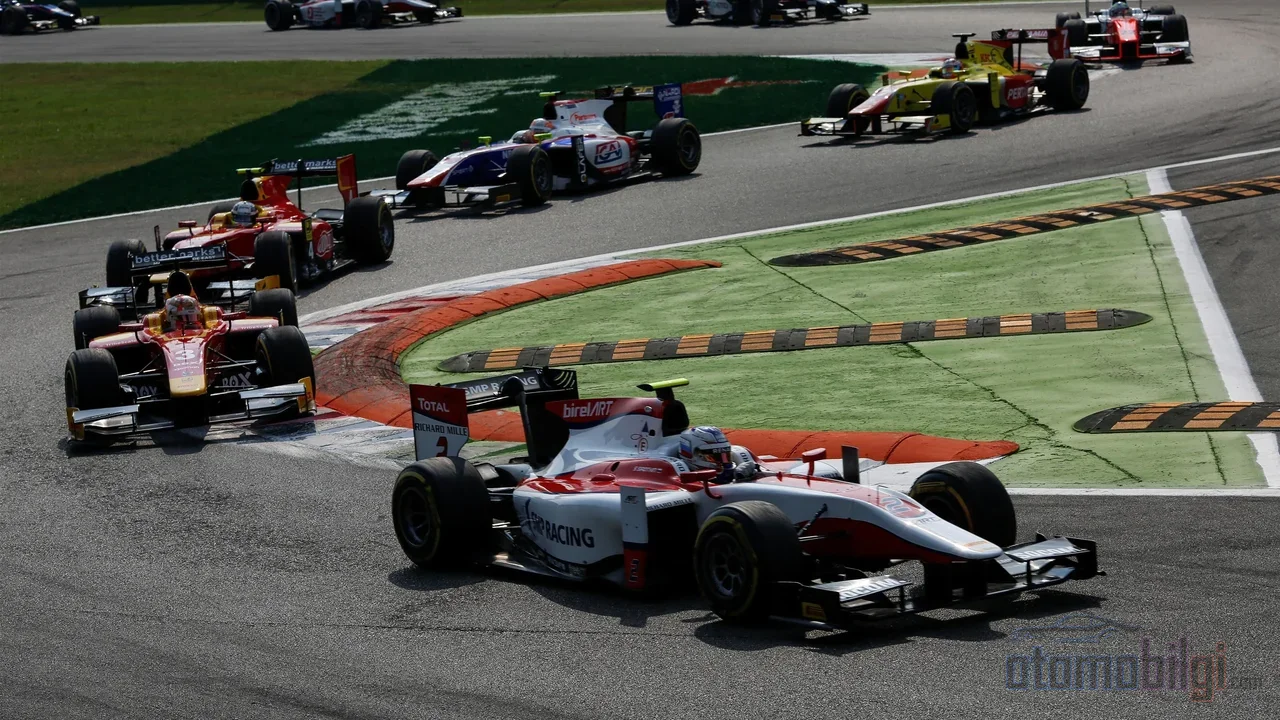
Now, here's a question for you: Does the car change when the series brand changes? The answer here is no. In 2017, the series kept exactly the same Dallara GP2/11 chassis used since 2011 and the Mecachrome V8 engine used since 2005. So the name changed first, and the technical world gradually evolved later. Making this distinction is super important for understanding the series' transformation.
How the Cars Evolved: From GP2/11 to F2 2024
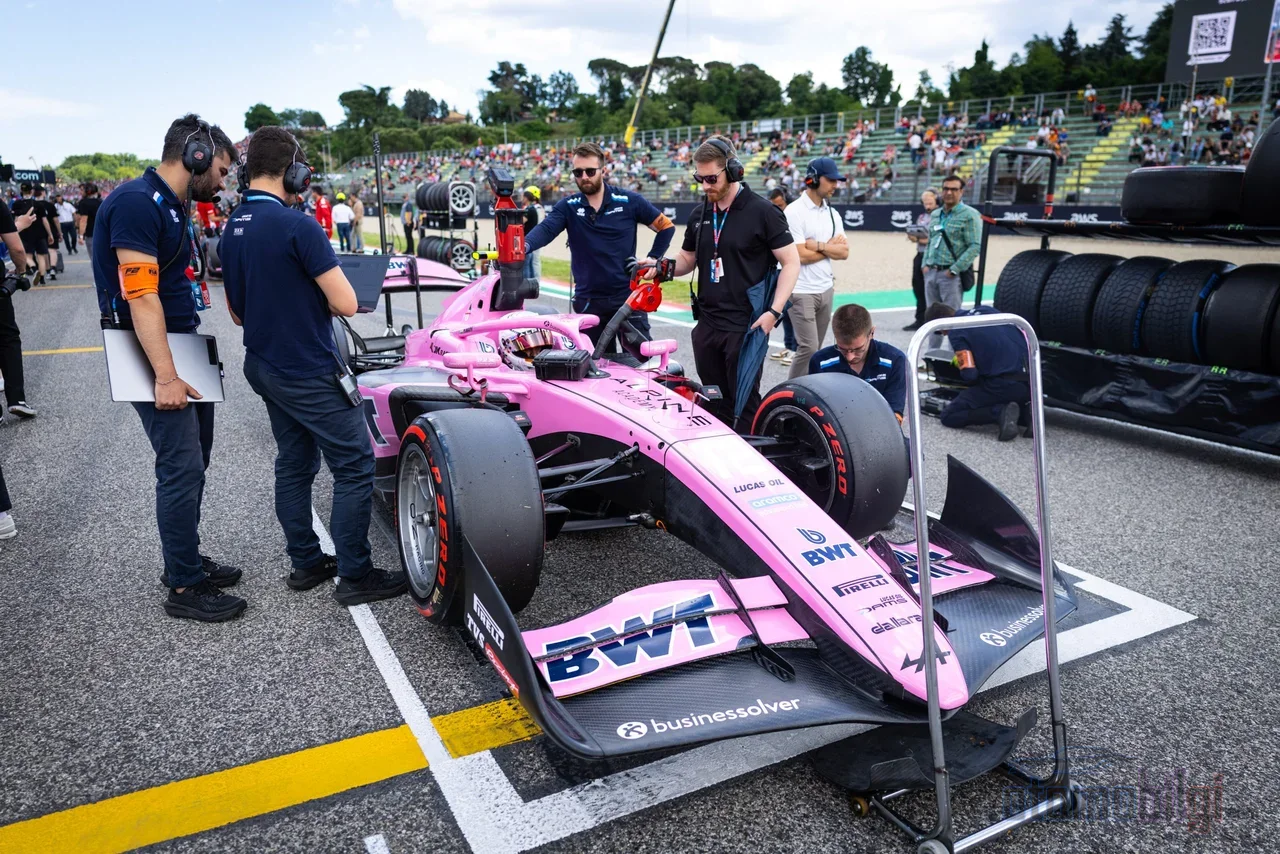
F2 is a "spec", meaning single-brand, series: All 22 cars on the track are produced by Dallara to the same specification and all use Mecachrome V6 turbo engines. This, unlike Formula 1, is a setup where driver skill, not engineering, is at the forefront. Just like students taking an exam at the same school with the same stationery set: The only thing that makes the difference is the hand that solves the exam.
Dallara F2 2018 and halo
2018 was, technically speaking, the first big turning point year. That year the Dallara F2 2018 chassis was introduced, the engine switched to the Mecachrome V634, and the most striking innovation arrived: the halo. The halo, that titanium cage above the cockpit; the structure that protects the driver from objects falling on their head. An interesting detail: F1 also adopted the halo the same year. So F2 didn't fall behind in F1's safety revolution - it took the step alongside it.
18-inch wheels and F2 2024
In 2020, the wheels switched from 13-inch to 18-inch magnesium alloy rims; and the wheel supplier remained the OZ Group, unchanged since 2005. Then in 2024 came the Dallara F2 2024. The goals for this chassis were very clear: To resemble current F1 cars more closely, to offer advanced safety technologies, and to provide a cockpit design better suited to female drivers. On the tire side, Pirelli has been the sole supplier since 2017: four slick compounds (purple supersoft, red soft, yellow medium, white hard) and a single rain tire. In 2023, Aramco also became the series' official fuel partner.
Let's get a little closer to the technical details, because they define the car's character: The car has a minimum weight of 755 kg including the driver, the gearbox is Hewland, the clutch is ZF Sachs, the tank is the 125-liter FIA Premier FT5 safety tank, and refueling during races is prohibited. So the strategy is built entirely on tire management and the driver standing on their own two feet, without pit stops.
Weekend Format: How Do the Sprint and Feature Races Work?
In 2017, the format was as follows: Saturday the long-distance Feature Race, Sunday the Sprint Race. Later this arrangement changed and took its current form: On Friday, a 45-minute practice session and a 30-minute qualifying; Saturday the sprint, Sunday the feature. The most colorful rule in the sprint is the reversal of the top 10 on the grid: The driver who takes pole starts from 10th place. That way, moving up on Saturday is genuinely hard, which makes it that much more fun to watch. The sprint runs about 120 km or 45 minutes, the feature about 170 km or 1 hour, and both are held before the F1 race.
The points scoring also differs between the two races: In the sprint, the top 8 score (10-8-6-5-4-3-2-1); in the feature, the top 10 (25-18-15-12-10-8-6-4-2-1). Pole position earns +2 points, and the fastest lap for a top-10 finisher earns +1 point. So the maximum points available in one round is 39.
The format was shaken up after the pandemic too: In 2021, as part of cost cuts, it went to 3 races per round, the number of tracks dropped from 12 to 8, and the calendar separated from F3. In 2022, it returned to the two-race format, and the pole and fastest lap points in the sprint were reduced; the season was run over 14 rounds with 28 races. That year, the Sochi round was also removed from the calendar following Russia's invasion of Ukraine.
Super Licence: The Points System That Opens the Door to F1
To race in F1, you need an FIA Super Licence, and for that you must collect at least 40 points over the last 3 seasons. F2 is the series where this total can be accumulated the fastest. Moreover, during weekends held as part of the F1 event, a driver completing 100 km of free practice earns 1 point per event (capped at 10 points). So in F2 you both fight for the championship and rack up superlicense points on top of that; that is why the series is considered the final rung of the F1 ladder.
And the list of names who have passed through this gate reads almost like a chronicle of F1's recent history: In 2018, Leclerc and Sirotkin became the first F2 graduates to reach F1; in 2019 came Russell, Norris and Albon. In 2021, Schumacher, Mazepin and Tsunoda; in 2022, Zhou; in 2023, Piastri and Sargeant; in 2024, Lawson, Bearman, Colapinto and Doohan; in 2025, Bortoleto, Hadjar and Antonelli followed. In 2026, Arvid Lindblad will be in F1 with Racing Bulls, and in 2027 Rafael Câmara will join Haas.
And here is the sweetest figure of all: In 2025, Lando Norris became the first F1 world champion to have graduated from F2/GP2. A name emerging from the series born out of GP2 reaching the very top all but crowned the series' founding purpose.
The F3 Line: The Feeder System from GP3 to Today
The story of F2 is not read on its own; beneath it lies the F3 layer, transformed from the old GP3. GP3 was founded in 2010 as part of the F1 Grands Prix and closed at the end of 2018. On March 13, 2017, it was announced that the GP3 Series would merge with the FIA Formula 3 European Championship to become the FIA Formula 3 Championship from 2019 onward. Since 2019, F3 has been running with F1 support as a direct feeder series to F2.
So imagine a roadmap for a young driver today: Coming up from karting to F4, from there to F3, then F2, and finally to that dream F1 seat. All the names are numbered with the same logic; nobody scratches their head over "what is GP2, what is F2" anymore. This is perhaps the most tangible success of the rebranding.
The Cost Reality and the Series' Delicate Balance
Now for the other side of the coin: The operating cost of an F2 car is approximately 3 million US dollars per season. And in most cases, drivers have to cover this money through sponsorships or family resources. The final rung of the road to F1 carrying such a financial burden is the series' most hotly debated problem. The FIA is aware of it too: Cost control measures are in effect, such as freezing the chassis specification and reducing the number of rounds. The fact that the 2027 car will be renewed while keeping the current Dallara chassis reflects the same balance; while the front and rear wings are redesigned to improve followability and reduce dirty air effects, the choice not to build an entirely new car protects budgets. The current engine is planned to be updated in 2029.
There is also a delicate balance on the sporting side. Bruno Michel, long identified with the series, once said it would be "very sad" for the championship to be decided off track; what is wanted is a series where the driver speaks, not the budget. The good news is this: 2026 data shows that the gap between F1 and F2 cars has shrunk by 4 seconds compared to the first weekend. So F2 really gives a driver the experience of handling a modern car before stepping up to F1.
The Trail of Champions and the Line Extending to Türkiye
The last GP2 champion was Pierre Gasly in 2016; the first F2 championship was won by Charles Leclerc with Prema Racing in 2017: a truly dominant season with 8 poles, 7 wins and 282 points. The teams' champion was Russian Time. Since then, following the F1 careers of champions like Leclerc, Russell, De Vries and Schumacher is enough to see how good a showcase the series is. As the most recent title holders, Leonardo Fornaroli won the drivers' championship in 2025, while Invicta Racing took the teams' title.
On the Türkiye side, there are two pieces of good news as well. First, Cem Bölükbaşı became the first Turkish driver to race in F2 in 2022; that is a real milestone for us. The second is even more exciting: Istanbul Park has been added to the 2027 calendar, and on October 1-3, 2027, Türkiye will host F1, F2 and F3 at the same time. Moreover, Imola not appearing on the calendar after 2025 and the arrival of Madring in Madrid from 2026 show that the series' map is being redrawn as well.
In conclusion, the road from GP2 to Formula 2 is not just a name change: A clearer ladder, a consistently trusted single-chassis philosophy, evolving race formats, and a talent pipeline that now produces world champions too. Being able to watch this series live at Istanbul Park in 2027? I think that is something you should not miss. Which driver's journey from F2 to F1 are you most curious about?
Sources
- FIA Formula 2 Championship
- GP2 Series
- What is F2?
- F2 car and engine
- The Rules and Regulations
- New weekend format for FIA Formula 2 announced
- FIA Formula 3 Championship
- FIA Super Licence
- The GP2 Series becomes the FIA F2
- 2027 Formula 2 Car Revealed: Same Dallara Chassis
- The gap between 2026 F1 cars and F2 cars narrowed by 4 seconds
- F2 CEO Michel: It would have been very sad for the championship to be decided off track
- A historic weekend in Formula! Türkiye will host F1, F2 and F3 at the same time
- Cem Bölükbaşı is now in Formula 2!
- GP2 / F2 Archives - Motorsport Magazine Database
- Formula 2: Your Guide to the FIA F2 Championship
- The F2 Report: A brief history of Formula 2