Single Chassis, High Speed: How Do Formula 2 Cars Work?
Share This Page
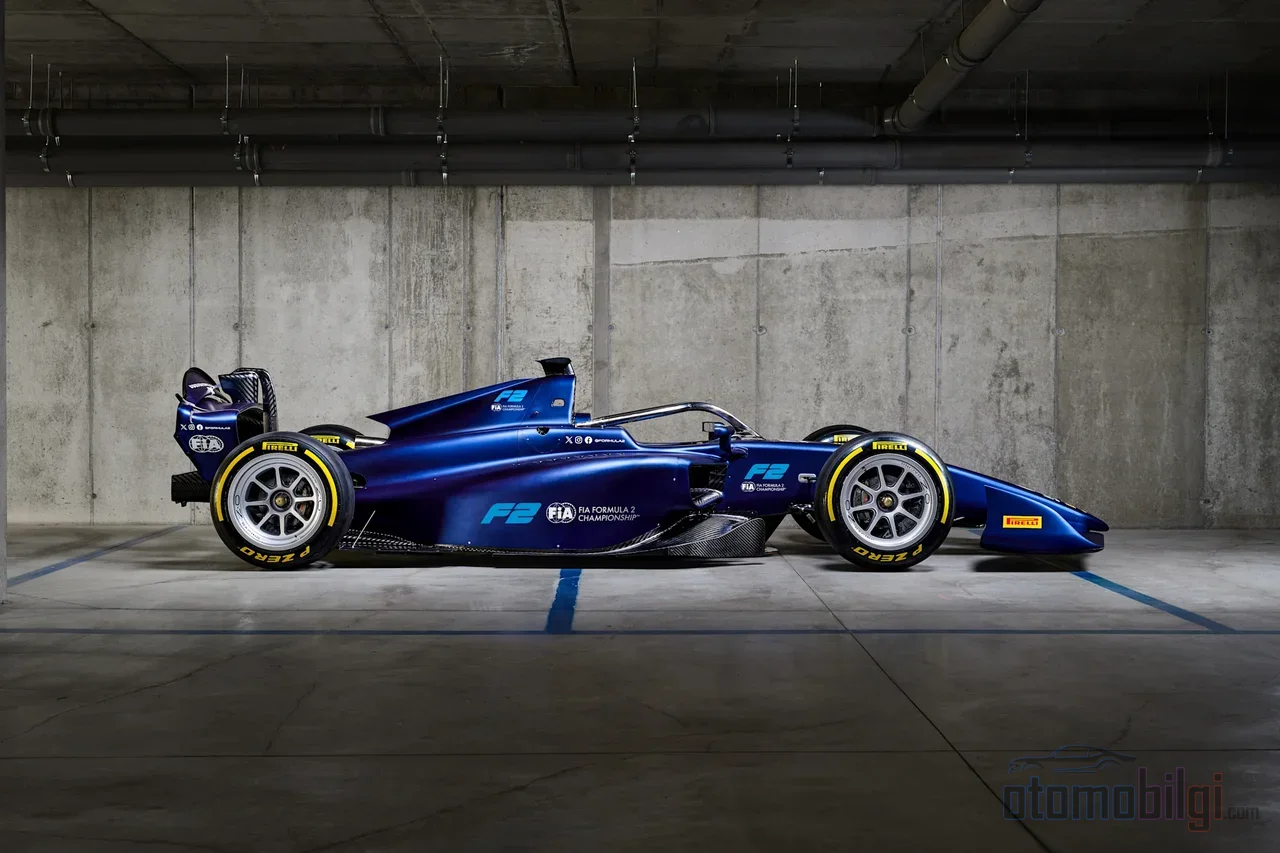
In Formula 2 cars, every team uses the same Dallara chassis, the same Mecachrome V6 engine and the same Pirelli tires; the aim of this "single chassis" philosophy is to keep costs under control while making the winner purely a matter of the driver's skill. In other words, none of the 22 cars on the grid is faster than any other - the fast driver makes it to the podium. So how exactly do these machines work, what do they share with F1, and how do they keep the budget in balance? Let's take a look!
Highlights
- All F2 cars are of the same specification: Dallara chassis + Mecachrome engine, 22 cars identical.
- Engine: 3.4-liter single-turbo V6, 620 HP at 8750 rpm, 570 Nm of torque.
- Top speed 335 km/h, 0-100 km/h in 2.9 seconds.
- Weight: including driver 795 kg; FIA's 2024 F1 safety standards, including the titanium Halo.
- A new car was introduced for 2027-2029: the chassis stays the same, the wings have been redesigned.
The Single Chassis Logic: Why Does Everyone Race the Same Car?
Think of it this way: you give an exam at school and everyone has a different textbook. It's hard to tell who is better prepared, right? Formula 2 solves this problem at its root. All teams must use the same chassis, the same engine and the same tire supplier. Dallara, the technical partner, produces all 22 cars to the same specification, and they are all powered by the same Mecachrome V6 engine.
The result? The driver's talent and the team's strategic intelligence come to the fore. Drivers who overtake through braking points rather than engine power move ahead. This arrangement also keeps racing relatively cost-effective for the teams; nobody is spending millions trying to squeeze out 20 extra horsepower over a rival. That's why F2 was designed as the ideal preparation ground for F1.
This philosophy is also felt on the cost side. Teams use new car packages for three seasons; for example, the chassis and engine introduced in 2024 last for three seasons. Instead of cars being purchased individually, a central supply system has been established. This arrangement also makes it easier to keep the grid fixed at 11 teams and 22 cars.
Technical Specifications of the F2 Car: The Machine in Numbers
Let's take a look at the car's report card. The engine is a 3.4-liter single-turbocharged V6 prepared by Mecachrome: it produces 620 horsepower at 8750 rpm and 570 Nm of torque at 6000 rpm. The throttle system works via fly-by-wire, and the engine undergoes a mandatory rebuild every 8000 kilometers. The performance side is also impressive: 0-100 km/h in 2.90 seconds, 0-200 km/h in 6.60 seconds. With the Monza aerodynamic setup and DRS, the maximum achievable speed is 335 km/h. In corners, the driver feels lateral forces of up to 3.9 G, and deceleration of -3.5 G under braking.
| Feature | Value |
|---|---|
| Engine | Mecachrome 3.4 L single-turbo V6 |
| Power / Torque | 620 HP (8750 rpm) / 570 Nm (6000 rpm) |
| 0-100 km/h | 2.90 seconds |
| Top speed | 335 km/h (Monza setup + DRS) |
| Length / Width / Height | 5285 / 1900 / 1097 mm |
| Wheelbase | 3135 mm |
| Weight (including driver) | 795 kg |
| Gearbox | Hewland 6-speed, paddle shift |
| Fuel tank | Premier FT5, 125 liters |
| Tires | Pirelli (F2-specific), O.Z. Racing magnesium wheels |
Compared to F1, the picture becomes much clearer: F1 engines produce roughly 1000 horsepower, and this gap makes F1 cars an average of 16-24 km/h faster on the straights. In other words, F2 is "F1's little brother" - but being the little brother isn't all that easy, as we'll see.
Chassis, Halo and Safety
The monocoque body is made of a carbon/aluminum honeycomb sandwich structure and is reinforced with Zylon anti-intrusion panels. The car fully meets the FIA's 2024 F1 safety standards; including the F1-specification titanium Halo So that black arch protecting the driver's head when a tire or wheel comes flying into the cockpit is on duty in F2 as well. The suspension uses steel double wishbones and a pushrod layout; the dampers on the front axle are adjustable in two ways, the rear ones in four ways. The brakes are seriously top-notch: Brembo 6-piston monoblock calipers and carbon-carbon discs.
Gearbox and Tires
The rear axle features a Hewland-built 6-speed longitudinal sequential gearbox; gears are controlled electro-hydraulically via the paddle shift on the steering wheel, while the clutch is a ZF SACHS carbon unit. An interesting detail: the car has no starter motor - if the engine stalls, external intervention is required. (But wait, this changes in 2027; I'll explain below.) Pirelli has been the sole tire supplier since 2017: purple supersoft, red soft, yellow medium and white hard compounds on dry surfaces, and a single blue wet tire in the rain. A TPMS system that continuously monitors tire pressures is also standard.
How Does DRS Work in F2?
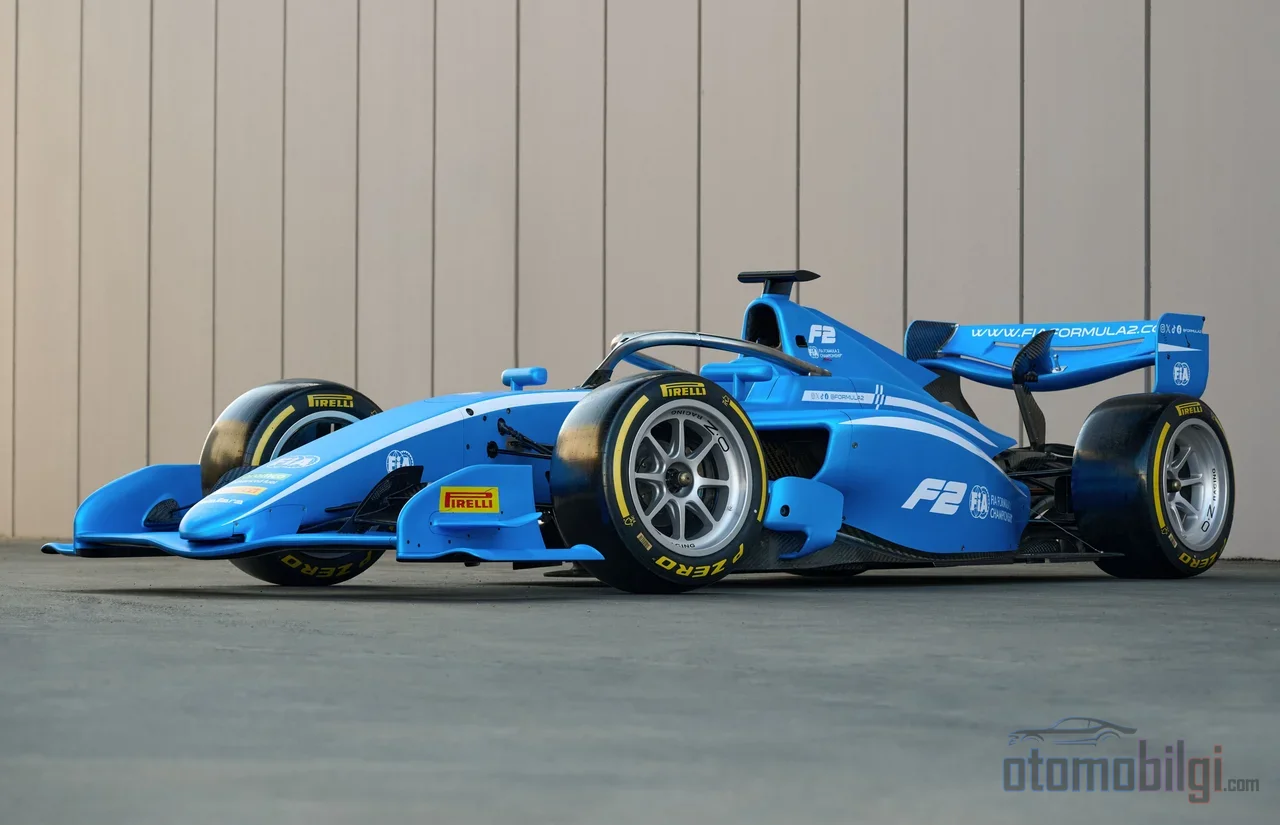
DRS exists in F2 too and works on exactly the same principle as in F1. A quick reminder: DRS is an adjustable rear wing that opens at the driver's command. When opened, the car's air resistance temporarily decreases, straight-line speed increases, and closing in on the car ahead becomes easier. In F2, activation is done hydraulically.
The rules feel familiar too: during free practice and qualifying, everyone can use DRS freely in the designated DRS zones - the zones are the same as in F1. In the race, it can only be activated when the gap to the car ahead drops below 1 second So F2 drivers don't have to "learn something new" about DRS when they step up to F1; their muscle memory is already prepared.
What's the Difference Between F2 and F3?
Both series are rungs on the F1 ladder, but the power difference between them is significant. While F2 has a 620-horsepower turbocharged V6, F3 uses a smaller naturally aspirated engine of approximately 380 horsepower (i.e. without a turbo). This difference means that a driver moving up from F3 to F2 has to learn to manage both more power and turbo lag.
The format difference matters too. In F2 there are both Sprint and Feature races during the weekend, and the Feature race includes a mandatory pit stop. F3, on the other hand, offers a shorter, single-race format. There are also some similarities in the technical infrastructure: both series use a Hewland 6-speed gearbox; in the new F3 car, gearbox production shifts to a different supplier but the concept remains the same. In fact, the steering wheel ergonomics of the new F3 car were deliberately matched with F2 - so that the driver's muscle memory isn't disrupted when stepping up from the smaller rung to the bigger one. Think of it like switching from one gaming chair to another: the buttons are in the same place so your reflexes don't get lost.
Cost Balance and Race Format
One of the biggest advantages of the spec format is that it keeps the budget predictable. According to figures shared in the series' early years, a car was expected to cost around €300,000 and power units were to be kept under €100,000 including lease and revision. Let's note that these figures are historical data today, but the logic remains the same: no one burns fortunes in a development race.
The race format is also educational in nature. An F2 weekend works like this:
- Friday: 45 minutes of free practice and 30 minutes of qualifying.
- Saturday: 120 km Sprint race; the grid is formed by reversing the top 10 from qualifying, and there is no pit stop.
- Sunday: A 170 km Feature race before the F1 Grand Prix, with a mandatory pit stop.
In the 2025 season, the calendar consisted of 14 rounds, spanned three continents, and was placed entirely on F1 race weekends. The points system also rewards climbing the ladder: a maximum of 39 points can be collected per weekend - 2 points for pole position, points starting from 10 for the top 8 in the Sprint, points starting from 25 for the top 10 in the Feature, and bonuses for the fastest laps.
2027 Car: Same Chassis, New Wings
The series' big news has already arrived: FIA Formula 2 unveiled its new car, to be used in the 2027-2029 seasons, at Monza, on the F1 circuit. And here's the funny (or clever) part: the 2026 Dallara chassis is kept exactly as is, and the real change lies in the redesigned front and rear wings. The new aerodynamic package aims to allow cars to race closely together, similar to the current regulations in F1 - that is, to prevent the dirty air of the car ahead from killing the speed of the car behind. If you're asking why they didn't change the chassis, the answer is very clear: cost control.
Formula 2 is where the next generation of top-level drivers is raised.
There's no surprise in the engine package either: the same 3.4-liter single-turbo V6 Mecachrome continues with 620 HP and 570 Nm. On the fuel side, however, there is an update - the advanced sustainable fuel successfully introduced in F2 in 2025 will also be used in 2027. My favorite technical innovation is the on-board starter motor: Hewland adapted the current gearbox to this system, and the driver will now be able to restart the car without stopping it after spinning and stalling the engine. A detail that will significantly ease the operational burden on the teams.
The development process has also progressed: the first prototype ran at Barcelona-Catalunya in June 2026; wind tunnel and aerodynamic tests were carried out with Dallara. Teams will receive their first car kit in December 2026 and their second kit in January 2027.
Does F2 Really Prepare Drivers for F1?
F2 is F1's official feeder series, and that's not just empty talk: five drivers from the 2024 grid raced in the 2025 F1 season. For example, Gabriel Bortoleto found a seat at Sauber and Jack Doohan at Alpine. Many F2 drivers are also tied to F1 teams' young driver programs; in other words, they are growing up within the F1 ecosystem. In addition, each F1 season requires two FP1 sessions to be completed by a rookie driver - this gives young drivers the chance to rack up mileage in real F1 machines.
But things aren't all rosy. While F2 Feature races last a maximum of 60 minutes, F1 races can run up to two hours; F2 graduates need to build up their physical endurance as they move to F1. There's also a philosophical debate: some circles argue that allowing limited car development in F2 would prepare drivers better for F1, since F1 teams keep bringing new parts throughout the season. On the other side, the series' CEO Bruno Michel's approach is this: a single chassis and a controlled budget preserve balance, making it possible for drivers to showcase their talent - that's already the whole point of the spec format. F1 president Stefano Domenicali, meanwhile, puts it in one sentence: F2 is F1's ultimate testing ground.
My take is this: the single-chassis format perhaps offers the most honest test on track. When car differences are removed as an excuse, all that remains is the driver. The fact that young drivers competing for an F1 seat have to prove themselves here also shows how solid the ladder is.
Final Word: A Simple Machine, A Tough Test
The F2 car isn't as exotic as F1, but it's exactly as it should be: 22 young drivers entering a shared exam with 620 horsepower, proving who is truly talented in identical machines. Same chassis, same engine, same tires - the only difference is the person behind the wheel. For every young driver who wants to climb the F1 ladder, passing this exam is like a mandatory course. Don't you think this is one of the most honest battles in motorsport?
Sources
- F2 car and engine
- FIA Formula 2 unveils its new car for the 2027-2029 seasons
- Everything you need to know about Formula 2 in 2025
- FIA Formula 2 Championship
- Dallara GP2 cars
- Formula 2 unveils its new-for-2024 car to be built by Dallara
- F3 Explained: How the new car is closer to F2 than ever
- How do the FIA single-seater championships compare?
- F1 vs F2: what's the difference?
- Drag reduction system
- More Formula 2 details emerge
- How Formula 2 became the launchpad for F1's next generation
- How beneficial are F1 FP1 runs for young drivers?