How Does a Race Weekend in Formula 3 Work Differently from F2?
Share This Page
A Formula 3 race weekend flows much faster than Formula 2: a single 45-minute practice session, a single 30-minute qualifying, a Saturday Sprint, and a Sunday Feature. As in F2, there are no pit stops, three cars run per team, and the Sprint grid is set by reversing the order of the fastest 12 drivers. In other words, the two series you watch in the same weekend are actually taking on two completely different tasks: F3 teaches the fundamental skills, while F2 prepares drivers for F1.
Highlights
- The F3 weekend has a single practice session (45 min) and a single qualifying (30 min); the same format as F2 has been used jointly since 2022.
- On the Sprint grid, the fastest 12 drivers in F3, and the fastest 10 drivers in F2, are reversed.
- F3 cars produce ~380 HP of power; the turbo engine in F2 produces 620 HP produces.
- In F3 races, there are no pit stops; F2's Feature race includes a mandatory stop.
- The F3 championship is worth 30 super licence points and is not enough on its own for F1.
How Does an F3 Race Weekend Work? An Hour-by-Hour Breakdown
First, a little background: F3 was founded in 2019 through the merger of the GP3 Series and the European F3 Championship, and Robert Shwartzman won its first championship. The format has not been fixed since its founding either; in 2021, due to costs, it raced on separate weekends from F2, with three races held at each event. From 2022 onward, both series returned to the same weekend alongside F1, and the familiar arrangement we know today settled in.
Today's schedule works like this. On Friday, there is a single 45-minute practice session, immediately followed by a 30-minute qualifying . On Saturday comes the Sprint Race, lasting 40 minutes plus one lap. On Sunday, before the F1 Grand Prix, the Feature Race is run, lasting 45 minutes plus one lap . F2 uses the same skeleton; so watching three series back to back over an F1 weekend is really just a matter of habit.
So why is this brevity so important? Think about it: in a single practice session, the teams' learning time is not even as long as an engineering breakfast. They have to apply every setup they tried on Friday morning straight to qualifying. If you read it wrong, it comes down on you like a penalty that sends you out on the Sprint grid in 12th place on Saturday morning. This pressure is actually one of my favorite things about watching F3; every lap seems like a genuine effort to gather information.
The Cars: Power Figures You Can Feel
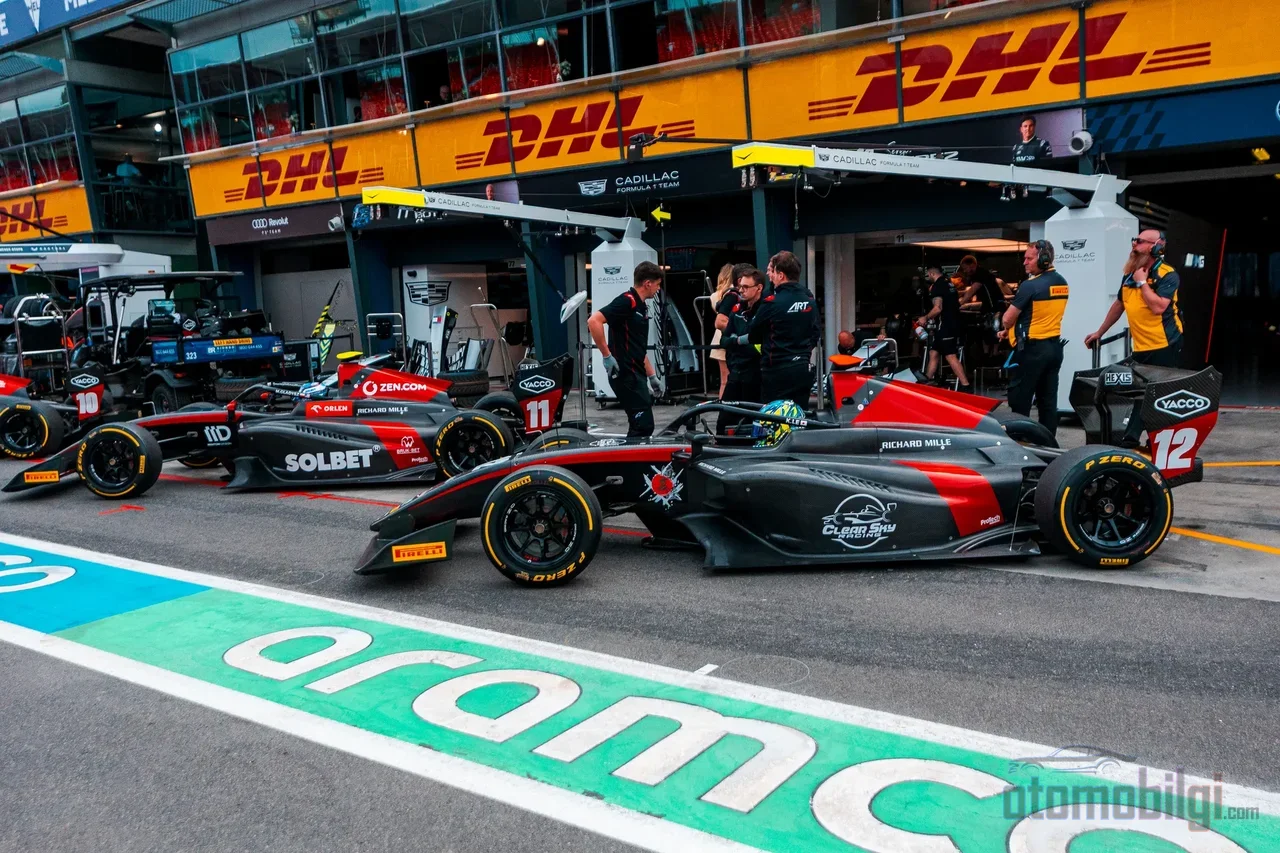
F3 is a one-make championship: all teams use the same Dallara chassis and the same Pirelli tyres. The power comes from a 3.4-liter naturally aspirated Mecachrome V6 engine, which produces approximately 380 HP . The car can reach a maximum speed of ~300 km/h , complete 0-100 km/h in 3.1 seconds , and generate around ~2.6G of lateral acceleration in corners, and it uses an F1-style Virtual Safety Car system. The Dallara F3 2025 introduced in 2025 moved to 16-inch wheels, updated aerodynamics, and increased safety standards; the 2026 season is this car's second year.
On the F2 side, the same 3.4-liter Mecachrome family's turbocharged V6 version and produces 620 HP at 8750 rpm . A simple analogy: F3 is like a driving school in the city; F2 is like graduating from that school and hitting the highway. In both series, engines are designed to last 14 rounds, meaning 28 races, and are randomly distributed among the teams. So even a team that thinks its engine is a bit weak races under the same conditions.
| Feature | Formula 3 | Formula 2 |
|---|---|---|
| Engine | 3.4 lt naturally aspirated V6 | 3.4 lt turbocharged V6 |
| Power | ~380 HP | 620 HP (8750 rpm) |
| Cars per team | 3 cars (10 teams, 30 cars) | 2 cars |
| Pit stop | None | Mandatory in the Feature |
| Reverse grid scope | Fastest 12 drivers | Fastest 10 drivers |
| Season | 10 rounds, 9 countries, 20 races | Longer season |
Sprint and Feature Balance: The Reverse Grid Difference
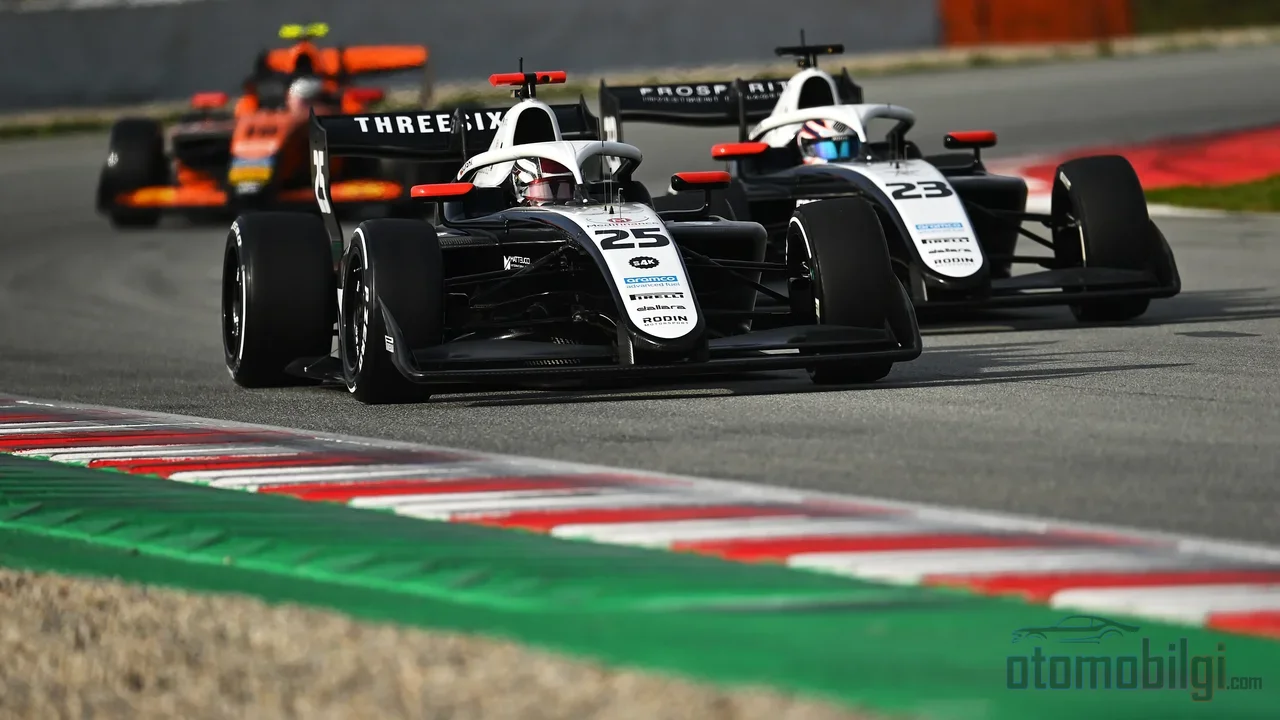
The two-race format exists in both series, but the details change. In F3, the Sprint grid is formed by reversing the order of the fastest 12 drivers from qualifying; meaning the driver who takes pole position starts the race from P12. In F2, the number reversed is 10. This seemingly small difference significantly changes the chaos on track: in the F3 Sprint you need to overtake more cars to move forward, and the race spreads out and turns into a procession more quickly.
There is also a divergence in the points distribution. In F3, the top 10 in the Sprint race score points: 10-9-8-7-6-5-4-3-2-1. In F2, Sprint points only go to the top 8: 10-8-6-5-4-3-2-1. In the Feature race, both series use the F1 format: 25-18-15-12-10-8-6-4-2-1. Pole position in F3 is worth 2 points (reduced from 4 to 2 in 2022), and in both races an extra point each is awarded for the fastest lap.
The reverse grid idea has actually been discussed for a long time. In 2021, two separate reverse-grid Sprints were run on Saturday, and series boss Bruno Michel argued that this format would make the championship race even more exciting. Over time, it settled into a single reverse grid; today, whether 12 or 10 is ideal is still a matter debated in forums. My opinion? A grid reversed up to 12 in F3 is a generous exercise for giving young drivers overtaking practice.
No Pit Stops, No Tire Pressure: F3's Approach to Strategy
F2's Feature race has a mandatory pit stop and all four tires must be changed. Additionally, at least one set of each dry tire compound must be used. So in F2, being fast alone is not enough; you also need to plan well when to make your stop. In F3, however, you never stop during the race: tire and fuel management is essentially learned within the race itself.
I think the logic here is very clever. F3 aims to teach the fundamental skills of driving - braking points, defensive lines, clean exits - in the simplest possible environment. Strategic cunning is F2's job. That's why, when watching both series on the same weekend, you should focus on different things: in F3, watch the qualifying lap and the first corners; in F2, watch the pit window and how the tire phase changes. While F3's main story unfolds on track, part of F2's is written at the pit wall.
The Weight of Qualifying and Its Impact on the Championship
A single qualifying session in F3 opens two doors at once: on one hand it directly sets the Sunday Feature grid, and on the other it is reversed to shape the Saturday Sprint. So a mistake on Friday changes not just one race, but the character of two. It is also critical in terms of team strategy: a driver who comes out on top in qualifying starts the Feature with an advantage, while in the Sprint it turns into what is sarcastically called a "speed penalty."
This weight is felt even more throughout the season. The F3 season consists of 10 rounds, 9 countries and 20 races, and they are all run on F1 weekends. F2, meanwhile, has a longer calendar and more rounds. So a single bad weekend in F3 can open a hole in the points table that is hard to make up. There is an update to follow in the 2026 season as well: the season finale at MADRING (Madrid) has been expanded; an extra Feature Race has been added to the finale at the circuit that hosted official testing in August. The Sprint will run on Saturday morning, and the first Feature on Saturday afternoon - an exception to the standard "two races per weekend" rule. Another detail worth remembering for 2026 is that the championship is being followed by 30 drivers, and that last year's champion was Rafael Câmara.
Does the F3 Championship Lead to F1? Super License and the Türkiye Note
The clearest part of the matter is this: the F2 champion earns all 40 super license points in a single season and completes the points required for F1. The F3 championship, on the other hand, is worth 30 points, so on its own it is not enough to open the F1 door. Even so, there are names who stepped straight from F3 to F1: since 2019, 8 drivers have followed this path; Oscar Piastri (2020 champion) and Gabriel Bortoleto (2023 champion) are the best-known examples. Yuki Tsunoda, Oliver Bearman, Isack Hadjar and Jack Doohan also came through F3. When you add that Charles Leclerc, George Russell and Lando Norris also proved themselves in the junior categories, F3's importance becomes even clearer.
There is also a nice note from the Türkiye side: Cem Bölükbaşı, with the support of TGA (GoTürkiye), raced in Formula 3 with BlackArts Racing Team and later moved up to the F2 Championship. In addition, it was talked about that Alp Aksoy, after representing Türkiye in F4 Italy and Euro4, conducted a test at Istanbul Park with an F3 car painted in Turkish colors. The FIA has announced the 2027 calendar for F1, F2 and F3, and announcements were shared that Türkiye is included in the calendar; patience is needed until official confirmation comes, but Istanbul Park's place in this ecosystem is still a lively topic.
One final closing question: which one will you watch now, Saturday's chaotic Sprint or Sunday's strategy-filled Feature? I say both. F3 and F2 can be seen as two different lessons from the same ecosystem; it is hard to fully grasp one without watching the other.
Sources
- The beginner's guide to Formula 3
- The beginner's guide to Formula 2
- Recapping F3's new-points system and overhauled weekend format
- The Rules and Regulations - FIA Formula 3
- F2 car and engine - FIA Formula 2
- Formula 2 vs Formula 3: what's the difference?
- FIA Formula 2 and FIA Formula 3 to change race weekend format in 2022
- New weekend format for FIA Formula 2 announced
- The beginner's guide to the F1 Super Licence
- FIA Formula 3 to hold official tests at MADRING in August as the 2026 F3 season finale expands
- How does an F3 weekend work? - FanAmp
- Turkish Driver Cem Bölükbaşı to Race in Formula 3 - TGA