What Awaits Drivers Moving Up from F3 to F2?
Share This Page
Drivers moving up from F3 to F2 can struggle to adapt, because the two are completely different jobs: The F2 car is more powerful, faster, and puts F1-specific skills like tire management and pit stop strategy to a serious test for the first time. Moreover, on that grid there are rivals who have already proven themselves, alongside the star who swept F3. That's why even the F3 champion has to prove themselves from scratch in F2.
Highlights
- The F2 car produces about 620 hp while the F3 car delivers around 380 hp
- F2 is about 6 seconds faster than F3 over a single lap at Spa
- F2 has a mandatory component change in the Feature race; there are no pit stops in F3
- The first 10 grid positions of the Sprint race are set by reversing the qualifying result
- The Super License requires 40 points over the last three seasons
What's the difference between F2 and F3? A side-by-side comparison of the two cars
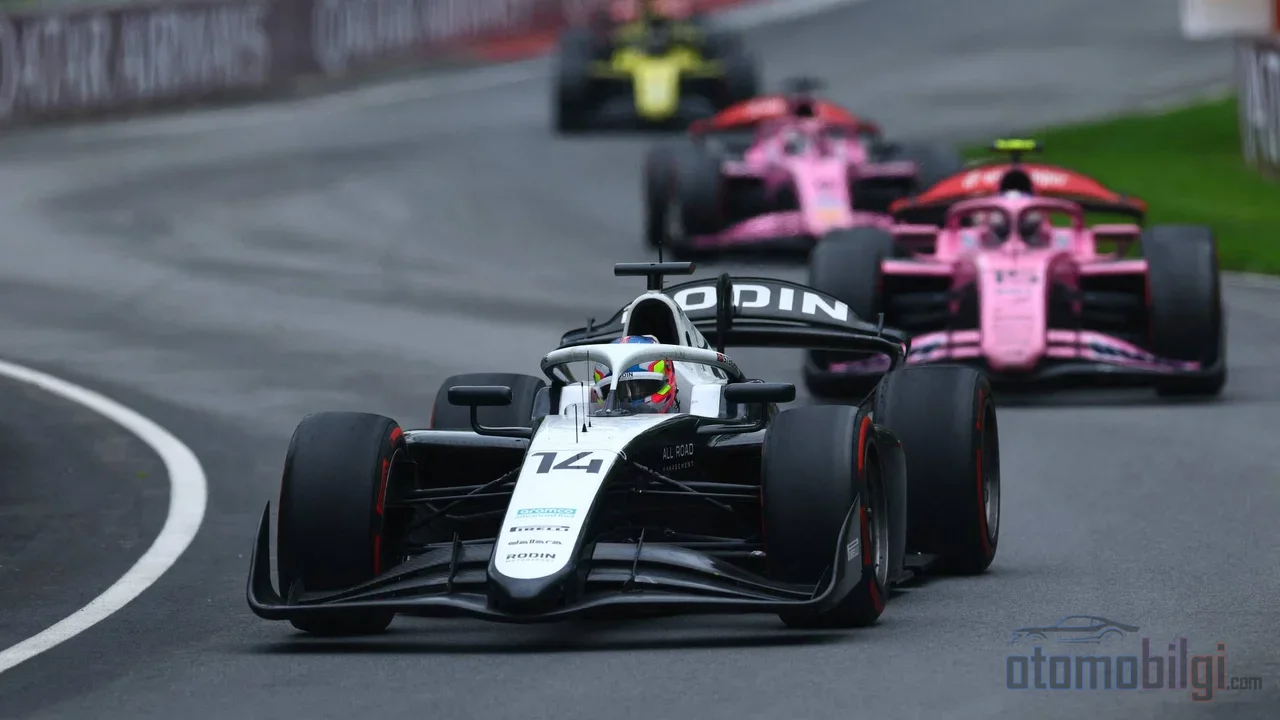
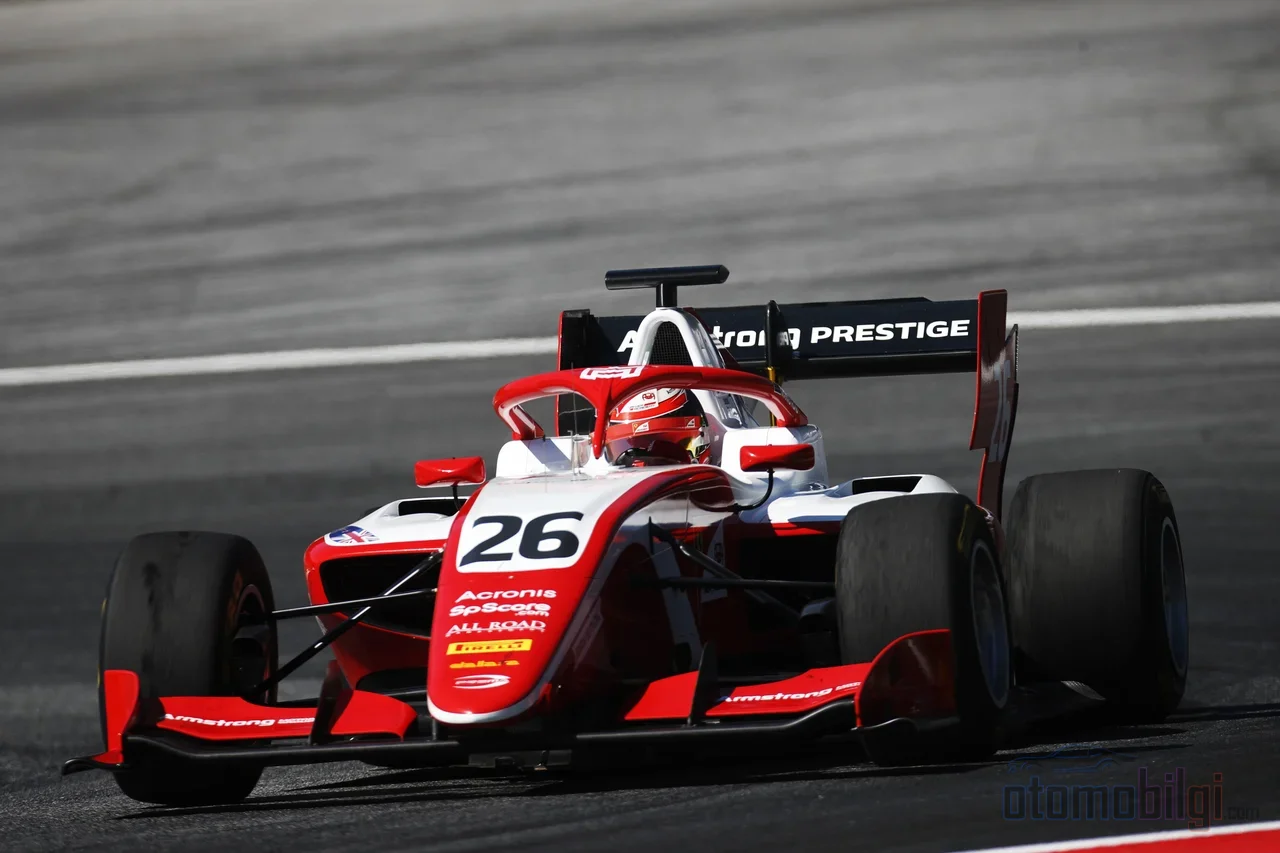
Let's start with the most visible difference: the engine. Both series use the same Mecachrome V6 base, but in F2 this unit is turbocharged and produces about 620 hp. In F3, the engine is naturally aspirated, meaning no turbo, and power stays at around 380 hp. On the chassis side, both bear the Dallara signature; so the comfort of being a spec series puts the driver's skill front and center in both championships.
The interesting part is this: the difference in 0-100 km/h acceleration is almost negligible, with F2 only about 0.1 seconds ahead. The real divergence starts at high speeds. At 0-200 km/h, F2 finishes in about 6.6 seconds while for F3 this stretches to 7.7 seconds. The difference is also clear at top speed: F2 reaches about 335 km/h, while F3 is around 300 km/h. So F2's real strength doesn't show at low speeds, but where you brake later and where it stares you down on the straights.
| Feature | F2 | F3 |
|---|---|---|
| Engine | 3.4L Mecachrome V6 turbo, ~620 hp | 3.4L Mecachrome V6 naturally aspirated, ~380 hp |
| 0-100 km/h | ~2.9 seconds | ~3.1 seconds |
| 0-200 km/h | ~6.6 seconds | ~7.7 seconds |
| Top speed | ~335 km/h | ~300 km/h |
| Gearbox | 6-speed sequential | 6-speed sequential |
| Tire set | 2 dry compounds + wet | 1 slick + wet |
| Mandatory pit stop | Required in the Feature race | None |
Let's also give some lap time perspective, because the numbers can sometimes stay abstract. Looking at the 2022 Spa pole times, F1 completed the lap at about 1:44 while F2 was around 2:05 and F3 in the vicinity of 2:11. The gap explains everything: F2 is about 6 seconds faster than F3 over a single lap at the same track. This is the best illustration of what moving up a level actually means.
More power, less aerodynamic security: Why does the car end up in the driver's hands?
The F2 car is as demanding as it is powerful. Aerodynamic stability is limited compared to F1; the car prioritizes simplicity and minimalism. So the magic downforce that saves you when the rear steps out isn't always there; control rests largely in the driver's right foot and wrists. Although the new F3 car looks closer to F2 in design than ever before, it still carries a simpler floor and less downforce. In your first corner in F2, you feel how far the limits you got used to in F3 have moved forward.
Think of it this way: While the F3 car is like a partner that constantly talks to you and smooths out your mistakes, the F2 car is a bit colder. It doesn't trust you; you have to trust it first. Drivers stepping up to F2 within the same team can speed up this transition by using the setup knowledge and working habits they learned in F3. Inheriting a year's worth of notes about F2 from your teammate is worth gold in the first test days.
Those who have experienced this transition share the same observation. Oliver Goethe, who races in MP Motorsport colors, says that when he stepped into F2, the small details became more important than ever, and the tough moments taught as much as the good ones. So what makes the difference in F2 isn't big moves, but fine adjustments like a meter at the braking point or how hard you push the tires on the first lap.
Pirelli tires and the mandatory pit stop: Why is F2's exam about tire management?
This is exactly where F2 breaks away from F3. In F3, the driver has a single dry compound and a wet; there's no pit stop requirement, and the tires last long enough to finish the race. In F2, however, Pirelli offers two different dry compounds, and in the Feature race every driver must change compounds. Even this single rule changes the chemistry of the race: being fast is no longer enough; you also need to know when to go fast.
Pirelli's analysis of the F2 tires is quite clear: the soft compound demands an aggressive approach and careful management, while the hard compound is better suited to longer stints. When the pre-race tire choice, the pit stop window, and the pressure of responding to a rival's strategy come together, F2 becomes a critical step that introduces drivers to race strategy and tire degradation. This is actually the school of that tire-saving art we talk about every week in F1.
On the distance side, F2 is a completely different world. The races are run in a format of approximately 100-125 km or 45 minutes plus one lap. This means that after F3's short races, the question of endurance also comes into play; both the car and the driver need to stand strong until the end.
Sprint and Feature race: What does the weekend format demand from the drivers?
The F2 weekend format also requires a different discipline than F3's. The grid for the Sprint race, run on Saturday, is created by reversing the top 10 from qualifying. So the driver who takes pole in qualifying must start the Sprint from the back and show the ability to climb forward. The scoring is creative too: In the Sprint, points of 10, 8, 6, 5, 4, 3, 2, and 1 are distributed to the top 8, while the Feature race has a higher points table.
This format is controversial for some, we have to admit. The criticism that reverse grids please the spectators but make everything a bit random for the drivers holds serious weight among the fan base. Still, it must be said: a driver climbing forward from a reversed grid is priceless data in the eyes of F1 teams. A pilot who scores points without being pressured, who sweeps through the grid while managing their tires, is always taken into consideration.
The Feature race, meanwhile, is the main course of the weekend. A longer distance, more points, and a mandatory pit stop. Opening the pit window at the right moment, pulling ahead on soft tires and switching to the harder compound without losing positions... These are scenarios you never experience in F3. In F2, every weekend is an exam.
Why do F3 champions have to prove themselves again in F2?
The answer to the question lies in three parts: the car is faster, the strategy layer is new, and the grid is already full of names who have proven themselves. When you become champion in F3, you have proven you are the best, but that doesn't mean you will also be the best in F2's stronger and more challenging environment. The new champion taking the seat of a driver who won the title with the same team a year earlier is judged not by last year's performance, but by this weekend's lap times.
A brilliant example of this has actually happened: 2024 F3 champion Leonardo Fornaroli went on to win the title in F2 as well in 2025, claiming two consecutive championships. This is of course not a rule; it counts as an exception. But it shows that a well-prepared driver who works well with their team and quickly learns the language of the tires can play for the top in a short time.
There are always exceptions, of course. Max Verstappen skipped F2 entirely, going straight from F3 level to F1, and said this leap was even bigger than stepping from karting to F3. It's also known that Kimi Räikkönen similarly skipped F3. But these two are not statistics, they are exceptions. For most drivers, F3 is not a step to be skipped; it is one of the cornerstones of development. Age rules also remind us of this: To race in F3 you must be at least 16, and for F2 at least 17 years old. The system is designed to mature a driver step by step.
What do F1 academies do in this transition? How important are Super Licence points?
F1 academies serve as both supporters and filters on this ladder. By placing young drivers with teams in the feeder series, they accelerate their development. The Red Bull Junior Team, during the era of Dr. Helmut Marko, built one of the most effective talent pipelines in this field; Marko left his post at the end of 2025, but the system continues to operate. Another fine example is Arvid Lindblad: After racing one season each in F3 and F2, he rose to F1 with Racing Bulls in 2026. So the classic path still works.
Of course, not every academy achieves the same success. Of the 18 drivers who have passed through this path at the Ferrari Driver Academy, 5 have reached F1 - a rate of about 27.8 percent. But only one of them has been able to achieve lasting success at the top. And this is the real issue for academies: finding the right team to house the driver and moving them to the right level at the right time.
Then there is the licensing side of things. For the F1 Super Licence, you need to accumulate 40 points over the last three seasons and complete at least 80 percent of two full seasons. Winning the F2 championship is the most direct route to this point total; even finishing in the top 8 in F2 can exceed the 40-point threshold. As for the licence that grants FP1 outing rights, it requires 25 points in the previous three years or at least 6 races in F2. In short, good rankings in F2 are not just trophies, they are the key that opens the F1 door.
The first Turkish driver to race in F2: Cem Bölükbaşı's journey
We cannot talk about this ladder's Türkiye branch without mentioning it. Cem Bölükbaşı became the first Turkish driver to race in this series by joining F2 with Charouz Racing System in 2022. He took this step at the age of 23, having previously finished the 2021 Euroformula Open season in 5th place with 2 wins. place. But the most impressive part is this: After racing in the F1 Esports Series between 2017 and 2019, Bölükbaşı became the first driver to follow the path from sim racing to F2. This story, stretching from the virtual steering wheel to real grids, proves that the ladder has no single template. Today he continues his racing career in the European Le Mans Series with Nielsen Racing.
In terms of ecosystem as well, F2 and F3 are a fascinating organization: both series run on F1 weekends, and a total of 52 cars travel around the world with F1's logistics network. Since 2023, the cars have been using a sustainable fuel with a 55 percent blend developed in partnership with Aramco. So young drivers already start working with F1's future technologies as they move up to F1. There is also a 1 million euro prize fund distributed to those finishing in the top 5 on the F3 side; because F3 costs often exceed one million euros, and drivers are financed either by their own sponsorships or by academy support. This is also the source of the pay-driver debate.
Final word: Is a driver who passes this exam ready for F1?
Let's answer briefly: A driver who reads F2 correctly is the most technically ready candidate for F1. A driver who has mastered a more powerful car, learned to preserve the tires, opened the pit stop window at the right time, and tried to gain positions with an overtake around the outside has completed a rehearsal of F1's expectations. Fornaroli's back-to-back championships show that this is possible, and Verstappen's leap shows that the rules can change. But most stories, as Goethe said, are hidden in the small details. Which F3 star do you think will make the next big leap? My predictions are ready.
Sources
- F1 vs F2 vs F3 vs F4: What's the Difference?
- F1 vs F2 vs F3: Key Differences Explained
- The Rules and Regulations
- F3 Explained: How the new car is closer to F2 than ever
- The life of a Pirelli Formula 2 tyre before, during and after the race
- The beginner's guide to Formula 2
- FIA Formula 2 Championship
- How does an F2 weekend work?
- Formula 2 vs Formula 3: what's the difference?
- Oliver Goethe talks through learning from F3 to F2
- The Ferrari Driver Academy
- How does F1 driver academy support shift as drivers rise on the ladder?
- FIA Super Licence
- What is a super licence in Formula 1?
- Cem Bolukbasi to compete in F2 with Charouz
- Bölükbaşi on achieving his F2 dream
- Cem Bölükbaşı
- How are all 52 F2 and F3 cars shipped around the world
- F2 & F3 Aramco sustainable fuels partnership