Is Formula 3 Really a Stepping Stone to F1?
Share This Page
Formula 3 was designed as the third rung of the F1 ladder but is a development series without a guaranteed F1 ticket: since 2019, only two of the champions have made it to F1. So an F3 title brings you to the F1 door but doesn't open it. So what exactly is this series, why is it so expensive, and does it really prepare young drivers? Let's take a look together!
Highlights
- Since 2019, there have been 8 drivers who moved up from F3 to F1; of the champions, only 2 (Piastri and Bortoleto) made it to F1.
- The cost of an F3 season is around 1.2 million USD - roughly half of F2.
- All teams use the same car: Dallara chassis, Mecachrome 3.4-liter V6 engine, 380 hp.
- Maximum points available in a single round: 39.
What Is Formula 3 and How Does a Race Weekend Work?
The FIA Formula 3 Championship, or F3 for short, is the third rung of the single-seater pyramid that stretches from karting to F1. It was established in 2019 through the merger of the GP3 Series and the FIA Formula 3 European Championship, and its most distinctive feature is this: it races only on Formula 1 race weekends. That means F3 drivers race in front of the F1 community's eyes - both an advantage and a pressure.
Here's how a race weekend works: Friday features a 45-minute free practice session and a 30-minute qualifying session. On Saturday, there's a short practice session first, followed by the Sprint race. The Sprint's trick is this: the top 12 qualifiers start on a reversed grid. So the driver who wins qualifying starts the Sprint from the very back! That's why Sprint races are always chaotic and incredibly fun to watch. On Sunday, before the F1 Grand Prix, there's a 45-minute practice session and the Feature race - the long race where the big points are awarded.
The points system is also interesting: the top 10 in the Sprint score 10-1 points; in the Feature, like F1, points are awarded as 25-18-15-12-10-8-6-4-2-1. Feature pole position is worth +2 points, and the fastest lap within the top 10 in both races is worth +1 point . If you add it all up, it's possible to collect 39 points in a single round. The season is usually around 10 rounds, but it hasn't always been this way: in 2021, to cut costs, a 7-round format with 3 races per round was tried, before returning to the two-race setup.
Everyone in the Same Car: What Does the Single-Supplier Structure Achieve?
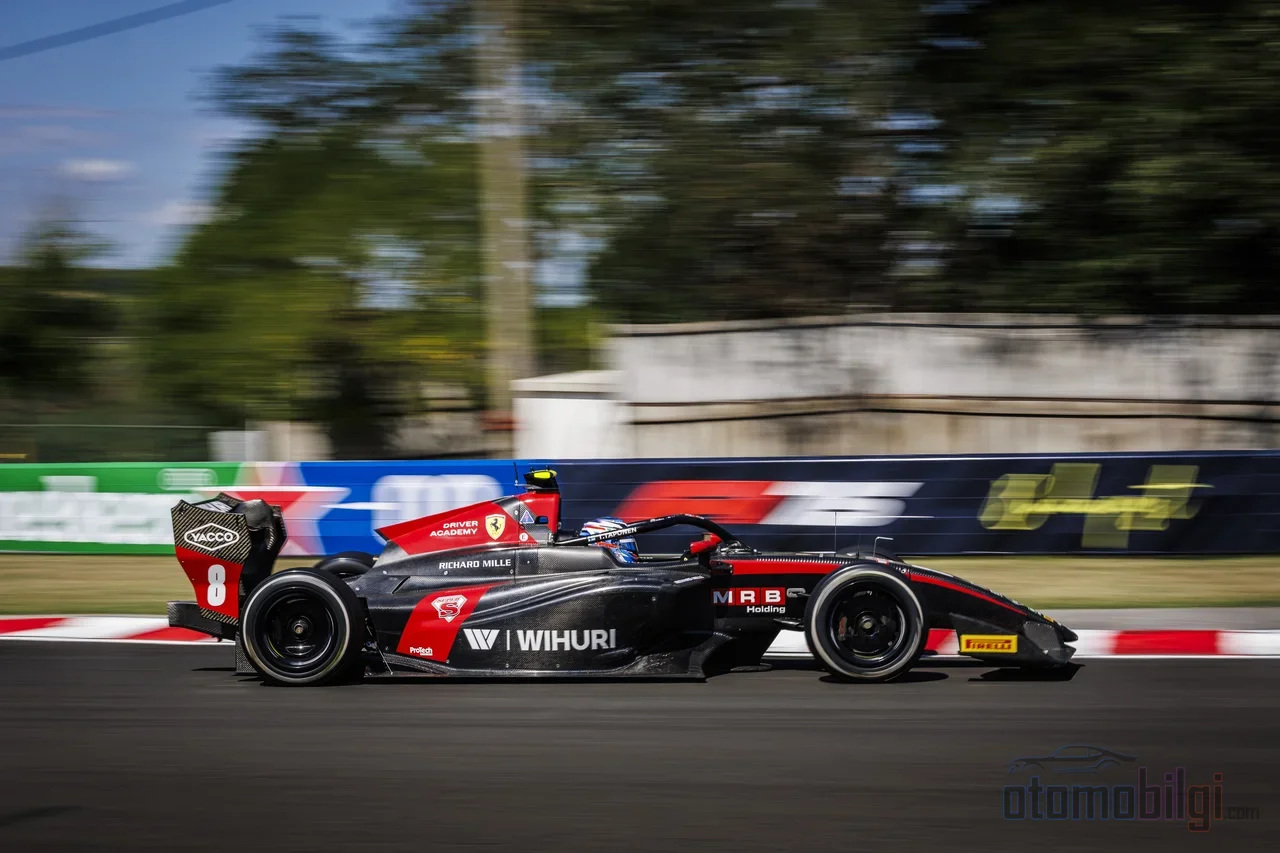
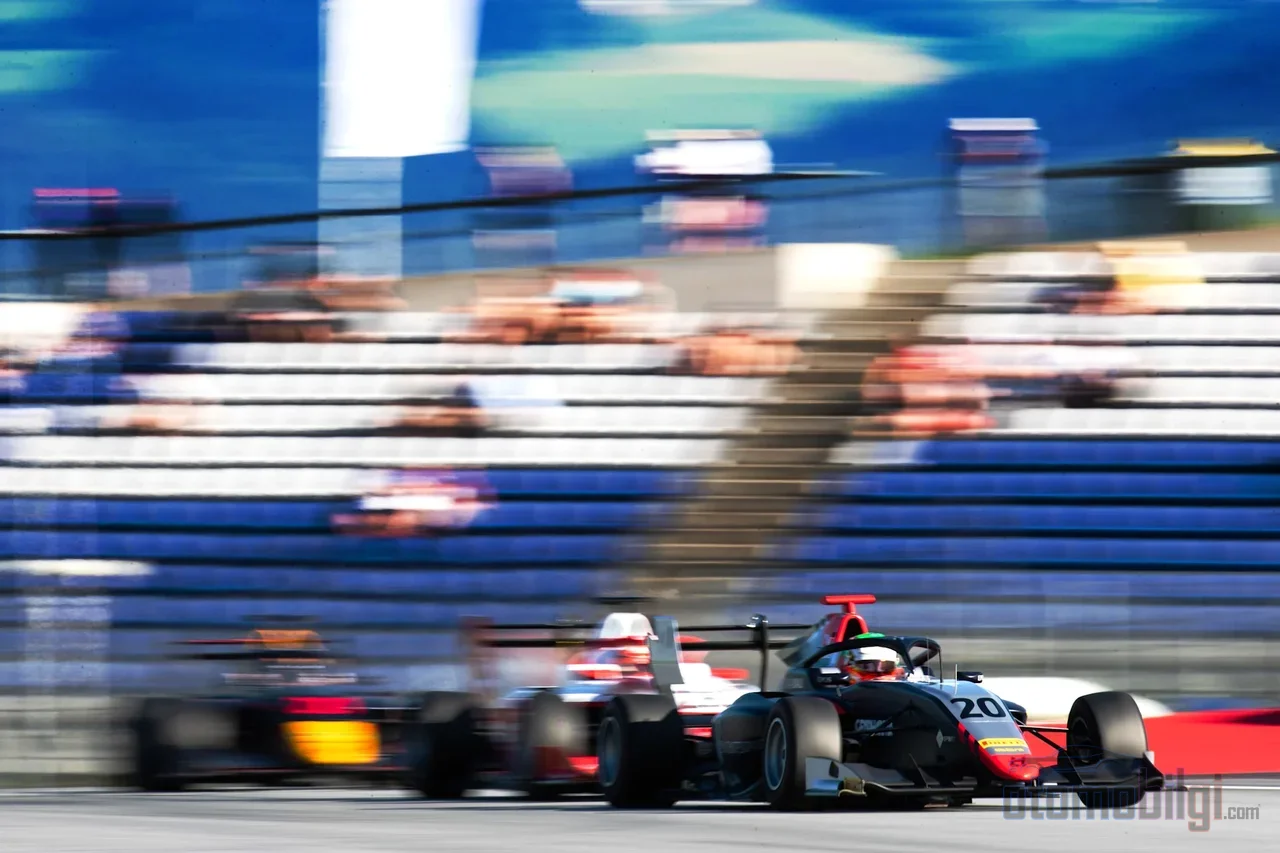
F3's most fundamental idea is this: no car advantage - winning should be the driver's job. That's why the 30 identical cars on the grid are made of the same parts: a Dallara carbon-fiber monocoque chassis, Mecachrome's 3.4-liter naturally aspirated direct-injection V6 engine, and Pirelli tires. The engines are distributed by the FIA with serial numbers; renting or rebuilding an engine unit can cost up to 60,000 euros per unit. So if your engine blows up, your wallet takes a hit too, unfortunately.
Let's look at the car's technical sheet: 380 hp of power (it was 400 hp initially, later reduced for safety and cost reasons), and 673 kg weight, a Hewland-built 6-speed paddleshift sequential gearbox. A striking detail: there is no power steering! This means young drivers also develop physically. There is a halo, there is DRS (which automatically deactivates in the rain), and 55% sustainable fuel has been used since 2023.
On the performance side, the car reaches a speed of about 300 km/h, reaches a speed of, 0-100 km/h acceleration is completed in 3 seconds, and in corners it subjects the driver to 2.6 g of lateral force. So how close is it to F1? In 2023 in Melbourne, F3's fastest lap was about 14 seconds slower per lap than F1. The gap sounds big, but this is where most of what an 18-19-year-old will learn before driving an F1 machine is formed. For 2025, a new-generation car was again developed in collaboration with a Dallara chassis and Mecachrome engine; the series maintains its single-supplier line.
Does Becoming F3 Champion Guarantee F1?
Here is the series' most brutal question. Since F3 was founded in 2019, there are 8 drivers who have made it to F1; but among the champions, only 2 people have reached F1: Oscar Piastri and Gabriel Bortoleto. The fate of the remaining champions is a complete "what happened next?" story.
From the Top to F1: The Path of Piastri and Bortoleto
Oscar Piastri is the textbook example of how F3 is played. In 2020 with Prema, he amassed 6 wins in 23 races and 14 top-five finishes; he won the championship in the final race, beating Theo Pourchaire by just 3 points. He then moved to F2 and won that too - becoming the name to complete the junior hat-trick by winning Formula Renault Eurocup, F3 and F2 in three consecutive seasons. He also took the title of the first FIA F3 graduate to win a race in F1. Let's not forget that Charles Leclerc and George Russell are the only names to win GP3 and F2 back to back; as of the 2026 Singapore GP, Russell has 8 wins, 12 poles and 32 podiums, making him one of F1's established names.
Yuki Tsunoda, meanwhile, took a different route: he finished the 2019 F3 season in only 9th place but two years later, in 2021, he made it to F1. So the door can open even without a championship - as of 2026 he has started 114 F1 races; he has no win yet, but he is proof that his F3 ranking did not block his path to F1.
Champions Who Could Not Make It to F1
The other side of the coin is more bitter. The first F3 champion, Robert Shwartzman, never reached F1. Dennis Hauger (2021), Victor Martins (2022) and Leonardo Fornaroli (2024) share the same fate. Fornaroli's story is particularly interesting: he became the first and only name to win the championship without winning a single race - by consistently collecting points. This also sparked the debate about whether the Sprint and Feature points balance is fair. In 2025, Trident took its third consecutive drivers' championship with Rafael Câmara; the teams' championship in the last two seasons was won by Campos Racing. The F1 journey of these names has yet to be written.
What usually keeps drivers away from F1 is not a lack of speed: it's funding, injury and bad timing. As experienced observers often point out, the careers of very promising F3 drivers can stall because of this trio. F3 offers you the stage to prove your talent; but the stage lights are powered by money.
The $1.2 Million Step: The Financial Reality of F3
The cost of an F3 season is approximately 1.2 million USD. Yes, about half of F2 - but still a few billion times a high school student's allowance, let's be realistic. More importantly: most of this cost falls on the driver. In other words, a driver who cannot find family wealth or personal sponsorship struggles to find a place on the grid, no matter how fast they are. The FIA introduced cost control measures in 2021 and sustainability-focused cost reduction packages were announced for F2 and F3, but the gap between the "low-cost development series" goal and reality remains contentious.
F3 does not lack a rival alternative carrying full FIA status either: the Formula Regional European Championship is moving into its second generation with full status from 2026 onwards; series like Eurocup-3 also aim to fill the gap between F4 and F3. The 40 points required for a Super Licence are collected through results in approved junior series within a rolling three-season window; in F1 practice sessions, 1 point is earned per 100 km driven, with a maximum of 10 points. So F3 is a machine that produces not only race experience but also licence points.
Academies, F1 Academy and the Young Driver Support Network
Who funds F3 drivers? There are two paths: either your own resources or an F1 team's academy. The junior programs of teams like Red Bull, Ferrari and Mercedes discover the most talented youngsters while they are still in karting and carry them to F3. The fact that the F3 format is almost identical to F2's also makes the academies' job easier - drivers learn the same weekend rhythm.
There is activity on the F1 Academy side as well: the series raced in 2025 on the F1 calendar with 7 events across three continents; karters supported by Discover Your Drive featured on 25% of the podiums of the top categories and 4 drivers were admitted to F1 junior programs. Still, F2-F3 CEO Bruno Michel had said he did not expect F1 Academy drivers to move up to F3 in the short term - the ladder is climbed step by step. Let's also add that on the 2026 F3 grid, Red Bull junior Nikola Tsolov (Campos) had a strong second half of the season and sits in second place behind Rafael Câmara. There are also exceptions like Antonelli who skip F3 entirely and move straight to F2; this shows the pyramid is not always rigid.
Where Are Turkish Drivers on This Ladder?
The best-known name to climb this ladder from Türkiye is Cem Bölükbaşı. With TGA support, he raced in the F3 Asian series with the BlackArts Racing team and then became the first Turkish driver to race in F2. Even more striking: he went down in history as the first driver to come from e-sports and race in Formula categories. His own goal is clear: "To be the first Turk to race in Formula 1."
Today's Turkish hopes are younger: names like Emir Tanju and Alp Aksoy are aiming for the path into the F1 academy system. For the new generation following in Bölükbaşı's footsteps to climb from karting to F4 and then to F3, both funding and infrastructure are essential. Unfortunately, every rung of the ladder requires a ticket paid out of one's own pocket.
The Verdict: Is F3 Really an F1 Stepping Stone?
My answer: yes, but not guaranteed. F3 is an extremely well-designed school that teaches young drivers the rhythm of an F1 weekend, the media pressure, the sprint/feature format, and the battle of pure talent in identical cars. Having all competitors in the same car answers the question "who is the best young driver?" almost under laboratory conditions. But single-supplier equality does not solve every problem: in 2019, Prema drivers swept the top three, and in the teams' championship they beat second place by 304 points . In other words, even with identical cars, the strongest team can still be decisive.
My opinion is this: an F3 championship is not a badge or a certificate; it is a reference. Piastri and Bortoleto turned it into the key to F1, while Hauger and Martins were left waiting at the door despite an excellent reference. What makes the difference is academy support, timing, and budget just as much as speed. In my view, F3's biggest problem is not racing, but economics. If the cost balance is fixed, this series could truly become "the F1 ladder for every talented young driver." Do you think everyone who wins the championship deserves F1, or should the system change? My answer is clear - now it's your turn!
Sources
- FIA Formula 3 Championship
- The Rules and Regulations
- F3 car and engine
- FAQ
- The beginner's guide to Formula 3
- Rising stars Leclerc and Russell seal junior titles
- 8 key questions on Formula 2 and Formula 3's new cost-cutting measures
- Oscar Piastri - 2020 Champion
- Road to 100: Memories of the Champions
- George Russell (racing driver)
- FIA Super Licence
- FIA F3 confirms Dallara chassis and Mecachrome engine
- Development, chassis, engine... Where is the new F3 car?
- F1 vs F2 vs F3: Key Differences Explained
- A Beginner's Guide to The Formula 1 Ladder
- F1 ACADEMY 2025 Season Review
- Our Impact - F1 ACADEMY
- Eurocup-3 Prepares Drivers for the Demands of F3 and Beyond
- Turkish Driver Cem Bölükbaşı to Race in Formula 3
- Bölükbaşı: "My goal is to be the first Turkish driver racing in Formula 1"
- The Turkish Drivers Closest to F1: Emir Tanju and Alp Aksoy