F2's Unforgettable Championship Battles
Share This Page
Formula 2's (and earlier the GP2 era's) unforgettable championship battles, champions decided on the final lap, intra-team duels, disqualifications that changed results, and careers that extended all the way to F1 - a treasure trove. Here are the season stories that remain etched in this series' memory.
Highlights
- GP2 was founded in 2005 and took the FIA Formula 2 name in 2017.
- Lewis Hamilton moved to McLaren after winning the 2006 GP2 title and became world champion in his second F1 year.
- As of 2016, 9 of the 12 GP2 champions had found an F1 seat.
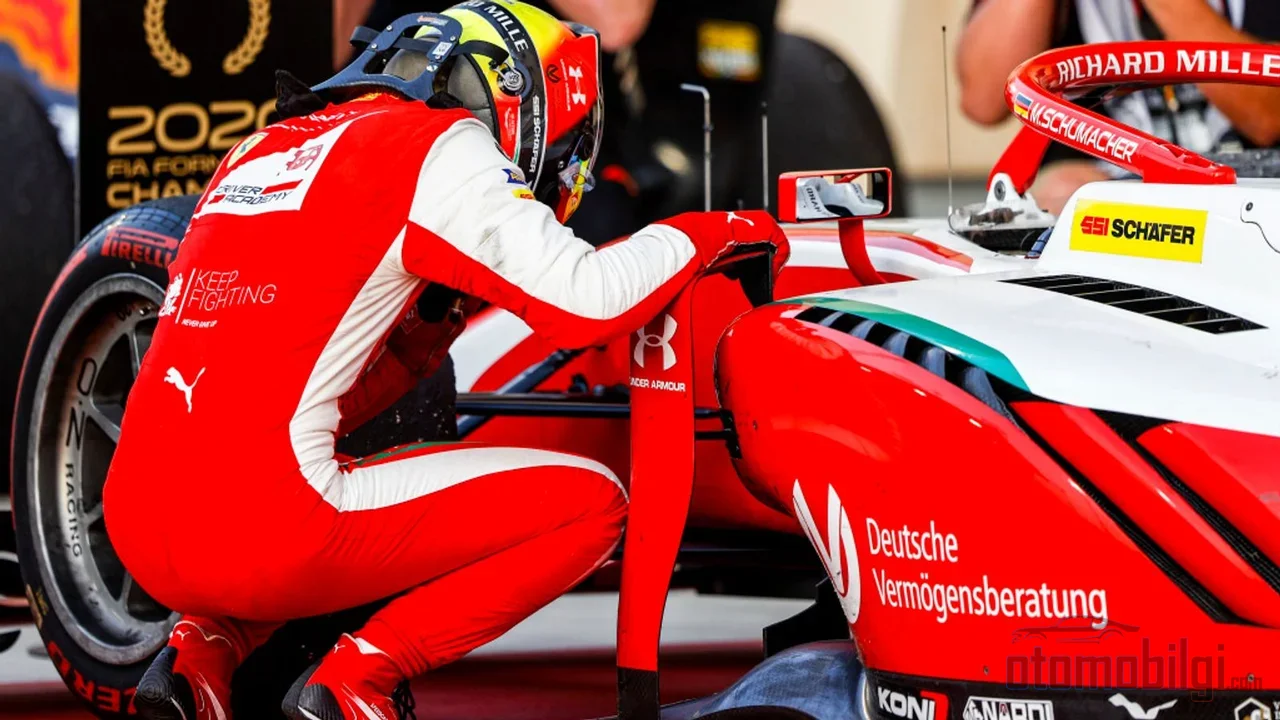
- Mick Schumacher won the 2020 championship with consistency, taking only 2 wins all season.
- In 2022, Liam Lawson won the race only to be disqualified hours later and lose it.
First, Let's Get to Know the Stage: The Road from GP2 to Formula 2
The GP2 Series was founded in 2005, replacing Formula 3000. Its format was designed by Bernie Ecclestone and Flavio Briatore, and Bruno Michel took over the organization. The core idea was brilliantly clever: every team would use the same chassis, the same engine, and the same tires. So if there's no car difference, what's left? The driver's talent. Just like everyone solving the same question book at school - that's how you see who truly deserves to pass the exam.
The races were run almost entirely as support races on F1 weekends. Saturday brought the 180-kilometer Feature Race with a mandatory pit stop; Sunday brought the 120-kilometer Sprint Race. The top 8 grid positions of the sprint race were reversed - meaning Saturday's winner started Sunday from the very back. This rule alone produced dozens of dramas; come on, admit it, even if only in your head, those reverse-grid battles were the most exciting parts everyone watched.
On the car side, there was the Dallara chassis, Mecachrome's 4.0-liter V8 engine, and Pirelli tires. The engine produced 612 horsepower and ran with a 10,000 rpm limit; it went in for a revision after roughly 4,000–4,500 kilometers. The car's total weight was 688 kilograms. The GP2/11 chassis cost around 1.5–2 million euros excluding the engine - yes, a junior series, but the costs were real. In 2017 the series was rebranded as the FIA Formula 2 Championship; the stories, however, went on unchanged.
2005: Nico Rosberg and the Value of the First Championship
The first season had 23 rounds and went down in history as the only season in which GP2 used grooved tires like F1. Nico Rosberg became the series' first champion, leaving Heikki Kovalainen in second place. Another nice detail: he secured the championship on September 29–30, 2005, by taking the series' first double victory - you know how they'd film such a beautiful final scene on TV; Rosberg did exactly that in real life. On the teams' side, ART Grand Prix won by a 61-point margin; a dominant opening season from start to finish.
And here's the real story: along with the championship, Rosberg transferred directly to Williams in F1. In its very first year, the series sent the message "the road to F1 is open from here." Kovalainen, meanwhile, was appointed as a Renault test driver as runner-up - meaning even the first season's top two were tied into the F1 ecosystem.
2006: The Hamilton–Piquet Jr. Duel, the Series' First Big Battle
For me, this is one of the series' most classic stories. The season opened in Valencia for the first time, independent of the F1 calendar, and Nelson Piquet Jr. took the first win. Then Lewis Hamilton seized the lead with a dominant run; the balance swung back to Piquet. Over 20 races of cat-and-mouse, the story closed at the penultimate race in Monza when Hamilton secured the championship. However big the blows the two young drivers landed during the season, none were fatal - which is exactly why it turned into a complete classic.
And what came after? Hamilton moved to McLaren and became world champion in his second year in F1. This is the strongest example shown of the series producing competitive drivers; it leaves no room for argument. As for Piquet Jr., he was appointed as a Renault test driver after finishing second. The top two names of a single season opened two separate doors into F1.
2007: Timo Glock's Dominance and di Grassi's Resistance
In 2007, Timo Glock dominated the series but faced fierce competition from Lucas di Grassi in the final part of the season. Glock still won the championship with his victory in the season finale in Valencia - meaning even the seemingly dominant name couldn't relax until the very end. Across this trio of seasons (2005, 2006, 2007), the champions went straight into F1: Rosberg to Williams, Hamilton to McLaren, Glock to Toyota. The runners-up Kovalainen, Piquet Jr. and di Grassi were also appointed as Renault test drivers. Just imagine: a ladder whose three consecutive steps all climbed into F1.
Championships Won by a Single Point: Brutal Gaps on the Teams' Side
The gaps on the teams' side are just as striking as the drivers' stories. In 2008, Campos took the championship with 8 points; in 2010, the Rapax gap was 5 points; in 2012, DAMS were ahead by 6 points. The name at the peak, though, is 2013, when Russian Time won the teams' championship by a 0-point margin - yes, zero. Not gaining a single point, not losing a single position... Once you see these numbers, you switch into "not exactly a spec series" mode.
But the table has another side to the coin: in 2015 ART created a crushing dominance with a 160-point gap, and in 2016 Prema with 172. In other words, the series produced knife-edge battles at times, and one-sided races at others. This decade-long swing between the two extremes shows how much the format depends on people.
2020: Mick Schumacher's Championship That Almost Gave Fans a Heart Attack in the Second Half
I struggle to keep my hands steady on the keyboard while describing the finale of the 2020 season. Mick Schumacher, with Prema, entered the reversed-grid Sprint Race held on the shortened Sakhir circuit in Bahrain with a 14-point advantage over his rival Callum Ilott. For Schumacher, finishing 6th was enough; for Ilott, at least 2nd was required. In the closing laps, Ilott moved up to 3rd - the moment that had everyone on the edge of their seats - but then dropped to 11th. Schumacher finished 18th and scored no points, but the 14-point cushion held. The championship entered the history books; the race was won by Jehan Daruvala.
Do you know what the most striking detail is? Schumacher took only 2 wins that season and did not have a single pole position. He won the championship through consistency - someone who kept scoring points, made no mistakes, and played the mathematically correct game. He became the fourth champion in F2 history; before him, Leclerc, Russell, and De Vries had sat in that seat. In his own words:
Honestly, I am a bit overwhelmed, I do not feel like a champion yet... Callum gave me a good fight.
And the following year he moved to F1 with Haas - meaning he followed exactly the path laid out by Leclerc, Russell, and De Vries.
Disqualifications That Change Results: Won, Lost, Won
The cruelest kind of championship story: winning the race and losing the victory hours later. Liam Lawson was disqualified for a technical infringement roughly four hours after winning the 2022 Red Bull Ring Sprint Race 2; the win was awarded to Dan Ticktum. Four hours! You have parked your car, done the celebrations, and then a document arrives and everything changes.
And it is not an isolated event. Alex Dunne was disqualified for a technical violation after finishing 2nd in the 2025 Austrian GP Feature Race and lost the F2 championship lead. In the 2026 Spa Feature Race, meanwhile, Roman Stanek inherited the win thanks to Alexander Dunne's penalty and Arvid Lindblad's disqualification - a bunch of doors closed and one opened in a wet Spa. Imagine a series where technical checks can change so many results; you always have to say "there is one race, but actually there are several races."
Traces Leading to F1: The Champions and the Limits of the Talent Pipeline
Let's look at the numbers: by the end of 2016, 9 out of 12 GP2 champions, meaning 75%, had found an F1 seat. From a wider angle: of the 174 drivers who raced in GP2 up to the 2020 F1 season, 35, meaning about 20.1%, raced in F1. The difference between them tells this: becoming a champion opens the door, but the rest of the ladder is much steeper.
The list of champions who went directly to F1 is impressive: Rosberg (Williams, 2006), Hamilton (McLaren, 2007), Glock (Toyota, 2008), Hulkenberg (Williams, 2010), Maldonado (Williams, 2011), Grosjean (Lotus, 2012). The pipeline continued in later years too; Schumacher immediately followed the path of Leclerc and Russell into F1. Russell became F2 champion in consecutive years right after Leclerc, and it was emphasized that he won in "probably the strongest field." The theoretical maximum of 20 points in a single weekend (pole + double win + fastest laps) could only be achieved by Nelson Piquet Jr. (2006 Hungaroring) and Nico Hulkenberg (2009 Nurburgring) - two rare examples of what true domination means.
So What Happens to Those Who Never Reach F1?
This story has a bitter side too. Robert Shwartzman, Callum Ilott, Jüri Vips and Victor Martins are among the names expected to reach F1 but never did. Remember Ilott's 2020 duel; the championship slipped away, and an F1 seat never came. A name like Roberto Merhi, meanwhile, returned to F2 in 2017 after his F1 adventure and was beaten by a wide margin against Charles Leclerc - the series can sometimes turn into a hall of comebacks.
But the doors don't always lead to F1. 2025 F2 champion Leonardo Fornaroli was taken into the McLaren driver development program; 2023 champion Theo Pourchaire became a Mercedes development driver in February 2026. The championship seat sometimes turns into a test seat - slow, but still a way forward. Champions like Charles Leclerc also built brilliant careers after moving to F1; Leclerc won three Grands Prix in 2022, only failing to challenge Verstappen for the championship. Whether Isack Hadjar would land an F1 seat was a separate debate.
The series' talent pipeline success is not undisputed; based on the unchanged car since 2018, there are those who argue "F2 no longer feeds talent to F1." I think this debate is open - Zak O'Sullivan starting 15th in the 2024 Monaco Feature Race and taking the lead thanks to a pit stop during the late VSC, then holding off Isack Hadjar on the final lap to take his first win, explains in a single frame why this series is still watched. With that result, Paul Aron rose to the championship lead for the first time, as someone other than Zane Maloney.
So What Is the Lesson from These Stories?
GP2/F2 history is not written with a single formula. Sometimes dominance (the team differences of Glock, ART and Prema), sometimes knife-edge balance (Russian Time's 0-point championship, Rapax's 5 points), and sometimes the decisive role of luck and technical inspections (Lawson, Dunne, Stanek) write the story. The common denominator is always the same: names emerging from this series, champion or not, remain on the F1 world's agenda. And I think there is no better proof than this that the series is still worth watching.
Sources
- GP2 Series
- Mick Schumacher wins Formula 2 title after dramatic final Sakhir race
- When Nico Rosberg won the inaugural GP2 Series title
- FEATURE RACE: O'Sullivan takes dramatic maiden Formula 2 victory in Monte Carlo
- Lawson disqualified and stripped of Sprint Race 2 victory
- Dunne disqualified from second place in Austria
- Stanek inherits victory of a wet Spa Feature Race
- Every GP2/F2 champion ranked
- Formula 2 / GP2 champions: what happened to them?
- The Formula 2 drivers who were expected to get to F1 (but never did)
- McLaren adds the F2 champion to its roster
- F2 champion Theo Pourchaire becomes a Mercedes development driver