Aston Martin DBR1: Le Mans' One-Night Legend
On the night of June 20-21, 1959, some 150,000 spectators held their breath on the tarmac of Le Mans. On the track, Ferrari's red 250 TRs were battling Aston Martin's green-and-white DBR1s through the final corners. And toward dawn, everything changes: the winning car crowns not just a race, but a brand's decade-long dream. But here is the strange part: Aston Martin won Le Mans outright only once in its entire history. Just once! While Jaguar took the trophy five times, and Bentley perhaps six, why did this elegant British marque stop at a single victory? And even more intriguingly, why did it shut down its factory racing program right after that win? The answer lies hidden in David Brown's stubborn project and in a surprising decision that followed the racing car.
David Brown's Dream: How Was the DBR1 Born?
Let's first meet the hero of the story. In 1946, David Brown saw a newspaper ad and bought Aston Martin. Yes, you read that right: he found the sports car manufacturer through an ad. The DB letters in the brand's name are, in fact, that man's initials. Brown's goal was grand: to build the world's best racing car in England.
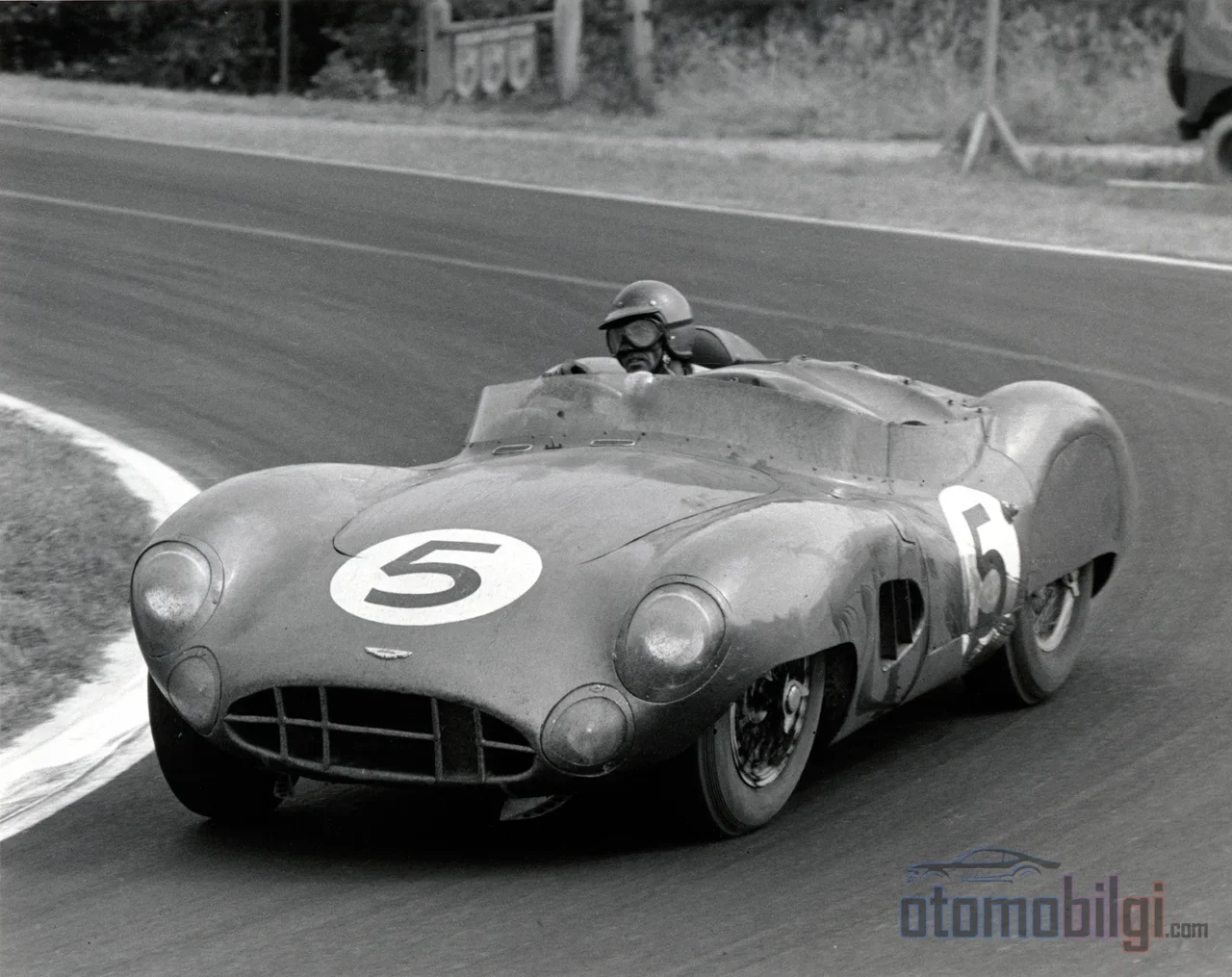
The road to that goal opened with the DBR1, introduced in 1956. Chief designer Ted Cutting was the name who left his mark on the project, from body to chassis and engine. The form inherited from the previous DB3S evolved into a much lower and more flowing body; the rear of the front wheel arch was no longer left open, and full body cladding was used with large triangular vents on the sides. This detail would become standard on all subsequent Aston Martins. So the DBR1 was not just a racer; it also shaped the brand's design DNA.
The Technical Side: How Light, How Powerful?
The chassis consisted of a multi-tubular space frame structure. At the front there were torsion bars and trailing arms; at the rear, a De Dion axle, longitudinal torsion bars and a Watt linkage. The engine was an all-aluminum, flat-six racing engine: it started at 2,493 cc due to the 1956 Le Mans regulations, grew to the 2,992 cc RB6.300 version in 1957, and produced 250 hp. There are different records showing the power between 240 and 255 hp, but the encyclopedic value converges on 250 hp. The power was transmitted to David Brown's own 5-speed manual gearbox, the CG537.
And its weight? Just 801 kg. Let's put that with an everyday comparison: putting 250 hp into a body far lighter than today's compact hatchback was, for the 1950s, like fitting sprinter's legs onto a footballer's physique. In total, only 5 chassis were built.
Highlights
- Aston Martin's only outright Le Mans victory: 1959, with Carroll Shelby and Roy Salvadori
- DBR1: 801 kg, 2,992 cc flat-six, 250 hp, 5 chassis in total
- That same year, the World Sportscar Championship title also went to Aston Martin
- After the victory, the factory program was terminated; the move to the top class came with the Valkyrie LMH in 2025
- The DBR1/1 set the British-built car record in 2017 with USD 22,555,000
| Specification | Value |
|---|---|
| Engine | 2,992 cc inline-six, all-aluminum (RB6.300) |
| Power | 250 hp |
| Transmission | David Brown CG537, 5-speed manual |
| Weight | 801 kg |
| Length / Width / Height | 4,026 / 1,630 / 978 mm |
| Wheelbase | 2,290 mm |
| Production | 5 chassis |
Three Years of Silence Before Victory: 1956-1958
Did everything really happen overnight in 1959? Not at all. The DBR1's path was filled with three years of patience tested before victory. In its first Le Mans outing in 1956, the car was running at a good pace against the winning Jaguar D-type, but retired with a gearbox failure after 246 laps while in third place when it retired with a gearbox failure after 246 laps. In 1957, the first world championship victory came at the Nurburgring: Brooks and Cunningham-Reid won the 1000 km against Ferrari's and Maserati's star-studded lineup (yes, Fangio and Moss were on the rival side that year). But at that year's Le Mans, both DBR1s failed to finish.
1958 was even crueler. At Sebring, both cars broke down; at the Targa Florio, Moss broke his own record by more than a minute, but the overall result didn't come; Moss and Brabham won the Nurburgring; at the Tourist Trophy, a 1-2-3 finish was achieved. So there was speed, but no reliability and no luck. And at Le Mans, all three DBR1s dropped out of the race. This picture meant great pressure for the team heading into 1959: the racing budget was strained, and that season was, in a sense, the last chance for the DBR1.
1959 Le Mans: How Did the Plan to Wear Down Ferrari Work?
On June 20, 1959, the race started at 16:00 on a dry track. Team boss Reg Parnell's plan was like a movie script: have Stirling Moss, in the No.4 car, push at full throttle despite not using it in the corners, pulling the Ferraris into a speed they couldn't endure, while patiently holding back the other two factory DBR1s from 8th and 9th places. It sounds like a joke, but it's true: you throw your fastest car in like a firework so the rivals wear themselves out. Moss carried out this task to the letter and took the early lead.
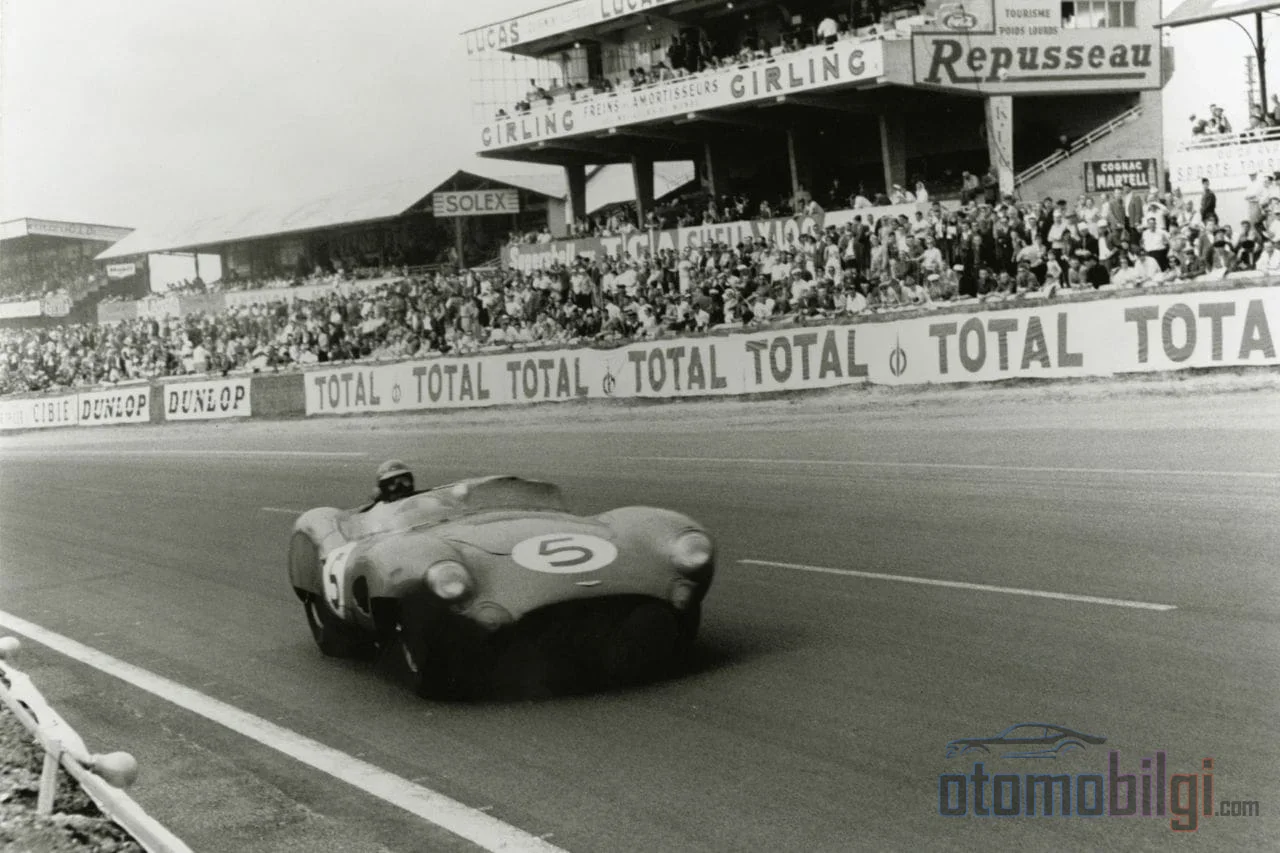
Then the dominoes began to fall. Around the 5th hour, Brian Naylor crashed his private-entry Whitehead car after hitting oil on the track. On lap 70, the Moss/Fairman car retired with engine trouble, but it had completed its mission. When the leading Behra/Gurney Ferrari pitted with a headlight problem, Salvadori/Shelby moved ahead. Toward dawn, Gendebien/Hill's 250 TR took over the lead, and Salvadori/Shelby was having suspension trouble; but around 11:00 that Ferrari also dropped out due to overheating. The remaining two DBR1s crossed the finish line 1-2, a full 25 laps ahead of the third-place car. Shelby took the flag; the victory belonged to Salvadori and Shelby's No.5 DBR1/2, and second place went to Trintignant/Frère's DBR1/4.
Championship in the Same Year: The Team That Dethroned Ferrari for the First Time
Le Mans was only one round of the 1959 season. Aston Martin, focusing on the championship with four chassis, took another win at the Nurburgring with Moss/Fairman. The season finale, the Goodwood Tourist Trophy, was full of drama: the leading DBR1/3 caught fire while refueling in the pits, and the team had no pit box left to use. Right at that moment, privateer driver Graham Whitehead withdrew his own entry and opened his pit to the team; Moss got into the Shelby/Fairman car and secured both the race and the championship. If this were football, the referee would stop the match, but endurance races are written into history in places exactly this dramatic.
At the end of the season, Aston Martin became champion with 24 points, Ferrari was second with 18 points, and Porsche was third with 18 points. Now look at the bigger picture here: Aston Martin became one of only three cars in the 1950s to win Le Mans and the World Sportscar Championship in the same year. And this was the brand's only world sportscar championship; until that day, Ferrari was the only manufacturer to have won the championship.
So Why Did the Factory Leave? The Surprising Decision Behind the Victory
Here is the real answer to the question, the part most people skip. Why did Aston Martin win Le Mans only once? Because the factory quit sportscar racing after that victory. David Brown decided to move to Formula 1 after the perfect closing of 1959: with the fruitless DBR4 and DBR5 cars. This transition failed, and the departure from Grand Prix racing followed as well. The factory's racing department was no longer racing in sportscars; all four DBR1s on hand were sold to customers.
But the DBR1's own story did not end right away. It ran for a long time in the hands of private teams: DBR1/3 finished third at the 1960 Le Mans with Salvadori and Jim Clark, the 1961 Charterhall victory went down in the records as the last win for any DBR1, and by the end of the 1962 season all the cars were retired from racing. Today, DBR1/3 is on display at the Simeone Foundation Automotive Museum in Philadelphia. And its value? DBR1/1 was sold at Monterey in August 2017 for $22,555,000, a world record price for a British-built car. A car that won the race it entered as a last chance became, sixty years later, one of the most valuable British automobiles in history. Not cinema, reality.
The Return After 65 Years: The Hypercar Era with the Valkyrie
So how did this half-century of silence come to an end? Aston Martin returned to the FIA WEC and the 24 Hours of Le Mans in the 2025 season with two Valkyrie LMH hypercars. The program, run in cooperation with The Heart of Racing, fields a heavily modified racing version of the Valkyrie AMR Pro on the track; in the 2026 season, it continues on with its driver lineup unchanged. The hypercar battle in Le Mans' top class counts as a legacy for the brand that continues from where the DBR1 left off. The limited-production Valkyrie LM track car developed directly from this program is also a product of this bond.
The Short Answer: Why Was One Victory Enough?
Let's wrap up the question in one clear sentence: Aston Martin won Le Mans overall only once, in 1959, with Carroll Shelby and Roy Salvadori's DBR1/2, because the factory closed that decade-long project at its highest point and shifted its resources to Formula 1. There is no streak like Jaguar's or Bentley's repeated victories; there is a single perfect season: the Nurburgring, Le Mans and Tourist Trophy triple, plus the world championship.
Is winning once not enough? I don't think so. An underfunded team taking everything in the race against Ferrari at its strongest era, and then walking away, is far more legendary than never winning at all. The DBR1 remained both a one-time spark and a torch rekindled 65 years later with the Valkyrie. It is a story unlike any other in Le Mans history.
Sources
- Aston Martin DBR1 - Wikipedia
- The Aston Martin DBR1 and Le Mans 1959 - HWM Aston Martin
- 1959 Le Mans 24 Hours - Motorsport Database
- Carroll Shelby Looks Back at 1959 Le Mans Victory - Sports Car Digest
- Aston Martin returns to Le Mans with two Valkyrie LMH hypercars in 2025 - Aston Martin F1
- Aston Martin Valkyrie will race with unchanged line-up in 2026 - Aston Martin
- Aston Martin DBR1 - The Aston Martin that Made Good - Supercars.net