The Crashes That Transformed Le Mans: How Safety Improved?
The darkest moments in Le Mans history literally built motorsport's modern safety culture: from the introduction of disc brakes in racing to carbon monocoques, from the HANS device to the triple safety car rule, behind every protective measure there is a real-life tragedy. So what happened in 1955, and what has changed from that day to today?
Key Highlights
- June 11, 1955: Motorsport history's deadliest crash claimed 82-84 lives
- Mercedes withdrew from racing on the night of the tragedy and stayed away from motorsport until 1985
- HANS device became mandatory in Formula 1 in 2003, then spread to endurance racing
- 1999: Mercedes CLR flips permanently drove the brand away from Le Mans
- 2026: For the first time at Le Mans, three safety cars can be deployed at the same time
The 1955 Disaster: A Single Moment, Dozens of Lives
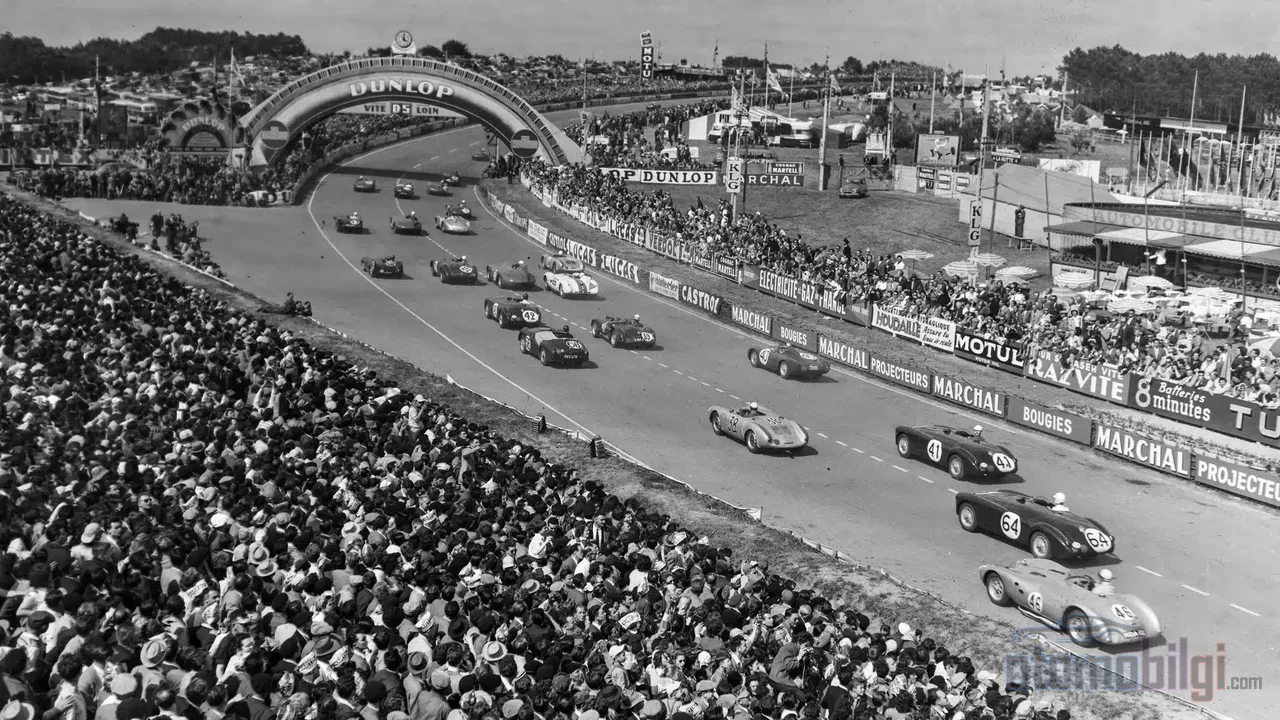
Imagine: cars on the track traveling at over 270 kilometers per hour, with only a 1.2-meter earthen embankment between the spectators and the track. Moreover, the grandstand standing behind that embankment was part of a layout that had remained almost unchanged since 1923. The cars did not even have seat belts. By today's standards it is almost hard to believe, isn't it? But on June 11, 1955, the Circuit de la Sarthe was exactly like that.
That day at 18:26, at the end of lap 35, a chain-reaction crash made history. Mike Hawthorn, pulling his Jaguar to the right for the pit signal, braked hard with his advanced disc brakes. Lance Macklin's Austin-Healey 100S swerved, and Pierre Levegh's Mercedes 300 SLR arriving at over 200 km/h climbed on top of the car and launched into the air. After tumbling for about 80 meters, the car slammed into the earthen embankment and broke apart. Heavy components such as the engine block, radiator, and front suspension were hurled through a crowd of spectators along a 100-meter stretch; the fuel tank exploded.
The death toll was between 82 and 84: 81-83 of them were spectators, and one was Levegh himself. At least 120 people - according to some records, up to 178 - were injured. This remains the deadliest event in motorsport history to date. And in fact, the nightmare was not over: the body of the 300 SLR was made of an ultra-light magnesium alloy called "Elektron," meaning it had a lower ignition temperature than ordinary metal. Spraying water on the fire only made the flames grow, and the car burned for hours. That day, everyone learned the hard way that sand instead of water should have been used.
Who was blamed? No one
The most controversial aspect is this: the official investigation blamed no driver and cited inadequate track safety standards as responsible for the spectator deaths. Macklin accused Hawthorn of a sudden pit maneuver; Jaguar, in turn, questioned the competence of Macklin and Levegh. In 1975, Paul Frère's photographic analysis debunked the first media narratives, but disagreements persisted for years - even to this day. So there is no clear answer to the question of "who was at fault"; focusing on safety standards instead of searching for a culprit is perhaps the disaster's only positive legacy.
Even more surprising: the race continued. Race director Charles Faroux argued that the crowd's mass exodus would block emergency crews and that he had no authority to stop the race. Seen from today, it seems unthinkable, yet in the conditions of that day it was defended with a logic known as "the brutal law of sport." The debate continues to this day.
Mercedes' Withdrawal: A Brand's Long Silence
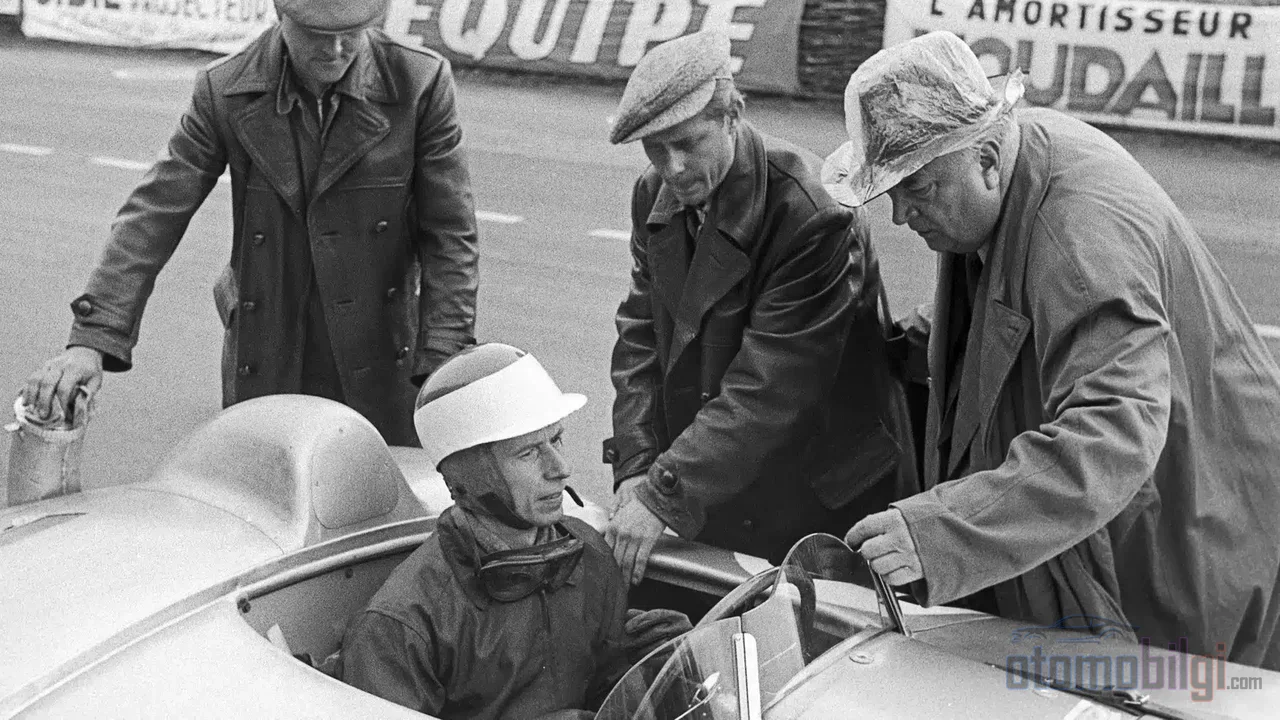
On the night of the disaster, Mercedes driver John Fitch suggested withdrawing; team manager Alfred Neubauer reached the same conclusion. An emergency board vote conducted by phone in Stuttgart gave approval in the middle of the night, and at 01:45 - while running 1st and 3rd in the rankings - the remaining two 300 SLR cars were withdrawn from the race. Rudolf Uhlenhaut asked Jaguar for the same gesture, but "Lofty" England refused. Hawthorn and Bueb won the race by a 5-lap margin.
Here is an interesting nuance: Mercedes' withdrawal from motorsport had already been decided before the race - it was not a result of the disaster. But after this accident, the brand stayed completely away from motorsport until 1985, returned to Le Mans with Sauber in 1989, and took a victory. Then in 1999 another disaster knocked on the door, and Mercedes withdrew from Le Mans for a second and final time.
The impact of 1955 shook not just one brand, but the entire world. Temporary race bans were declared in France, Spain, Switzerland and West Germany. In the USA, the AAA Contest Board was dissolved and replaced by USAC. Switzerland's ban lasted so long that it was relaxed only for electric vehicles in 2015, and full repeal had to wait until July 2026. A 70-year ban! If you want to measure the mark motorsport leaves on public opinion, this figure alone is enough.
What changed on the track?
After the disaster, concrete steps were taken at the Circuit de la Sarthe: the pit straight was redesigned and widened, a dangerous kink was removed and a deceleration lane added, and the pit complex was rebuilt from scratch (starting rights dropped from 60 to 52 cars). The grandstands were demolished and moved back, with wide trenches placed between them and the track. All these arrangements, which seem ordinary today, came at the cost of that June night.
1999: The Mercedes CLR That Flipped in Mid-Air
44 years later, Mercedes was at Le Mans again, and once again it left images etched in everyone's memory. Three Mercedes-Benz CLR cars experienced aerodynamic instability on the track's long sections: at excessive speed the front end lifted, and the car launched uncontrollably into the air and flipped. We are talking about an aerodynamic design flaw that Mercedes never fully solved. It was also debated that damage to one CLR's front diffuser in a racing incident may have contributed to the instability.
Fortunately, no fatalities occurred this time, but the footage was so striking that Mercedes withdrew from Le Mans a second time - and this time permanently. These events also clarified the safety limits of prototypes with closed cockpits and advanced aerodynamic bodies: no matter how fast the car is, keeping it on the ground is the job of the design, and this job must be taken seriously. Technical communities studied the physics of these flips for years; today's aerodynamic testing standards for Hypercar and LMP classes are built on this experience.
The HANS Device and Carbon Monocoque: The Backbone of Modern Safety
Let me give you a simple analogy: the seatbelt holds your body in the seat, but your head remains free. In a hard impact, the head whips forward like a pendulum, and in every collision above ~48 km/h this can lead to a broken neck. This is exactly where the HANS (Head and Neck Support) device comes in: by connecting the helmet to the shoulders with a system that prevents head and neck flexion, it protects the driver. It became mandatory in Formula 1 in 2003 and was gradually introduced to other disciplines and endurance racing. Today, every driver you can watch at Le Mans has this system in their helmet.
The other giant step is in the car itself: carbon fiber monocoque chassis. The word "monocoque" comes from Greek meaning "single shell," and indeed the car is built around a carbon fiber cell that behaves like a single-piece shell. Think of it like a nut: the kernel inside is protected from external impacts. The monocoque structure solves three problems at once: weight, torsional rigidity, and crash safety. Modern cars like the Ferrari 499P Hypercar are built on a new carbon fiber monocoque chassis; even LMP3 cars now use closed-cockpit carbon monocoques. So it's the exact opposite of the logic of the 1955 dirt embankment: protection is no longer on the outside, it's around the driver.
| Milestone | Year | Contribution to Safety |
|---|---|---|
| Le Mans disaster | 1955 | Redesign of pits and grandstands, worldwide safety debate |
| Mercedes CLR flips | 1999 | Awareness of aerodynamic instability and bodywork safety |
| HANS device made mandatory | 2003 | Greatly reduced risk of broken necks |
| Hypercar regulation | 2021 | Replaced LMP1, aims to cut costs by ~80% |
| Triple safety car rule | 2026 | More controlled neutralization of track sections |
Today's Rules: Safety Car, Slow Zone, and Classes
Nothing stops at the 24 Hours of Le Mans. When marshals have to intervene on the track, stopping the entire race would end both the excitement and the strategy. Instead, there are two clever tools: Slow Zones neutralize specific track sections, allowing intervention without stopping the whole race. Under the virtual safety car (VSC), cars 80 km/h must slow to this speed limit, and overtaking is forbidden.
The safety car rules were also rewritten. Under the ACO's new system, three safety cars can be deployed at the same time, and this arrangement was used for the first time in the 2026 edition (the 94th race run on June 13-14) - so much so that Porsche's 50-second lead was wiped out during a safety car period. Not everyone welcomes this change, of course: Toyota was one of the teams that criticized the new system. But the logic is this: a problem on track should affect only that zone, and the rest should keep flowing.
Do the classes also shape safety?
To summarize briefly: Hypercar (LMH) replaced LMP1 at the beginning of 2021 and aims to reduce costs by roughly 80%. On track, the Hypercar, LMP2 and LMGT3 classes race together. This class system is important not only for competitive balance but also for safety: each class has different speeds, and the Slow Zone and safety car rules are designed to manage these speed differences. A slower GT car can create a problem in front of a Hypercar; that is why the neutralization procedures are extremely detailed.
How Disasters Transform a Race
In 1955, the distance between spectators and the track was 1.2 meters; today the grandstands sit behind the layered protection of trenches, barriers and run-off areas. In 1955, no car had a seatbelt, while today every driver is inside a HANS device and a carbon monocoque. Back then, when not a single voice objected to the race continuing, whereas today safety car procedures are explained page by page in official briefing documents. The change did not come for free - every rule was written on top of a price that had been paid. Perhaps this is exactly what makes Le Mans so compelling: as much as speed and courage, the will to learn from mistakes is part of the race's identity. If it were you, which era's Le Mans would you want to watch?
Sources
- 1955 Le Mans disaster
- 24 Hours of Le Mans - Mercedes-Benz Public Archive
- Mercedes-Benz CLR
- HANS device
- The HANS system, protecting endurance racing drivers
- Safety Car procedure at the 24 Hours of Le Mans
- Le Mans Car Classes
- Le Mans Hypercar
- Ferrari unveils 2023 Le Mans 499P Hypercar
- Circuit de la Sarthe
- Le Mans - RacingCircuits.info
- 24 Hours of Le Mans: From Start to Finish - Metropole
- 2026 24 Hours of Le Mans
- 24 Hours of Le Mans 2026 - FIA WEC
- 2026 Technical and Sporting Regulations - European Le Mans Series
- 2026 Road to Le Mans - Drivers' Briefing
- INSIGHT: Why Le Mans is Changing its Safety Car Rules - Sportscar365
- Safety Car Changes Will Make This Year's Le Mans Look Very Different - Road & Track
- AUTO+ Medical - Safety in our HANS - FIA
- Why did the Mercedes CLR flip at Le Mans? - Mulsannes Corner
- The day racing lost its innocence: the 1955 Le Mans tragedy - Motorsport Magazine