Why Is Finishing Le Mans So Difficult?
Share This Page
Because Le Mans is a saw-toothed test like no other: it demands that you believe a car will not break down not for seconds, but for an entire day, exactly. Since 1923, the majority of cars entered have failed to see the finish line at the end of 24 hours. The winner is the car that covers the most distance in that day - but the story of the dozens of cars that never made it to that victory podium actually tells the true face of the race far better. In this article there is no victory literature; there are the numbers of unfinished races, the failures, and the lessons.
Highlights
- Highest finish rate: 90.9% - the first race, held in 1923, saw 30 of 33 cars finish
- Lowest finish rate: 13.7% - in 1970, only 7 of 51 cars saw the finish
- To be classified, a car must complete at least 70% of the distance covered by the winner
- In the latest race, only 13 of 62 cars failed to cross the finish line - the reliability exam of the modern era
What the Numbers Say: The Extremes of Retirement Rates
Le Mans's statistical history clusters around two extremes. The first extreme is 1923: when the race was run for the first time, 33 cars took the start and 30 finished. This 90.9 percent finish rate is still the record. It sounds strange, doesn't it? Because the cars of that year were slow and simple - there was little mechanical content, so there was little to break. And since speeds were quite low under the conditions of the day, the cars were not racing at a pace that would destroy one another.
The other extreme is an outright carnage year: 1970. That year 51 cars took the start, and only 7 saw the finish line. Thirteen point seven percent. In other words, six out of every seven cars were left stranded on the road. This figure sums up the cruelest era of endurance racing: the cars were fast, dancing on the edge of reliability, and the track spent all night trying to tear something off every car that stayed in one piece.
| Year | Cars started | Finished | Finish rate |
|---|---|---|---|
| 1923 | 33 | 30 | 90.9% |
| 1970 | 51 | 7 | 13.7% |
| 2026 | 62 | 49 | Around 79% |
The latest race (the 94th running, held on 13-14 June 2026) started with 62 cars; 13 failed to cross the finish line. A finish rate of around 79 percent - compared to 1970, an almost entirely different sport. Although the full table, as a complete series containing each year's rate by decade, has not been published, these three anchor points clearly show the direction of change: easy at the start, savage in the middle, and reliable once again today.
Mechanical Failures or Accidents? The Anatomy of Attrition
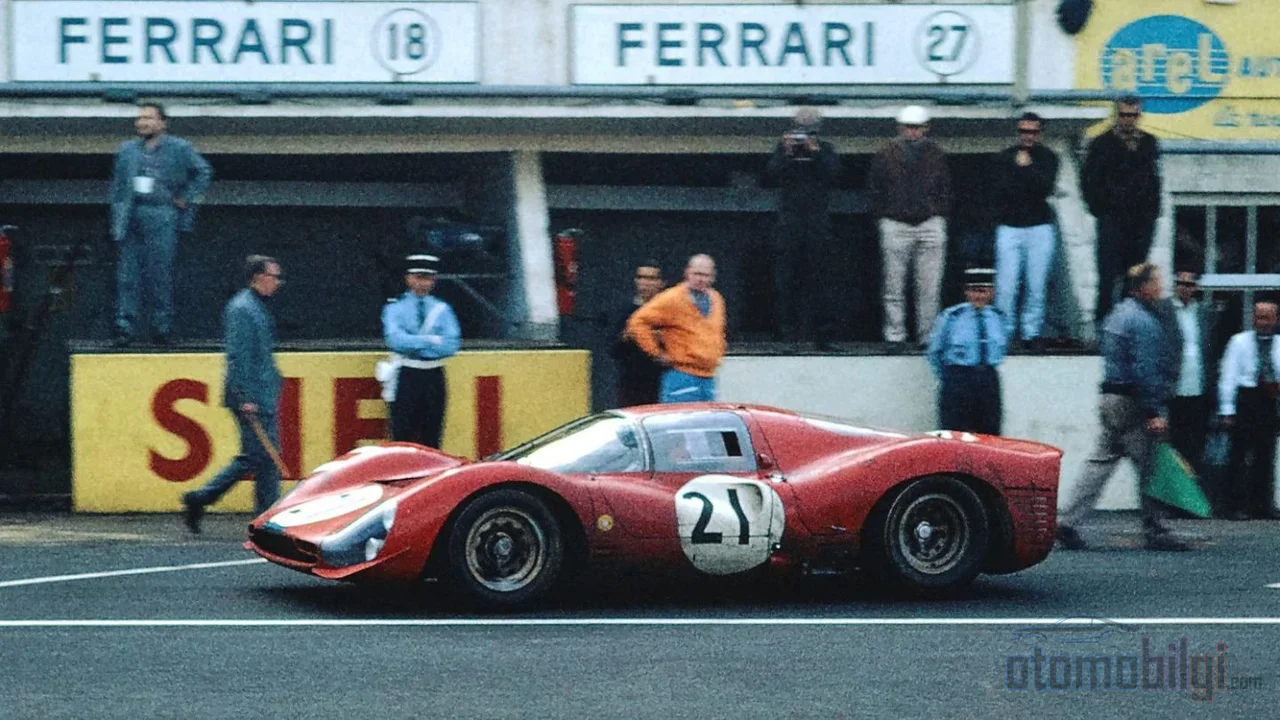
It is possible to sum up why a car failed to finish Le Mans under two major headings: the machine giving up and the driver making a mistake. The ratios of the two have changed significantly across eras, and this change is a mirror of the race's technical evolution.
Engine, gearbox, and the war of consumables
Imagine a motor running for 24 hours: Picture the vehicle as a marathon runner covering the same distance as you while you fill the fuel tank. Le Mans tests exactly this - in addition to speed, the management of everything from fuel to tires and brake materials. Teams constantly strike a balance: speed is traded off against the ability to run 24 hours without mechanical failure. In the early days, the ACO even turned this balance into a rule: in the first hour of the race, cars could not refill fluids such as oil and coolant (except fuel). Cars that could not complete the first hour without losing fluids faced the risk of disqualification. So failure could begin right after the start, on the pit lane.
There is also the most grueling rule of the race: the engine must be switched off while refueling in the pits, and mechanics cannot work on the car during that time. This means the engine is restarted many times within 24 hours - each restart acts like an insurance policy on reliability, however small. Moreover, the oil crisis of the 1970s pushed the ACO toward the Group C formula, which rewarded fuel economy; from that point on, efficiency became a direct part of race strategy.
The track and safety: eras transformed by accidents
The story of accident-related retirements is harsher than mechanical failures. The deadliest accident in motorsport history happened on this very track on June 11, 1955: Pierre Levegh's car flew into the crowd; an estimated 82-84 people lost their lives and 120-180 were injured. This tragedy led to radical changes in track and safety regulations - the pit complex was demolished and moved back, and the pit straight was widened. The causes of accidents also varied by era: as track safety improved, the balance between retirements caused by errors and mechanical failures shifted in favor of pure accidents.
There is also the story of bringing speed itself under control. On the Mulsanne Straight in 1988, a car reached 407 km/h ; after the FIA's ban on straights longer than 2 km, two chicanes were added to the straight in 1990 and it was split into three sections. Today, the record on the straight is 366 km/h, while typical peak speeds are around 320 km/h. One of the factors reducing failures and accidents is the constant revision of regulations.
Driver Fatigue and the Endurance Imposed by the Rules
One of the major factors reducing retirement rates in the modern era is rules that protect not only the car but also the human. Since the 1990s, a driver can drive for a maximum of 4 hours in a 6-hour window, and a total of no more than 14 hours over the entire race. When the air temperature exceeds 32 °C, a maximum continuous driving limit of 80 minutes and a 30-minute rest rule have been in effect since 2017. This means that not only the car but also the driver is put to an endurance test - and the fatigued driver was one of the oldest causes of accident-related retirements.
Night driving, variable weather, and 62 cars battling on the same track at the same time already make the job harder. Among motorsport fans, the debate over "which is the toughest race" never ends; some point to other endurance races with even rougher and more irregular terrain. But what sets Le Mans apart is that these challenges pile on top of each other: night, traffic, fatigue, and the chance of anything that can break in a day breaking, all tested at once.
Finishing Is Winning: The Fine Detail of Classification Rules
In endurance racing, the "finishing is winning" philosophy is not a poetic slogan but a technical reality. For a car to be classified, it must first complete the final lap, and then have covered at least 70 percent of the distance covered by the winner. In other words, a car that makes it to the final lap but, by rule, fails to reach the required distance is not classified, even if it technically crosses the finish line.
In recent years, a practice-related addition was made to this rule: the tradition of damaged cars waiting for the final lap and sneaking across the line in the pit lane is now banned. This detail nicely sums up the spirit of the race - at Le Mans there is no fake version; covering the real distance under real conditions is a must. There is symmetry on the driver side too: three drivers are mandatory and each must respect stint limits; nothing about the car or the human escapes scrutiny.
A small example from the 2026 race: in the modern 62-car grid, the Ferrari AF Corse #50 car appeared on the DNF list, and some drivers (including Frederik Vesti) announced in the early morning hours that they had retired from the race due to mechanical failure. So even the modern era has its own heartbreaks - only the odds are much lower.
Today's Le Mans: A Race That Can Almost Be Finished
In the current format, 62 cars compete across the hypercar, LMP2, and LMGT3 classes - 23, 16, and 23 respectively; the grid features 14 manufacturers and 186 drivers. Modern cars typically cover distances in excess of 5,000 km; the record stands at 5,410 km, set in 2010 - roughly six times the distance of the Indianapolis 500. Covering this distance with almost no breakdowns is a difficult goal even in daily car maintenance.
The race has been canceled ten times throughout its history: a strike in 1936, and World War II between 1940 and 1948. The event is run by the Automobile Club de l'Ouest (ACO), and Le Mans is the oldest endurance race still held in the world. Failing to finish has always loomed somewhere in this race's century-plus history - but today, thanks to rules and technology, not every car ends up stranded on the roadside as in that dreadful year of 1970.
Final Word: Not the Winner, but the One Who Lasts, Wins
While watching the next race, I suggest you don't look at the podium but at the lower ranks of the results list. Every name there marked DNF is a story of someone who spent 24 hours trusting their luck, the weather conditions, their tire choice, and thousands of mechanical parts. The car that wins Le Mans isn't the fastest one; it's the one that refuses to fall apart for 24 hours. That's the whole philosophy of the race anyway: endurance, strategy, and survival - it's won at the moment when the car, the team, the driver, and the strategy are all at their best. If it were you, which would you choose: an engine that leads by a lap but breaks down in the 18th hour, or a noisy car that finishes?