How Did the Hypercar Era Reshape Le Mans?
Share This Page
The Hypercar era is the new period that began at the 24 Hours of Le Mans in 2021 with the Le Mans Hypercar (LMH) regulations, replacing LMP1; by reducing costs, it aims to draw manufacturers back to racing. The rule worked: after the transition years when Toyota ran alone, giants like Ferrari, Porsche, Cadillac, Peugeot and Alpine filled the grid one after another. So how does a set of regulations revive a legend this quickly? Here is the story.
Highlights
- Hypercar class In 2021 it replaced LMP1; the target was a reduction of around 80% in costs.
- Maximum power 500 kW (670 hp), minimum weight 1,030 kg.
- The race of the century in 2023 the Ferrari 499P beat Toyota by 1 minute 21 seconds .
- In 2026 in the Hypercar class, 18 cars from 8 manufacturers raced at Le Mans.
How and Why Did LMP1 Fade into History?
First came the collapse. Audi withdrew from the WEC in 2016, and Porsche at the end of the 2017 season, with Volkswagen's emissions scandal lurking in the background. LMP1 suddenly became a class where Toyota was left almost entirely alone. Sustaining the top category of the race in this state was simply not viable.
The solution was the Le Mans Hypercar (LMH) regulations introduced in 2021. The idea was simple: to allow car manufacturers to field race cars derived from their road cars, or their traditional prototypes, with a far more reasonable budget. The regulation's goal was to achieve a cost reduction of around 80% and to attract a wide range of manufacturers to the door. Moreover, race cars derived from hypercars were also accepted; in other words, the door was left as open as possible.
Grandfathered LMP1 cars competing at the same performance level as LMH would kill the new category before it even started.
These words reflect the essence of the debates before 2021: the non-hybrid LMP1 cars racing under their old homologation status (that is, "grandfathered") were able to compete with the new class in 2021 and 2022, and this balance issue was a concern from the very beginning.
LMH and LMDh: Two Rulebooks, One Victory
The beautiful part is this: at Le Mans there is no longer a single rulebook, but a system where two different approaches meet at the same finish line. While LMH gives manufacturers more design freedom, LMDh, which debuted in IMSA in 2022 with the Daytona 24, draws a stricter framework. Thanks to an agreement between the FIA, IMSA and ACO, LMDh cars can race in the WEC, and LMH cars in the IMSA WeatherTech series; LMDh cars joined Le Mans's Hypercar class from 2023 onwards.
| Feature | LMH | LMDh |
|---|---|---|
| Chassis | Manufacturer's choice | Spec chassis from Dallara, Multimatic, Ligier or Oreca |
| Hybrid system | Optional; hybrid cars may use up to 200 kW of energy | Common rear axle hybrid system mandatory |
| Total power | 500 kW | 500 kW |
| Debut | 2021, WEC | 2022, IMSA; in WEC in 2023 |
The performance levels of the two concepts are deliberately kept close and balanced through Balance of Performance (BoP). In other words, no brand can guarantee its natural superiority; adjustments are made to the cars before each race. On the LMH side, the downforce/drag ratio in aerodynamics is limited to 4:1 and movable aerodynamic elements, contrary to the original plan, were later restricted. No one calls this "unfair," because the logic is this: why would anyone spend 20 million dollars on the aerodynamics of a Le Mans car?
Did Cost Caps Actually Work?
The numbers tell their own story. A cost cap of 3 million euros (approximately 3.4 million dollars) was set for the supply of ERS systems (i.e., energy recovery units). For manufacturers who had wrestled with unlimited budgets in the LMP1 era, this is more than an improved hospital bed: it is serious medicine. The LMH regulation was also extended until 2032, meaning manufacturers can see a future for their investment. The result? The number of brands coming through the door.
Toyota's Lonely Years: 2021 and 2022
In the first two years of the new era, there was a single star at the center of the stage. In 2021, the Hypercar class featured the Toyota GR010, two Glickenhaus cars and an Alpine (a car based on the Rebellion R13, built by Oreca); Peugeot was planned for 2022 and Ferrari for 2023. That year, a total of 62 cars entered Le Mans, but there were only 5 cars in the Hypercar class. While Toyota was aiming for its fourth consecutive victory with the GR010 Hybrid, it fought a neck-and-neck battle with Alpine at Spa in the season opener; the debate over whether BoP could really bring LMP1-based cars to the same level never fell silent.
In 2022, things became clear. The No. 8 GR010 Hybrid won Le Mans, with the No. 7 finishing second; Toyota's fifth consecutive victory and its third 1-2 finish in history. Since its debut season, the GR010 had won 16 of the 19 races it entered. It sounds monotonous, doesn't it? But the real show had not yet begun. While Toyota was celebrating its fifth consecutive championship in 2022, everyone was already locked onto the centenary race of 2023.
The 2023 Race of the Century: Why Was Ferrari a Turning Point?
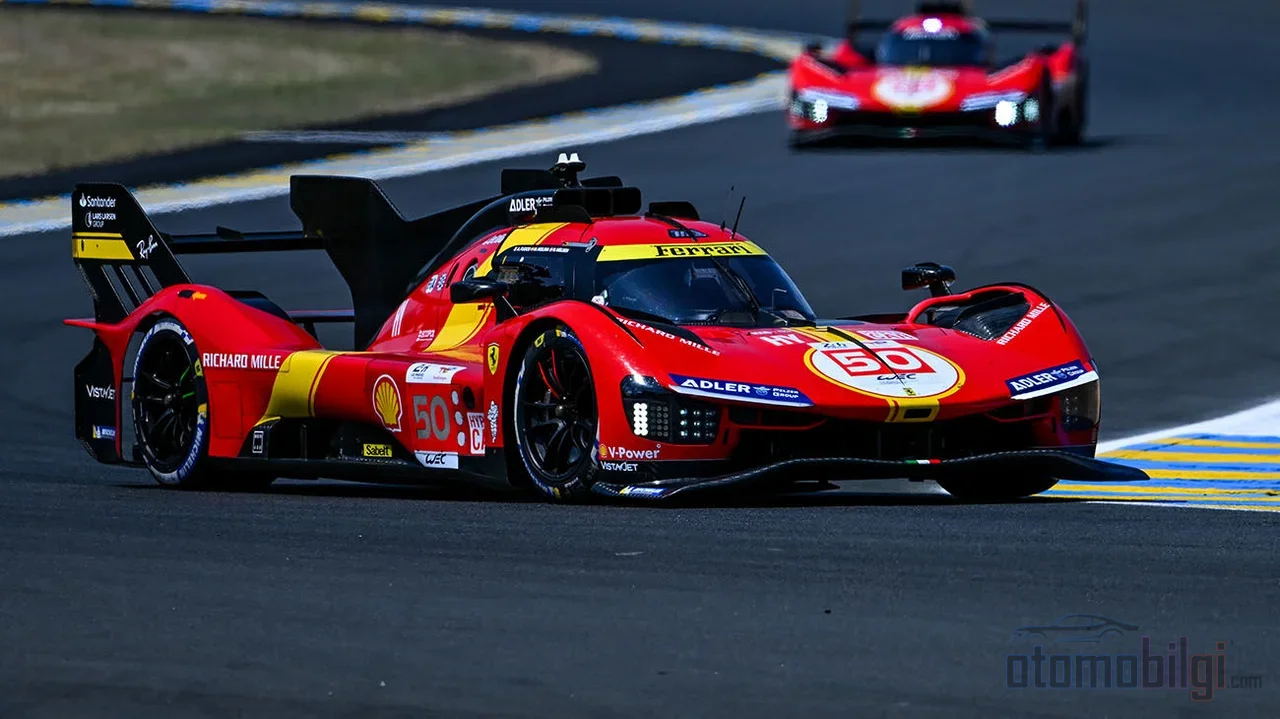
It was the first real fight in four years. The No. 51 AF Corse Ferrari 499P - with James Calado, Antonio Giovinazzi and Alessandro Pier Guidi in the seats - beat the No. 8 Toyota by 1 minute 21 seconds. Ferrari completed 342 laps and, in difficult weather conditions, left Toyota, Cadillac, Peugeot, Glickenhaus, Vanwall and Porsche behind. The highest speed at the centenary race was measured with the Ferrari 499P on lap 279 at 347.8 km/h. Just imagine: two giants separated by mere seconds at the end of a 24-hour battle of endurance.
The meaning of this victory is more than numbers. Ferrari ended a half-century absence from Le Mans; it brought Toyota's four-year winning streak to an end. And the story did not end there: Ferrari went on to sign three consecutive Le Mans victories. So 2023 was not a one-off surprise, but the manifesto of a new era. There was no longer a single favorite on the grid, but several genuine contenders.
Brand Rush: What's on the 2026 Grid?
The provisional 2026 WEC entry list showed 35 cars and 14 brands; 18 prototypes raced in the Hypercar class at Le Mans. The brands in the class were Aston Martin, Alpine, BMW, Cadillac, Ferrari, Genesis, Peugeot and Toyota. Genesis's participation is the latest proof of the era's appeal. A striking detail was that the Porsche 963 was completely absent from the first provisional list - not a luxury, but it shows that brands' relationships with these projects are re-negotiated every season.
What about the race itself? Toyota, with the GR010 Hybrid's successor, the TR010 Hybrid, was on the grid aiming for its first Le Mans win and world championship since 2022. And it worked: the No. 7 Toyota (Mike Conway, Kamui Kobayashi, Nyck de Vries) won the overall classification, ending Ferrari's three-year streak. With heavier cars and less downforce, 2026 was called the hardest Hypercar-era race to predict - and indeed it was. Fuel and tire strategies could swap positions until the final hours. Also, starting in 2025, a new LMP3 class took the stage: with a 3.5-liter twin-turbo Toyota V35A-FTS engine, 350 kW (470 hp) of power and a 1,000 kg
minimum weight, it also energizes the lower tiers.
How the Hypercar Era Changed the Character of the Race
The three-word answer: far more balanced. In LMP1, the highest budget won; in the Hypercar era, BoP, power caps and aero limits reduced the difference to the teams' strategy, pit work and their drivers' ability to endure 24 hours. This philosophy, which controls the outcome rather than performance, at one point also spawned "hidden BoP" debates; the restriction of movable aero elements and the mandatory low-downforce kit for Le Mans were part of this.
But the result is clear: a peak class where as many as 8 brands, with cars from two different rule sets, compete head to head. The end of LMP1 was a disaster; the birth of Hypercar was the long-awaited correction. Don't you think this era is the most exciting period of Le Mans in recent years?
- Sources
- Le Mans Hypercar
- Le Mans Prototype
- Revealed! The 62-strong entry list for the 2021 24 Hours of Le Mans
- Fillon Confirms LMP1 to Be At "Same Level" as LMH in 2021
- Toyota GR010 Hybrid
- Victories continued in the new Hypercar era to give TGR a...
- 24 Hours of Le Mans 2023 - Ferrari Hypercar
- Ferrari Beats Toyota to Historic 24H Le Mans Win
- Le Mans Hypercar Explained - FIA WEC
- What is "Balance of Performance"?
- FIA WEC 2026 - Provisional Entry List, 14 Brands
- 24 Hours of Le Mans - The 2026 Hypercar class preview
- Le Mans victory for TOYOTA RACING
- 2026 24 Hours of Le Mans