Can an Electric Car Tow a Caravan?
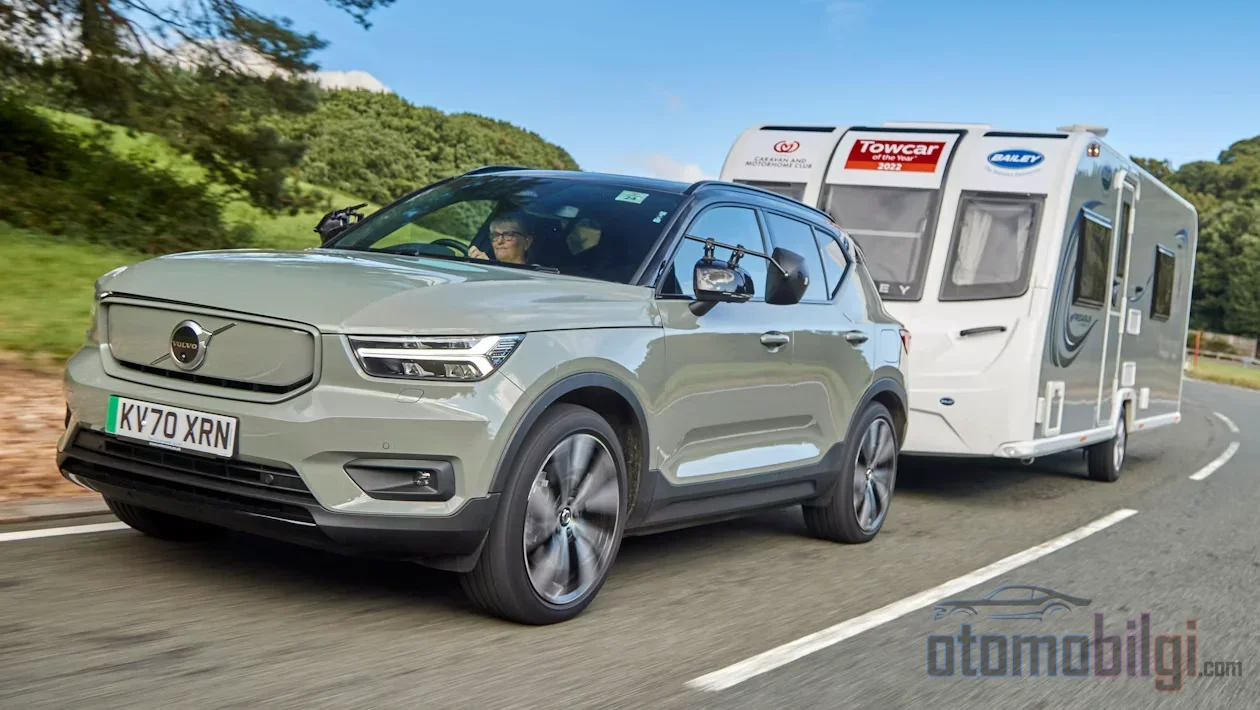
When buying an electric car, most people don't think about towing a caravan at the dealership; the thought comes with planning the first caravan holiday. The picture that emerges at that moment can be surprising: While some electric vehicles effortlessly haul caravans over 2 tonnes and deliver smooth towing even on steep hills, others are not even approved to tow more than 300 kilograms. Moreover, even if you find a model with high towing capacity, the real challenge begins there: How much does the range drop when the caravan is hitched, do you need to detach the trailer at the charging station, does regenerative braking continue to work under these conditions? On this page, we cover all of them with numbers, model by model.
What Determines the Towing Capacity of Electric Vehicles?
Towing capacity is defined by the maximum weight the manufacturer specifies for trailers with their own braking system, and it varies by model. Small, city-focused electric vehicles may have no towing approval at all; in that case, the vehicle cannot tow a trailer no matter its power and torque figures. What matters is not the technical data but the official approval.
When choosing the right vehicle, looking at towing capacity alone is not enough. The maximum gross weight, the trailer's nose weight, the vehicle's payload, its kerb weight, and the ratio of the caravan's weight to the towing vehicle's weight must all be evaluated together. A vehicle that can tow 1,600 kg may look sufficient on paper for a 1,400 kg caravan; but when the weight of luggage and passengers loaded into the vehicle enters the equation, the limit can be approached quickly.
Key Takeaways
- Most towing-approved electric vehicles tow trailers between 1,600–2,500 kg; none yet reach the 3,500 kg limit.
- When towing a caravan, range typically drops by 30–60%: a vehicle with a 400 km range travels about 200 km.
- Real-world example: The Tesla Model X dropped from 410 km to about 230 km with a 1,300 kg caravan.
- Instant torque and a low center of gravity make EVs exceptionally stable when towing.
- Since most charging stations are not designed for vehicles with trailers, detaching the caravan is often necessary.
The Physical Advantage of Electric Towing
The electric motor's biggest asset is the instant torque delivered in full from zero rpm. With a trailer behind, launches and steep hill climbs pass far more smoothly than with an internal combustion engine; since the transmission needs no gear changes, there is no interruption in traction. The battery pack mounted beneath the floor lowers the center of gravity. The practical result is reduced body sway when towing a caravan and better stability at high speeds. Automobile clubs and towing associations also attribute electric vehicles' good balance with trailers, thanks to their own weight, to this physical foundation.
How Many Kilograms Can Each Electric Model Tow?
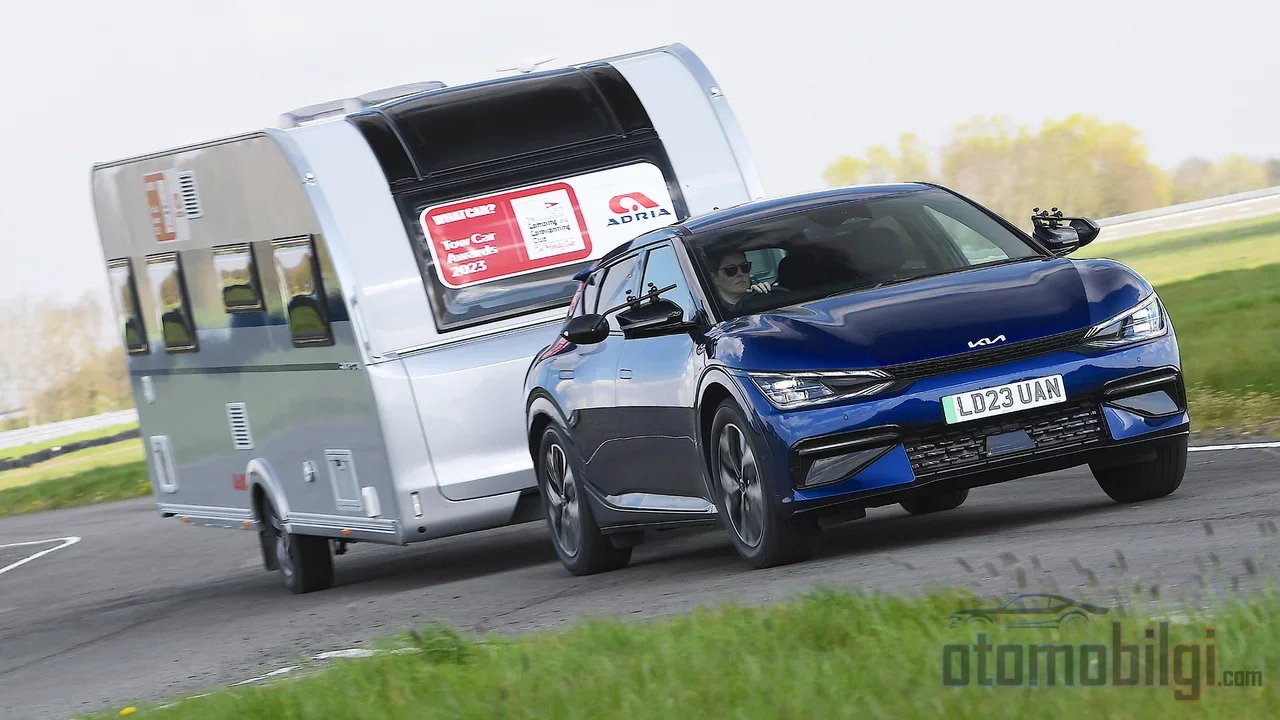
Regardless of brand, the figures span a wide range by class: from 300 kg to 2,500 kg depending on the model. The highest values are concentrated in premium brands like Audi, BMW, and Mercedes, while the numbers drop noticeably in the compact class.
| Model | Towing Capacity (with braked trailer) |
|---|---|
| Tesla Model X | 2,250 kg |
| BMW iX | 2,500 kg |
| Ford F-150 Lightning | over 4,500 kg |
| Audi Q8 e-tron | 1,800 kg |
| Mercedes EQC | 1,800 kg |
| Tesla Model Y | ~1,600 kg (tongue weight 159 kg) |
| Kia EV6 / Hyundai Ioniq 5 | 1,600 kg |
| Polestar 2 / Volvo XC40 Electric | 1,500 kg |
| Jaguar I-Pace | 750 kg |
| Kia Niro Electric | 300 kg |
A few contextual notes help make sense of this table. The dual-motor AWD version of the Hyundai Ioniq 5 produces 605 Nm of torque; that figure is close to the level of large V8 diesel off-road vehicles with 650 Nm. The best EVs for heavy and frequent towing are electric pickups like the Rivian R1T and Ford F-150 Lightning; the F-150 Lightning pulls more than 4.5 tonnes, while the GMC Silverado EV is stated to target around 9 tonnes with its maximum towing package. On the other hand, new-generation large electric SUVs like the Kia EV9 comfortably cover most European caravans in the 1-1.5 tonne range.
The Limit That Trips Things Up: 3,500 kg
The critical constraint is this: No electric vehicle has yet reached the 3,500 kg standard upper limit of conventional tow vehicles. The highest certified figure is the BMW iX's 2,500 kg. Large, full-size caravans therefore remain outside the reach of electric towing; petrol and diesel engines as well as plug-in hybrids dominate in this segment. Indeed, despite the high curb weight brought by their large batteries, PHEVs offer capacities similar to their petrol counterparts: the Mercedes-Benz GLC 300e tows 2,000 kg and the BMW X5 xDrive40e 2,700 kg, while the Porsche Cayenne e-Hybrid goes up to 3.5 tonnes. Homologation also varies from market to market; some models (for example the Tesla Model 3 and Mercedes EQA/EQC) are technically capable of towing in certain markets but cannot tow because local approval is lacking. For this reason, a definitive check should be made against the official technical data valid for the market you are buying in.
How Much Does Range Actually Drop With a Caravan?
One of the most debated realities of electric vehicle ownership is the loss of range while towing. When aerodynamic drag and added mass work together, the typical loss falls in the 30-60% range; the size and weight of the caravan, speed, weather conditions, road gradient and driving style determine this rate. As a practical calculation, a vehicle with 400 km of range typically travels around 200 km with a caravan attached. A common approach is to assume a 40-50% expected loss when towing and plan accordingly.
Measured examples make the table concrete. One Tesla Model X owner reports that usable range with a 1,300 kg caravan dropped from about 410 km to about 230 km; acceleration is not lost, but consumption rises noticeably. The Rivian R1T was met with only 177 km of range at 112 km/h with a 2,767 kg tandem-axle trailer. In AAA's June 2023 test, the range of a heavily loaded F-150 Lightning dropped from 278 miles to 210 miles; that is, a loss of 24.5%. The loss rate grows as trailer weight and speed increase; the percentage achieved with a 2.7-ton trailer is far above what is achieved with a light box trailer.
There is a fair point of comparison here: internal combustion vehicles also experience a similar loss, roughly around 50%, when towing. The real difference lies in the infrastructure. Petrol and diesel stations are everywhere and refueling takes minutes; DC fast charging normally adds about 300 km of range in 20 minutes, but with a trailer attached the same time may equate to roughly 100 km of range. In short, the problem is not energy efficiency but rather the frequency and duration of stops.
Ways to Manage Range Loss
Although the numbers look daunting, they are manageable with planning. The proven principles are:
- Deliberately keeping highway speed low; speed is the single biggest variable in towing consumption.
- Smooth acceleration and early deceleration; using kinetic energy without wasting it.
- Keeping the towing weight within the manufacturer's limit and maintaining the correct tire pressure.
- Writing into the route plan the distance between charging stops, fast charging availability, and a battery percentage to be kept in reserve as a safety buffer.
If winter conditions come into play, an additional coefficient comes into effect: low temperatures typically reduce EV range by 10-25%. Someone setting off with a caravan in winter should layer the effects of towing and cold weather and shorten the intervals between stops accordingly.
How Do Regeneration and Thermal Management Work When Towing?
Regenerative braking turns from a disadvantage into an advantage for the first time when towing. When slowing down and especially on long descents, the vehicle recovers part of the braking energy back into the battery; it reduces the load on the conventional brakes. The longer the descent and the more the trailer's own brakes contribute, the more opportunity arises for recuperation. The balance is this: the extra energy spent on acceleration and maintaining speed partially reverses the gains from regeneration; meaning net consumption still rises noticeably. Also, with trailer mode active, some models automatically reduce regenerative braking and prioritize the mechanical brakes; you need to drive knowingly of this change in vehicle behavior.
Thermal management is the second critical topic. Under extra load, the motor and battery generate more heat; for the cooling system to handle this load is essential both for maintaining performance and for keeping charging speeds from dropping. The self-leveling rear suspension and level towing platform of models like the Mercedes EQC are engineering solutions cited as examples of maintaining balance under load.
A warning also for the reverse scenario: if an electric vehicle's drive wheels spin while it is being towed by another vehicle, the motor acts like a generator and can produce uncontrolled voltage. For this reason, a disabled electric vehicle must be transported on a flatbed, not with improper towing methods.
Charging Infrastructure and the Legality of Towing
Regardless of range, the biggest practical problem occurs here: most existing charging stations are not designed in a way that allows a vehicle with a trailer to park and reach the cable. In most cases, you have to detach the caravan and hitch it back up after charging is finished. Electric vehicle owners who have set out with a caravan note that, over time, they have gotten quite fast at this detaching-and-reattaching process; they also point out that fast-charging points with wider bays suitable for trailer access are becoming more common at motorway rest facilities.
Legal rules also vary from market to market. For example, in the UK, vehicles with trailers are limited to 50 mph on single-carriageway roads and 60 mph on dual carriageways, and the outermost lane of a motorway may not be used. Extension mirrors are a legal requirement in order to be able to see the traffic behind. If lateral sway (snaking) starts in the trailer, the correct response is not panic braking, but taking your foot off the accelerator and brake pedal and relying on engine braking. The tow hitch and trailer connection must comply with the approval and registration rules of the market you are in; generally, the hitch must be recorded in the official documents.
The Camping Advantage: A Giant Battery You Carry With You
The towing story does not consist only of limitations. Some electric vehicles offer external power outlets; a large battery can power a campsite for a night or longer. At campsites with electrical outlets, the vehicle can also be charged during your stay. In this respect, a caravan holiday actually fits very well with electric vehicle ownership.
Can You Tow a Caravan With an Electric Vehicle? The Answer and a Selection Guide
The short answer: YES - electric vehicles can tow a caravan; most models with towing approval can handle trailers between 1,600 and 2,500 kg, range typically drops by 30-60% with a caravan, and the system works flawlessly if you plan around this new range. For heavy caravans approaching 3,500 kg, however, there is no electric option for now; plug-in hybrids offer a flexibility advantage in this segment.
Make your choice based on three criteria. The first is towing capacity: for lightweight caravans under 1,500 kg, the 1,500-1,600 kg class such as the Ioniq 5, EV6, Model Y, Polestar 2 and XC40 Electric is sufficient; for caravans exceeding 2 tonnes, the Model X, iX, Q8 e-tron or EQC are required. The second is range and charging speed: features such as the Kia EV6's ultra-fast charging that reaches 80% battery in 18 minutes are decisive on routes with frequent stops. The third is the use scenario: for a driver who is in the city on weekdays and heads out with a caravan on weekends, fully electric makes sense; for someone who spends most of the year on the road with a heavy caravan, a PHEV is still a safer equation.
Towing a caravan with an electric vehicle is not a technical obstacle, but a matter of planning discipline. Instant torque, a low center of gravity and regeneration are on the player's side physically; range and charging infrastructure are the variables that need to be solved on the planning side. With the right model, a realistic route plan, and equipment that complies with the market's homologation rules, a caravan holiday is a perfectly feasible option with an electric vehicle.
Sources
- Can an EV Tow a Caravan? | Electric Towing Explained
- Some electric cars now ideal for towing caravans
- Can an Electric Car Tow a Caravan or Boat?
- Best electric cars for towing in 2026
- EVs Lose Significant Range When Hauling Heavy Cargo
- Can You Tow a Caravan with an Electric Vehicle (EV)?
- The Flatbed Requirement: EV Towing Procedures and Risks
- Expert Guide to Towing With an Electric or Hybrid Vehicle
- Can a Tesla Model Y Tow a Caravan?
- Can Electric and Hybrid Cars Tow Caravans?