First Long Trip in an Electric Car: Planning Breaks and Real Range
Share This Page
On your first long trip in an electric car, the most critical skill is break planning that accounts for real-world range, not the catalog range: Preparing for 10–20% less range than advertised at highway speeds, applying an 20–80% fast-charging strategy for every stop, and identifying a backup charging point at each stop make the journey predictable. This page systematically covers the entire first long journey, from range estimation to connector selection, from queue scenarios to the charging network in Türkiye.
Highlights
- Roughly 85–90% of the catalog range in summer highway driving; 65–75% in winter highway driving is a realistic target.
- Keeping your speed below 113 km/h is the single biggest contributor to range savings.
- Departing at 80% at en-route charging shortens the total journey time.
- DC fast charging adds 240–320 km of range in 20–30 minutes at peak power.
- In Türkiye, rest-area charging queues during Ege holiday return traffic can spill over onto the highway.
Why Is the Gap Between Catalog Range and Real Range So Large?
The range value announced by the manufacturer is measured in standardized test cycles and does not reflect real highway use. At highway speeds under continuous cruising, you should expect 10–20% less range than advertised. The physical reason is simple: aerodynamic drag increases rapidly with speed, and the energy recovered through regenerative braking in city traffic is almost never generated at a constant highway speed.
A practical calculation framework works as follows: plan with roughly 85–90% of the catalog value for summer highway driving, and 65–75% for winter conditions. In mountainous terrain, continuous climbs can consume an additional 15–20% of range; regenerative braking on descents recovers some of the energy but does not fully offset the cost of the climb overall.
On the navigation side, the picture is improving. Modern solutions can estimate range by accounting for parameters such as driving habits, tire pressure, load, wind, and temperature; AI-powered real-time data integration can bring prediction accuracy down to a ±10% band. Google Maps has also simplified battery consumption estimation and route planning with charging stops for nearly 350 Android Auto-compatible electric vehicle models. Still, on your first long trip, read the estimate shown by your vehicle not as a promise, but as an instantaneous approximation.
Speed, the Most Expensive Variable of Range
The relationship between speed and range is felt far more sharply in an electric vehicle than in a gasoline car. A gasoline engine enters its efficient zone at highway speeds; in an electric vehicle, however, aerodynamic resistance grows exponentially with speed and dominates consumption. Measurements show that driving at 130 km/h instead of 105 km/h can reduce range by 15–25%. An even more striking example: When going from 50 km/h to 130 km/h, range loss can reach 39% - a table where drag doesn't get heated, but speed weighs heavily.
This is also confirmed at a scientific level: A peer-reviewed study has shown that range at highway speeds decreases significantly and deviates noticeably from the manufacturer's published figures. Reaching the catalog value at highway cruising speeds is not very likely.
The engineering recommendation is clear: Stay below 113 km/h as much as possible. On its own, this can add range on the order of 50-80 km per charging stop; you convert the difference between two stops into charging time, and charging time into your total arrival time. Reducing speed is a cheaper investment of your time than waiting for a charge.
Break Planning: The 80% Rule and Charging Time Calculation
DC fast charging stations deliver power in the 150-350 kW range and add 150-200 miles (approximately 240-320 km) of range in 20-30 minutes at peak speed. For comparison: A 240 V Level 2 charger delivers only 15-30 miles of range per hour; too slow for a highway stop, but ideal for an overnight hotel stay. A standard household outlet (Level 1) yields 3-5 miles per hour - an emergency-only solution.
The critical point is the shape of the battery's charging curve: Electric vehicles charge fastest in the 10-80% range; above 80%, power drops off noticeably. Waiting until 100% every time on the road means buying the last kilowatt-hours at the slowest rate. The rule is this: Charge from 20% to 80% and go. Total arrival time is shortened by shorter, more frequent stops rather than one long wait.
You can work out the timing in advance: multiply the usable battery capacity (kWh) by the percentage range you will add. For example, charging from 10% to 80% in a vehicle with 65 kWh of usable capacity means transferring 70% of the capacity; estimate this duration in minutes based on the target station's power and the maximum power the vehicle can accept.
Connector Compatibility: The Detail That Determines the Length of Your Stop
Before setting off, know your vehicle's fast-charging connector type and the maximum power it can accept; it is not the station's sign but your vehicle's limit that determines your stop time. The main DC fast-charging standards are CCS, CHAdeMO and Tesla/NACS; for AC charging, Type 2 (IEC 62196-2) is common in Europe, and Type 1 (J1772, up to 7.4 kW) in North America and Japan.
| Connector | Charging Type | Key Feature |
|---|---|---|
| Type 2 (IEC 62196-2) | AC | European standard |
| Type 1 (J1772) | AC | Single-phase, up to 7.4 kW |
| CCS | AC + DC | Two additional DC pins on top of a Type 2 socket, up to 350 kW |
| CHAdeMO | DC | One of the main DC standards |
| Tesla/NACS | AC + DC | Tesla charging network; being opened to other vehicles via adapter |
Two practical warnings: the same connector family can support very different charging power levels depending on the vehicle and the station; and plan for the second-to-last charging point on your route, not the last one - the final station may be out of order or have a queue.
Peak Periods: What Should You Expect in Holiday Queues?
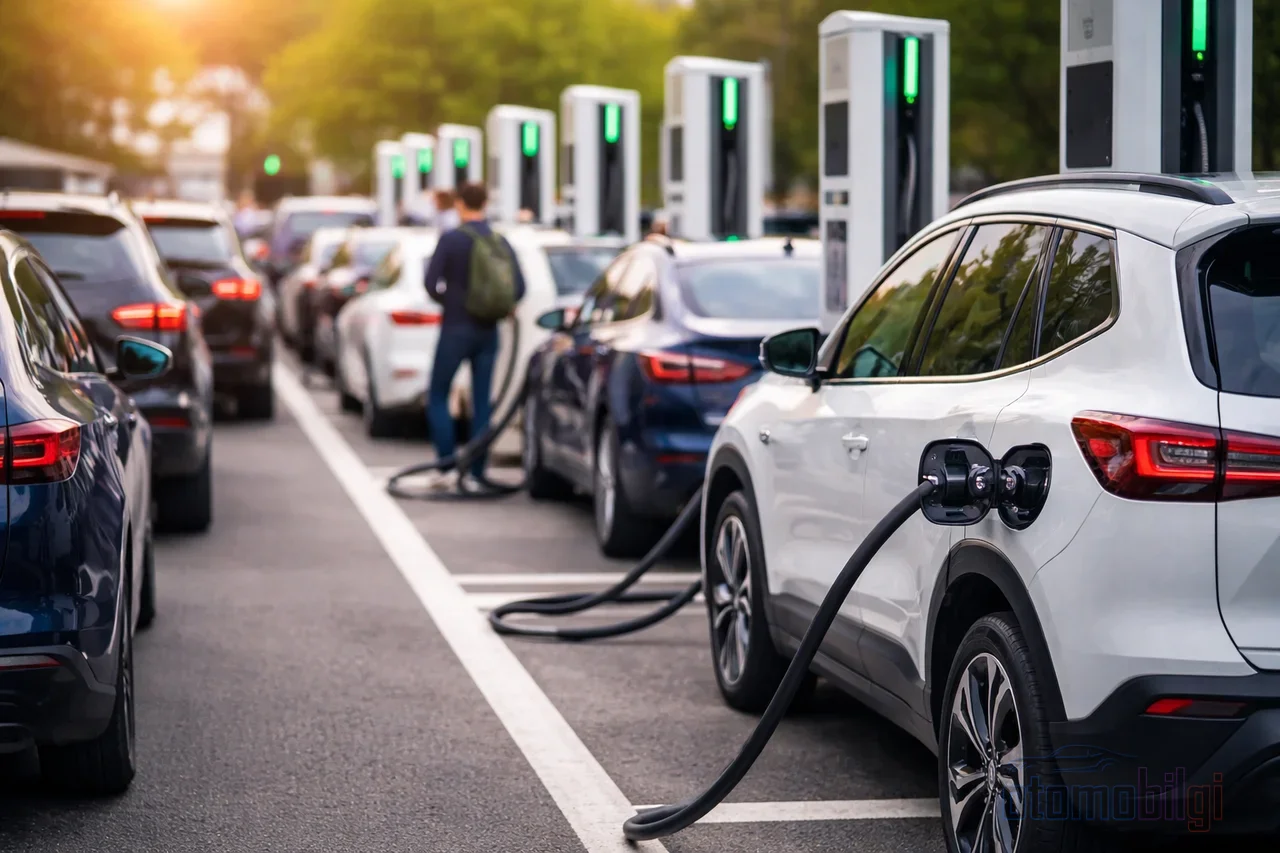
Charging infrastructure is expanding every year, but demand can exceed capacity at peak times. Academic studies confirm that electric vehicles face long waiting times at highway rest stops, especially during holiday and vacation periods; queue models based on traffic flow forecasts also show that these waiting times can be predicted in advance. In Norway, charging demand in July was more than double that of May; in China, drivers were left waiting for hours at rest facilities during national holiday periods. In Germany, forecasts of 3-4 hour waits at some fast-charging points were voiced during the summer months.
Türkiye is not outside this picture. The rest stop charging stations on the Izmir-Istanbul Motorway cannot keep up with demand during holiday traffic returning from the Aegean; the queue spills onto the motorway, and the public's demands are twofold: increasing the number of stations and drivers behaving in a planned manner. Expert opinion points in the same direction: charging queues during holiday periods will get worse before they get better - and the risk for new electric vehicle drivers is concentrated precisely in these peak periods.
The most effective defense against queues is planning rules:
- Prefer stations with many charging points; a single-socket point can cut your journey short with a single failure.
- For each stop, identify a backup charging point within 50 km.
- End charging at 80% and vacate your spot as soon as the vehicle is done; idle fees on some networks are on the order of $0.40-1.00 per minute.
- Carry a backup payment method with you.
- Avoid faulty charging points by checking user reviews and photos on apps like PlugShare.
Long-Distance Driving in Türkiye: Where Does the Charging Network Stand?
Türkiye's charging map is expanding rapidly; major cities and tourism regions take priority. In Istanbul, a target of a charging point every 2-3 km on both the European and Anatolian sides is being discussed; Ankara and Izmir are following. In Izmir, density is tangible at the district level as well: as of February 2026, there are more than 140 charging points in Konak, more than 130 in Karsiyaka, and more than 120 in Bornova.
Domestic apps are also strong for route planning: SarjGezgini, ArabamSarj, and ChargeIQ offer route planning with interactive maps, pricing, and socket information. Start a long journey with a charge as close to 100% as possible if you can; read the density of highway fast-charging as a parameter that shapes your holiday plan. An electric vehicle route is not planned with the gasoline-era logic of "there are stations everywhere along the road," but by calculating range and station distribution together - this is the fundamental difference from a gasoline-powered vehicle.
There is opportunity on the accommodation side as well: many hotels and tourist facilities offer charging. On overnight journeys, aiming for hotel charging lets you set off in the morning with a full battery. As of 2026, DC charging rates vary at parking lots, shopping malls, and urban points; including the prices along your route in your planning reduces surprises.
Tactics for Making Efficient Use of Breaks and Range
Turn your break time into double duty: A 30–45 minute fast charge largely overlaps with the range where charging peaks at its highest speed, and the same amount of time reduces driver fatigue and improves safety. Matching fatigue with a charging break is the most fundamental approach that turns the break from "waiting" into something purposeful.
The items that actually work on the range side are clear:
- Cruising below 113 km/h: a gain of 50–80 km per charging stop.
- Maximum regenerative braking setting.
- Preconditioning the cabin heating/cooling while plugged in - from the grid, not the battery.
- Correct tire pressure; insufficient pressure reduces efficiency.
- Removing the roof rack - eliminates the aerodynamic penalty.
- Using Eco mode.
In route planning, use the vehicle's built-in navigation (because it can precondition the battery before arriving at a charging stop) together with custom planners that calculate real efficiency, elevation and weather based on your vehicle model, and apps that show live charging point status. Live status changes as you keep driving; so make the final decision anew at every stop.
Conclusion: Not Range Anxiety, But Calculation
Modern electric vehicles offer real-world range in the order of 400–560 km, and the charging network grows every year with narrowing gaps; there are strong arguments that range anxiety is exaggerated. On the other hand, the queues during peak holiday periods are real and are experienced at highway rest areas in Türkiye. On your first long journey, the formula is this: plan with a realistic range multiplier, control your speed, depart at 80%, and have a Plan B ready for every stop. When you do this, long-distance travel in an electric vehicle turns from a risk management exercise into a style of journey with regular breaks - one that probably leaves you less tired than a gasoline car.
Sources
- EV Road Trip Guide: Charging, Range & What to Pack - JACO
- How to Plan a road trip with an EV
- How Does Speed Affect EV Range?
- Speed Outweighs Heat in EV Range Loss
- Best EV Road Trip Planning: 2026 Driver's Guide
- Driving electric vehicles at highway speeds: The effect of higher driving speeds on energy consumption and driving range
- Google Maps simplifies battery predictions and trip planning
- Cost-Effective and Waiting Times-Aware Charging - IET
- Dynamic EV Route Planning via Traffic Flow - MDPI
- EV Drivers Face Long Waits at Highway Charging Stations During Holiday Rush
- What EV charging will look like this summer 2026
- EV charger queues to get worse before they get better - Drive
- Electric vehicles hit Aegean vacationers - TekReferans
- Türkiye Charging Map 2026 - VMob
- Charging stations map 2026 forecast - Vizyon Enerjim
- 2026 Türkiye EV charging guide - Toger
- Long-distance guide for electric cars - Oggusto
- Route planning for electric vehicles - Borusan Oto
- First electric car trip checklist - WAT Mobilite
- EV Charging Connector Types Explained - Injet Energy
- The Beginner's Guide to EV Connector Types - EkoEnergetyka
- How long will you wait to charge in 2026? - Electroverse
- EV charging: solutions to stop waiting - Electra
- Real world road-trip range : r/electricvehicles