What Should You Do If Your Electric Car Breaks Down on the Road?
Share This Page
If your electric vehicle breaks down on the road, here is what you need to do: pull the vehicle safely to the side of the road, do not turn the ignition on and off unnecessarily, and request that the tow truck you call be a flatbed (platform) tow truck; because electric vehicles must never be towed with the wheels rotating on the ground and should only be transported by lifting. This article covers, under Türkiye conditions, the battery depletion process, the correct rules for calling a tow truck, your comprehensive insurance and brand roadside assistance rights, and the steps to follow in scenarios such as charging card or station malfunctions.
Highlights
- A completely depleted battery accounts for less than 4% of all emergency roadside assistance calls.
- An electric vehicle must never be towed with its wheels on the ground; it is transported by lifting onto a flatbed tow truck.
- When the charge drops to a critical level, the vehicle enters a protective mode that restricts performance below 5%.
- The distance covered by the tow service under comprehensive insurance roadside assistance varies depending on the insurance company and the coverage limit.
The vehicle warns you before the battery is completely depleted: how does the graduated warning system work?
Running out of charge in an electric vehicle is not a sudden event like fuel cut-off in a gasoline car. The battery management system gradually informs the driver as energy decreases and restricts performance to preserve the remaining range. A typical flow works as follows: when the battery drops to the 20-25% level, the first visual notification appears. In the 10-15% band, warnings become more prominent and the navigation system starts showing you the nearest charging station. Below 5%, the vehicle enters protective mode: acceleration and maximum speed are limited, the air conditioning may shut off, the audio system is restricted, and an audible alert is activated. In everyday language, this state is called limp home mode, from the English term meaning limping back home.
Even if the energy is completely depleted, most vehicles carry a small reserve to keep safety systems such as steering and brakes operational. So the vehicle does not stop suddenly and uncontrollably on the road; it offers timing that allows you to manage the process. In addition, independent of the traction battery, there is a separate 12V low-voltage battery that powers the infotainment system, central locking, and lighting. If this battery is healthy, some controls and communication systems continue to work; which comes in handy when staying in contact with the roadside assistance team.
In a one-time, normal breakdown scenario, the battery is usually not seriously damaged; the system enters protective mode before going into deep discharge. The risk increases when the vehicle is left at low voltage for a long time. That is why, if the vehicle is not running, instead of turning the ignition on and off repeatedly, allow the battery management system to preserve the remaining energy and organize the solution with a single call.
Is an electric vehicle towed or lifted? The golden rule of calling a tow truck
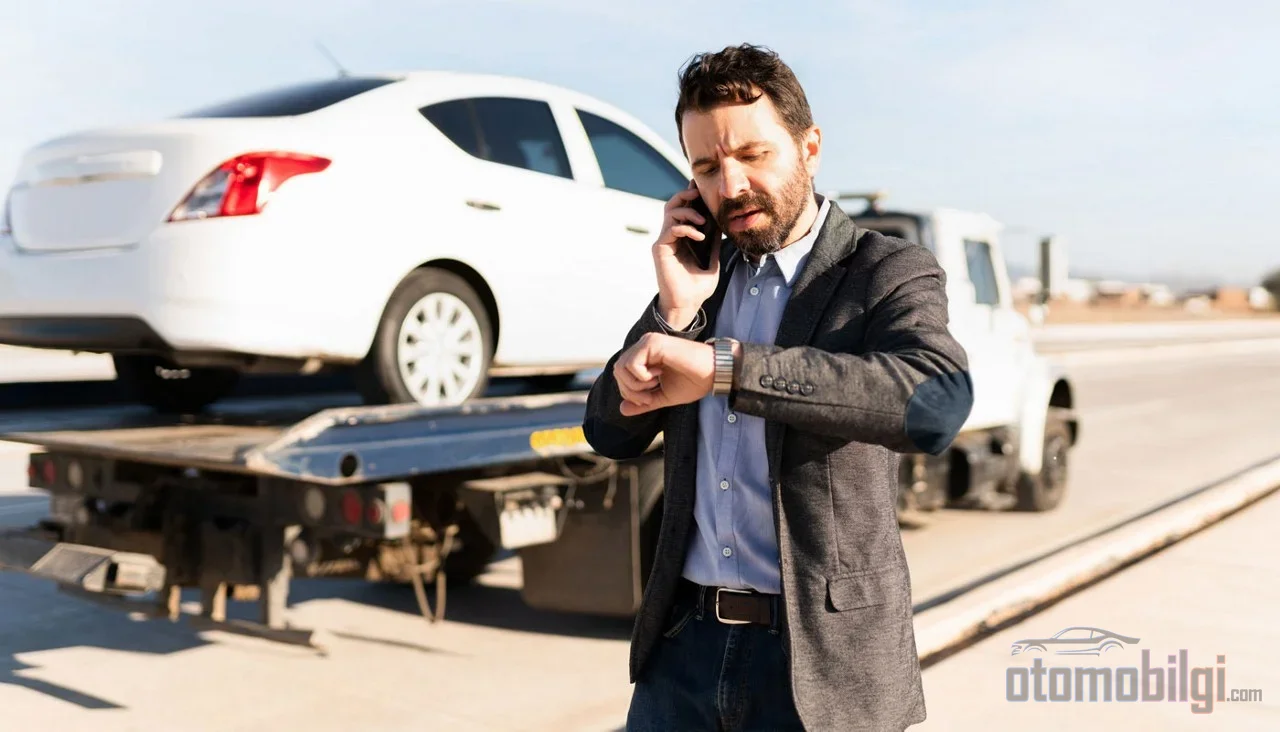
This is the most critical sentence of this article: an electric vehicle is never towed with its wheels touching the ground. The reason is technical and clear. In electric vehicles, the motor is directly connected to the wheels; in a vehicle towed by a flatbed or fixed-bed tow truck, the spinning wheels generate energy in the motor. Regenerative braking kicks in involuntarily and the motor starts producing energy while no cooling or protection procedure is running. The result is very costly, often large-scale motor damage.
The correct method is for all of the vehicle's wheels to be off the ground. This is done in two ways:
- Flatbed (platform) tow truck: The vehicle drives up the ramp and is placed entirely on the platform. This is the most common and safest option.
- Wheel lift kits: If a flatbed truck cannot be found, the vehicle can be transported with auxiliary kits that lift the front or rear wheels off the ground. The principle remains the same: no wheel turns on the road.
When calling the tow truck, clearly tell the operator that the vehicle is electric and request a flatbed vehicle. This rule applies no matter the nature of the breakdown; for an electric vehicle exposed to floodwater, also report the water contact, as this information may change the team's response method. Before transport, check the towing instructions in the vehicle manual and, if available, put the vehicle into tow/service mode; this mode allows the wheels to spin freely and protects the electronic systems during transport.
Before the tow truck arrives: a mobile charging solution may do the job
Not every stranded-on-the-road scenario has to end with a tow truck. A roaming charging service arrives at the scene with generator or battery-based portable systems and gives the vehicle enough energy to reach the nearest charging station. With some services, DC units provide a charge of nearly 20% in a short time, while others offer slower filling via AC. The vehicle is charged on the roadside before being loaded onto the tow truck; this is advantageous in terms of both time and cost. Some brands organize this service with their own authorized service teams; for example, when you call the customer communication center, their mobile charging vehicles may step in.
As a long shot, any point with grid electricity can be a remedy: slow charging from a standard outlet, in the worst-case scenario, gives you enough energy to reach the next station. It is a slow but working plan B.
Comprehensive insurance, warranty, and brand roadside assistance: do you have the right to a free tow truck?
Most electric vehicle owners are unaware of the free roadside assistance rights they hold. You can get support through three separate channels:
- Your comprehensive insurance policy: By calling the roadside assistance line included in your policy or purchased as an additional service, you can request a tow truck or roaming charging. In some insurance companies' comprehensive insurance products designed specifically for electric vehicles, towing to the nearest station with unlimited assistance is possible. The distance covered by the insurance tow truck varies by company and coverage limit; ask about this limit before signing your policy.
- Brand call center: Almost all brands offer 24/7 roadside assistance in Türkiye. Kia provides fault and flatbed towing support via its lines 0850 222 5 542, MG via 0850 522 27 64; Citroën Assistance offers 24/7 service across Türkiye regardless of vehicle age; Volkswagen also provides 24/7 roadside assistance. For faults covered under warranty, this line should be your first call.
- Warranty coverage: If the fault is covered by warranty, towing and transport are usually covered by the brand. That's why making the first call to the authorized service center or the brand's roadside assistance line, rather than your insurer, may lower the cost to you.
As of 2026, comprehensive insurance packages specific to electric vehicles have become standard; roadside assistance packages are offered both independently and as additional coverage to comprehensive/traffic insurance. In some products, coverage for wall-mounted charging units has also been expanded. When choosing comprehensive insurance, be sure to check whether the roadside assistance service is suitable for electric vehicles - that is, whether it provides flatbed towing; otherwise, a standard tow truck call could result in motor damage.
Charging card not working, station faulty, range estimate off: steps to follow
If the card is not read at the station or charging does not start
If the station does not respond when you tap your card, the problem is usually in the reader module or the connection cable. If no error code appears on the screen, you can try switching the station off and back on at its breaker; this simple reset resolves many faults. A flashing red light on the unit indicates an error or protection state; in such a case, do not persist with that station and find the nearest alternative through the app. Keeping the charging operators' support lines saved on your phone is a habit that pays off in these moments.
Why does the range estimate go wrong?
The range estimate in the vehicle is not a promise, but a calculation based on current consumption data. Vehicle weight, high speed, sudden acceleration, use of air conditioning and heating, cold weather, wind, and tire pressure all shorten the range. Especially in cold weather, take into account that consumption increases noticeably when the battery drops below a certain percentage. The practical result is this: no matter what the dashboard says, verify the stations along your route in advance and leave a buffer of around 20% in your charging plan. Knowing that WLTP values reflect laboratory test conditions, and that variables such as load, speed, and air temperature reduce this value in real road conditions, helps you set your expectations correctly.
Common mistakes: that's why I say don't do this list
- Taking range warnings lightly and deciding to push on to one more station. The warning stage starts early by design; being early is always better than being late.
- Setting off without researching stations along the route and relying on a single possibly faulty station without an alternative.
- Aggressive driving with a low charge percentage; sudden acceleration consumes the remaining range much faster than you expect.
- Continuing to drive in the middle of the road despite the warnings. Stopping uncontrolled in traffic is both more dangerous and more costly than pulling over safely.
- Trying to push the vehicle by hand or having it towed improperly. Pushing can damage the motor through the wheels; transportation must always be carried out according to the rules above.
- Repeatedly turning the ignition on and off in a non-working vehicle. This wastes energy that the battery management system is trying to protect.
A small emergency kit kept in the trunk also makes the process easier: a reflective vest, first aid kit, charging cable, flashlight, water, and a power bank. Having roadside assistance and tow truck numbers saved on your phone, and having read the towing procedure in your vehicle's manual in advance, saves seconds when the day comes.
A realistic picture: Electric vehicle experience on long roads in Türkiye
Neither exaggerating nor underestimating the risk of being stranded is correct. Industry data shows that less than 4% of emergency roadside assistance calls are caused by the battery being completely depleted; in other words, a full charge depletion is a rare scenario. On the other hand, experiences shared by owners who drive long distances in Türkiye clearly reveal that the infrastructure still has points needing improvement. For example, in a 1,050 km İzmit–Antep journey described by a vehicle owner, 6 charging stops were needed; it was observed that in cold weather consumption accelerates below a certain charge level, navigation can direct you to a faulty station on a deserted street, and stations are concentrated in locations requiring exiting the highway. The conclusion drawn by the user who had this experience is also meaningful: despite criticizing the infrastructure, he states that he is satisfied with his vehicle and would buy one again.
The view that an internal combustion vehicle is necessary for long journeys is still widespread on forums and social media. The technical fact is more discriminating: electric vehicles do not have a full-value generator; there is only recovery limited to regenerative braking, which does not charge the battery. In other words, the risk is real for the driver who does not plan, and low for the one who does. Since charging station density tends to be concentrated in city centers, marking stations along highway routes in advance should be a standard precaution under conditions in Türkiye.
Conclusion: the right number, the right tow truck, the right mode
The scenario of being stranded in an electric vehicle can be reduced to a predictable and cost-free event with the right information. The summary is this: pull the vehicle over safely, do not turn the ignition on and off in vain; first call your comprehensive insurance assistance or your brand's roadside assistance line; if possible, request mobile charging; if not, ask for a flatbed tow truck and tell the tow truck driver that the vehicle is electric; activate service mode before transport. Never forget the single rule: an electric vehicle is not towed, it is lifted.
Sources
- What Happens If an Electric Vehicle's Charge Runs Out on the Road?
- What Happens If Electric Vehicles' Charge Runs Out on the Road?
- What Happens When an Electric Vehicle's Battery Runs Out and It Gets Stranded?
- What Should You Do If Your Electric Vehicle Gets Stranded?
- Can electric vehicles be towed?
- Safe Towing Practices for Electric Vehicles
- Things to Consider When Using Towing Services for Electric Vehicles
- Electric Vehicle Insurance (Casco)
- Mercedes-Benz Roadside Assistance
- Kia 24/7 Roadside Assistance
- Electric Vehicle Not Charging: The Charging Station Is Not Working
- I Bought an Electric Vehicle: Charging Stations Are Far Too Insufficient on Long Trips