DRS (Drag Reduction System) in F2: What Is It and What Does It Do?
Think of an F2 race in Monaco: there is maybe half a second between you and the car ahead, you enter the straight, you press a button on the steering wheel and the rear wing opens... and yet you still cannot pass. Yes, Formula 2 has DRS, the rules are almost identical to F1's, and still every overtaking attempt ends like a thriller movie. So why does the same wing, the same tracks, the same one-second rule sometimes work and sometimes not? Let's go step by step, because the answer to how DRS works in F2 is more interesting than you think.
Highlights
- In F2, DRS is enabled in races after two laps have been completed; in practice and qualifying it is used freely in the zones.
- DRS zones are the same as F1's on every track; to activate it, you need to be within 1 second of the car ahead at the detection point.
- The flap lifts at most 85 mm; the estimated speed gain varies from track to track, reaching up to about 10-12 km/h.
- F1 is leaving DRS behind in 2026, but in F2 and F3 the system continues in 2027 as well.
What Exactly Does DRS Do, and Why Is It So Important?
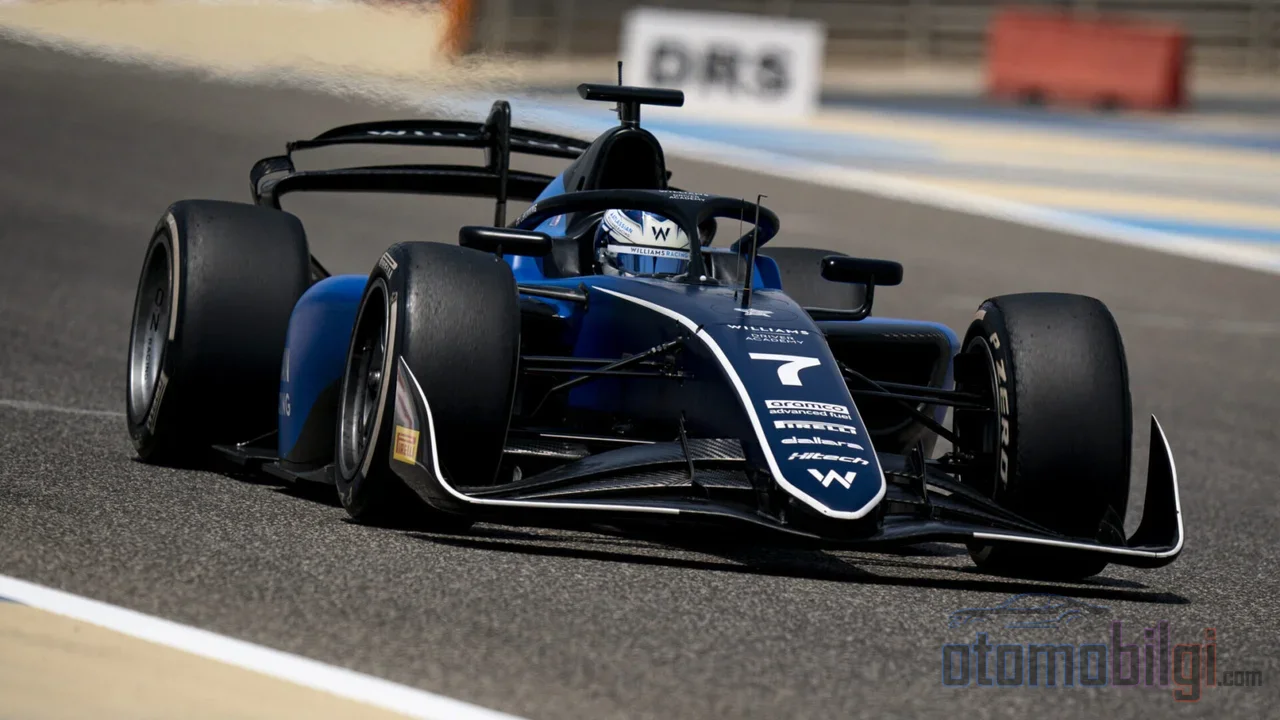
DRS, or the Drag Reduction System, is an adjustable rear wing that opens at the driver's command. When the flap on the rear wing lifts, aerodynamic drag and downforce decrease; the car accelerates to higher speeds on the straight and it becomes easier to close in on the car ahead. The wing flap rises at most 85 mm from the fixed main plane. Think of it this way: imagine you are riding a bicycle with an open umbrella on top of your helmet; when you close the umbrella on the straight, you feel how much easier it gets. DRS closes that virtual umbrella at the back of the car.
So how much is the gain? Estimates vary from track to track: some calculations show a speed increase of 10-12 km/h by the end of the activation zone, while some technical assessments give more modest figures like 4-5 km/h on low-drag tracks (such as Monza). So the length of the zone, the character of the corner immediately after it, and the track's aerodynamic setup seriously affect the result. Fortunately, you don't have to memorize this; the rules in the next section work with the same logic on every track.
DRS Rules in F2: On Which Lap Does It Open, and How Do You Earn It?
Here's the key point: DRS is not an always-open button, it's a privilege. In practice and qualifying sessions, drivers can use it whenever they want in the designated DRS zones; but in the race, the system comes into play after two laps have been completed. The race director can restrict it due to bad weather conditions or yellow flags in the DRS zones.
Throughout the race, this is how it works: there is a detection point on the track. The moment you pass it, if you are within 1 second of the car ahead, you earn the right to open the flap in the next DRS zone. The wing closes automatically at the end of the zone or at the first moment of braking after activation. So DRS is not like free coffee; it's a system you have to constantly track who is in the queue behind you.
What's more, the choice of DRS zones in F2 feels familiar too, because the exact same zones used in F1 are used at every track. So in Monaco, Bahrain or Silverstone, F2 drivers know exactly where the F1 cars were opening their flaps just a week earlier.
The Rhythm of a Race Weekend: DRS in the Sprint and Feature Race
To understand DRS, you need to know how an F2 weekend flows. On Friday there is a 45-minute practice session and a 30-minute qualifying. On Saturday there is the Sprint race (120 km or 45 minutes), and on Sunday, before the F1 race, the Feature Race (170 km or 60 minutes) is run. The Feature Race includes a mandatory pit stop, and drivers must use two different dry tyre compounds.
This is where things get complicated and the crucial detail emerges: The Sprint race grid is determined by reversing the top 10 from qualifying. So the fastest driver in qualifying starts from P10. Why? Because the aim is to test the driver's racing craft and overtaking ability. The fast driver has to catch the slower grid ahead, use DRS at the right moments and move forward. In the Feature Race, the grid is the qualifying result directly.
The points system also sets the two races apart: In the Sprint, points are awarded to the top 8 as 10-8-6-5-4-3-2-1, and in the Feature Race to the top 10 as 25-18-15-12-10-8-6-4-2-1. Two points are awarded for pole position, and one point for the fastest lap inside the top 10 in both races. An example from the 2026 season: Ritomo Miyata won the Madrid Sprint, with Emerson Fittipaldi Jr. second and Laurens van Hoepen third. Noel León, who started at the front in the reversed-grid Sprint, held the lead at Sainte Dévote and brought his race home with a disciplined pace; in other words, even with DRS, starting at the front is an art of its own.
How Is It Different from F1? One Brand, One Chassis, One Chance
F2 is a single-make championship run with 22 identical Dallara-built cars. The chassis introduced in 2024 is powered by a 3.4-litre turbocharged V6 engine prepared by Mecachrome. While an F1 car has around 1,000 hp, power in F2 is around 620 hp; F1 is on average 10-15 mph faster. But the real difference lies not in these figures but in the structure of the competition: since everyone uses the same car, the technological advantage is zero, and the difference lies entirely in the driver's performance.
| Feature | Formula 1 | Formula 2 |
|---|---|---|
| Power | Around 1,000 hp | Around 620 hp |
| Cars | Each team's own design | Identical Dallara chassis for all teams |
| DRS zones on track | Determined per track | The same as the F1 zones |
| DRS delay per race | 1 lap (after the start and restarts) | Two laps |
| DRS in defence | Cannot be used if the car ahead fails the 1-second rule | No DRS for defending |
| System in 2026 | New active aerodynamics | DRS continues |
The DRS delay detail in the table is striking: In F1, since 2024, only a 1-lap wait is required after the start or a safety car restart; in the official F2 rules, however, the wording still refers to use after two laps. It seems small, but after a restart when a queue forms, this single lap determines how early overtaking opportunities begin.
There is also a historical frame: DRS entered the junior tiers of single-seaters during the GP2 era in the 2015 season; it has been used on the F3 side since 2017. So an F2 youngster learning DRS before F1 is not a new situation at all. In fact, since 2017, 21 drivers have moved from F2 to F1; Charles Leclerc, Lando Norris, George Russell, Oscar Piastri, Yuki Tsunoda, and Alexander Albon all came down this path. DRS is one of the shared languages of this ladder.
The Dirty Air Reality: Why Doesn't DRS Guarantee an Overtake?
Now we get to the heart of the question. Why can't DRS still solve every overtake? The first half of the answer is dirty air, meaning the turbulent flow left behind by the car in front. In high-downforce categories, the front wing of the following car works far less efficiently in this disturbed air; cornering grip drops - you get closer, but you lose speed at corner exit. DRS was designed precisely against this problem, but to be honest, DRS was never a solution for dirty air - it was merely a patch that eased the outcome on the straights.
A comparison is useful: In low-downforce categories like NASCAR, the following car gains an advantage through drafting; it does not lose cornering performance because of the car ahead. In F2, however, DRS does two jobs at once: cutting drag and serving as the overtaking tool. F1 chose to continue by splitting these two jobs into two separate systems in 2026 and bid farewell to DRS. Its first user was Jenson Button, and its last was Andrea Kimi Antonelli; the first DRS-assisted overtake was made by Fernando Alonso, and the last by Lance Stroll. In F2 and F3, however, DRS lives on.
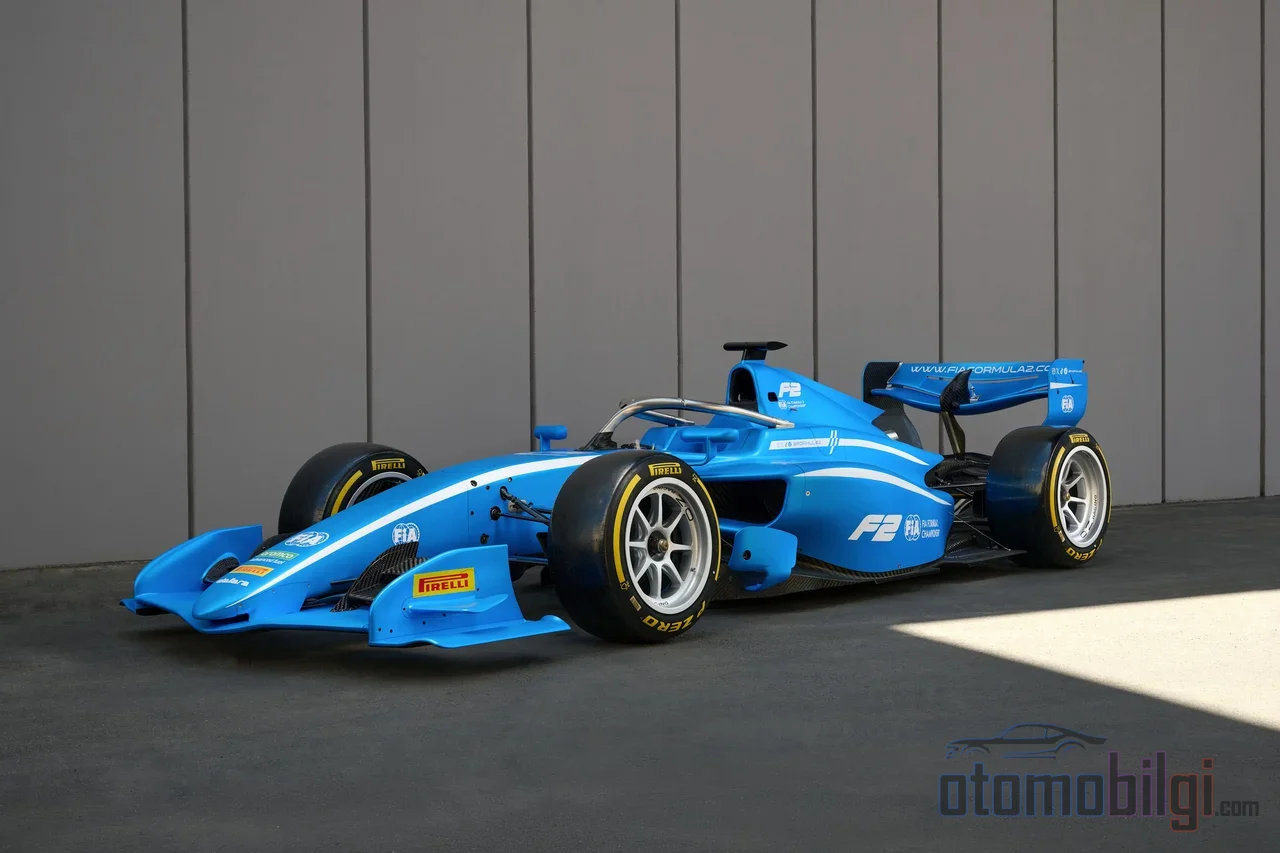
So why didn't F2 give it up? Partly cost and simplicity, partly training value: DRS is retained in the 2027-2029 era car introduced in September 2026. The chassis continues as the 2026 Dallara (cost control), the front and rear wings are being redesigned, and the aim of the revised aerodynamics is to bring the car as close to F1 as possible. A push-to-start system operable from inside the car is also being added. So when F2 youngsters step up to F1, they will already have learned how to use the same button on the straights.
The Train of Identical Cars: Three Factors That Make Overtaking Hard
We can summarize why overtaking in F2 remains frustratingly difficult despite DRS under three headings:
- Identical cars, identical speeds: Since everyone uses the same chassis and engine, lap times are very close; the car ahead doesn't have the same DRS advantage but sits at the same performance ceiling. The result: you close in on the straight, then realign in the braking zone. The series itself prides itself on this closeness; exactly half of the 122 drivers who raced up to 2026 have won at least one F2 race.
- The DRS train risk: When several cars form a queue, they can all open their flap at once; as everyone speeds up, the order barely changes and the train carries from one straight to the next.
- Dirty air persists in the corners: The moment the flap closes, you are once again in the turbulence of the car ahead; the loss of cornering performance can wipe out the top speed DRS granted.
It is also true that air towing, i.e. the slipstream, works on the straights. Behind the car ahead you gain from reduced drag, and you can close in even without the flap being enabled in the zone; but this effect becomes pronounced in low-drag configurations and on long straights. On tracks like Monza this combination opens the door for overtaking, while in tight, slow-flowing places the door hardly ever appears.
So Let's Give the Answer: Does DRS Deliver Overtakes in F2?
Let's give a clear answer to the opening question: In F2, DRS is a straight-line tool that becomes available after two completed laps, for pilots within one second of the car ahead at the detection point, used in the same zones as F1; it cuts drag and increases top speed, but it never guarantees an overtake, because dirty air keeps causing downforce loss in the corners, all the cars are identical so speeds remain very close, and there is no DRS entitlement when defending.
And in my view, that is exactly why it is so enjoyable to watch. Passing is not a button-pressing test; it is the chess of young drivers who calculate how many tenths to cross the detection point with, who manage their tyres with 5 sets of dry compounds (3 prime, 2 option) and 3 sets of wets over the weekend, and who try to take out the slow players ahead on the reversed grid. DRS is the strongest piece in this game, but not the only one. Do you think the new wings on the 2027 car will upset this balance, or will that fierce closeness, my favorite feature of F2, continue just the same? See you in the comments.
Sources
- The Rules and Regulations - Formula 2
- F2 car and engine - Formula 2
- Drag reduction system - Wikipedia
- The beginner's guide to Formula 2
- FIA Formula 2 unveils its new car for the 2027-2029 seasons - FIA
- Revised aerodynamics to get 2027 F2 car "as close to F1 as possible" - Formula Scout
- F1 vs F2: what's the difference? - Red Bull
- What Is Dirty Air in F1? - Formula Dream
- 2026 Formula 2 Championship - Wikipedia