What Is the Speed Difference Between F2 and F3 Cars?
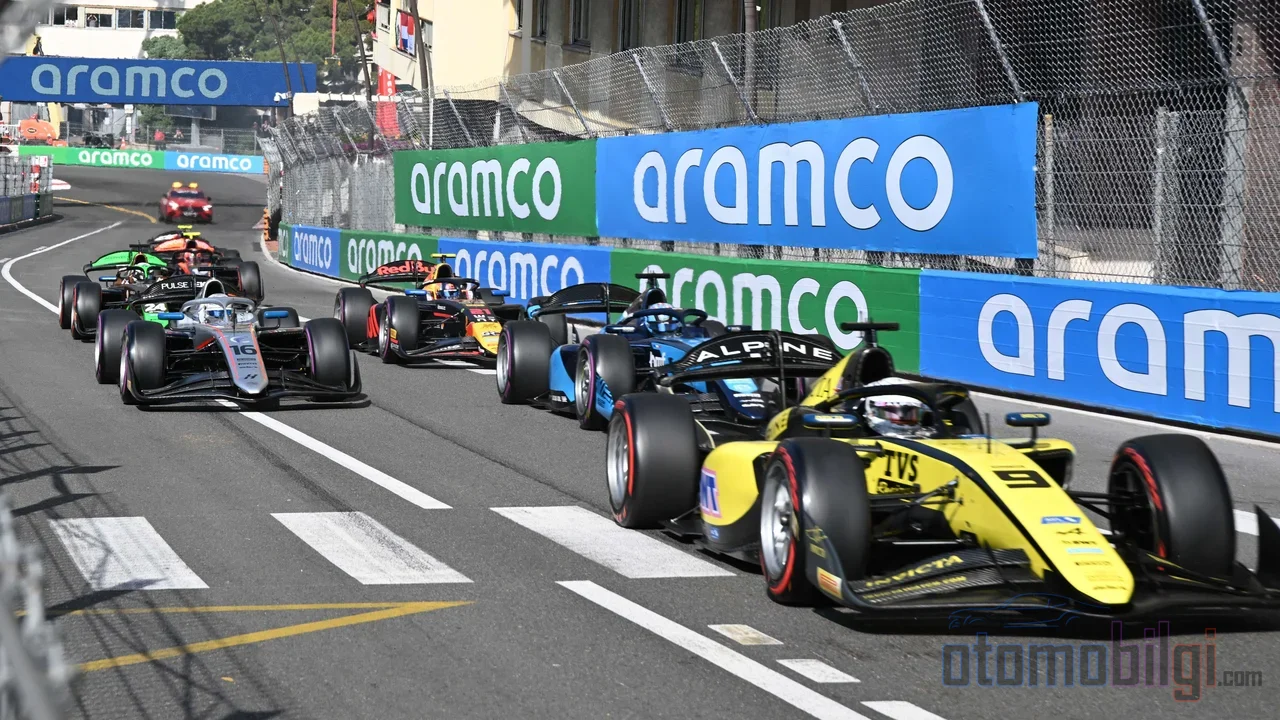
The two rungs directly below Formula 1, Formula 2 and Formula 3, look almost like twins from the outside: both use a Dallara chassis, Pirelli tires and a Mecachrome engine. But when you look closely at the grid, the picture changes. Most fans are surprised to learn that the two cars carry the same 3.4-liter V6 block; so why is the F2 car seconds faster per lap than F3? The difference here lies in technical details that don't look big on paper but feel enormous on track.
On this page, we'll put the two cars side by side and break down all the measurable differences one by one, from engine power to weight, from aerodynamics to tire size. In the end, we'll compare the two on the same track using real lap times from Barcelona. If you're ready, let's begin, because the numbers really do speak.
Technical Comparison of F2 and F3 Cars
First, let's clarify the table. Both series are single-supplier (spec) championships: meaning every team racing on track competes with the same car. In the 2026 season, F2 teams use the Dallara F2 2024 chassis, while F3 teams use the Dallara F3 2025 chassis. This means the difference between the cars comes entirely from the series' design philosophy.
| Feature | Formula 2 | Formula 3 |
|---|---|---|
| Engine | Mecachrome 3.4 L V6, turbocharged | Mecachrome 3.4 L V6, naturally aspirated |
| Power | 620 HP @ 8750 rpm | 380 HP @ 8000 rpm |
| Maximum torque | 570 Nm @ 6000 rpm | Not disclosed by the manufacturer |
| 0-100 km/h | 2.90 seconds | Not disclosed by the manufacturer |
| Maximum speed | 335 km/h (Monza + DRS) | Approximately 300 km/h |
| Minimum weight | 795 kg (including driver) | 722 kg (without fuel) |
| Transmission | 6-speed Hewland sequential, paddle shift | Sequential gearbox |
| Wheels | 18-inch O.Z. Racing magnesium | 16-inch Pirelli (from 2025 onwards) |
| Chassis | Dallara F2 2024, titanium Halo | Dallara F3 2025, Halo |
What immediately stands out in the table is the power difference: 620 HP versus 380 HP, meaning the F2 car's engine is roughly 240 horsepower more powerful than F3's. The reason such different power comes from the same displacement is simple: the F2 engine is turbocharged, while the F3 engine is a naturally aspirated unit. The F3 car's torque figure and 0-100 km/h acceleration time are not officially disclosed data; so instead of making guesses, we honestly leave them blank.
Highlights
- The F2 car produces 620 HP, the F3 car 380 HP; the difference is roughly 240 horsepower.
- F2 completes 0-100 km/h in 2.90 seconds.
- At Barcelona 2024, the fastest lap difference between F2 and F3 was approximately 3.7 seconds.
- F2 has a minimum weight of 795 kg (including driver), F3 722 kg (without fuel).
- Both series use a Dallara chassis, Mecachrome engine and Pirelli tires.
Engine: Same Block, Different Character
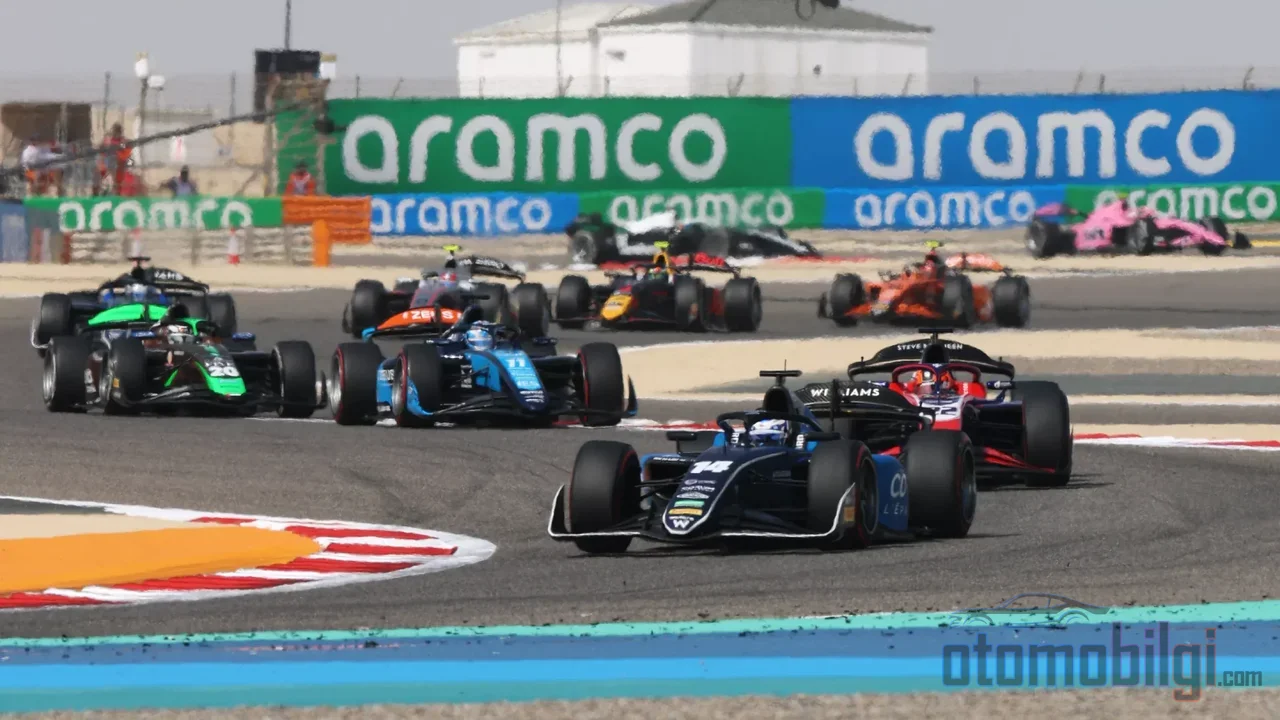
The heart of both engines is the same: Mecachrome's 3.4-liter V6. The French manufacturer distributes the engines randomly, and both are designed to last 14 events, i.e. 28 races; they are refreshed after 8000 km. So the luck factor has been minimized - the entire grid uses the same machine.
The difference lies in the presence of the turbocharger. While F2's forced-induction engine produces 620 HP at 8750 rpm and 570 Nm of torque at 6000 rpm, F3's naturally aspirated engine stays at 380 HP at 8000 rpm. The F2 engine uses a fly-by-wire throttle system; F3 has the same system as well. An interesting detail: The F2 car contains no hybrid component - all the power comes purely from the internal combustion engine.
On the performance side, F2's figures are dizzying: 0-100 km/h in 2.90 seconds, 0-200 km/h in just 6.60 seconds. Maximum speed reaches 335 km/h at Monza with the low-downforce setup and DRS open. On the F3 side, maximum speed is around 300 km/h. In F2, braking generates -3.5 G instantly, and lateral forces of up to 3.9 G are experienced in corners; these are values the human body has to take seriously.
Weight, Aerodynamics and Tire Differences
Is lightness always an advantage?
A surprising detail: The F3 car is actually lighter. Its minimum weight is 722 kg without fuel; F2, meanwhile, is 795 kg including the driver. So while F3 may seem to hold an ace in terms of power-to-weight ratio, the 240-horsepower difference easily wipes out this advantage. The result: Despite being heavier, the F2 car is clearly faster on track.
The downforce difference is a deliberate choice
The story is similar in aerodynamics. F3's new-generation car was designed with cockpit dimensions identical to F2's, from the pedals to the steering wheel; the aim is an aerodynamic package resembling F2's but simpler, more layered and less complex. F3 cars produce less downforce than F2, and this is a deliberate engineering decision. In F2's aero design, simplicity and minimalism are also the priority; downforce provides cornering assistance but does not approach F1 levels. In terms of size, the F2 car is 5285 mm long and 1900 mm wide; F1 cars are more than 200 mm longer than F2, and more than 500 mm longer than F3.
Tires and DRS
On the tire front, the two series follow different approaches. F2 uses series-specific Pirelli tires on 18-inch O.Z. Racing magnesium wheels; 12 inches wide at the front, 13.7 inches at the rear. F3 raced on 13-inch wheels for a long time, and from 2025 switched to 16-inch Pirelli tires. F2 has four dry compounds, and two of them (Prime and Option) are brought to each event; both compounds must be used in the feature race, and there are no tire warming blankets. Since F3 races are shorter, they are run on a single compound. Neither series has intermediate tires; in the rain, blue-banded wet tires are used. DRS operates in both series with the same logic as in F1; in F2, it is hydraulically actuated.
The Real Difference on Track: What Do Lap Times Say?
The numbers on paper are nice, but the real question is: how many seconds do all these differences translate to on track? In 2024, the fastest laps of the three series at the Barcelona-Catalunya circuit give a clear answer to this question. On the same circuit, the F1 car was the fastest with 1:11.383; The F2 car posted a lap time of 1:24.766, while the F3 car managed 1:28.463.
So at the Barcelona benchmark, the gap between F2 and F3 is roughly 3.7 seconds. 3.7 seconds a lap is a world of a difference in motorsport terms; over a race distance, that gap means tens of positions. F2 cars are about 18 percent slower than F1; and F3 sits at a similar deficit behind F2. Of course, this gap varies from track to track: on layouts where downforce is critical, F2's advantage grows, while on tracks with long straights the power difference is felt more strongly.
What Do Drivers Experience Moving from F3 to F2?
The numbers tell one story, those behind the wheel another. Victor Martins, one of the names who has lived through this transition, says that stepping up from F3 to F2, the car inevitably feels bigger, wider and heavier; in his view, the real leap is not in power but in the car's overall character. In F3, drivers can adjust the car from the steering wheel just as in F1 and F2, so the adaptation infrastructure is already in place.
The philosophy of both series reflects this difference too. F3 is the step where a young driver proves they belong in single-seaters and learns speed. F2 is the final rehearsal before the summit: 620 horsepower, DRS, race strategy and tyre degradation management all come into play here. F3 teaches speed, while F2 tests the ability to manage performance close to F1.
In Short, How Big Is the Speed Gap Between F2 and F3?
Briefly and clearly: With its turbocharged 620 HP engine, the F2 car is about 240 horsepower more powerful than F3's naturally aspirated 380 HP engine; yet F3 is lighter. Using the Barcelona 2024 benchmark, this gap translates to roughly 3.7 seconds per lap on track (F2 1:24.766, F3 1:28.463). In top speed, F2 reaches 335 km/h while F3 stays at around 300 km/h. Let's take a quick look at the remaining questions too.
Do F2 and F3 use the same car?
No. Both use Mecachrome's 3.4-litre V6 engine and a Dallara chassis, but while F2's engine is turbocharged and produces 620 HP, F3's engine is naturally aspirated and stays at 380 HP. The chassis, wheels and race formats are also different.
Why does the F2 car produce 620 HP from 3.4 litres while F1 reaches 1000 BHP from 1.6 litres?
F1's power unit is a turbo-hybrid system: alongside the internal combustion engine, electrical power is also in play. In 2026, the MGU-H will be removed, the MGU-K's weight will increase, and electrical power will triple. F2's engine, on the other hand, is a pure internal combustion unit with no hybrid components; that's why less power comes out of the same displacement.
Are new cars on the way?
Yes. The FIA has unveiled the new F2 car for the 2027-2029 seasons; the car retains the 2024 specifications for braking performance, steering effort and cockpit ergonomics. Formula 3's new-generation car was unveiled at Monza and is powered by a 3.4-litre naturally aspirated Mecachrome engine. Mecachrome has renewed its partnership with F3, and Aramco supplies the fuel for both series.
The short version of the summary: A driver moving up from F3 to F2 faces a more powerful, heavier and aerodynamically more capable machine; on track, this translates to a jump of roughly 3.7 seconds per lap. The distance between the rungs of the F1 ladder is measured precisely by these figures.
Sources
- F2 car and engine (FIA Formula 2 official)
- F3 car and engine (FIA Formula 3 official)
- F1 vs F2 vs F3 - how do the FIA single-seater championships compare?
- 2025 Formula 3 Technical Regulations (FIA)
- F3 Explained: How the new car is closer to F2 than ever
- FIA Formula 2 unveils its new car for the 2027-2029 seasons
- FIA Formula 3 next generation car unveiled in Monza
- Victor Martins on the differences between F2 and F1
- Formula 2 vs Formula 3: what's the difference?