Why Is Slipstream a Double-Edged Sword in F3?
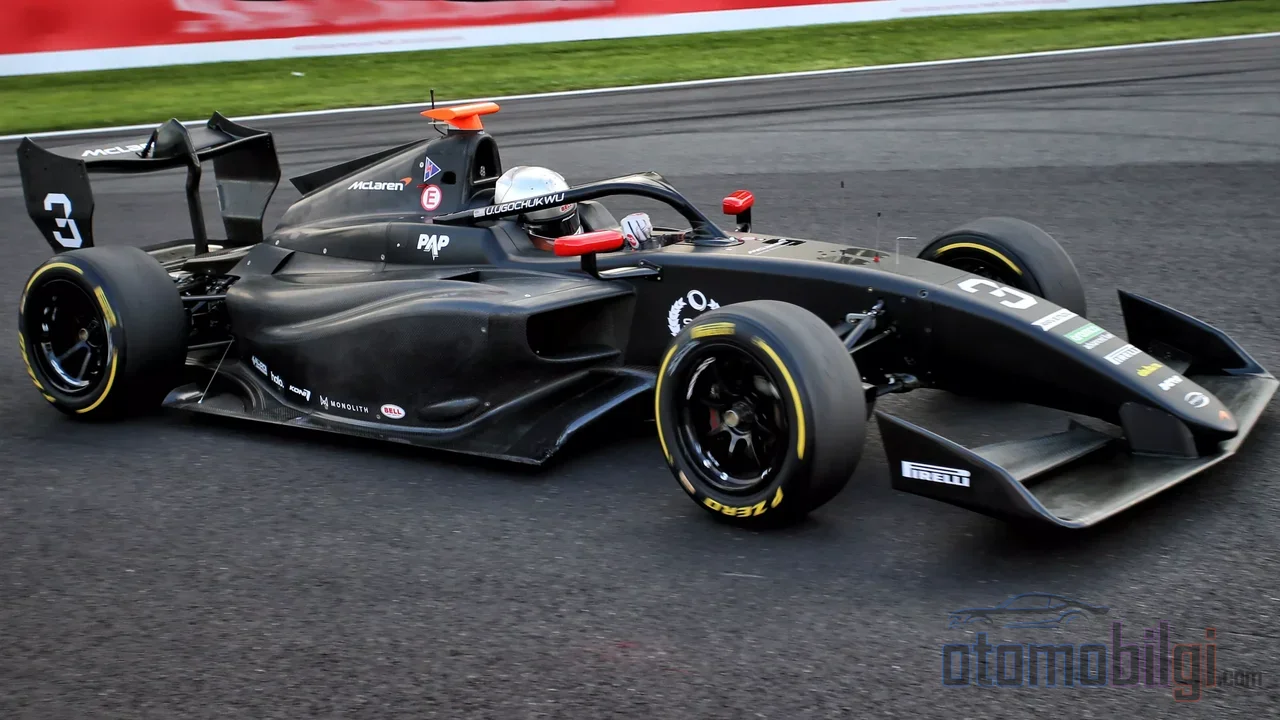
Just think about it: There's a grid of 30-40 cars in F3, they come out of the final corner side by side, and on the main straight you're glued behind the car ahead. It's as if an invisible hand is pushing you forward, the speedometer climbs, and the pass becomes decisive right at the braking point. Then the moment you enter the corner, everything flips: the steering is the same but the car feels like it's skating on soap. Same air, same distance, same car; your greatest friend one second, your greatest enemy the next. So why is the slipstream in F3 such a sharply double-edged weapon? The answer lies in the car's character, and I promise you, once you've read this page, you'll watch crowded F3 races with completely different eyes.
Slipstream and Dirty Air: Two Faces of the Same Physical Reality
Let's first get down to the basics, because many people confuse the two. As the car ahead generates downforce, it leaves behind a low-pressure zone. If you're close enough, you're practically pulled into this zone: you spend less effort overcoming air resistance and go faster on the straights. This is what's called slipstream, or simply tow.
Dirty air, on the other hand, shows itself in the corners. The turbulent, low-total-pressure air left behind by the car ahead reduces your car's aerodynamic efficiency. So we're talking about two faces of the same phenomenon: an advantage on the straight, a penalty in the corner. And the most interesting part is this: a car can gain a drag advantage on the straight even while in dirty air. The two effects work at the same time, at the same distance; one pulls you forward, the other drags you down in the corners.
What Do the Numbers Say? Gain and Loss at Following Distance
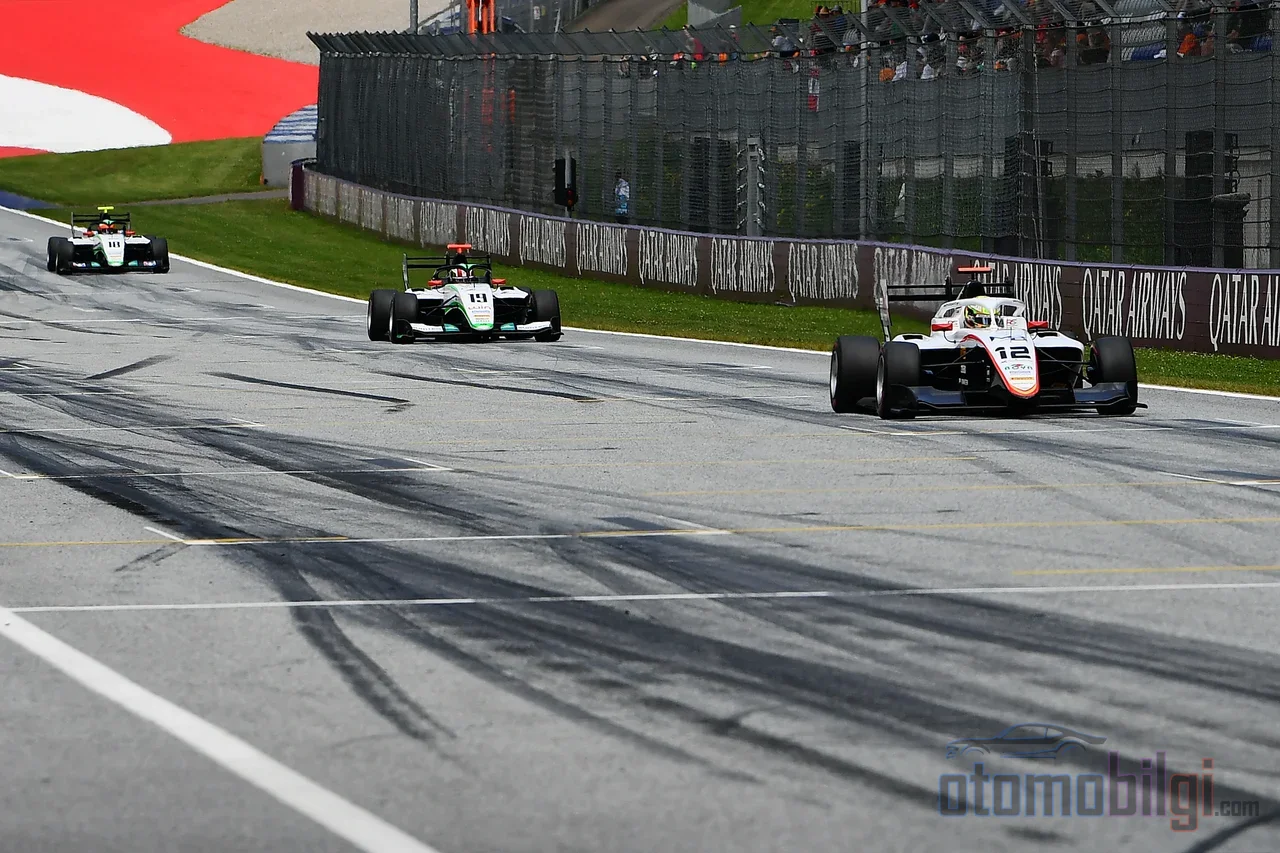
To make this concrete, let's look at data from a general aerodynamic model developed for formula cars at a speed of 200 km/h. These figures are not direct measurements from the F3 car; but they clearly show how gain and loss alternate as the following distance changes.
| Distance (car lengths) | Power required on the straight (hp) | Downforce in the corner (kg) |
|---|---|---|
| 0.25 | 45 | 260 |
| 0.5 | 54 | 310 |
| 1 | 68 | 390 |
| 2 | 90 | 520 |
| Free stream | 118 | 680 |
What catches your attention? At full following distance, meaning a gap of roughly a quarter of a car length, the power needed to overcome drag is about 62% lower compared to free stream. That sounds amazing, doesn't it? But on the other side of the same picture, downforce also drops by about 62%. A car that loses its aerodynamic grip realizes in the corner that it's as if 400 kilos of sand have been loaded into it: effective weight is 1.85 times in free stream while dropping to as low as 1.33 at full tow. So it's not the load the tires have to press, it's the aerodynamic force pressing on them that melts away.
Key Takeaways
- At a quarter car length tow, the power required on the straight decreases by about 62%, but downforce in the corner also drops by about 62%.
- The invisible cost of dirty air can be bigger than the downforce loss: cooling loss.
- The F3 car was designed with aerodynamics that make overtaking easier; its purpose is close and competitive racing.
- The slipstream advantage varies depending on the character of the track: impressive on one track, nearly useless on another.
The Hidden Costs of Dirty Air: Balance, Cooling, Tires
What happens when aero balance collapses?
The first part to feel the disturbed airflow is the front wing. When front downforce drops, the car's aerodynamic balance is upset, and when the driver cannot find the balance they were used to in the setup, they have to ease off the brakes earlier. In other words, dirty air not only reduces cornering speed, it also moves braking points earlier; and the moment you want to make an overtaking move is actually your most vulnerable moment.
The biggest problem may not be downforce
Here is the lesser-known side of the story: aerodynamics experts say that the real cost of dirty air is often not downforce loss but cooling loss. When enough air cannot reach the radiators and brake ducts, the systems overheat, and the driver has to lift off the throttle to protect the machinery. Having to think about engine or brake temperatures in the middle of a close-combat battle is a scenario no racer wants.
Add tire degradation on top of that: the increased sliding in corners raises tire temperature and wear. Loss of front downforce leads to understeer, while weakening rear grip causes stability problems. Even in a short F3 sprint race, this cycle can mean ending your own race by following too closely at the wrong distance.
Why F3 in Particular? Low Power, High Dependency, Easy Passing
Now let's come to the real question: why do these dynamics work differently in F3? The clue lies in a contradiction. Since drag force grows with the square of speed, the slipstream advantage theoretically shrinks in slower cars; F2's more powerful, faster cars catch a physically larger tow advantage on the straights. On the F3 side, drivers report that at Silverstone the slipstream was more effective than expected but equally challenging. Why? Because in F3, passing depends entirely on this assistance: when engine power combines with DRS, as drivers put it in Melbourne, genuinely fun races emerge. In fact, even though Melbourne has four DRS zones, the fact that there are only two detection points pushes drivers to the limit in the first sector; in other words, the rules deliberately encourage close following.
Counterexamples only prove the point: Christian Lundgaard was surprised that with the Dallara F3 2019 at Macau, DRS barely worked on exit; Callum Ilott could not regain his position even though DRS was open. Same car, same system, completely different result. The slipstream and DRS advantage depend so much on the character of the track that the combination that works here evaporates there.
The F3 car itself is part of this design. In the series' own description, the design philosophy is defined as simplification but imitating Formula 1; there is an aerodynamic package inspired by F1, with an aggressive look. Among the design criteria of the 2019 F3 car is the optimization of aerodynamics to make passing easier and encourage overtaking. In other words, F3 experiences close racing not as an accident but as a design goal. Since single-seaters that rely heavily on aerodynamic grip are more sensitive to dirty air, in aero-dependent formulas like F3 the penalty of following in corners grows; on the other hand, the tow on the straights becomes a lifeline that compensates for the low power. Precisely for this reason, races with three or four cars in close proximity have become F3's signature: passing is easy but staying ahead is hard, because everyone is using the same weapon.
Front wing risk: the physical price of proximity
This kind of close racing also has a monetary cost: front wing contact. tenths you can gain in one lap mean a few positions on the grid. You get close to take the tow, and at that moment a microscopic contact ends your race. The penalty of the slipstream is not only aerodynamic; the wing itself is on the table.
Tow in Qualifying: Strategy or Rule?
In qualifying, the slipstream becomes a more deliberate game than in the race. The common practice is this: one driver, usually a teammate, deliberately drives ahead to provide a tow on the straights to the car behind. This is the most practical way to compensate for low power; tenths of a second you can gain in one lap mean several rows on the grid.
So where do the rules draw the line for this team play? Let's be honest here: The known provisions in F3's official sporting regulations for the 2026 season concern the race format; the championship features a maximum of 10 and a minimum of 6 race events, and each event includes a Sprint race and a Feature race. Pole position in the Feature race is worth two championship points, while in the Sprint the top 10 score points. As for a detailed official rule text on tow usage, it is not yet clearly available to the public. Examples from the sim racing world give an idea: in some championships forming a train in qualifying and blocking the road is banned, while a randomly caught slipstream is accepted. Although on the real F3 side the balance seems to rest largely on sportsmanship and team practice, it would not be right to make a definitive claim on this matter based on a rule text.
Where Does the Distinction Between F2 and F3 Begin?
F2, traveling at higher speed, offers a greater straight-line tow advantage as a matter of physics. In F3, the same physics works twice over in different ways: first, because of the low power, the slipstream is always more valuable, since the gap on the road can only be closed this way; second, the aero-dependent character simultaneously magnifies the dirty air penalty in the corners. The F2 driver uses the tow as an advantage; the F3 driver, on the other hand, learns to live with it. On one hand the acceleration advantage on the straights, on the other the loss of downforce in the corners, the shifting braking point, cooling concerns and the front wing risk. That is why the answer is clear: In F3, the slipstream is a double-edged sword, because low power turns it into a one-move overtaking tool, while high aero dependency turns it against its owner in every corner. And it is precisely this tension that makes F3 races worth watching.
Closing: Same Air, Two Faces
Next time you watch an F3 race, watch this: the distance between the cars entering the straight. It is not the gap that opens on the main straight, but the distance that closes again a second before the corner that tells the real story. The car ahead enters the corner with clean air and full downforce; the car behind has found its speed thanks to the tow but has sacrificed part of its grip. The braking point, the overtaking move, the defensive line: all of it is shaped within this one-second trade-off. F3's crowded, fiercely contested races are no coincidence; they are the meeting point of low power, an aero-dependent car, and a design philosophy that tries to make overtaking easier. The good news is that a driver who knows how to use this weapon correctly gets another chance on every straight. The bad news is that everyone has the same weapon. But that is exactly the beautiful side of racing, isn't it?
Sources
- Slipstream and dirty air explained - Racecar Engineering
- What's the difference between slipstream and dirty air? - RaceTeq
- F3 Explained: F1-inspired aerodynamics - FIA Formula 3
- The beginner's guide to Formula 3 - Formula1.com
- F3: Silverstone slipstream more effective than anticipated - Formula Scout
- F3 stars praise super powerful DRS in Melbourne - Formula Scout
- Lundgaard surprised by DRS ineffectiveness after Macau - Formula Scout
- What Is a Tow in F1? Slipstream Explained - FormulaDream
- 2026 FIA Formula 3 Championship Sporting Regulations - FIA