What Makes F2 and F3 So Challenging in the Rain?
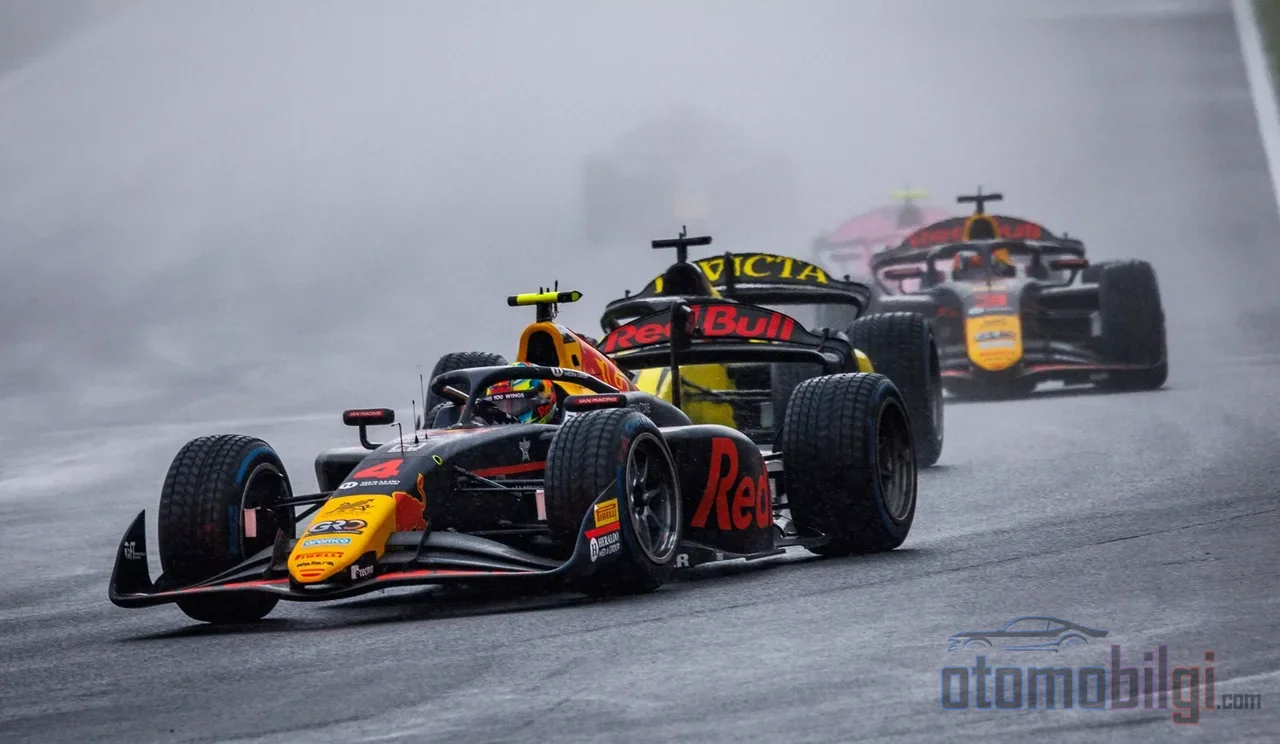
Spa-Francorchamps, 2025. One section of the track is soaking wet, the other end nearly dry. The F2 field is waiting for the rain to stop, for the tires to cool down, for the spray fog to disperse. One car slides like a rally car, another is searching for the dry line. The massive visibility blackout that comes to mind when rain is mentioned in F1 is a bit milder here - but what makes F2 and F3 so difficult in the rain is not just the spray. So why is a wet track really so hard in the series these young drivers compete in? The answer lies in the combination of four things: the downforce dilemma, a single wet tire, visibility, and inexperience.
The Downforce Dilemma on a Wet Track: The Nightmare That Keeps Teams Up at Night
First, a simple analogy: Downforce is pressing the car into the air with its wings - much like sticking your hand out the window of a fast-moving car and pushing your palm down. On a dry track, this force keeps the car glued to the ground through the corners. In the wet, the situation changes: Grip is already low, the tires are cold, and the extra downforce needed to press the car to the ground is of vital importance.
The problem is this: On long straights like those at Spa, teams choose low-downforce, thin wing setups for straight-line speed. If rain arrives, this setup should be exactly the opposite - but the specifications are fixed in advance. If the weather forecast doesn't hold, a car prepared for dry conditions is doomed to slide on a wet track. For F2 teams, this choice is a gamble replayed every time under unpredictable weather conditions. Storing heat in the tires is already hard in cold and wet conditions, and the wrong wing angle compounds the problem.
Spray and Visibility: What Separates F1 from F2 and F3?
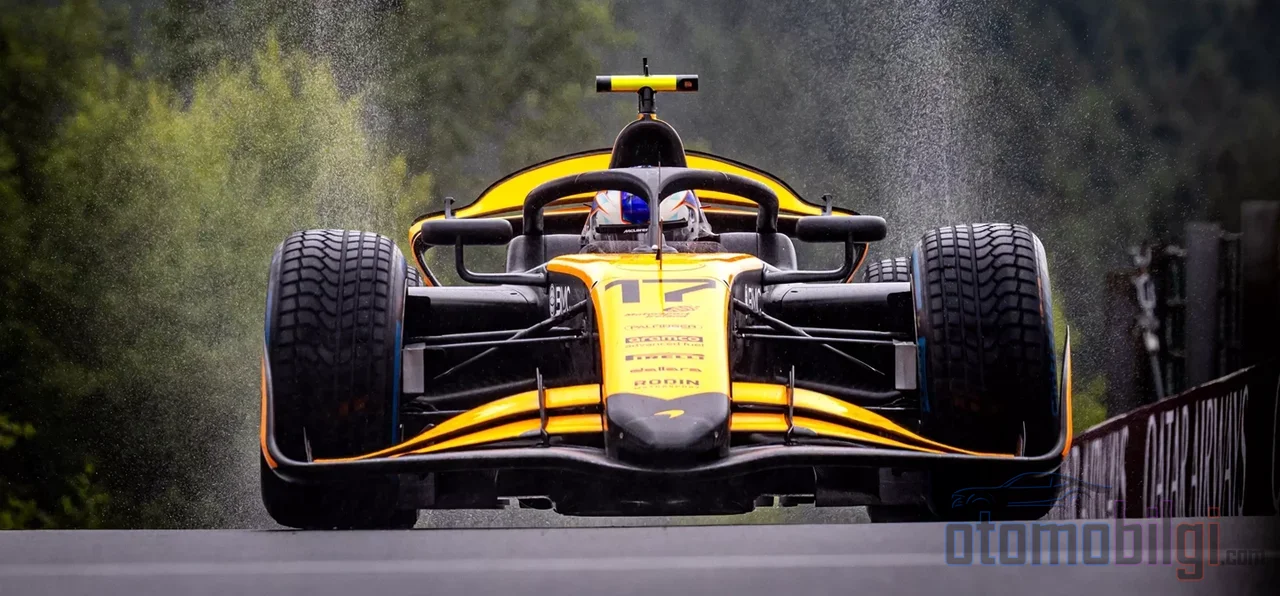
F1's biggest headache in wet races is not grip, it's visibility. Ground effect aerodynamics, with water sprayed from the floor and diffuser, creates a gray fog, and the following driver cannot see the car ahead. There are plenty of names saying that seeing nothing while exiting Eau Rouge at over 300 km/h is not driving, but a blind game of chance.
F2 and F3 cars do not experience this problem as dramatically as F1 - because their ground effect levels are different, the amount of water thrown up is also lower. But that doesn't mean it's "easy": The youngsters still struggle with visibility, especially behind the safety car and at race starts. The wheel covers the FIA tried after the 2023 British Grand Prix aimed to halve the water spray but did not create a measurable difference in visibility; because most of the water comes not from the wheels, but from under the floor and is launched by the diffuser. Covering the diffuser, however, affects the car's aerodynamic performance so much that this path is practically closed. The weakened Venturi tunnels in the 2026 F1 rules could reduce the water spray; but since the cars will still generate significant downforce, the problem does not disappear entirely.
What Do the Halo and Aeroscreen Do in the Rain?
The Halo is mandatory in all single-seater series from F1 to F4 and is proven equipment in terms of safety. Still, getting used to the frame in front of you and possible fogging in the rain is part of a driver's job. On the Aeroscreen side, the picture is more complicated: The aeroscreen in IndyCar received mixed reactions from drivers in the rain, with visibility lines being the main complaint. It had also been noted that in the Aeroscreen Red Bull tested at Sochi, the screen was perceived by the driver as an obstacle that had to be overcome. While the halo is standard in F2 and F3, no visibility problem caused by a screen is experienced - the remaining trouble is the spray itself.
Highlights
- In F2 and F3 there is a single wet tire compound for wet surfaces; it is not the same as F1's intermediate and full wet.
- Most of the water is thrown up by the floor and diffuser; wheel mudguards did not solve the problem.
- In F2, tire blankets are banned: warming up the tires is the driver's job.
- Pirelli has extended its F2 and F3 supply until 2027.
- The rain performance of the new F3 car introduced in 2025 is still not fully known; the Australia, Silverstone and Spa races passed with safety cars and red flags.
The Single Wet Tire: Pirelli's Tough Job
Here is one of the things that challenges F2 and F3 the most in the wet. In F1 there is an intermediate for light wet conditions and a full wet compound for heavy rain. In F2 and F3, however, there is a single wet tire for every condition. So this tire has to withstand everything from light moisture to a flood - like wearing sunglasses in both the desert and the poles.
Drivers describe the cost of this situation: The wet tires seem to be made for genuinely very waterlogged conditions; they degrade very quickly when the track is not wet enough. Alex Dunne says that from the third lap of the Silverstone feature race he felt as if he were driving a rally car, having to correct direction in every corner. At Spa, when the rear tires gave way he was thrown between understeer and oversteer, and he had a race in which he spent the first half of the first stint almost without touching the steering wheel. In the same race, a third of the track was wet while the other section was drying; when the rain stopped, keeping the tires alive became a huge problem, and when the rain returned the entire pit lane filled up for fresh wet tires.
Ritomo Miyata, who came to F2 from the Super Formula championship, emphasizes that tire management in the wet is very critical. On the F3 side, Noah Stromsted also points to the same point: there is more grip compared to F4 and FRECA, but in return the tires need to be managed much more. His teammate Charlie Wurz's summary is striking: More downforce means more spray; while flooring the throttle is possible in the small junior series, here you have to drive smarter.
How Does the Rule Book Change in the Wet?
F2 rules contain special provisions for wet conditions. There is a mandatory pit stop in the feature race and all four tires must be changed - however, if the driver has raced on wet tires, the obligation to use the dry compound set is lifted. In wet conditions, a rolling start behind the safety car is also among the options. The 2024 Spa sprint race, meanwhile, was shortened due to rain and the start was delayed for hours; the drivers then said that safety comes before everything else.
Then there's also tyre temperature: Tyre blankets are banned in F2. So warming up and getting the tyres working is entirely the driver's responsibility. A task that's hard even in the dry becomes especially tough in the wet.
Why Do the Youngsters Both Shine and Struggle in the Wet?
Here comes the dramatic part of the story. F2 and F3 are the stage for drivers at the start of their careers, and these drivers are under pressure to prove themselves every single lap for an F1 seat. A wet track tests this pressure in its harshest form: on one side, the chance to stand out by taking risks in qualifying, on the other, a weekend ended by a small mistake.
The 2025 Spa F3 race was started behind the safety car due to spray and visibility problems, and was ended early under a red flag because of what happened on the formation lap and at the start. The rain performance of F3's new car, introduced in 2025, is still a complete mystery; the opening feature race in Australia was shortened by rain, and Silverstone ended with red flags. So the youngsters are being tested in the wet before they even get to know the car. In the same weekends, names like Dunne, finishing second at Silverstone and crossing the line first at Spa (despite later receiving a technical penalty), showed the opportunistic face of wet conditions.
The Fine Line Between Risk and Opportunity
The debate also has a management side. At Spa in 2025, while one driver argued the pointlessness of waiting, another said that continuing with zero visibility at Eau Rouge isn't racing, and that it was right for race control to act cautiously. One team boss also pointed out that after crashes everyone blames race management and the first reaction comes from the drivers, calling for respect for the decisions. The same tension applies in F2 and F3: How long do you wait, when do you show the red flag, how do you manage the safety car lap count?
The answer: Four Things That Make F2 and F3 Hard in the Rain
Let's sum it up: What makes F2 and F3 cars hard in the rain is the single wet tyre compound that has to suit every condition, the wing setup decision made in advance against unpredictable weather, the spray and visibility limitations created by ground effect, and the inexperience of the young drivers fighting for an F1 seat in these conditions. When these four come together, a wet F2 or F3 weekend becomes the stage for both the most unpredictable and the most memorable races.
The next time you see a rainy junior series race on screen, don't look at the car ahead - look at the tyres and the tense faces on the pit wall: That's where the real story is being played out.
Sources
- The unexpected challenges of driving F2 and F3 in the wet
- F1's Wet Weather Problem Is Proving Tricky To Solve
- Why F1's wet weather problem won't be solved any time soon
- F1 eyes diffuser solution to help cure wet weather visibility problem
- F2 drivers say safety is 'paramount' after rain shortens sprint race
- The Rules and Regulations - FIA Formula 2
- Pirelli to remain as tyre supplier to Formula 2 and Formula 3 until 2027
- F1 – Red Bull tests 'Aeroscreen' head protection system
- Mixed reaction to Indycar aeroscreen in the rain