EV Battery Recycling: Which Method Wins?
When an electric car battery leaves its vehicle, it usually still retains 70-80% of its original capacity; meaning it is not technically "dead." But the day comes when that battery actually goes to the recycling line. At that point, two competing paths open up before the industry: hydrometallurgy based on reduction down to metal salts, and direct cathode recycling based on the idea of regenerating the cathode without destroying its chemical structure. Which one wins? The short answer is, unfortunately, the most classic answer to engineering questions: it depends on the battery's chemistry, the pack's form factor, and the homogeneity of the stream you have on hand. On this page, we break down these three variables one by one.
The Anatomy of the Two Methods: Hydrometallurgy and Direct Cathode Recycling
Hydrometallurgy is the process of passing the powder known as black mass, obtained from disassembled cells, through aqueous chemical processes. The leaching step, usually carried out with sulfuric acid and a reducing agent, dissolves the metal oxides in NMC chemistry, separating them into lithium, nickel, manganese and cobalt ions. Purification and solvent extraction follow; lithium is recovered in high purity in carbonate or hydroxide form. The process typically operates below 100°C and metal recovery efficiency is mostly above 90-95%. Holding roughly 70% of global recycling capacity, this method is the backbone of today's industry.
Direct cathode recycling, on the other hand, is a younger and more ambitious approach. Here the goal is not to break the cathode down into its components, but to rebuild it as battery-grade cathode material. The cathode powder is separated from the aluminum collector, the PVDF binder is removed with solvent or heat, and then relithiation is performed by adding lithium salt at relatively low temperatures such as 600-900°C. In laboratory analyses, cathodes regenerated this way can deliver 95-100% of their original performance. The reference center for the method is ReCell, known for its developments under the umbrella of the US Department of Energy.
Highlights
- Hydrometallurgy holds ~70% of global recycling capacity
- In direct recycling, cost is $1-4/kg; in hydrometallurgy, $3-8/kg
- Direct recycling reduces greenhouse gas emissions by up to 70%
- The direct method requires a single battery chemistry; mixed streams create a sorting problem
- Disassembly accounts for 33% of battery recycling cost
Cost, Efficiency and Environmental Impact: What Do the Numbers Say?
Let us make the comparison including pyrometallurgy as well; because it is still the industrial reference point. Smelting above 1000°C, reaching up to 1200-1500°C in some designs, can consume up to 10 GJ of energy per ton; lithium and aluminum are lost into the slag. While conventional methods recover 90-95% of cobalt and nickel, lithium efficiency remains in the 50-80% range.
| Method | Cost ($/kg) | Notable feature |
|---|---|---|
| Pyrometallurgy | 5-10 | High energy, lithium loss |
| Hydrometallurgy | 3-8 | High yield, complex chemistry |
| Direct recycling | 1-4 | Preserves the cathode, requires a single chemistry |
| Bioleaching | 2-5 | An emerging biological leaching method |
On the environmental side, the difference is even clearer. While conventional methods consume 10-20 kg of CO2 and 100-200 liters of water per kilogram of battery, advanced green methods reduce these figures to 2-5 kg of CO2 and 20-50 liters respectively. Direct recycling is calculated to reduce greenhouse gas emissions by 70% and cut energy consumption by 50-70%. Independent modeling studies also show that direct recycling produces a significantly smaller environmental impact than the hydrometallurgical route.
The economic picture, however, is not one-dimensional. Recycling today accounts for only 5-15% of battery cost. Yet since direct recycling produces the cathode material itself rather than metal salts, it is regarded as the option with the highest revenue potential. One technoeconomic analysis suggests that the real cost determinant of the business is not energy demand but byproduct credit potential - in crude terms, metal prices. Another calculated advantage is that using recycled materials can reduce carbon emissions by 40-70% compared to conventionally mined materials.
Which way is the market heading?
Industry analysis shows that while pyrometallurgy is falling behind due to inefficiencies and lithium losses, hydrometallurgy and direct cathode recycling are emerging as the two most promising methods. Pyrometallurgy's robustness against contaminants and its scalability are still valid arguments for large volumes; but money and policy are flowing toward the new methods. Estimates that the direct battery recycling market was worth 34 million dollars in 2026 and is projected to grow to 1.52 billion dollars are a tangible indicator of this.
NMC or LFP? Chemistry Determines the Method
The first determinant of method selection is cell chemistry. Thanks to nickel and cobalt, the NMC cathode is the battery's most valuable component; hydrometallurgical leaching makes the economic recovery of these metals possible. In a study on NMC 811 cells, 81.28% of lithium, 72.80% of nickel and 71.62% of cobalt were recovered; in optimized processes, these rates can rise toward a 99% total recovery target. In cobalt-rich chemistries, hydrometallurgy has a strong economic driving force.
The LFP picture reverses. There is no expensive nickel or cobalt in the cathode; the battery becomes cheaper, but the recycling economics weaken. High graphite content, binders and metallic components also make LFP recycling technically challenging. Still, it should not be assumed that there is nothing valuable in LFP except lithium to be lost: with rising LFP demand, lithium recovery is becoming a sustainability necessity. Research shows that the use of stoichiometric oxidants and acids can improve the economic viability of LFP leaching; one study recovered 99.23% of the iron and 84.18% of the lithium. Closed-loop hydrometallurgy, where wastewater is reused, is also a current development topic for LFP.
So does direct recycling work for both chemistries? Pilot-scale studies show that producing cathodes at battery-grade purity is possible for both LFP and NMC; homogeneous cathodes such as LCO, NMC and LMO can be successfully regenerated through solid-state or hydrothermal relithiation. The critical constraint is this: direct recycling requires a single, homogeneous chemical stream. The method does not work in an input stream where NMC and LFP cells are mixed unless reliable sorting is done first. The industry is seeking answers to this problem with hybrid facilities and AI-assisted sorting.
Pack Form Factor and the Hidden Cost of Disassembly
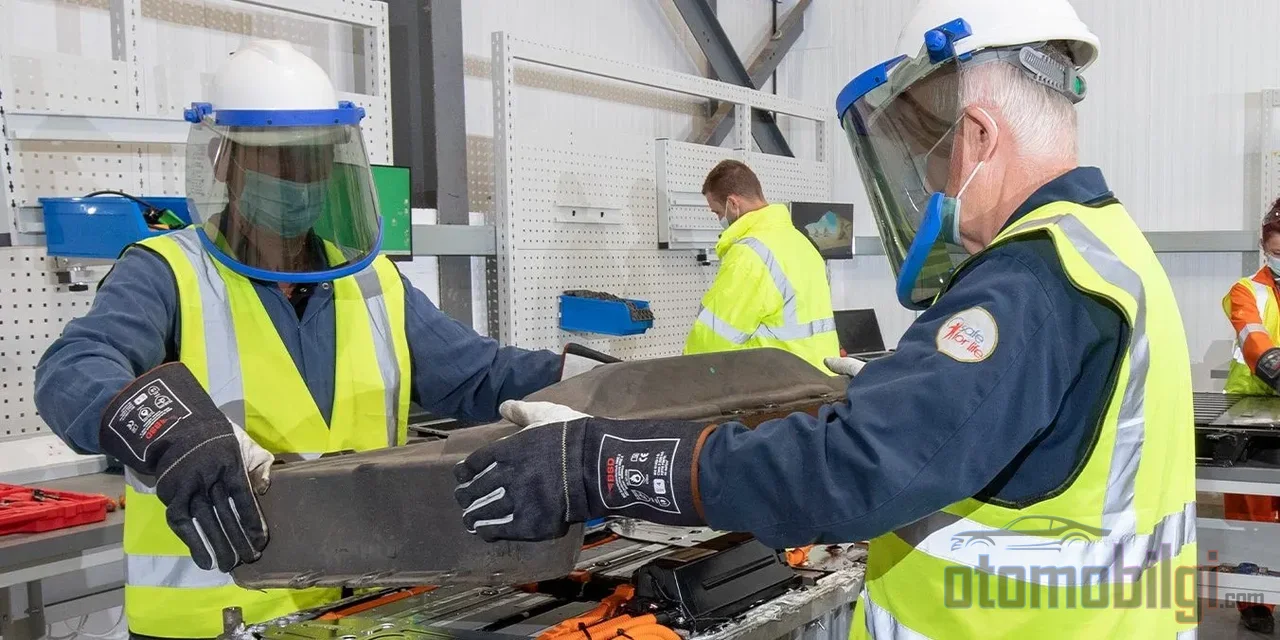
A second variable that is often overlooked in method selection is the form factor of the battery pack. Modern EV packs are not designed for easy disassembly; the process is manual and labor-intensive. Disassembly alone accounts for 33% of the recycling cost. High-depth disassembly steps begin with opening the pack and removing the cover and peripheral components; getting down to the cells can take hours.
The impact of pack design is also visible in the numbers. A techno-economic assessment reveals that the disassembly cost of two China-origin packs stayed in a low band of $47-50 per pack, while in European and Japanese designs it rose significantly. The difference comes from adhesive use, module architecture and ease of cell access. The same study predicts that automated disassembly could save up to $190 million by 2040. So the choice of recycling method is intertwined with the previous question: is money burning while your pack is being disassembled?
End of Life, SOH and the Data Gap in the Supply Chain
The entry gate of the system is also problematic. An EV battery is considered at end of life when its state of health, i.e. its SOH value, drops to 70-80%; 80% SOH means that approximately 80% of the original capacity and power capability is retained. However, this threshold itself is controversial: when the battery leaves the vehicle it still contains usable energy and is mostly directed to second-life applications, repair or recycling; it does not go to waste.
The real bottleneck is data. Quickly and reliably measuring the SOH of an old battery is a difficult engineering problem, especially for cells with no documented history, and a standardized battery data model has not yet been completed. The regulatory side is taking action: in the US, the legal basis for federal battery recycling and labeling guidelines came into force in October 2026; state laws in Washington and California were under development as of January 2025. International electrotechnical standardization committees are working on standards covering second life, disassembly readiness and recycling; The EU battery regulation also requires SOH data to be used for evidence-based routing. Until labeling and data standards are settled, both the second-life chain and the chemical disassembly required by direct recycling will continue to struggle.
Result: Which Method Wins?
The summary of the summary can be gathered in one sentence: In NMC streams, hydrometallurgy is today's proven economics; in homogeneous, accurately labeled LFP or NMC streams, direct cathode recycling is tomorrow's lowest-cost and lowest-emission route. The decision is made together by the battery's chemistry, the homogeneity of the stream, and the pack's disassembly cost. As LFP's rise makes lithium recovery mandatory and labeling standards take hold, the conditions that will strengthen direct recycling's hand are falling into place one by one. Until then, the industry will move forward on the shoulders of high-efficiency hydrometallurgy; and in cases requiring large volumes, the robustness of pyrometallurgy will still be needed.
Sources
- Comparative eco-techno-economic and life-cycle assessment
- Traditional vs. Advanced Green Recycling Methods for Batteries
- A Comparative Evaluation of Lithium-Ion Battery Recycling Technologies
- An Overview of the Global Battery Recycling Industry
- EV Battery Recycling for Investment Recovery: The 2026 Playbook
- Comparison of direct recycling and hydrometallurgical processes