Fiat 500e Review: Its Range, Charging, and Rivals
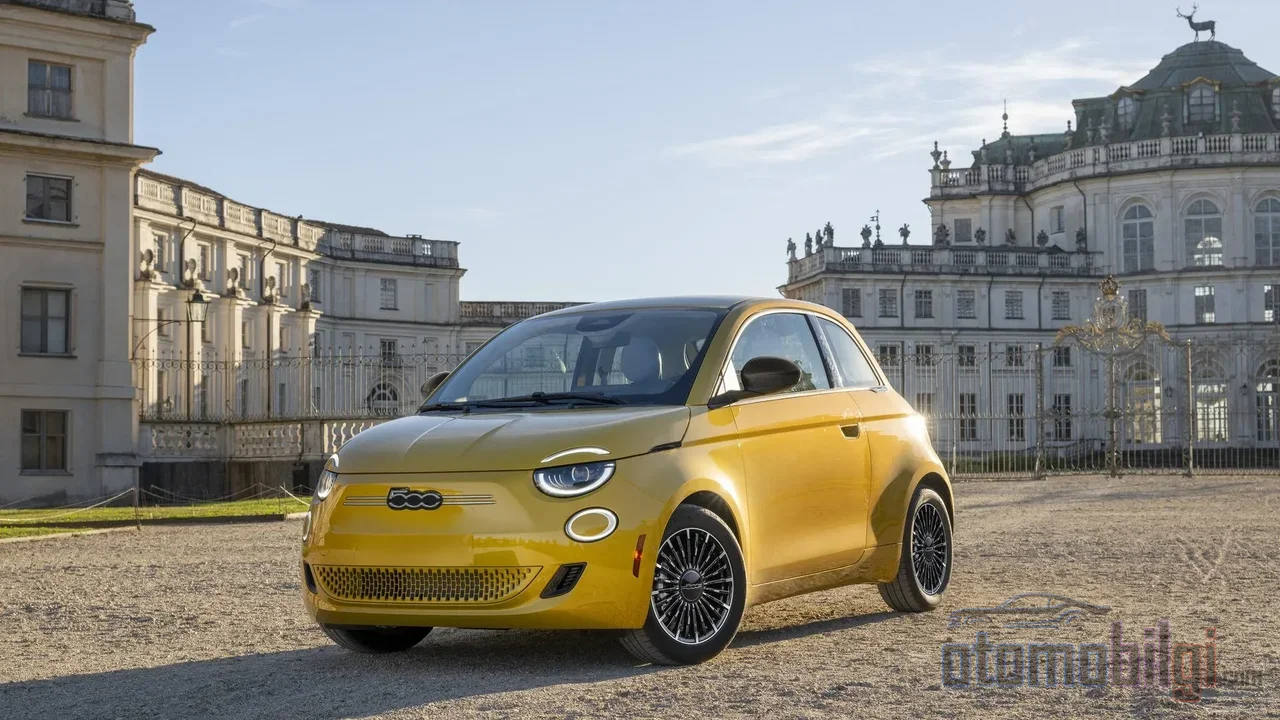
One of the clearest pieces of evidence of the electric transformation in the city car class was the Fiat 500, renewed as electric-only in 2020. The brand launched the third-generation 500 not with a conventional gasoline option, but directly with a battery-electric powertrain, thereby building an identity that rewrote the rules of the segment in the A segment. So how practical a choice is this compact Italian still in today's increasingly crowded electric city car arena? Its range, charging character and comparison with its rivals together form the answer to the question.
On this page, we cover the Fiat 500e's place in its segment, its official technical values, its interior and technology equipment, the points where it stands apart from rivals such as the Citroën ë-C3 and Renault R5 E-Tech, and its market position in Europe, without going into the price list.
An Electric-Only Identity in the A Segment
The third-generation Fiat 500e was developed under project code 332 and introduced in Milan on March 4, 2020. Its production has been carried out since February 2020 at the Mirafiori plant in Turin, Italy; the car uses Stellantis' STLA Small platform. Its design was undertaken by the Centro Stile Fiat team.
Compared to the previous generation, the body grew in every dimension: length increased by 60 mm, width by 60 mm, height by 40 mm and wheelbase by 20 mm. This growth creates a breathing interior space despite a total length of 3.63 meters. The body variety is also broad: at launch came a two-door cabriolet limited to 500 units per country, in June 2020 a three-door hatchback, and in October 2020 the 3+1 version with a rear-hinged rear right door, exclusive to left-hand-drive markets.
A notable development also took place in May 2025: Fiat introduced the 500 Hybrid with a 1.0 Firefly gasoline mild-hybrid engine in the same body, and production began in November 2025. So today the 500 family is offered with both pure electric and hybrid options; but the subject of this page is the fully electric 500e, which forms the essence of the family.
Highlights
- Motor: 87 kW (117 hp), 220 Nm of torque, front-wheel drive
- WLTP combined range: 320 km; up to 440 km in the city
- DC fast charging: from 0 to 80 percent in 35 minutes with 85 kW
- 0-100 km/h: 9.0 seconds; top speed 150 km/h
- The first city car with Level 2 autonomous driving equipment
Motor, Battery and Performance: What Do the Numbers Say?
In the 500e's main version, a GKN Automotive-produced interior permanent magnet synchronous electric motor works on the front axle. The system produces 87 kW (117 hp) of power and 220 Nm of torque; thanks to the instant availability of torque, 0-50 km/h acceleration is completed in just 3.1 seconds. The 0-100 km/h time is 9.0 seconds, and the top speed is 150 km/h. These figures are not a promise of a performance car; they are a definition of smooth and confidence-inspiring driving in city traffic. The 117 hp motor's acceleration is found sufficient in some tests but not particularly impressive; indeed, the high-performance Abarth 500e that arrived in 2023 fills this gap, completing 0-100 km/h in 7 seconds with 113.7 kW (152.5 hp) of power and 235 Nm of torque.
On the battery side, a lithium-ion pack with 42 kWh gross / 37.3 kWh usable capacity is standard. WLTP combined range is 320 km, while WLTP city range goes up to 440 km. Consumption is at the level of 14.3-14.4 kWh/100 km. In the North American market, the EPA measurement gives a range of 240 km; while Canadian authorities report a range of 227 km and a combined consumption of 19.0 kWh/100 km. This difference stems from the different measurement methods of the test cycles and is a typical situation for electric cars.
24 kWh Entry Version
For those who need less range, an entry version with a 24 kWh battery is also available: 70 kW (94 hp) of power, 220 Nm of torque, 0-100 km/h in 9.5 seconds and a top speed of 135 km/h. This package is about 100 kg lighter than the main version, and its DC charging power is limited to 50 kW. It is a sensible cost optimization targeting a profile weighted toward city use.
| Feature | Fiat 500e (42 kWh) | Fiat 500e (24 kWh) |
|---|---|---|
| Motor power | 87 kW (117 hp) | 70 kW (94 hp) |
| Torque | 220 Nm | 220 Nm |
| 0-100 km/h | 9.0 s | 9.5 s |
| Top speed | 150 km/h | 135 km/h |
| WLTP range | 320 km | - |
| DC charging power | 85 kW | 50 kW |
| Length / width / height | 3.632 / 1.683 / 1.527 mm | 3.632 / 1.683 / 1.527 mm |
| Wheelbase | 2.322 mm | 2.322 mm |
Charging Character: A Fast Profile for a City Car
The 42 kWh battery version supports 85 kW DC fast charging; charging from 0 to 80 percent takes 35 minutes. Fiat states that 5 minutes of fast charging adds approximately 50 km of range. This is still a respectable figure in the A segment; many rivals in the segment hover in the 50-100 kW DC power band.
On the AC side, an 11 kW three-phase onboard charging unit is standard; the socket is located in the right rear fender as a CCS Combo Type 2 standard. On the home side, since the launch period a wall unit solution has been offered, starting at 2.3 kW from a regular outlet and upgradeable to 7.4 kW. The 24 kWh version charges from 10 to 80 percent in 30 minutes with 50 kW DC power.
Real-world range can run below WLTP: independent databases report a wide range of 165-355 km; in cold weather the city range can drop to around 230 km, and at highway speeds to levels of 110-190 km. It is well known that the WLTP cycle is generally optimistic for electric cars; in winter use and on fast roads, this margin needs to be planned for.
Interior and Technology: Extensive Equipment in a Small Body
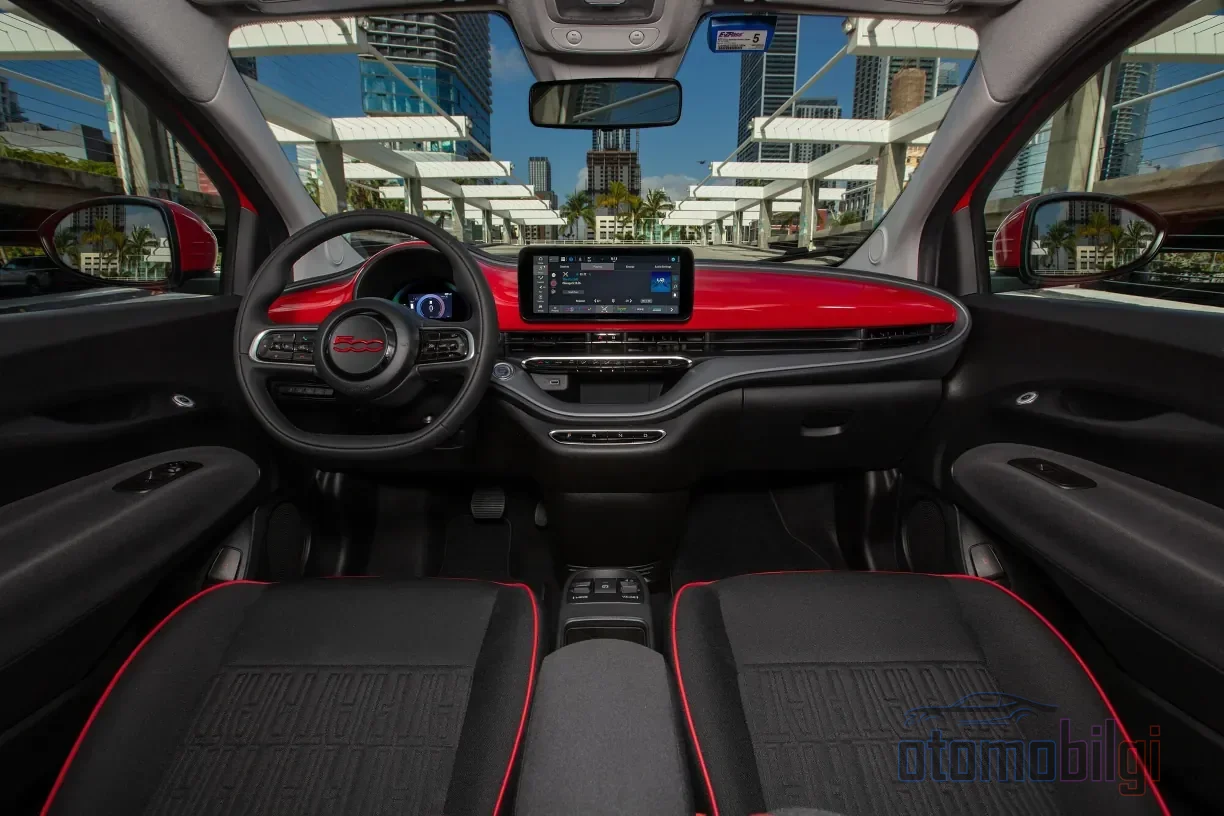
The cockpit features a 7-inch digital instrument cluster and a 10.25-inch central touchscreen. The Android-based UConnect 5 infotainment system supports wireless Apple CarPlay and Android Auto; the 500e holds the distinction of being the first Stellantis (then FCA) vehicle to be equipped with the new UConnect 5. Remote control via a smartphone app and an emergency call system are also part of the package.
Even more remarkable, the 500e is the first city car with Level 2 autonomous driving hardware. Autonomous Emergency Braking that can detect pedestrians and cyclists, Intelligent Speed Assistant, Lane Control, intelligent Adaptive Cruise Control (iACC) and Lane Centering offer an extraordinary safety range for this class. Details such as interior-exterior electric door handles (e-Latch) and a backup mechanical opening system are solutions that go above the segment.
There are three driving modes: Normal, Range, which enables one-pedal driving, and Sherpa, which maximizes energy savings. In Sherpa mode, speed is limited to 80 km/h, climate control and heated seats are disabled; an engineering-focused solution designed to extend the range in the final stretches of the battery. The warning sound played for pedestrians below 20 km/h is also a subtle detail designed with urban use in mind.
How It Differs From Its Rivals: Its Position Against the ë-C3 and R5 E-Tech
Europe's electric city car arena is quickly becoming crowded. The Citroën ë-C3 was developed on Stellantis' value-focused Smart Car platform, on a chassis housing both electric and combustion powertrains; meaning it carries a different cost priority from the 500e in terms of philosophy. The Renault R5 E-Tech stands out with its near-B-segment dimensions and stronger driving character: in comparisons, the R5's WLTP city range rises to around 500 km, while the ë-C3 stays at 400 km; 0-100 km/h times favor the R5 at 8 seconds versus 11 seconds, and consumption is 12.7 versus 13.8 kWh/100 km.
Where does the 500e stand in this picture? Although its power cannot match all versions of the R5, it is clearly better than the ë-C3: 9.0-second 0-100 km/h and a 150 km/h top speed, above the ë-C3's 135 km/h. On the range side, its 320 km WLTP combined value is in a similar zone to the ë-C3, but behind the R5. The 500e's real point of differentiation is its design identity, Level 2 driving assist hardware, three body types (hatchback, cabriolet, 3+1), and its 85 kW segment-leading DC charging speed. In short, it builds its competition not on efficiency or speed, but on character and hardware integrity.
Global Market Position and Sales Table
The 500e's market journey has had its ups and downs. While it was Italy's best-selling electric car in 2022, in the following years, particularly in the US, sales fell below 500 units in 2024, forcing Stellantis to temporarily halt production at Mirafiori. The picture in Europe is more positive: In the first half of 2026, Fiat recorded a 21.7 percent year-over-year increase in registrations in the EU market, and the 500 family (including the Hybrid) leads the class with a 57.6 percent share in the A segment with 3,700 units. In 2026, Fiat stands out among Europe's most improving brands. The fact that electric vehicles reached an average 23 percent market share in Europe during January-August 2026 also grows this segment's expanding pie.
On the reliability side, the picture is mixed but not at the extremes: most of the reported issues are software-related or at the level of wear parts; high-voltage battery recalls, 12V auxiliary battery management, and electronic door lock vulnerabilities are the most frequently cited headings. No catastrophic defect shadows its track record; still, in long-term ownership, using fast charging moderately and not depleting the battery too much is the recommended approach based on user experiences.
Conclusion: The City's Most Practical EV?
The clear answer to the question is this: The Fiat 500e is one of the most practical electric options for city use thanks to its balance of hardware and character rather than range. Its 320 km WLTP range and up to 440 km city value more than meet the demands of typical urban use; 35-minute 0-80 fast charging also makes long weekend getaways possible. While the R5 E-Tech stands out in range and performance and the ë-C3 in price-efficiency balance, the 500e offers the most cohesive electric identity in the A segment with its Level 2 driving supports, 85 kW DC charging, three body options, and iconic design. It is a strong candidate in the practicality debate; its limits, however, begin with highway-heavy and long-range use.