Renault 5 E-Tech Review: 410 km Range and 100 kW Charging
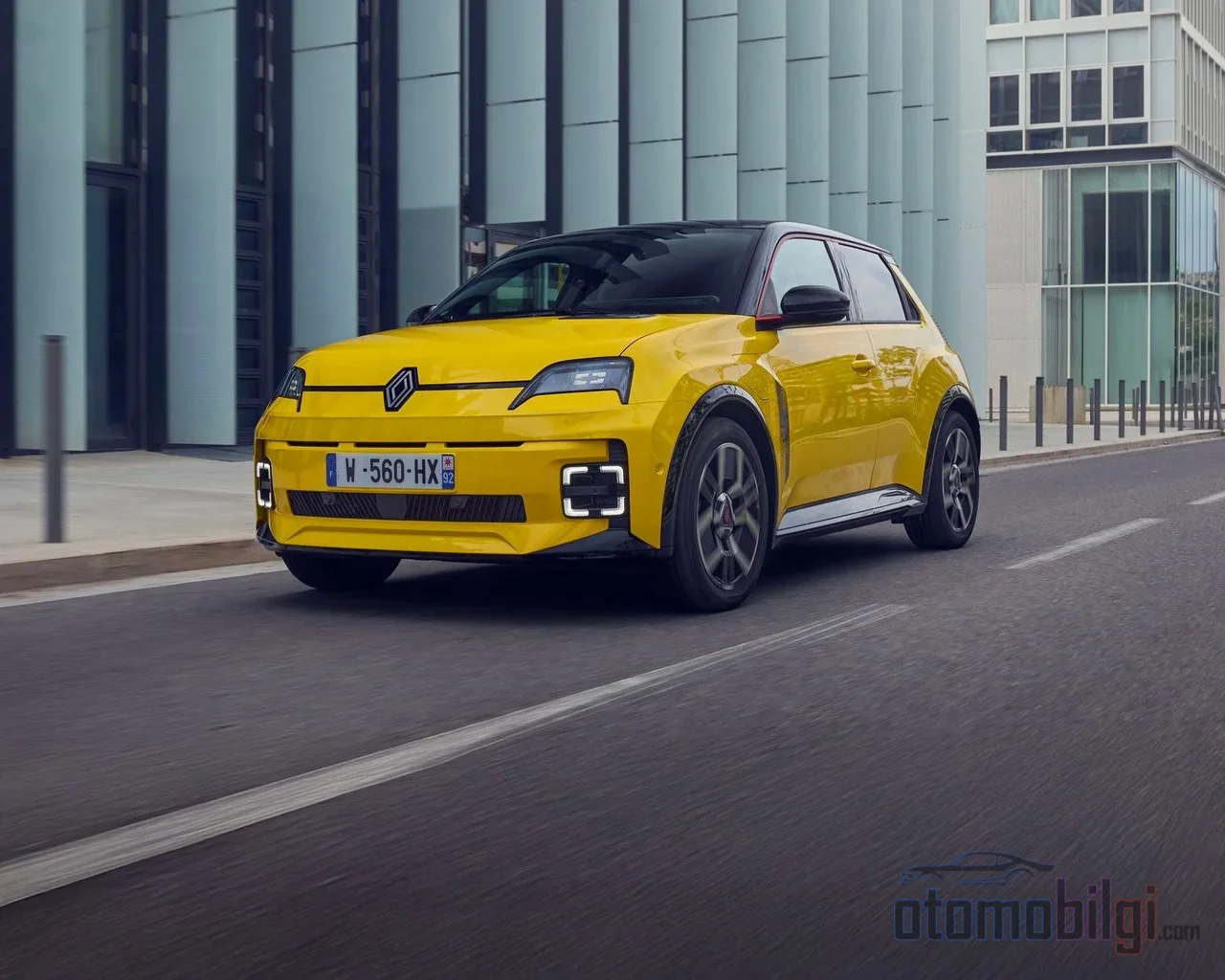
It is rare for a car to resemble its counterpart from 40 years ago so closely while at the same time carrying the most up-to-date solutions in its class from a technical standpoint. The Renault 5 E-Tech does exactly that: It places the iconic hatchback of the 1970s and 80s onto an electric carrier developed by Ampere engineering. However, the retro design is only the visible face of this car's story. The real issue is that it redefines the standards of small electric cars with its approaching-400 km WLTP range in the B segment, fast charging capacity of up to 100 kW, and technical balance that stands ahead of rivals such as the Citroën ë-C3 and Fiat 500e.
Identity: Electric B Segment on the CMF-B Platform
The Renault 5 E-Tech is a five-door, fully electric B-segment hatchback produced since 2024. The concept was introduced in January 2021, and the production version made its stage debut at the Geneva Motor Show in February 2024. The development process was shortened with a remarkable engineering decision: Starting from a design mock-up seen by Luca de Meo in 2020, the program cut the development period, which normally takes four years, down to three.
The CMF-B platform lies at the technical foundation. This is not an architecture designed specifically for electric power; it is an electric adaptation of the proven carrier that Renault uses for its small cars. The same foundation is also seen in its sibling model the Renault 4 E-Tech and its design relatives the Alpine A290 and Nissan Micra EV. The model that preceded these vehicles was the electric Renault Zoe; production is carried out at the Douai plant in France, together with suppliers in the Hauts-de-France region.
The dimensions mark the midpoint of the B segment: length 3,922 mm, width 1,774 mm, height 1,498 mm and wheelbase 2,540 mm. Curb weight varies between 1,350 and 1,450 kg. At 165 mm shorter than the Zoe, the car is larger than the MINI Cooper Electric and Hyundai Inster, but smaller than the Peugeot e-208. When these compact external dimensions combine with range and charging performance, one of the interesting equations in its class emerges.
Highlights
- Up to 410 km WLTP range with the 52 kWh battery
- DC fast charging: from 15% to 80% in about 30 minutes
- Most powerful version: 110 kW (150 hp), 245 Nm, 0-100 km/h in 8.0 seconds
- Standard 11 kW three-phase AC charging and V2L / V2G support
- Winner of the 2024 European Car of the Year award
Range and Battery: How Is the 400 Km Threshold Reached?
The Renault 5 E-Tech is offered with two battery options. The "Urban Range" pack with 40 kWh of usable capacity focuses on daily city use, while the 52 kWh "Comfort Range" pack (nominal capacity 55.0 kWh) forms the long-range option. The WLTP range of the large battery is announced in the 405-410 km band; the small pack speaks of about 193 miles, or around 310 km.
Translating these figures into the real world matters. Independent real-world range estimates show that the 52 kWh version moves within a range of 235 to 505 km depending on conditions. Range drops noticeably in cold weather and at highway speeds: In a test conducted at a constant 130 km/h at 7.5 degrees Celsius, the measured range fell to 183.5 km. This gap between the WLTP cycle and real-world use is a common characteristic of electric cars; the Renault 5 E-Tech is no exceptional outlier in this respect compared to its class.
From an engineering perspective, the small 40 kWh battery also has its logic: While fast-charging stations charge per kilowatt-hour, filling the small battery takes less time and costs less. Long-term user experiences show that this advantage carries serious economic weight for drivers who focus on city use.
Charging Character: 30 Minutes Halfway
DC fast-charging capacity varies depending on the battery pack: The 52 kWh version can draw a maximum of 100 kW, while the 40 kWh version draws 80 kW. According to the manufacturer's official data, the transition from 15% to 80% takes about 30 minutes. Independent measurements confirm this figure: At a 150 kW station, the charging time from 10% to 80% is measured at around 31 minutes; the average draw power is approximately 101 kW. At 50 kW stations, the same interval extends to about 57 minutes.
On the AC side, 11 kW three-phase onboard charging is standard on all versions. This fills the 40 kWh battery in about 4-4.5 hours, and the 52 kWh pack in about 5 hours 45 minutes. The vehicle also supports V2L (Vehicle-to-Load) and V2G (Vehicle-to-Grid); meaning the battery can supply power to external devices and return energy to the grid where suitable infrastructure exists. This bidirectional charging capability is equipment still not found on every model in the B segment.
Motor and Performance Values
Motor options are paired with the battery. The 40 kWh pack offers 70 kW (95 hp) or 90 kW (122 hp) drive motors; The 120 hp version has 225 Nm of torque. The 52 kWh pack's motor produces 110 kW of power, meaning 150 hp and 245 Nm of torque, with a top speed of 150 km/h. Acceleration from 0-100 km/h for this version is announced as 8.0 seconds; independent measurements also point to values of 7.9 seconds. On all versions, the drive is on the front wheels.
A clarification is needed regarding performance versions: A GT Premium with 130 kW (180 hp) and a GTS version equipped with the 160 kW (220 hp) motor taken from the Mégane E-Tech are being mentioned; however, this information is still based on a single source and does not match the main versions of the European market. The mainstream lineup takes shape through the three power levels above.
| Feature | Urban Range (40 kWh) | Comfort Range (52 kWh) |
|---|---|---|
| Battery (usable) | 40 kWh | 52 kWh |
| Motor power | 70 kW (95 hp) / 90 kW (122 hp) | 110 kW (150 hp) |
| Torque | 225 Nm (122 hp version) | 245 Nm |
| WLTP range | Approximately 310 km | 405-410 km |
| DC fast charging | 80 kW | 100 kW |
| AC charging (standard) | 11 kW three-phase | 11 kW three-phase |
Interior and Technology: Retro Details, Modern Infrastructure
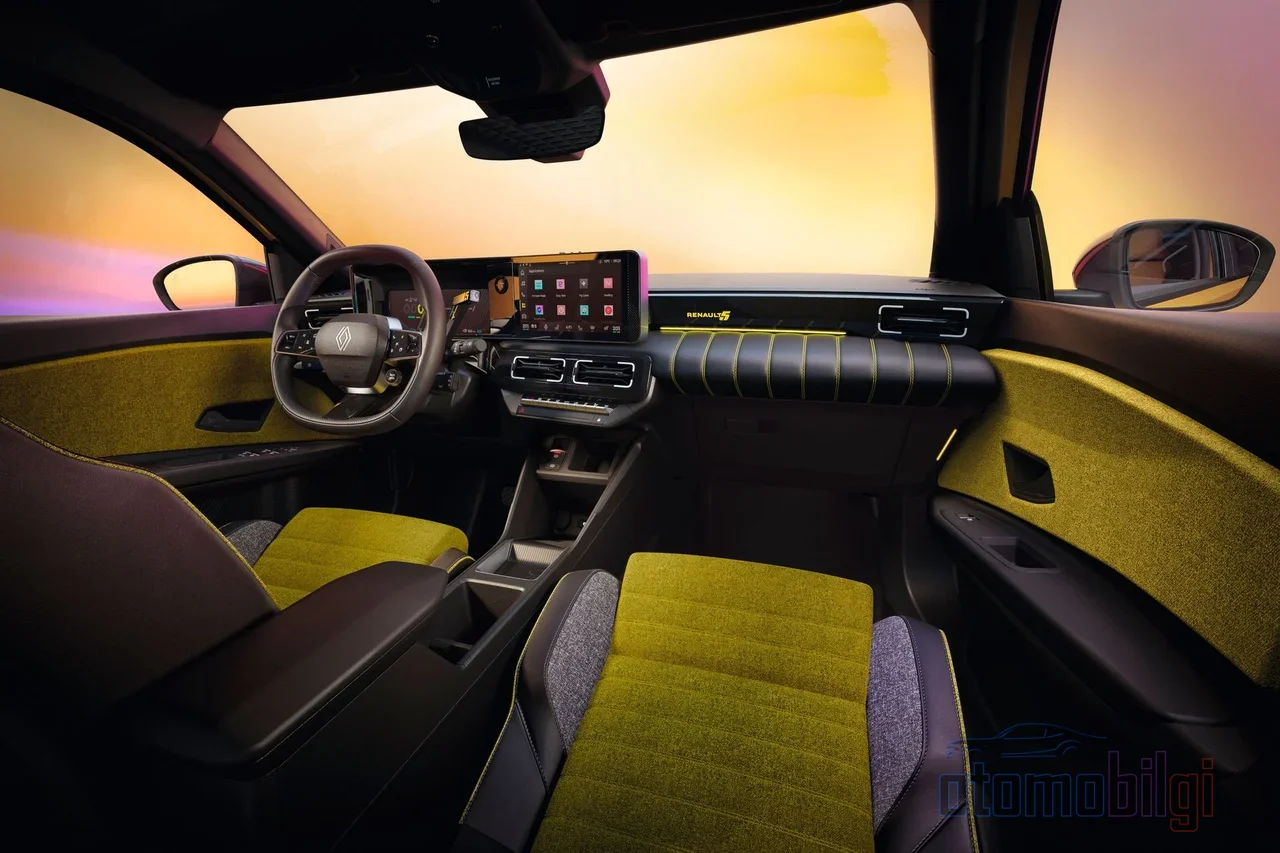
The interior continues the nostalgia of the exterior design, but in a clever way: the diamond pattern on the headliner, the fabric-covered shelf on the armrest, air vents reminiscent of the old Renault 5's headlight shape, and front seats that evoke the 1980s Renault 5 Turbo seats add emotion to engineering discipline. In top trims, denim-look upholstery made from recycled plastic bottles is used.
The technology package is above segment standards. In all versions, the 10.1-inch touchscreen and wireless Apple CarPlay and Android Auto are standard. The digital instrument cluster is 7 inches in the entry version, 10.3 inches in other trims. Google Built-in comes from the mid trim level onward; Google Maps-based EV route planning and battery preconditioning are part of this package. The voice assistant, 48-color ambient lighting and Multisense drive modes are also on the technology list. The top trim features a 9-speaker Harman Kardon sound system, heated seats and a heated steering wheel.
On the efficiency front, the standard heat pump across the entire series draws attention; this feature, which limits range loss in cold weather, is a paid option on many manufacturers. On safety, although up to 28 advanced driver assistance systems are offered, the 4-star result from the Euro NCAP 2024 test is criticized against the five-star norm, even though it is a similar outcome to class rivals Peugeot e-208, Fiat 500e and Opel Corsa.
Practicality: Strong Cargo Space, Tight Rear Seats
Cargo capacity is 326 liters; this is one of the largest values in its class, surpassing the Citroën ë-C3. However, the picture reverses at the rear seats: space is tight for adults, with headroom and legroom cramped especially for tall passengers. The ë-C3 and Fiat Grande Panda are more generous in passenger space. Still, the five-door body provides a clear practicality advantage in daily use against the Fiat 500e, which is only three-door. With the 2026 model year came a regenerative braking system with four levels via steering wheel paddles, including a one-pedal mode; this solution, which leaves energy recuperation to finer driver control, is a meaningful step for efficiency.
What Sets It Apart from Rivals: Its Position Against the ë-C3 and 500e
It is one of the most hotly contested classes among B-segment electric cars. The Renault 5 E-Tech's list of rivals is long: Peugeot e-208, Opel Corsa Electric, Citroën ë-C3, Fiat 500e, Fiat Grande Panda, Jeep Avenger, Kia EV2, MINI Cooper Electric, BYD Dolphin Surf, Hyundai Inster and platform sibling Nissan Micra EV.
A comparison with the Citroën ë-C3 paints a clear picture in technical data: While the ë-C3 is limited to a maximum 44 kWh battery and 113 hp motor, the Renault 5's 52 kWh pack produces 150 hp. The acceleration difference is clear: around 11 seconds versus 8 seconds in 0-100 km/h; 135 km/s compared to 150 km/s at top speed. On the consumption side, the Renault 5 sits ahead of the ë-C3 with a value of approximately 14.9 kWh/100 km in the 52 kWh version, versus the ë-C3's figure of approximately 17.4 kWh/100 km. The ë-C3's trump card, however, is price; it remains noticeably more accessible at the entry point in European markets.
The Fiat 500e, on the other hand, represents a different character: smaller, three-door, and city-focused. With both its five-door body and its range and charging speeds, the Renault 5 E-Tech covers a much wider range of use than the 500e. This balance also explains the car's position in Europe: Having won the 2024 European Car of the Year award, the Renault 5 is regarded as one of the best options among small EVs, and while it has nearly doubled its charging capacity per power output compared to the Zoe, it has retained its urban character.
Conclusion: Why Does This Car Make a Difference?
The Renault 5 E-Tech's advantage is not superiority in a single area; it is a correctly defined whole. In summary: It offers up to 410 km of WLTP range in the B segment, a battery that charges from 15% to 80% in about 30 minutes thanks to 100 kW fast-charging capability, acceleration in 8 seconds with its most powerful motor delivering 150 hp and 245 Nm, and on top of all that, a five-door body with a standard heat pump and V2L/V2G support. This combination answers the ë-C3's price advantage and the 500e's urban elegance with technical depth.
The criticisms are real too: the rear seats are cramped, the Euro NCAP result stayed at four stars, and the fast-charging curve does not deliver the same output at every station. But viewed through an engineer's eyes, transforming a retro icon into a modern electric car by using the CMF-B platform so efficiently is an achievement in itself. Every Renault 5 E-Tech coming off the production line in Douai is proof that small electric cars are no longer just "city cars".
Sources
- R5 E-Tech electric - Renault UK
- R5 E-Tech electric technical specifications - Renault UK
- Renault 5 E-Tech technical specifications - Renault Türkiye
- Renault 5 E-Tech - Wikipedia
- Renault 5 E-Tech 52kWh 150hp - EV Database
- Renault 5 E-Tech 52kWh 150hp - evkx.net
- Renault 5 Review 2026 - RAC
- Citroën ë-C3 vs Renault 5 E-Tech - EVMetra