Honda CR-V e:HEV Review: 204 hp Full Hybrid System
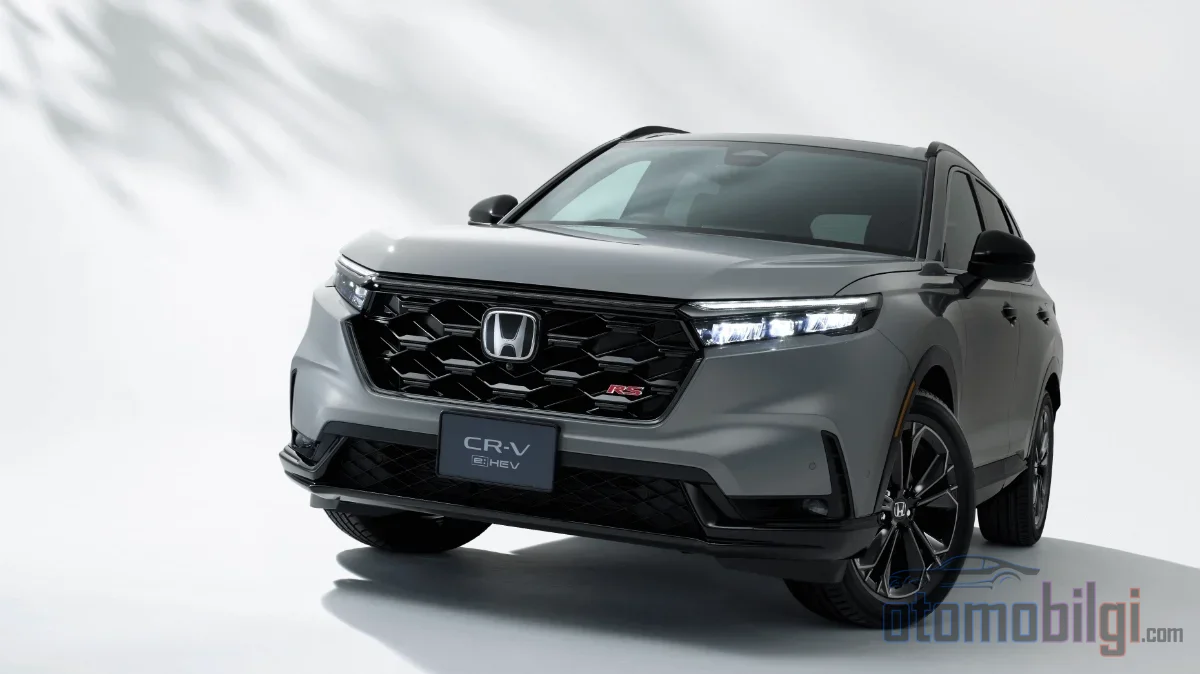
The Honda CR-V e:HEV is one of the most familiar names among full-hybrid family SUVs. But is this two-electric-motor system really enough against its rivals? The answer to that question begins with correcting a common misconception: The CR-V is a five-seat compact SUV and has no third row. Families looking for a three-row, seven-seat hybrid should turn to models like the Hyundai Santa Fe Hybrid. However, the story of the CR-V e:HEV is a story firmly built on numbers, and most of those numbers are surprisingly strong. On this page, we will go through one by one the engineering of the 204 hp system, its consumption character that burns less in the city than on the highway, the cargo and interior flexibility, and its position against the Toyota RAV4 Hybrid.
How the e:HEV System Works: Two Motors, a Three-Role Gasoline Unit
The architecture Honda calls e:HEV starts from a different place than the classic hybrid approach: the vehicle has no gear-shifting transmission. Instead of a torque converter or a belt-driven setup, two independent electric machines are on duty. At the heart of the system sits a 1,993 cc, four-cylinder, Atkinson-cycle 145 hp @ 6,100 rpm gasoline engine; engine torque is 138 lb-ft (approximately 187 Nm) at 4,500 rpm.
The main driver is the electric motor: It produces 181 hp @ 5,000-8,000 rpm of power and 247 lb-ft (approximately 335 Nm) of torque, reaching its maximum torque from zero up to 2,000 rpm. This means propulsion ready at the first centimeter of pedal travel in city driving. Total system output is 204 hp, and the energy is stored in a lithium-ion battery.
The clever part of the system is the triple role assigned to the gasoline engine. At low and medium speeds, the setup behaves like a series hybrid: the gasoline engine mostly feeds the generator, the electricity produced goes to the drive motor or the battery, and the electric motor drives the vehicle. In this region, the engine's speed is not tied to wheel speed; it operates at its efficient point. At high speeds, the system shifts into direct drive mode, and the gasoline engine connects to the front wheels through a clutch. Honda describes this unit not as a CVT but as a direct drive structure; and the reasoning is clear: at highway speeds, transferring energy via the mechanical path instead of the electrical journey reduces losses.
Highlights
- System output of 204 hp, electric motor torque of up to 335 Nm
- 6.0 L/100 km city and 6.9 L/100 km highway consumption on the Canadian cycle
- Cargo volume of 579-617 L behind the rear seats (depending on market)
- 0-60 mph time of 7.1 seconds in testing
- Honda Sensing safety package standard on all versions
Performance and Consumption: An Equation That Challenges Its Rivals in the City
Measured Performance Figures
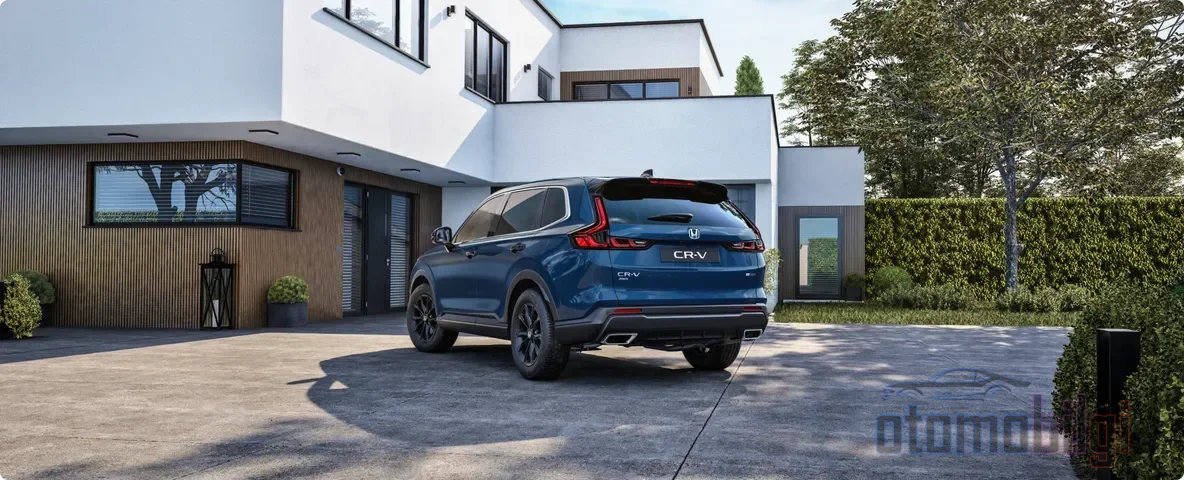
Regardless of the paper numbers, real-world measurements clarify the picture: the all-wheel-drive Sport Touring version completes the 0-60 mph in 7.1 seconds (TrailSport in 7.3 seconds), runs the quarter mile in 15.8 seconds @ 87 mph, and reaches a top speed of around 112 mph. There is no official figure for 0-100 km/h; Based on the 0-60 mph measurement, this time can be said to be around 7.4-7.5 seconds. A curb weight of 3,890 lb (approximately 1,765 kg) and a 70-0 mph braking distance of 182 feet are realistic values for the class.
Is the City Cheaper Than the Highway?
The most beautiful proof of the full hybrid system is seen in its consumption distribution. On the Canadian official cycle, the 2026 CR-V Hybrid consumes 6.0 L/100 km in the city and 6.9 L/100 km on the highway; meaning urban driving is more efficient than highway, exactly as being a full hybrid requires. The US EPA figures show the same character: front-wheel-drive hybrid at 43/36 mpg city/highway, all-wheel-drive versions at 40/34 mpg, and TrailSport at 38/33 mpg. For comparison, the gasoline front-wheel-drive CR-V returns 28/33 mpg, and the difference is felt in daily use.
Real-world data also confirms the claims. In a steady 75 mph highway test, the car observed 35 mpg; in long-term use in Australia, while the factory claim is 5.5 L/100 km, editors reported consumption between 4.8-5.3 L/100 km and approximately 6.0 L/100 km on long routes such as Sydney-Brisbane. The 14-gallon tank is fed with regular gasoline; which means a range of more than 490 miles in the test.
Interior and Cargo: Spacious for Five, No Room for a Third Row
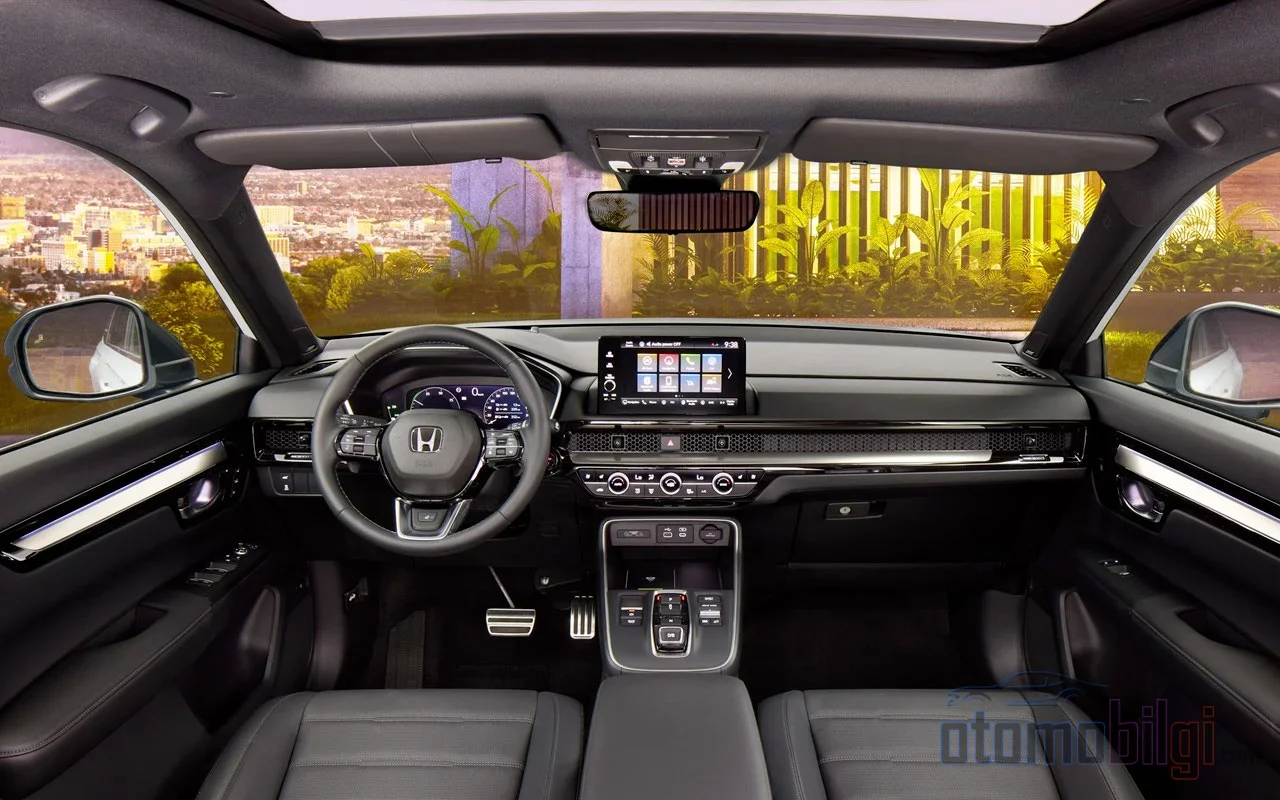
Here lies the technical side of the correction at the beginning. The CR-V e:HEV seats five; it offers ample head and legroom in both front and rear rows for adults, and the rear seat splits 60/40. Its dimensions are among the largest in the class: length of 4,694 mm, wheelbase of 2,701 mm, width of 73.5 inches and AWD height of 66.5 inches.
The cost of the hybrid architecture can be measured in the cargo area, but it is small. In US measurements, the hybrid offers 36.3 cu-ft behind the rear seat (34.7 cu-ft in the Sport Touring) and 71.8 cu-ft with the seats folded; the gasoline version offers 39.3/76.5 cu-ft. European market figures for the e:HEV range between 579-617 L, with 596 L (1,651 L when folded); the difference comes from equipment and formatting that varies by market. In everyday language: in a cargo test, 11 carry-on bags fit within the 36 cu-ft, and this number rose to 29 with the seats folded.
Equipment, Multimedia and the Honda Sensing Safety Package
Inside, a 9-inch touchscreen is standard on all versions; wireless Apple CarPlay and Android Auto as well as a wireless charging pad also leave the factory. The top-trim Sport Touring features a Bose sound system with 12 speakers, a structure with Google integration and a 10.2-inch digital instrument panel. The driving character is also selectable: standard versions have a 4-Mode setup consisting of Sport, Normal, Econ and Snow modes, which expands to 5-Mode in the Sport Touring.
In safety, the cornerstone is the Honda Sensing package being standard on all versions. The package includes Collision Mitigation Braking (CMBS), Road Departure Mitigation (RDM), Lane Keeping Assist (LKAS), Adaptive Cruise Control with low-speed follow, traffic sign recognition and traffic jam assist. Upper trims add blind spot information, cross traffic monitoring, low-speed braking control and front-rear parking sensors; The Sport Touring's hands-free power tailgate completes the practicality list. One limitation worth knowing is the towing capacity: the hybrid version tows 1,000 lb (about 450 kg) while the gasoline CR-V allows 1,500 lb.
Comparison with Rivals: Its Position Against the RAV4 Hybrid and Santa Fe Hybrid
The Toyota RAV4 Hybrid holds the numerical advantage: system output is 226 hp in front-wheel drive and 236 hp in AWD, and with a 1,750 lb towing capacity it is ahead of the CR-V; its EPA consumption is at a similar level in the 38-41 mpg city band. However, in acceleration measurements the picture reverses: the CR-V Hybrid has reached 60 mph 0.2 seconds faster than the RAV4 Hybrid. The electric motor's 335 Nm of torque largely closes the on-paper power gap in practice. In reviews, the CR-V stands out for comfort, interior quality and quietness; the RAV4 offers a marginal advantage in efficiency, and the difference above 35-40 mpg has only a limited effect on total fuel cost.
The Hyundai Santa Fe Hybrid, on the other hand, is a player from an entirely different category: as a three-row, seven-seat midsize SUV it stands out with its spacious interior and technology equipment. So family size is a matter of preference; if a third row is a must, the CR-V drops off the list, and if you are setting out with a five-seat plan, all of the Santa Fe's advantages turn into a category difference. There is also a reputation figure worth noting: the CR-V Hybrid has made the 10Best Trucks and SUVs list seven times in a row in compact SUV comparison tests - a record - and in the 2026 hybrid compact SUV comparison it left behind both the RAV4 Hybrid and the Mazda CX-50 Hybrid.
Ownership Experience and Reliability Picture
On the ownership side, the picture is largely positive but not uniform. In the US market, warranty coverage is 3 years/36,000 miles basic and 5 years/60,000 miles powertrain, and free maintenance limited to 12,000 miles in the first year is also included in the program. Independent reliability assessments give a high score of 4.5/5 and there are no recorded recalls. In consumer surveys, overall owner satisfaction is in the average band at 59 out of 100; meaning the car should be bought with an expectation of solidity and ease of use rather than passion. Long-term user experiences are also consistent in terms of comfort and ease of driving.
Conclusion: Is a Full Hybrid Enough?
The short answer: for a five-seat family, yes, more than enough. The CR-V e:HEV, with its 204 hp and 335 Nm of electric torque, is among the quicker ones in its class; its consumption in the 6-7 L/100 km band from city to highway, cargo volume exceeding 596 liters and the standard Honda Sensing package on all versions balance the power-consumption-practicality triangle. There is no plug-in charging hassle, no stepped gear changes, and its city consumption is lower than on the highway. Its limits must also be known: there is no third row, towing capacity is lower than its gasoline sibling and it is less powerful than the RAV4 Hybrid on paper; but in measurements it is faster. For a model that has made the awards list for the seventh time to date, full hybrid is not just adequate, it is the very essence of the CR-V's character.
| Feature | Value |
|---|---|
| Gasoline engine | 2.0 L Atkinson, 145 hp @ 6,100 rpm, 187 Nm @ 4,500 rpm |
| Electric motor | 181 hp @ 5,000-8,000 rpm, 335 Nm @ 0-2,000 rpm |
| System power | 204 hp |
| Battery | Lithium-ion |
| 0-60 mph (measured) | 7.1 s (AWD Sport Touring) |
| Consumption (Canada, AWD) | 6.0 / 6.9 / 6.4 L/100 km city/highway/combined |
| Cargo (UK) | 596 L / 1,651 L folded |
| Length / wheelbase | 4,694 mm / 2,701 mm |
| Towing capacity | 1,000 lb (approximately 450 kg) |
| Seating capacity | 5 |
Sources
- 2027 Honda CR-V Hybrid - Honda Automobiles
- 2026 Honda CR-V Specifications & Features - Honda Newsroom
- Honda Two-Motor Hybrid-Electric Powertrain - Honda Newsroom
- 2027 Honda CR-V Hybrid Review, Pricing, and Specs - Car and Driver
- 2027 Honda CR-V Hybrid vs. 2026 Toyota RAV4 - Car and Driver
- 2026 Honda CR-V e:HEV RS long-term conclusion - CarExpert
- Honda CR-V Review 2026 - Drive.co.uk
- Hyundai Santa Fe vs Honda CR-V & Toyota RAV4 - Giles Hyundai
- 2027 Honda CR-V Prices, Reviews - Edmunds
- 5 Reasons Not to Buy a Honda CR-V Now - Consumer Reports