Hyundai Santa Fe Hybrid with 10-Year Battery Warranty
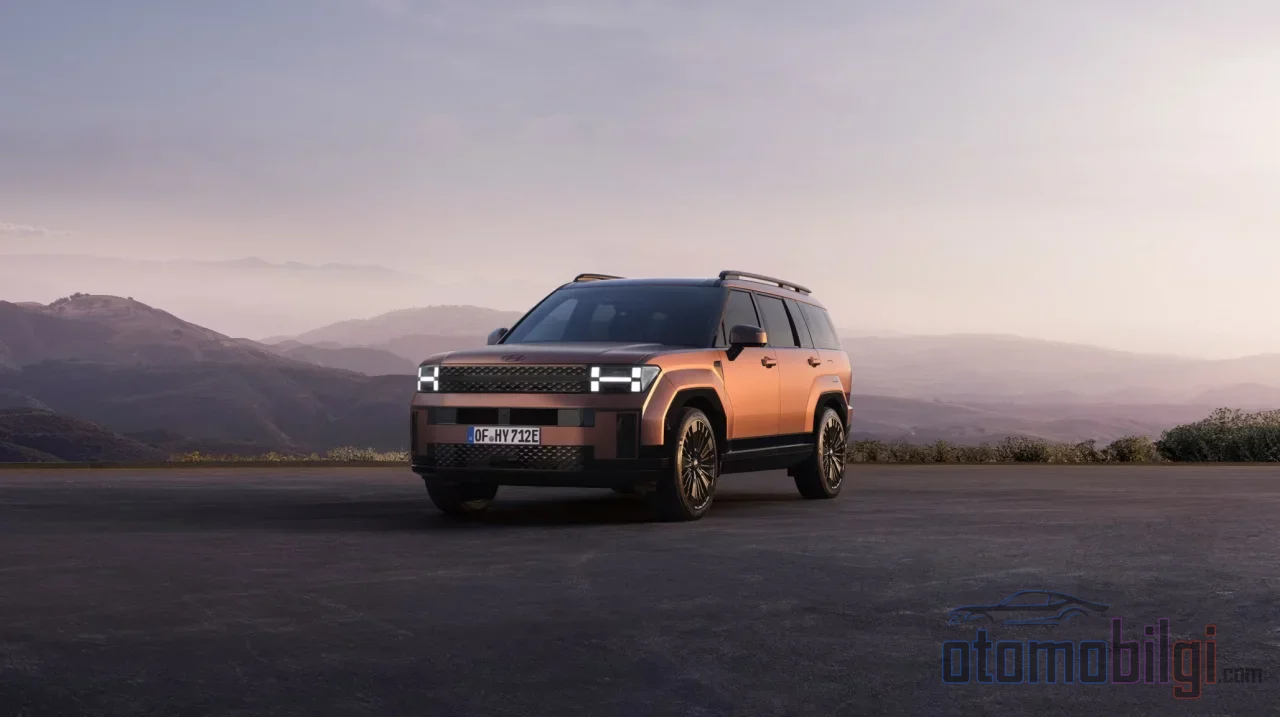
Putting a 1.6-liter engine in a seven-seat family SUV seems like a bold engineering decision on paper. The Hyundai Santa Fe Hybrid does exactly that: it pairs a turbocharged, direct-injection small gasoline unit with an electric motor and tries to move a body weighing over two and a half tons and three rows of seats with it. So does this equation hold up in the real world? Looking at the system's architecture, its consumption character, and the real usability of the third row, the picture becomes more complex, and at the same time more interesting.
1.6 T-GDI and Electric Motor: Small Engine, Smart Split
At the heart of the Santa Fe Hybrid is a turbocharged 1.6-liter four-cylinder gasoline engine. Unlike naturally aspirated engines, this forced-induction unit complements the power from its small displacement with the electric motor's instantly available torque. The system produces 231 horsepower of combined output and 271 lb-ft (approximately 367 Nm) of torque, delivering these figures to the road through a 6-speed automatic transmission. Front-wheel drive is offered as standard, while an all-wheel-drive option is also available.
The logic chain behind the numbers is simple: The electric motor kicks in at launch and low revs, taking on the load in the gasoline engine's least efficient operating range. The turbocharged engine takes over the power delivery as revs rise. The concern that the 1.6-liter engine alone would fall short for a seven-seat SUV is largely invalidated by the combined system output of 231 horsepower and around 367 Nm of torque. So the question is not the engine's size, but the harmony of the two power sources.
Highlights
- Combined power of 231 hp, torque of 271 lb-ft (approximately 367 Nm)
- EPA combined consumption: 36 MPG (approximately 6.5 l/100 km) in the front-wheel-drive configuration
- 413 liters behind the third row, 1,949 liters with all seats folded
- A claimed range of approximately 1,025 km on a full tank
- 0-100 km/h: approximately 9.0 seconds (hybrid, front-wheel drive)
Performance Expectations
On the acceleration side, the 0-100 km/h time in the front-wheel-drive hybrid configuration is measured at approximately 9.0 seconds; top speed is 196 km/h. These figures fall in line with the class average. However, the numbers do not tell the whole story: Driving reviews reveal that the car can feel a bit sluggish especially during overtaking and highway merging, and that its handling is not class-leading either. This profile is sufficient for everyday family use, but it may not fully convince a driving-focused buyer.
Hybrid in the City, Gasoline on the Highway: Consumption Character
The architecture of a full hybrid system shows its consumption advantage mainly in city driving. The Santa Fe Hybrid is a textbook example of this: EPA figures are announced as 37 city / 36 highway / 36 combined MPG for the front-wheel-drive configuration, and 35/34/35 MPG for all-wheel drive. In metric terms, the combined value corresponds to roughly the 6.5-6.7 l/100 km band. The city and highway figures being so close to each other shows that the system works in a balanced way in both modes.
Real-world data presents a more realistic picture. In long-term testing, an average of 24.9-26 MPG (approximately 9-9.5 l/100 km) was measured over 4,884 miles; on a 900-mile highway stage, a value of 23.7 MPG, clearly below the EPA figure, was recorded. By contrast, a band of 35-40 MPG is possible in heavy city traffic. A mixed consumption average of 30 MPG recorded by one user over five thousand miles seems like the most realistic target achievable when staying in ECO mode; SPORT mode pulls this value down by 3-4 MPG. A brief summary, if needed: This is a character that keeps its promises in the city but behaves like a gasoline SUV on long, steady-speed roads. Since the battery charges itself through braking, the vehicle does not need to be plugged in; the claimed range of approximately 1,025 km on a full tank is the practical counterpart of this.
Regenerative Braking and Drive Modes
The regenerative braking system, which converts momentum into electricity while slowing down and transfers it to the hybrid battery, can be adjusted in three stages via the paddles on the gear selector in ECO or SMART mode. While this does not offer an experience approaching one-pedal driving, it allows the driver to manage braking energy within the city. The manufacturer also positions cabin comfort, with its specially tuned engine and silent electric drive mode, as part of the system.
| Specification | Value |
|---|---|
| Hybrid system | 1.6 T-GDI turbocharged gasoline + electric motor (full hybrid) |
| Combined power | 231 hp |
| Combined torque | 271 lb-ft (approximately 367 Nm) |
| Transmission | 6-speed automatic |
| 0-100 km/h | Approximately 9.0 s (front-wheel-drive hybrid) |
| Top speed | 196 km/h |
| EPA combined consumption | 36 MPG FWD / 35 MPG AWD |
| Range (full tank) | Approximately 1,025 km |
| Towing capacity | Approximately 907 kg (2,000 lbs) |
| Battery warranty (US) | 10 years / 100,000 miles |
Three Rows and 7 Seats: Is It Really Enough for a Big Family?
This is where the Santa Fe's clearest point of differentiation lies. In the US market, only the hybrid version offers the three-row body structure; this option is not available in the gasoline variant. On the European side, the Santa Fe Hybrid is produced with a 230 PS powertrain. With three rows, the seat count rises to seven, and at upper trim levels, captain's chairs and a Nappa leather option are offered in the second row.
On the practicality side, the picture is two-sided. With the third row folded, 40.5 cu-ft (approximately 1,147 liters) of space opens up, and with all rear seats folded, 79.6 cu-ft, that is 1,949 liters; this figure is among the best in its class. The power tailgate's fast operation also earns praise. However, with the third row upright, cargo volume drops to 14.6 cu-ft, that is, approximately 413 liters, and this is considered one of the smallest volumes among three-row SUVs. To put it concretely: a full grocery shop or a stroller fits, but fitting seven people with weekend luggage is difficult. The realistic use scenario for the seven seats is occasional grandparents or school-run-style short passenger trips.
Equipment and Technology: From the Screen to the Tailgate
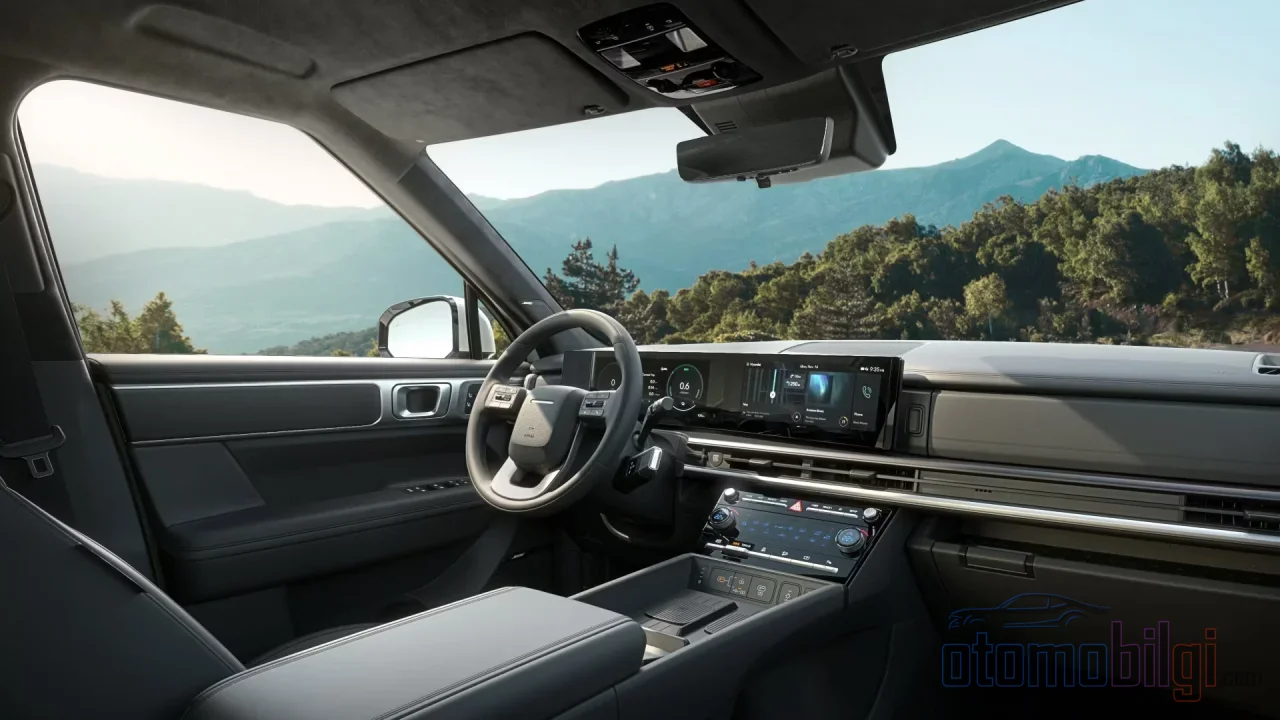
Inside, a 12.3-inch touchscreen comes as standard; it offers wireless Apple CarPlay and Android Auto connectivity. Bluelink+ connected services, a hands-free smart tailgate (the door opens automatically after waiting three seconds when the smart key is about 50-100 cm away) and wireless phone charging are the highlights that make daily use easier. On the driver assistance side, the blind spot view monitor (BVM) and remote smart parking assist (RSPA) are found on top trims. The top-tier Calligraphy trim features 20-inch alloy wheels, Nappa leather and a driver seat relaxation function. On the outside, the LED headlights signed with an "H" and the tall, long body profile are the vehicle's most recognizable design features.
Its Position Against the Sorento and Tiguan
A comparison with its natural class rival, the Kia Sorento Hybrid, is almost one-to-one: The Sorento Hybrid produces 227 hp and has nearly the same consumption profile at 37/36/37 MPG. The Santa Fe stands apart here with its body dimensions; it has a longer and noticeably taller body (69.7 inches versus 66.7 inches in height) and is advantageous in city consumption in four-wheel drive configurations. On the price side, at similar trim levels the Santa Fe Hybrid appears to be positioned a few thousand dollars more affordably. As for the Volkswagen Tiguan: The Tiguan is noticeably smaller, and its third row and full-hybrid character are not in the same league as the Santa Fe; its advantages are its starting price and a turbo engine sufficient for daily use. The Santa Fe's claim is simply to be bigger, more powerful and three-row; on the other hand, there are records showing it performs better than the Tiguan in pedestrian collision prevention tests. Its sibling, the Tucson Hybrid, is more efficient with 39 MPG combined consumption, but it has five seats and is a size smaller; the Santa Fe gives up a few MPG in return for torque, space and seat count compared to it.
Ownership Experience: What Do Owners Say?
In consumer reviews, the recommendation rate for the vehicle is around 77 percent; comments highlight comfort, living space and adequate power. In the US market, a 10-year / 100,000-mile warranty is offered for the hybrid battery, a serious signal of confidence regarding the system's long-term cost. The weak points can be summarized as long-distance consumption remaining above expectations and the limited cargo volume behind the third row.
Conclusion: Is It Enough, or Not?
The clear answer to the question is this: For a family that occasionally uses the seven-seat layout and does most of its driving in the city, the Hyundai Santa Fe Hybrid is yes, more than enough. With 231 hp of combined power, approximately 367 Nm of torque and 37 MPG in the city, the system carrying the three-row body keeps the equation balanced in most usage scenarios. On the other hand, for those who want to drive long distances fully loaded with seven people or carry a large load with the third row upright, the limits are real: The 413-liter volume behind the third row and the fuel consumption that loses the hybrid advantage on the highway are what the vehicle's price pays for. The Santa Fe's identity is not a compromise but an open choice: a small but turbocharged engine, the electric support that complements it, and a family life anchored in the city.
Sources
- 2027 Santa Fe Hybrid | Compact Hybrid SUV
- The Hyundai Santa Fe gets a hybrid powertrain
- Hybrid technology for Tucson and Santa Fe customers
- Hyundai Santa Fe - engine and powertrain overview
- 2026 Hyundai Santa Fe Hybrid Overview
- 2027 Hyundai Santa Fe Hybrid Review, Pricing, and Specs
- 2025 Hyundai Santa Fe Hybrid: What It Takes to Hit 35 MPG
- Hyundai Cargo Test: How Much Fits Behind Third Row
- Hyundai Santa Fe review - Boot space, practicality
- 2026 Hyundai Santa Fe Hybrid Drive Review